Outdoor Coffee Table Woodworking Plans: Where Great Outdoor Spaces Begin (Part 1)
Every outdoor space has a focal point.
Sometimes it’s a fire pit. Sometimes it’s a view. More often than people realize, it’s a simple table sitting quietly in the center of everything.
The morning coffee lands there first. Drinks gather there during long summer evenings. Books, candles, conversation, and countless small moments pass across its surface. Yet when homeowners begin searching for outdoor coffee table woodworking plans, they’re usually looking for something much deeper than furniture.
They’re looking for permanence.
They’re looking for a project worth building.
And they’re looking for a way to create something that feels custom, personal, and built to last in a world increasingly filled with disposable products.
The challenge is that outdoor furniture lives a harder life than almost anything else you can build. Sunlight attacks finishes. Rain finds weaknesses. Temperature swings force wood to expand and contract year after year. A beautiful table can become warped, cracked, or unstable surprisingly quickly when the wrong materials or construction methods are used.
That’s why choosing the right outdoor coffee table woodworking plan matters so much.
A well-designed project doesn’t just look better on day one. It performs better for years.
In this guide, we’ll move through the entire process—from choosing designs and materials to understanding costs, construction methods, and professional woodworking techniques that separate average builds from furniture that genuinely stands the test of time.
Quick Answer: What Is the Best Outdoor Coffee Table to Build?
For most DIY woodworkers, the sweet spot sits right in the middle of durability, cost, and simplicity.
A cedar outdoor coffee table with a slatted top consistently delivers the best overall balance.
Why?
Because cedar naturally resists rot, handles moisture well, remains relatively lightweight, and doesn’t require the budget commitment of premium hardwoods like teak.
For builders seeking maximum longevity, teak remains the benchmark against which nearly every other outdoor furniture wood is measured.
If your goal is value, build with cedar.
If your goal is legacy, build with teak.
Everything else falls somewhere between those two poles.
Why Building Your Own Outdoor Coffee Table Feels Different
Walk through any furniture showroom and you’ll notice something interesting.
Most outdoor coffee tables look remarkably similar.
They’ve been engineered for manufacturing efficiency, shipping constraints, and profit margins. They haven’t been designed around your patio, your seating arrangement, or the way your family actually uses outdoor space.
Building changes that.
Suddenly every decision belongs to you.
The dimensions fit your space perfectly. The materials reflect your priorities. The design complements your home instead of forcing your home to adapt to it.
There’s also a practical advantage that’s difficult to ignore.
Many premium outdoor coffee tables command premium prices while relying on construction methods that prioritize production speed rather than longevity. Thin stock, inexpensive hardware, and surface-level finishes often hide beneath attractive marketing photos.
A custom-built table allows you to invest directly in quality instead of brand markup.
The result isn’t simply cheaper furniture.
It’s often better furniture.
Complete Control Over Materials
One of the biggest advantages of woodworking your own outdoor furniture is material selection.
You decide whether the project uses:
- Cedar
- Redwood
- Teak
- Acacia
- Pressure-treated lumber
- Composite materials
Each species brings its own personality, appearance, maintenance requirements, and lifespan.
Retail furniture rarely offers that level of flexibility.
Built Around Real Spaces
Outdoor furniture frequently looks perfect online and awkward in person.
A coffee table that’s too tall interrupts conversation. Too wide, and movement becomes difficult. Too small, and it disappears visually among larger seating pieces.
When you build from woodworking plans, every measurement can be adjusted to suit your environment.
That’s the difference between furniture that merely occupies space and furniture that belongs there.
Understanding Outdoor Coffee Table Designs Before You Build
Choosing a design isn’t only about aesthetics.
Different styles influence construction methods, material requirements, maintenance schedules, and even long-term durability.
The smartest builders begin by understanding how each design category performs in the real world.
Modern Outdoor Coffee Tables: Clean Lines, Minimal Distractions
Modern outdoor furniture thrives on restraint.
No excessive ornamentation.
No unnecessary details.
Just strong proportions, clean geometry, and carefully balanced negative space.
Most modern outdoor coffee table woodworking plans feature:
- Rectangular profiles
- Straight edges
- Slatted tops
- Hidden fasteners
- Open-frame construction
What makes these designs particularly appealing is their versatility.
A modern cedar coffee table can feel equally at home on a contemporary rooftop terrace or a suburban backyard patio.
The simplicity also makes maintenance easier because there are fewer places for moisture and debris to accumulate.
Farmhouse Outdoor Coffee Tables: Warmth You Can Feel
Some furniture looks impressive.
Farmhouse furniture feels familiar.
That’s its superpower.
Farmhouse outdoor coffee tables often incorporate:
- Thick lumber
- X-frame bases
- Visible joinery
- Heavier proportions
- Natural wood character
These projects appeal to homeowners who want outdoor spaces that feel welcoming rather than curated.
The small imperfections become part of the story.
A knot in the wood isn’t a flaw.
It’s character.
Over time, exposure to weather often enhances that feeling rather than diminishing it.
Rustic Outdoor Coffee Tables: Built Around Authenticity
Rustic design isn’t concerned with perfection.
In fact, perfection often works against it.
Many rustic outdoor coffee table plans intentionally highlight natural variation through:
- Reclaimed lumber
- Live-edge components
- Hand-worked textures
- Weathered finishes
- Visible grain movement
There’s a reason these designs continue to perform well in search results year after year.
People aren’t simply searching for furniture.
They’re searching for authenticity.
Rustic projects satisfy that desire in a way few other styles can.
Contemporary Luxury Designs: When Craftsmanship Becomes the Feature
At the highest end of outdoor woodworking, the conversation shifts.
The goal is no longer affordability.
It’s excellence.
Luxury outdoor coffee table designs frequently incorporate:
- Teak hardwood
- Mortise-and-tenon joinery
- Furniture-grade detailing
- Architectural proportions
- Premium finishing systems
These builds require more skill, more patience, and often more money.
But they also create pieces capable of lasting for decades rather than years.
For serious woodworkers, these projects often become milestone builds—furniture that demonstrates not only craftsmanship, but mastery.
The Foundation of Every Great Build: Choosing the Right Wood
Ask experienced furniture makers what matters most in outdoor furniture construction, and many will give the same answer.
The wood determines everything.
Not just appearance.
Not just cost.
Everything.
Strength. Maintenance. Lifespan. Stability. Weather resistance.
Before a single board is cut, material selection quietly shapes the future of the project.
And nowhere is that more important than outdoor furniture.
Cedar: The Gold Standard for Most DIY Builders
There’s a reason cedar appears in so many outdoor coffee table woodworking plans.
Actually, there are several.
Cedar offers an unusually attractive combination of qualities:
- Natural rot resistance
- Resistance to insects
- Excellent dimensional stability
- Lightweight handling
- Affordable pricing
It machines cleanly, accepts finishes well, and remains forgiving for beginners.
Most importantly, cedar performs beautifully outdoors without requiring excessive maintenance.
For many builders, it’s the ideal starting point.
Not because it’s the cheapest option.
Because it’s often the smartest one.
Redwood: Beauty Meets Durability
Redwood occupies an interesting middle ground.
It carries much of cedar’s natural resistance while introducing richer coloration and a more luxurious appearance.
Its advantages include:
- Strong weather resistance
- Excellent stability
- Natural insect protection
- Attractive grain patterns
Many premium outdoor furniture makers choose redwood when they want a project to feel elevated without reaching teak-level pricing.
The result is furniture that feels refined yet approachable.
Exactly the balance many homeowners are trying to create outdoors.
The Complete Outdoor Coffee Table Woodworking Plans Guide: Designs, Materials, Costs & Pro Secrets (Part 2)
The moment woodworkers begin comparing outdoor coffee table woodworking plans, a subtle shift happens.
The conversation moves beyond style.
Questions become more practical.
How long will this last?
Will it survive winter?
Is the extra cost worth it?
Can I realistically build this with my current skill level?
The answers rarely come from the plans themselves.
They come from understanding the materials, dimensions, and design decisions that determine whether a project becomes a favorite gathering place—or a lesson learned the hard way.
Teak: The Benchmark Every Outdoor Wood Is Measured Against
Mention premium outdoor furniture anywhere in the woodworking world and one species inevitably enters the conversation.
Teak.
Not because it’s trendy.
Not because it’s rare.
Because few woods perform under outdoor conditions as consistently as teak.
For decades, shipbuilders, furniture makers, and craftsmen have trusted teak for environments where moisture, sunlight, and temperature swings are relentless.
Its reputation comes from what exists deep inside the wood itself.
Natural oils.
Those oils help protect teak from:
- Moisture intrusion
- Rot
- Insect damage
- Mold growth
- Weather-related deterioration
This built-in protection creates a unique advantage.
While many outdoor furniture woods require constant attention, teak often ages gracefully with surprisingly little intervention.
Over time, untreated teak develops the silver-gray patina that homeowners and designers frequently seek.
Some consider it aging.
Others consider it character.
Either way, the transformation tends to enhance rather than diminish the furniture’s appeal.
The Trade-Off
Of course, performance comes at a cost.
Teak is significantly more expensive than cedar, pine, or acacia.
For some projects, the investment makes perfect sense.
For others, the additional cost may be difficult to justify.
That’s why many experienced woodworkers view teak as less of a default choice and more of a destination material—a wood selected when the goal is exceptional longevity and heirloom-quality craftsmanship.
Acacia: The Rising Star of Outdoor Furniture
A decade ago, acacia wasn’t mentioned nearly as often in conversations about outdoor furniture.
Today, that’s changed dramatically.
Acacia has become increasingly popular because it offers an appealing combination of:
- Attractive grain patterns
- Excellent hardness
- Modern appearance
- Reasonable pricing
Visually, it often resembles far more expensive hardwoods.
Structurally, it’s strong enough for demanding outdoor applications.
For homeowners searching for a balance between affordability and sophistication, acacia frequently emerges as a compelling option.
Many modern outdoor coffee table plans now incorporate acacia specifically because it aligns so well with contemporary design trends.
Clean lines.
Warm tones.
Durable construction.
The combination feels current without becoming temporary.
Pressure-Treated Lumber: Practical, Affordable, and Often Misunderstood
Pressure-treated lumber rarely wins beauty contests.
Yet dismissing it entirely would be a mistake.
For budget-conscious builders, pressure-treated wood remains one of the most accessible pathways into outdoor furniture construction.
Its popularity comes from three straightforward advantages:
- Availability
- Affordability
- Structural strength
Almost every lumber yard carries it.
Most budgets can accommodate it.
And properly selected boards provide impressive durability.
The challenge lies elsewhere.
Fresh pressure-treated lumber often contains significant moisture.
Building too soon can lead to:
- Warping
- Twisting
- Shrinkage
- Joint movement
Patience becomes essential.
Many experienced builders allow lumber to acclimate and dry before beginning construction.
The result is a far more stable finished project.
Pressure-treated wood may never possess the elegance of teak or the warmth of cedar, but for practical outdoor coffee table woodworking plans, it remains a viable and cost-effective option.
Outdoor Coffee Table Dimensions: Why Size Matters More Than Most People Realize
A beautiful coffee table can still be the wrong coffee table.
This is where many projects quietly go off track.
Builders become focused on appearance and overlook usability.
Yet the most successful outdoor furniture isn’t judged by how it looks standing alone.
It’s judged by how it functions within a space.
A coffee table exists in relationship to chairs, sofas, movement pathways, and people.
The dimensions should reflect that reality.
The Ideal Height for an Outdoor Coffee Table
Most outdoor coffee tables perform best between:
16 and 18 inches tall
This range aligns naturally with typical outdoor seating heights.
Too low, and guests constantly reach downward.
Too high, and the table begins competing visually with surrounding seating.
The goal is effortless accessibility.
A coffee cup should feel easy to place down and easy to pick up.
The best furniture disappears into the experience.
You stop noticing it because it simply works.
Finding the Right Length
Length depends largely on seating arrangements.
Small Patios and Balconies
Recommended length:
30–36 inches
Compact tables preserve walking space while maintaining functionality.
Medium Outdoor Seating Areas
Recommended length:
40–48 inches
This range accommodates most conversation sets comfortably.
Large Patios and Sectionals
Recommended length:
50–60 inches
Larger layouts require more visual weight and usable surface area.
Undersized tables often appear disconnected from expansive seating arrangements.
Width: The Balance Between Function and Flow
Most successful outdoor coffee tables fall between:
20–30 inches wide
This range offers enough surface area for:
- Drinks
- Books
- Serving trays
- Decorative accents
Without creating barriers to movement.
When in doubt, slightly narrower tends to outperform slightly wider.
Outdoor spaces benefit from openness.
Choosing the Right Project for Your Skill Level
One of the fastest ways to lose enthusiasm for a woodworking project is selecting a build that exceeds your current abilities.
Ambition is valuable.
Momentum is more valuable.
The best outdoor coffee table woodworking plans challenge you just enough to learn without becoming overwhelming.
Beginner Outdoor Coffee Table Plans
Every experienced woodworker remembers the project that made woodworking feel possible.
For many people, an outdoor coffee table becomes exactly that project.
The dimensions are manageable.
The material costs are reasonable.
And the skills translate directly into future furniture builds.
The Classic Slatted Cedar Coffee Table
If there were a universal recommendation for first-time builders, this would be it.
A slatted cedar coffee table combines:
- Straightforward construction
- Forgiving materials
- Excellent outdoor durability
- Clean aesthetics
Most versions rely on:
- Straight cuts
- Pocket-hole joinery
- Basic assembly techniques
The project feels substantial without becoming intimidating.
For beginners, that balance matters enormously.
Every completed step reinforces confidence.
Pallet Coffee Tables
There’s something deeply satisfying about transforming reclaimed materials into functional furniture.
Pallet coffee tables continue attracting DIY builders because they combine creativity with affordability.
Benefits include:
- Minimal material costs
- Rustic appearance
- Sustainable sourcing
- Creative flexibility
No two builds are exactly alike.
Each project develops its own personality through the imperfections and character of reclaimed lumber.
Box Frame Outdoor Coffee Tables
Simple.
Clean.
Remarkably versatile.
Box-frame designs have become increasingly popular because they deliver a modern aesthetic with minimal construction complexity.
Most versions rely on:
- Straight cuts
- Simple joinery
- Repetitive assembly processes
Which makes them ideal for developing foundational woodworking skills.
They’re also easy to customize, allowing builders to experiment with dimensions and proportions without redesigning the entire structure.
Intermediate Outdoor Coffee Table Plans
Once basic construction feels comfortable, many builders naturally seek projects that introduce new challenges.
Not because the simpler projects are inadequate.
Because mastery thrives on progression.
Intermediate woodworking plans often add complexity through design rather than sheer difficulty.
The result feels more sophisticated while remaining accessible.
X-Leg Farmhouse Coffee Tables
Few outdoor furniture styles communicate craftsmanship as effectively as an X-leg farmhouse design.
The visual appeal comes from structure itself.
The joinery becomes part of the aesthetic.
These builds introduce concepts such as:
- Angled cuts
- Structural alignment
- Decorative framing
- Enhanced stability
The finished table feels heavier, more substantial, and more architectural than beginner-level projects.
Outdoor Storage Coffee Tables
Functionality becomes the headline here.
A storage coffee table transforms otherwise unused space into practical storage.
Homeowners often use these compartments for:
- Outdoor cushions
- Blankets
- Gardening accessories
- Patio entertainment items
The design solves a problem while maintaining visual appeal.
That’s a combination people rarely regret building.
Herringbone and Patterned Tabletops
This is often where woodworking begins to feel like artistry.
Patterned tabletops introduce visual complexity through layout rather than structure.
Herringbone designs create movement.
They draw the eye naturally across the surface.
They make guests look twice.
And they dramatically elevate perceived value without necessarily requiring advanced joinery.
For many builders, this is the moment a functional project starts feeling custom-made.
The difference is subtle.
But powerful.
The Complete Outdoor Coffee Table Woodworking Plans Guide: Designs, Materials, Costs & Pro Secrets (Part 3)
There comes a point in every woodworker’s journey when building furniture stops being about saving money.
The motivation changes.
The project becomes an opportunity to create something that couldn’t be purchased off a showroom floor. Something tailored to a specific space, a specific lifestyle, and a specific standard of craftsmanship.
This is where advanced outdoor coffee table woodworking plans begin to matter.
Not because they’re complicated.
Because they’re intentional.
Every joint, material choice, and design decision serves a purpose.
And when those decisions are made correctly, the difference is visible for years.
Advanced Outdoor Coffee Table Plans for Builders Ready to Level Up
Advanced projects aren’t necessarily larger.
They simply demand a deeper understanding of woodworking fundamentals.
Precision becomes more important.
Material selection matters more.
And the margin for error becomes smaller.
The reward, however, is furniture that feels distinctly different from beginner and intermediate builds.
Not better.
More refined.
Mortise-and-Tenon Teak Coffee Tables
Few joinery methods have earned more respect among furniture makers than the mortise-and-tenon joint.
Long before modern fasteners existed, craftsmen relied on this technique to create durable furniture capable of surviving generations of use.
The principle is elegantly simple.
A projecting tenon fits precisely into a corresponding mortise.
The result is extraordinary strength.
When paired with teak, the outcome is often remarkable.
Benefits include:
- Superior structural integrity
- Minimal reliance on hardware
- Clean aesthetics
- Exceptional longevity
These projects require patience and precision, but many builders consider them a defining milestone in their woodworking development.
Lift-Top Outdoor Coffee Tables
Modern outdoor living spaces increasingly serve multiple purposes.
Morning coffee spot.
Casual dining area.
Remote workspace.
Entertainment zone.
Lift-top coffee tables respond directly to that reality.
By incorporating adjustable surfaces and hidden compartments, these designs offer flexibility without sacrificing aesthetics.
Features often include:
- Concealed storage
- Adjustable work surfaces
- Space-efficient functionality
- Multi-purpose usability
The engineering is more complex than traditional coffee tables, but the convenience can be transformative for smaller patios and decks.
Fire Pit Coffee Table Hybrids
Certain furniture pieces naturally become gathering points.
Fire pit coffee tables take that concept further.
They create an experience.
The combination of warmth, light, and shared space encourages people to linger. Conversations stretch longer. Evenings feel more memorable.
These projects require additional planning around:
- Heat management
- Material selection
- Ventilation
- Safety clearances
Yet the payoff can completely redefine how an outdoor living area is used.
For many homeowners, a fire pit coffee table becomes the centerpiece around which the entire patio is organized.
The Professional Construction Secrets Most Plans Never Explain
Woodworking plans tell you what to build.
Experience teaches you how to make it last.
This distinction matters enormously outdoors.
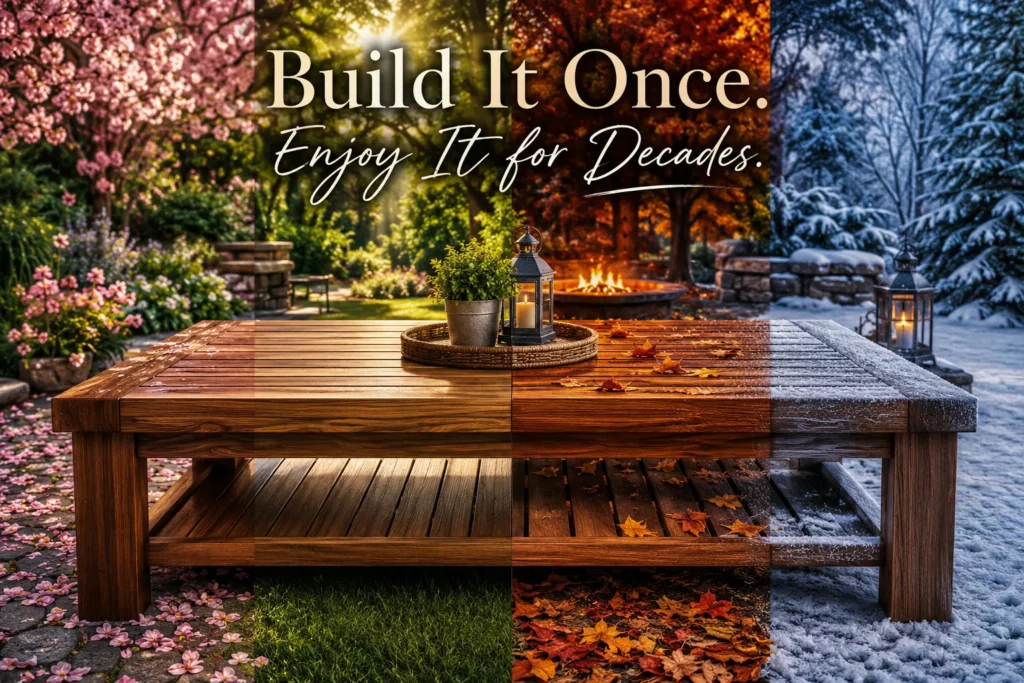
Weather exposes shortcuts quickly.
A beautiful project can deteriorate surprisingly fast if fundamental construction principles are ignored.
Professional furniture builders understand this.
They focus less on appearance and more on the invisible decisions that influence long-term performance.
Secret #1: Respect Wood Movement
Wood is alive in a way many materials aren’t.
Even after milling and drying, it continues responding to changes in humidity and temperature.
Outdoor conditions amplify this movement dramatically.
Boards expand.
Boards contract.
Season after season.
Ignoring that reality often leads to:
- Cracks
- Split joints
- Warped surfaces
- Structural stress
Experienced builders account for movement from the very beginning.
They create expansion gaps.
They avoid overly rigid construction.
They allow wood the freedom it needs to behave naturally.
Furniture that survives outdoors isn’t built to resist movement.
It’s built to accommodate it.
Secret #2: Hardware Matters More Than Most People Think
A common mistake appears long before visible failure.
It starts with the wrong screw.
Standard interior fasteners frequently corrode when exposed to moisture.
The damage begins slowly.
Then rust stains appear.
Connections weaken.
Structural integrity declines.
Professional outdoor furniture builders typically rely on:
- Stainless steel screws
- Exterior-rated hardware
- Galvanized fasteners
- Corrosion-resistant connectors
The additional cost is small.
The long-term benefit is enormous.
Secret #3: Water Is the Real Enemy
Many people assume sunlight causes the most damage outdoors.
In reality, standing water is often far more destructive.
Moisture infiltrates joints.
It settles on flat surfaces.
It accumulates in hidden areas where drying occurs slowly.
Eventually, deterioration begins.
Great outdoor furniture designs actively encourage water to leave.
Common strategies include:
- Slatted tabletops
- Drainage gaps
- Rounded edges
- Elevated feet
- Open-frame construction
Every design choice should answer one question:
Where will the water go?
Secret #4: Protect the End Grain
If wood had a weak point, this would be it.
End grain absorbs moisture dramatically faster than face grain.
That makes it particularly vulnerable in outdoor applications.
Professional builders often apply additional finish coats specifically to:
- Leg bottoms
- Exposed cuts
- Structural joints
- End-grain surfaces
It’s a small step.
Yet it can significantly extend furniture lifespan.
Outdoor Finishes: The Difference Between Aging and Deteriorating
Every outdoor coffee table eventually changes.
The question isn’t whether change happens.
It’s how gracefully it happens.
A quality finish controls that process.
It slows moisture intrusion, reduces UV damage, and helps preserve the appearance of the wood beneath it.
Different builders pursue different outcomes.
Some want a natural weathered look.
Others want the table to appear freshly built for as long as possible.
The finish should reflect that goal.
Exterior Oil Finishes
Oil finishes remain popular because they enhance wood rather than conceal it.
Advantages include:
- Natural appearance
- Easy maintenance
- Simple reapplication
- Rich grain enhancement
They work especially well on:
- Cedar
- Teak
- Redwood
The trade-off is frequency.
Most oil finishes require periodic renewal to maintain peak performance.
Spar Urethane
When greater protection is needed, spar urethane often becomes the preferred option.
Developed for demanding marine environments, it offers:
- UV resistance
- Moisture protection
- Flexible durability
Unlike rigid finishes, spar urethane moves with seasonal wood expansion and contraction.
That flexibility helps prevent premature failure.
Marine-Grade Finishing Systems
For extreme climates, marine-grade products provide the highest level of protection available.
They’re frequently used on:
- Boats
- Coastal structures
- Waterfront furniture
While they require more preparation and maintenance, they deliver exceptional defense against harsh environmental conditions.
How Much Does It Cost to Build an Outdoor Coffee Table?
One reason outdoor coffee table woodworking plans continue attracting interest is simple.
The economics often make sense.
A custom build can rival or exceed the quality of premium retail furniture at a surprisingly competitive cost.
Budget Builds
Materials:
- Pressure-treated lumber
- Reclaimed wood
- Basic hardware
Estimated cost:
$40–$100
Ideal for beginners and experimental projects.
Mid-Range Builds
Materials:
- Cedar
- Acacia
- Upgraded fasteners
- Better finishing systems
Estimated cost:
$100–$250
This range offers the strongest balance between value and longevity.
Premium Builds
Materials:
- Teak
- High-end hardwoods
- Furniture-grade joinery
- Premium finishes
Estimated cost:
$250–$800+
These projects prioritize craftsmanship and long-term performance over initial savings.
Common Outdoor Furniture Mistakes That Quietly Shorten Lifespan
The biggest threats to outdoor furniture are rarely dramatic.
They’re usually small decisions made early.
Decisions that seem harmless at the time.
Using Indoor Lumber Outdoors
Interior materials often lack the durability required for weather exposure.
The result is predictable.
Premature deterioration.
Ignoring Drainage
Even beautifully designed furniture can fail when water has nowhere to go.
Moisture trapped repeatedly in the same locations creates long-term problems.
Choosing Cheap Hardware
Fasteners may be among the smallest components in a project, but they influence durability far more than their size suggests.
Using the Wrong Finish
Not all wood finishes are designed for exterior conditions.
Indoor products frequently break down rapidly when exposed to UV light and moisture.
Overcomplicating the Design
Interestingly, some of the longest-lasting outdoor furniture pieces are also the simplest.
Every additional joint, cavity, hinge, and decorative feature introduces another potential failure point.
Complexity should serve a purpose.
Not exist for its own sake.
Maintaining an Outdoor Coffee Table Without Turning It Into a Chore
Maintenance doesn’t have to become a seasonal burden.
In most cases, consistency matters far more than intensity.
A few simple habits can dramatically extend the life of outdoor furniture.
Annual maintenance checklist:
- Clean surfaces thoroughly
- Inspect hardware connections
- Tighten loose fasteners
- Reapply protective finishes when necessary
- Check for cracks or movement
- Remove debris from drainage areas
Small actions performed regularly are often more effective than major restoration efforts performed too late.
Questions People Ask Before Building an Outdoor Coffee Table
“If I only build one outdoor coffee table, what wood should I choose?”
For most builders, cedar remains the safest recommendation.
It offers an exceptional balance of durability, affordability, workability, and weather resistance.
If budget isn’t a concern, teak remains the premium choice.
“Will my outdoor coffee table survive without a cover?”
It can.
But lifespan depends heavily on wood species, finish quality, climate, and construction methods.
Even highly durable furniture generally lasts longer when protected from prolonged exposure.
“How often will I need to refinish it?”
That depends on the finish.
Oil finishes may require attention every year or two.
Film finishes such as spar urethane often provide longer protection intervals.
Environmental conditions play a major role.
A covered patio and a fully exposed deck create very different maintenance schedules.
“Is building one actually cheaper than buying one?”
In many cases, yes.
Particularly when comparing custom-built cedar or hardwood furniture against premium retail products.
The value becomes even stronger when customization and material quality are considered.
Products / Tools / Resources
If you’re planning to build an outdoor coffee table, these are the tools, materials, and resources that consistently provide value regardless of project complexity.
Recommended Wood Species
- Cedar for all-around performance
- Redwood for premium appearance
- Teak for maximum longevity
- Acacia for modern aesthetics
- Pressure-treated lumber for budget builds
Essential Tools
- Circular saw
- Miter saw
- Drill and driver set
- Pocket-hole jig
- Orbital sander
- Speed square
- Measuring tape
- Clamps
Recommended Hardware
- Stainless steel screws
- Exterior-rated pocket-hole screws
- Galvanized lag bolts
- Weather-resistant washers
Outdoor Finishes Worth Considering
- Exterior penetrating oil
- Teak oil
- Spar urethane
- Marine-grade protective coatings
Helpful Accessories
- Furniture leveling feet
- Outdoor furniture covers
- Silicone glue brushes
- Moisture meter
- Corner clamping jigs
Project Ideas for Your Next Build
Once your outdoor coffee table is complete, many woodworkers naturally progress into:
- Outdoor side tables
- Patio storage benches
- Outdoor sectional furniture
- Garden planters
- Dining tables
- Pergola projects
- Deck furniture sets
Each project builds upon the same core skills—material selection, weather-resistant construction, joinery, and finishing—while expanding your ability to create outdoor spaces that feel intentional, durable, and uniquely your own.