
The Difference Between a Backyard Project and a Piece of Furniture People Remember
There’s a moment that happens with truly beautiful outdoor furniture.
Someone walks onto your patio, pauses for a second longer than expected, runs a hand across an armrest, and asks a simple question:
“Where did you buy these?”
Not because they’re trying to be polite.
Because they genuinely assume you did.
That’s the line separating ordinary DIY patio chairs from luxury outdoor furniture.
And surprisingly, it isn’t crossed by spending more money.
It’s crossed through design decisions most builders never notice.
The thickness of a leg. The angle of a backrest. The way water slips off a surface after a summer storm. The subtle alignment of grain patterns across connected pieces.
These details rarely scream for attention. Instead, they work quietly in the background, creating the impression that the chair simply belongs. It feels intentional. Balanced. Expensive.
The irony is that many retail patio chairs carrying luxury price tags aren’t built with significantly better materials than what you can buy from a local lumber supplier. What you’re often paying for is design intelligence—the understanding of how comfort, durability, proportion, and craftsmanship interact.
That’s exactly what this guide explores.
Not how to build another outdoor chair.
How to build outdoor furniture that looks as though it came from a designer showroom, survives years of weather exposure, and becomes one of those projects you’re still proud of a decade from now.
What Makes a Patio Chair Feel Luxurious?
Before discussing lumber species, joinery methods, or finishes, it’s worth answering the question hiding beneath nearly every search for luxury patio chairs:
What actually makes furniture look expensive?
The answer is surprisingly human.
People don’t judge quality through technical specifications. They judge it emotionally.
A chair feels premium when it communicates confidence.
That confidence comes from a combination of:
- Clean proportions
- Thoughtful ergonomics
- Durable materials
- Refined joinery
- Consistent design language
- Weather-resistant construction
- Professional finishing techniques
When these elements work together, something interesting happens.
Visitors stop seeing individual components.
They stop noticing screws, boards, and measurements.
Instead, they see furniture.
And furniture is always judged as a complete experience.
Why Most DIY Patio Chairs Never Look High-End
Many woodworking plans focus almost entirely on construction.
Can it hold weight?
Will it stay square?
Does it survive outdoors?
Those are important questions.
They’re just not the questions luxury furniture asks first.
Premium outdoor furniture begins with aesthetics and experience, then engineers strength and durability around those goals.
Most DIY projects reverse the process.
The result is often furniture that’s structurally impressive but visually forgettable.
The Hidden Cost of Overbuilding
One of the most common mistakes among DIY builders is making everything bigger than necessary.
Thicker legs.
Bulkier arms.
Oversized framing.
At first glance this feels logical.
More material should equal more quality.
In reality, excess material often creates the opposite effect.
Luxury furniture rarely feels heavy-handed.
It feels deliberate.
Every dimension exists for a reason.
When proportions are balanced, furniture gains a visual lightness that expensive brands spend years perfecting.
Why Visual Consistency Matters More Than Complexity
Many first-time builders assume intricate designs create luxury.
They don’t.
Consistency does.
Look closely at premium outdoor collections and you’ll notice something.
The spacing between slats is consistent.
The reveal lines are intentional.
The curves repeat.
The visual rhythm remains uninterrupted.
Luxury furniture isn’t complicated.
It’s disciplined.
That discipline creates calm.
And calm is often interpreted as quality.
Choosing the Best Wood for Weather-Resistant Patio Chairs
Material selection influences everything.
Appearance.
Maintenance.
Longevity.
Comfort.
Even the emotional character of the finished piece.
Different woods tell different stories.
The best choice depends not only on climate and budget but also on the feeling you want the furniture to create.
Cedar: The Sweet Spot Between Beauty and Practicality
For many builders, cedar occupies a rare position.
It’s approachable enough for DIY projects yet refined enough to produce furniture that looks custom-made.
Freshly milled cedar carries a warmth that’s difficult to replicate.
The grain feels alive.
The color shifts subtly throughout the day as sunlight changes.
And because cedar naturally resists rot and insect damage, it performs remarkably well outdoors.
Benefits include:
- Natural weather resistance
- Lightweight workability
- Dimensional stability
- Attractive grain patterns
- Lower maintenance requirements
Cedar works particularly well in outdoor spaces that prioritize comfort and natural texture.
Think covered patios.
Garden seating areas.
Modern rustic outdoor rooms.
Spaces where the furniture should feel inviting rather than formal.
Teak: The Benchmark for Luxury Outdoor Furniture
There is a reason teak appears repeatedly throughout high-end outdoor furniture collections.
Actually, there are several.
Teak contains natural oils that help protect it from moisture, insects, and environmental stress.
But the appeal extends beyond durability.
Teak ages beautifully.
Over time it develops the soft silver-gray patina associated with some of the world’s most expensive outdoor furniture.
The transformation isn’t deterioration.
It’s character.
That’s a distinction luxury buyers understand instinctively.
Teak offers:
- Exceptional weather resistance
- Natural oil protection
- Long service life
- Minimal maintenance demands
- Premium appearance
For homeowners seeking furniture designed to stay outdoors year-round, teak remains one of the strongest investments available.
White Oak: Understated Strength with Architectural Appeal
White oak doesn’t always receive the same attention as teak, but among serious furniture makers it has become increasingly respected.
Part of its appeal lies in restraint.
White oak doesn’t demand attention.
It earns it.
Its grain structure feels refined.
Its appearance pairs naturally with contemporary architecture.
Its strength inspires confidence without appearing oversized.
White oak is particularly appealing for:
- Modern outdoor furniture
- Minimalist patio designs
- Contemporary landscaping projects
- Long-term outdoor installations
Builders who appreciate clean lines often find themselves returning to white oak again and again.
Redwood: Warmth, Character, and Outdoor Durability
Redwood occupies a unique space in outdoor woodworking.
Few materials combine visual warmth and weather resistance quite so naturally.
Its rich tones create instant visual depth.
Its stability reduces movement over time.
Its natural resistance to decay helps furniture maintain structural integrity through changing seasons.
For homeowners seeking an organic, timeless aesthetic, redwood remains one of the most visually rewarding choices available.
Comfort Is the Luxury Feature Nobody Notices
Until it’s missing.
Many patio chairs look incredible in photographs.
Then someone sits down.
Five minutes later they start shifting position.
Ten minutes later they’re standing again.
Luxury outdoor furniture avoids this problem because it prioritizes ergonomics as carefully as appearance.
Great furniture disappears beneath the user.
It feels effortless.
Natural.
Almost invisible.
And achieving that feeling starts with dimensions.
Comfort by Design: The Measurements That Change Everything
Most people assume comfort is subjective.
To a degree, that’s true.
But furniture makers have spent generations refining dimensions because certain measurements consistently feel better to most people.
Luxury patio chairs aren’t comfortable by accident.
They’re comfortable because every angle and proportion has been carefully considered.
The remarkable part is that small adjustments can create dramatic differences in how a chair feels.
A change of a single inch can transform a seat from awkward to inviting.
A few degrees of backrest angle can determine whether someone stays for ten minutes or two hours.
The Ideal Seat Height
For most adults, a seat height between 16 and 18 inches creates the best balance between accessibility and relaxation.
Too low and the chair feels difficult to exit.
Too high and the body never fully relaxes.
The sweet spot allows feet to rest naturally while maintaining comfortable posture.
This is one of those details that rarely gets noticed when it’s done correctly.
But everyone notices when it’s wrong.
Seat Depth: Where Relaxation Begins
Depth influences how supported the body feels.
A shallow seat often creates pressure points and limits comfort.
A deeper seat encourages relaxation and a more luxurious seating experience.
For premium patio chairs, a seat depth between 18 and 22 inches typically delivers the best results.
If cushions will be added later, account for their thickness during the design stage.
Many builders forget this step and unintentionally reduce usable seating space.
Backrest Angles That Invite People to Stay
Walk through a luxury resort, a boutique hotel, or a high-end outdoor living showroom and you’ll notice something consistent.
The seating encourages lingering.
That’s not accidental.
Backrest angles between 100 and 110 degrees create a natural reclining position that feels relaxed without becoming overly casual.
The body settles into the chair rather than balancing against it.
That subtle difference dramatically improves perceived comfort.
And comfort is one of the fastest ways to elevate perceived value.
Armrests: The Detail Most Builders Underestimate
Armrests are often treated as structural components.
In reality, they’re comfort components.
A well-positioned armrest supports natural shoulder alignment and reduces tension through the upper body.
Generally, armrests positioned 7 to 9 inches above seat level create the most comfortable experience.
When properly designed, users rarely think about them.
Which is exactly the point.
Designing for Weather Resistance Without Sacrificing Beauty
Here’s where luxury outdoor furniture separates itself from ordinary furniture.
Many pieces can survive outdoors.
Far fewer are designed specifically for outdoor environments.
Weather-resistant patio chairs succeed because they understand one simple principle:
Water always wins.
At least eventually.
The goal isn’t to stop water completely.
The goal is to make sure it never stays where it shouldn’t.
The Most Important Outdoor Furniture Question
Whenever you’re evaluating a design detail, ask:
“Where does the water go?”
That single question prevents countless problems.
Because moisture damage rarely occurs during rainfall itself.
It happens afterward.
When water sits.
When airflow stops.
When surfaces remain damp for days.
Luxury outdoor furniture manages water proactively.
Every angle, gap, and surface contributes to that strategy.
Why Slatted Seating Matters
Solid surfaces trap moisture.
Slatted surfaces release it.
This is why premium outdoor furniture frequently incorporates seat slats and back slats.
They allow:
- Faster drainage
- Better airflow
- Reduced mildew risk
- Improved drying times
- Greater dimensional stability
The practical benefits are obvious.
The visual benefits are equally valuable.
Slatted construction creates rhythm and texture, two elements commonly associated with high-end furniture design.
Ventilation Is an Invisible Luxury Feature
Many builders focus on what people can see.
Experienced furniture makers pay equal attention to what people cannot.
Airflow matters.
Proper ventilation helps wood dry more efficiently after exposure to rain, humidity, or morning dew.
Tiny spacing adjustments often have a greater impact on longevity than expensive finishes.
It’s one of the least glamorous aspects of furniture design.
And one of the most important.
Rounded Edges and Water Management
Sharp edges tend to collect moisture.
Rounded edges encourage water runoff.
That sounds like a small distinction.
Over years of outdoor exposure, it becomes significant.
Softened edges also improve tactile experience.
A hand resting on a gently rounded armrest feels different than one resting against a sharp corner.
Luxury furniture is often defined by these small sensory improvements.
Not because they’re dramatic.
Because they accumulate.
Elevating Furniture Above Ground Moisture
Ground contact creates problems.
Even highly durable woods benefit from reduced moisture exposure.
Designing chair legs to minimize prolonged contact with standing water extends furniture lifespan and preserves appearance.
This principle becomes especially important in climates that experience frequent rainfall, seasonal humidity, or freeze-thaw cycles.
Premium Joinery: The Difference Between Furniture and Construction
There’s a reason luxury furniture rarely draws attention to its hardware.
The craftsmanship itself becomes the focal point.
Joinery isn’t merely about holding parts together.
It’s about creating visual confidence.
When connections feel seamless, furniture appears intentional.
When hardware dominates the design, furniture begins to resemble a project instead of a product.
Mortise and Tenon: The Gold Standard
Few woodworking techniques carry the same reputation as mortise and tenon joinery.
For centuries, furniture makers have relied on this method because it combines elegance and strength.
The joint allows components to connect cleanly while distributing stress efficiently.
Advantages include:
- Exceptional structural integrity
- Long-term durability
- Refined appearance
- Reduced hardware visibility
Many luxury outdoor furniture manufacturers still use variations of this technique today.
Not because it’s traditional.
Because it works.
Floating Tenons for Modern Builders
Floating tenons offer many of the same benefits while simplifying construction.
For serious DIY woodworkers, they provide an excellent balance between efficiency and craftsmanship.
The finished appearance remains clean and professional while reducing complexity during assembly.
This makes them especially attractive for builders creating multiple chairs as part of a coordinated patio furniture collection.
Hidden Fasteners Create a Custom-Built Look
Visible screws instantly attract attention.
Hidden joinery directs attention elsewhere.
Toward grain.
Toward proportions.
Toward craftsmanship.
Methods include:
- Concealed pocket-hole systems
- Hardwood plugs
- Embedded hardware
- Hidden brackets
- Decorative joinery techniques
The less attention the hardware receives, the more attention the design receives.
And that’s exactly what luxury furniture aims to achieve.
Building a Luxury Patio Chair: The Foundation Phase
Once the design principles are understood, construction becomes significantly more intentional.
You’re no longer assembling boards.
You’re creating an experience.
Every cut contributes to comfort.
Every joint contributes to longevity.
Every detail contributes to perception.
Materials Worth Investing In
Premium results begin with premium materials.
A carefully selected board often saves hours of correction later.
For a luxury-grade build, consider:
- Cedar
- Teak
- White oak
- Redwood
- Exterior-grade waterproof glue
- Marine-rated fasteners
- Stainless steel hardware
- High-quality outdoor finish systems
The material cost may increase slightly.
The perceived value often increases dramatically.
Selecting Boards Like a Furniture Maker
This step separates professional-looking projects from average ones.
Instead of selecting boards solely by dimensions, evaluate:
- Grain consistency
- Color harmony
- Straightness
- Surface quality
- Character markings
Imagine how adjacent boards will appear after assembly.
The goal is visual continuity.
Luxury furniture feels cohesive because someone paid attention before construction even began.
Constructing the Seat Frame
The seat frame acts as the structural core of the chair.
Everything else depends on its accuracy.
Take additional time here.
Check for:
- Square corners
- Consistent dimensions
- Clean joinery
- Proper alignment
Small errors introduced at this stage tend to amplify throughout the project.
Precision now saves frustration later.
Installing Legs and Structural Supports
Leg placement affects more than appearance.
It influences:
- Stability
- Weight distribution
- Long-term durability
- Visual balance
Professional furniture often appears effortless because structural requirements have been integrated into the design rather than added afterward.
The goal is strength without visual heaviness.
That balance is where luxury lives.
Where Luxury Actually Happens: The Finishing Stage
Many woodworking projects are won or lost during the final ten percent of the build.
Not because the structure changes.
Because perception changes.
A chair can be perfectly engineered, flawlessly assembled, and built from premium hardwoods. Yet if the finishing process feels rushed, the entire piece can look ordinary.
Luxury furniture earns its reputation in the details people experience with their eyes and hands.
The smoothness of an armrest.
The way light moves across the grain.
The subtle consistency of color and texture.
These are the things people remember long after they stop thinking about dimensions and joinery.
Sanding: The Step That Creates Professional Results
The difference between “nice” and “wow” often begins with sanding.
Experienced furniture makers understand that finishing starts long before any oil, stain, or protective coating is applied.
Every surface should feel intentional.
Progress through sanding grits gradually rather than skipping stages.
A typical progression includes:
- 80 grit for shaping
- 120 grit for smoothing
- 180 grit for refinement
- 220 grit for finish preparation
Take special care around:
- Armrests
- Front seat edges
- Backrest contact points
- Visible corners
These are the areas people touch most frequently.
And touch is often where quality becomes real.
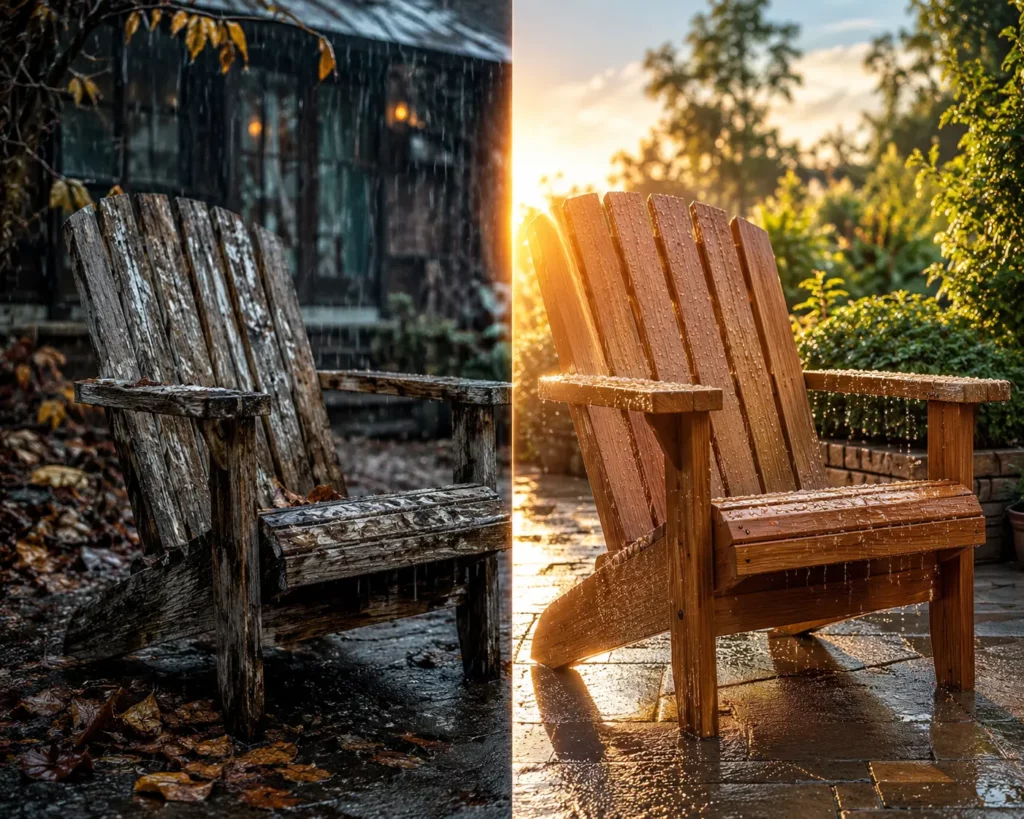
Oil Finishes: Bringing Wood to Life
Few moments in woodworking are as satisfying as applying the first coat of oil to raw wood.
Grain patterns deepen.
Color becomes richer.
Character emerges.
For cedar, teak, redwood, and white oak, penetrating oil finishes often provide the most natural luxury appearance.
Benefits include:
- Enhanced grain definition
- Easier maintenance
- Natural appearance
- Repairability over time
Rather than creating a thick surface layer, oil allows the wood itself to remain the focal point.
That understated elegance is one reason luxury outdoor furniture frequently favors oil-based finishing systems.
Marine-Grade Protection for Harsh Environments
Some outdoor spaces demand additional protection.
Coastal properties.
Open patios.
High-UV climates.
Regions with extreme seasonal weather.
In these conditions, marine-grade exterior finishes provide enhanced defense against:
- Moisture intrusion
- UV degradation
- Surface wear
- Environmental stress
The goal isn’t to make wood look coated.
The goal is to preserve the appearance that made the wood beautiful in the first place.
Why Modern Luxury Favors Matte Finishes
Gloss once dominated premium furniture.
Today, preferences have shifted.
Many high-end outdoor furniture collections embrace low-sheen and matte finishes.
There’s a reason.
Matte surfaces allow craftsmanship to become visible.
They highlight grain instead of glare.
They create depth without distraction.
And perhaps most importantly, they age gracefully.
A perfectly executed matte finish feels confident because it doesn’t need to compete for attention.
The Small Details That Make Furniture Look Custom-Built
Luxury rarely comes from a single dramatic design choice.
More often, it emerges from dozens of subtle decisions working together.
These details may seem minor individually.
Collectively, they’re transformative.
Edge Profiles That Invite Touch
People interact with furniture physically before they evaluate it intellectually.
A sharp edge creates resistance.
A softened edge creates comfort.
Rounded transitions communicate refinement.
They feel finished.
Intentional.
Human.
Every edge on a premium patio chair should feel as though someone cared enough to spend an extra few minutes getting it right.
Because that’s often exactly what happened.
Grain Matching and Visual Flow
One of the quiet secrets behind luxury furniture is continuity.
When grain patterns appear to flow naturally from one component to another, furniture feels unified.
Most people won’t consciously identify grain matching.
They’ll simply describe the piece as beautiful.
Or balanced.
Or expensive.
What they’re responding to is visual harmony.
Thoughtful board selection creates that harmony long before assembly begins.
Hardware Should Support the Design, Not Dominate It
Cheap hardware has a way of announcing itself.
Quality hardware tends to disappear.
For weather-resistant patio chairs, prioritize:
- Stainless steel fasteners
- Marine-grade screws
- Corrosion-resistant hardware
- Concealed mounting systems
The goal isn’t secrecy.
The goal is restraint.
The furniture should remain the hero of the story.
The Power of Shadow Lines
Luxury furniture designers frequently use subtle spacing to create depth.
These small gaps, often called shadow lines, introduce visual separation between components.
They create rhythm.
They reduce visual heaviness.
And they make furniture feel more sophisticated without increasing complexity.
Once you begin noticing shadow lines in premium furniture, you’ll see them everywhere.
What Does It Actually Cost to Build Luxury Patio Chairs?
One reason DIY luxury furniture continues gaining popularity is simple:
The value proposition is difficult to ignore.
Consumers regularly spend thousands of dollars on premium outdoor seating.
Much of that cost reflects branding, distribution, retail markup, and logistics.
Building your own furniture allows more of the investment to remain in the materials themselves.
Typical Cost Ranges
| Material | DIY Luxury Chair | Comparable Retail Chair |
|---|---|---|
| Cedar | $120–250 | $700–1,500 |
| White Oak | $180–350 | $1,000–2,000 |
| Redwood | $180–400 | $1,000–2,500 |
| Teak | $300–600 | $1,500–4,000+ |
While pricing varies by region and lumber availability, the savings can be substantial.
More importantly, customization becomes possible.
You control dimensions.
You control materials.
You control every detail.
That’s difficult to put a price on.
Mistakes That Quietly Undermine a Luxury Look
Sometimes furniture doesn’t look expensive because of what’s included.
Sometimes it’s because of what wasn’t avoided.
Several common mistakes repeatedly appear in outdoor woodworking projects.
Fortunately, they’re easy to prevent once you know where to look.
Oversized Components
Bigger doesn’t automatically mean better.
Bulky arms, oversized legs, and excessively thick framing often create a heavy appearance.
Luxury furniture tends to feel balanced rather than overbuilt.
Strength should be present.
It just shouldn’t dominate the visual experience.
Inconsistent Spacing
Uneven gaps immediately attract attention.
Unfortunately, they rarely attract it in a positive way.
Consistent spacing creates visual rhythm and professionalism.
Even simple designs become more refined when spacing remains disciplined throughout the build.
Ignoring Grain Direction
Grain orientation influences more than appearance.
It affects how furniture feels visually.
When grain patterns conflict unnecessarily, the eye experiences subtle tension.
When they work together, the entire piece feels calmer and more cohesive.
Rushing the Finish
Many builders reach the finish line and accelerate.
Understandably so.
The project is nearly complete.
The excitement is high.
But finishing is not the final step.
Finishing is part of the build itself.
A rushed finish can diminish weeks of excellent craftsmanship.
A thoughtful finish can elevate a relatively simple project into something extraordinary.
Questions People Ask Before Building Luxury Outdoor Furniture
“If I want the absolute best wood, should I just buy teak?”
Teak is exceptional, but it isn’t automatically the best choice for every project.
If budget allows and long-term outdoor performance is the primary goal, teak remains difficult to surpass.
However, cedar, white oak, and redwood can produce stunning results while offering distinct visual personalities and lower material costs.
The better question is often:
“What experience do I want this furniture to create?”
The answer usually reveals the right material.
“Will my patio chairs really survive outdoors year-round?”
They can.
But durability depends on the entire system, not just the wood species.
Material selection, joinery quality, water management, finish choice, and maintenance habits all contribute to longevity.
A thoughtfully designed cedar chair will often outlast a poorly designed teak chair.
Construction matters.
“Do I need advanced woodworking skills to build furniture that looks expensive?”
Not necessarily.
Many luxury characteristics come from attention to detail rather than technical difficulty.
Consistent spacing.
Clean sanding.
Balanced proportions.
Thoughtful finishing.
These improvements are accessible to builders at almost every skill level.
Patience often contributes more to quality than complexity.
“How often will outdoor furniture need maintenance?”
That depends on climate, exposure, and finish type.
Oil-finished furniture may benefit from periodic reapplication.
Protective exterior coatings typically require occasional inspection and renewal.
The encouraging reality is that routine maintenance usually takes far less time than rebuilding furniture prematurely.
“Why do some expensive outdoor chairs still look ordinary?”
Because price and design are not the same thing.
Luxury is not created by a price tag.
It’s created through proportion, craftsmanship, materials, comfort, and attention to detail.
The most memorable furniture often succeeds because every element works together rather than because any single feature stands out.
Products / Tools / Resources
If you’re planning to build premium weather-resistant patio chairs, these are the resources and materials most experienced builders reach for repeatedly:
Recommended Woods
- Western Red Cedar for affordability and natural weather resistance
- Teak for maximum longevity and luxury appeal
- White Oak for modern outdoor furniture designs
- Redwood for warmth, color, and stability
Essential Hand Tools
- Combination square
- Block plane
- Marking gauge
- Chisels
- Clamps (more than you think you’ll need)
Recommended Power Tools
- Table saw
- Miter saw
- Random orbital sander
- Router with round-over bits
- Drill and driver set
Joinery Solutions
- Mortise and tenon systems
- Floating tenon jigs
- Pocket-hole systems with exterior-rated hardware
- Hardwood plug cutters for concealed fasteners
Outdoor Hardware
- Stainless steel screws
- Marine-grade fasteners
- Exterior-rated bolts and washers
- Corrosion-resistant brackets
Finishing Products
- Penetrating outdoor oils
- Marine-grade spar varnish
- UV-resistant exterior sealers
- Matte outdoor furniture finishes
Helpful Companion Projects
- Outdoor side tables
- Cedar coffee tables
- Garden benches
- Dining chairs
- Outdoor ottomans
- Patio conversation sets
- Matching outdoor dining tables
Internal Reading Opportunities
To create a complete luxury outdoor furniture collection, consider exploring:
- Outdoor furniture wood selection guides
- Weather-resistant finishing systems
- Advanced outdoor joinery techniques
- Patio layout and outdoor living design
- Furniture ergonomics and comfort engineering
- Outdoor furniture maintenance schedules
The builders who consistently produce furniture that looks custom-built rarely rely on a single technique. Instead, they combine quality materials, thoughtful design, patient craftsmanship, and a willingness to pay attention to details that most people never notice—but somehow always feel.