
There’s a strange kind of disappointment that comes with furnishing an apartment.
You spend hours scrolling through furniture sites. Everything looks beautiful in the photos—soft lighting, clean walls, perfectly styled rooms that feel calm in a way real apartments rarely do. Then the piece arrives. It’s too wide for the corner you measured three times. The wood feels hollow. The drawers stick. Six months later, it wobbles every time you set down a cup of coffee.
And somewhere in the middle of tightening loose screws again, a thought starts forming:
Maybe the problem isn’t my apartment. Maybe it’s the furniture.
That realization is what pulls so many people into woodworking for the first time. Not because they dream of becoming carpenters. Not because they want a garage workshop or a wall of expensive tools. They just want a home that feels intentional. Personal. Calm.
A place that fits them properly.
The good news is that modern apartment woodworking doesn’t look the way most people imagine it. You don’t need a giant workspace. You don’t need years of experience. And you definitely don’t need to build elaborate handcrafted heirlooms to create a designer apartment with free woodworking plans.
You need smart projects.
Compact projects.
Projects that solve real-life problems beautifully.
That’s where everything changes.
Why DIY Furniture Feels Different in a Small Apartment
Small spaces magnify everything.
Clutter feels heavier. Bad layouts feel tighter. Cheap furniture ages faster because you interact with it constantly. In a studio apartment or compact one-bedroom, every object participates in the emotional atmosphere of the room.
That’s why thoughtfully built furniture has such an outsized effect.
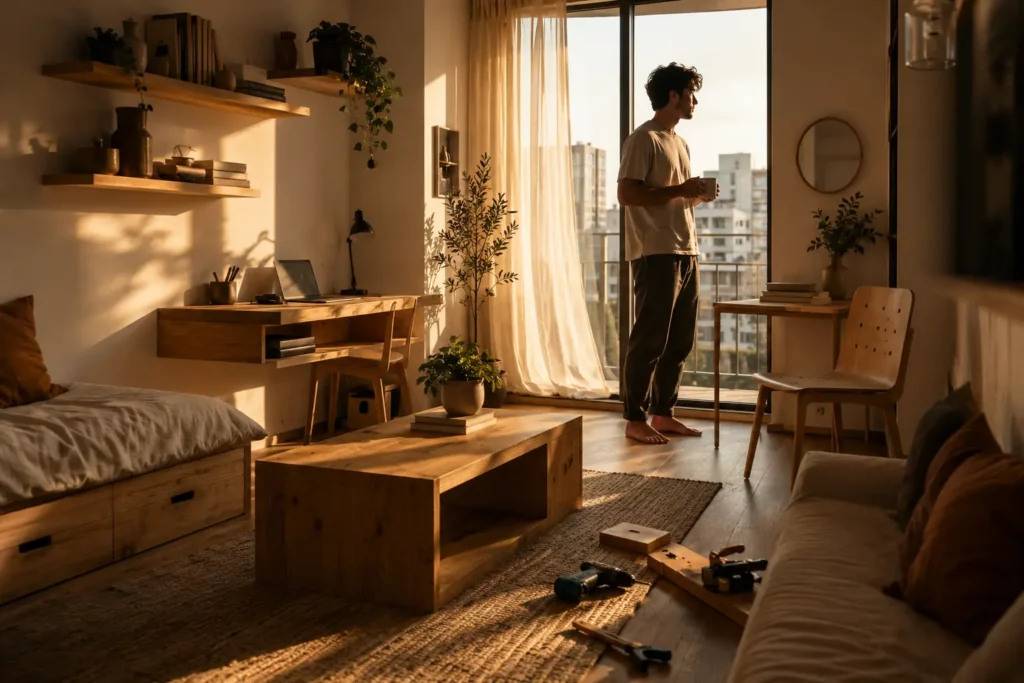
A floating shelf doesn’t just hold books. It clears floor space. A fold-down desk doesn’t just save room—it changes how your apartment functions throughout the day. A platform bed with hidden storage quietly removes visual stress every single morning.
Good apartment furniture creates relief.
And relief is deeply emotional.
Mass-produced furniture rarely understands that because it’s designed for scale, not specificity. Most pieces are built around average room dimensions and broad aesthetics. Apartment living is more nuanced than that. It requires flexibility, restraint, and clever use of space.
That’s why apartment-friendly woodworking has exploded alongside minimalist interiors, Scandinavian furniture design, and Japandi-inspired homes. People are searching for furniture that works harder without making the room feel crowded.
And increasingly, they’re realizing they can build it themselves.
What Actually Makes Furniture Apartment-Friendly?
Not all DIY furniture belongs in a small apartment.
Some projects look impressive online but become visual clutter the moment they enter a tighter room. Others dominate floor space or feel impossible to move after one lease renewal.
The best apartment furniture follows a completely different philosophy.
It’s lighter. Smarter. More adaptable.
Usually, it does at least two jobs at once.
A storage bench becomes seating and organization. A coffee table hides blankets, cables, or books. A fold-down wall desk disappears when the workday ends, allowing the apartment to breathe again.
That’s the real secret behind designer apartments:
they aren’t necessarily larger.
They’re simply more intentional.
The Four Traits Shared by Great Apartment Furniture
1. It Uses Vertical Space Intelligently
Floating shelves, wall-mounted desks, pegboards, and vertical storage systems create openness by freeing the floor visually.
The eye relaxes when the floor remains visible.
That visual lightness matters more than people realize.
2. It Solves Multiple Problems Simultaneously
The best small-space furniture is layered with utility.
Think:
- storage beds
- nesting stools
- rolling kitchen carts
- slim entryway consoles
- foldable dining tables
Furniture earns its footprint.
3. It’s Easier to Move
Apartment life changes fast. Furniture that’s impossible to carry upstairs becomes a burden eventually.
That’s why many modern woodworking plans prioritize:
- modular construction
- lightweight plywood
- collapsible components
- compact dimensions
Mobility is freedom.
4. It Reduces Visual Noise
This is the one most beginners overlook.
A room can be technically organized and still feel stressful.
Designer interiors work because they reduce visual friction:
- clean lines
- consistent wood tones
- open negative space
- restrained detailing
Minimalist woodworking projects naturally support that atmosphere.
The Beginner Tool Setup That Changes Everything
Most people delay woodworking for one reason:
They think they need more before they begin.
More space.
More money.
More knowledge.
More tools.
In reality, many apartment furniture projects can be built with a surprisingly small setup.
A drill.
A saw.
A sander.
A few clamps.
That’s enough to build furniture that completely changes how a space feels.
Start With a Cordless Drill
If you only buy one tool, make it this.
A cordless drill handles:
- pilot holes
- assembly
- hardware installation
- screw driving
- basic construction
You’ll use it constantly.
And unlike specialized woodworking equipment, it remains useful long after the hobby evolves.
Why Circular Saws Work Better Than Table Saws for Most Beginners
Table saws dominate traditional woodworking culture. But for apartment DIYers, compact circular saws are often more practical.
They:
- store easily
- cost less
- work well with plywood
- function in temporary setups
Pair one with a straight edge guide and suddenly beginner woodworking feels far less intimidating.
Sanding Is Where Cheap Furniture Becomes Beautiful
People often assume luxury furniture comes from advanced craftsmanship.
Usually, it comes from patience.
Sanding changes everything:
- the way wood reflects light
- the way edges feel in your hand
- the way stain absorbs
- the overall perception of quality
An orbital sander is one of the highest-value tools a beginner can own because it instantly improves the emotional experience of the final piece.
Pocket Hole Jigs Quietly Make Beginners Better
Pocket hole joinery simplified furniture building for an entire generation of DIYers.
It allows beginners to create:
- strong joints
- hidden fasteners
- cleaner finishes
- modern furniture aesthetics
Without mastering advanced woodworking techniques first.
That matters psychologically.
Because early success creates momentum.
And momentum is what keeps people building.
You Don’t Need a Workshop—You Need a System
One of the biggest misconceptions about woodworking is environmental.
People picture giant garages, industrial lighting, and walls covered in tools.
Most apartment woodworking happens differently.
It happens temporarily.
A balcony on Saturday morning.
A living room protected with moving blankets.
A hallway workspace with open windows.
A foldable table stored behind a couch afterward.
Once you understand that, the barrier disappears.
How Apartment DIYers Build Furniture Without Losing Their Minds
Use Pre-Cut Lumber Whenever Possible
Most hardware stores will cut plywood and boards before you bring them home.
That single decision dramatically reduces:
- dust
- noise
- complexity
- setup time
For beginners, it also lowers cognitive overload.
You focus on building instead of wrestling oversized sheets of plywood inside an apartment stairwell.
Build Around Foldable Equipment
Portable workbenches and collapsible sawhorses are game changers in small apartments.
When the project ends, the “workshop” disappears.
That flexibility makes woodworking feel sustainable instead of intrusive.
Think in Phases, Not Marathons
The fastest way to burn out is trying to build everything at once.
Designer apartments evolve project by project:
- first shelf
- first side table
- first desk
- first storage piece
Over time, the apartment becomes layered with objects that feel connected.
Not because they match perfectly.
Because they were built intentionally.
The Free Woodworking Plans Worth Starting With
Some projects create disproportionately large upgrades in apartment living.
Not because they’re expensive.
Because they change the way space behaves.
These are the builds beginners return to again and again.
Floating Shelves That Make Apartments Feel Taller
Floating shelves are one of the few woodworking projects capable of making a room feel instantly more sophisticated.
They create vertical rhythm.
They reduce floor clutter.
They add storage without heaviness.
And unlike bulky bookcases, they allow the walls to breathe.
Best Materials for Floating Shelves
For beginners, these work especially well:
- birch plywood
- pine
- poplar
- white oak veneer plywood
Birch plywood is particularly popular in Scandinavian-inspired interiors because it balances affordability with a clean modern appearance.
The Styling Trick That Makes Shelves Look Expensive
Most people overcrowd shelves.
Designer spaces rarely do.
Leaving intentional empty space creates:
- visual calm
- contrast
- balance
That restraint is what makes minimalist apartments feel elevated instead of unfinished.
Why Storage Coffee Tables Are So Effective in Small Spaces
Few furniture pieces work harder in an apartment than a good coffee table.
The right build anchors the room while quietly hiding clutter:
- chargers
- remotes
- blankets
- notebooks
- cables
Lift-top coffee tables are especially useful because they transform functionally throughout the day.
A coffee table becomes:
- workspace
- dining surface
- storage system
- visual centerpiece
That adaptability is exactly what small apartments need.
The Quiet Luxury of a Slim Entryway Table
Even tiny entryways benefit from structure.
A narrow console table creates a subtle transition between outside life and home life. Keys get a place. Bags stop ending up on chairs. Mail stops drifting across counters.
The apartment begins feeling calmer because small systems reduce invisible stress.
That’s something beginner woodworking often teaches unexpectedly:
good furniture changes behavior.
Bedroom Projects That Instantly Reduce Clutter Stress
Bedrooms carry emotional weight.
When they’re overcrowded, everything feels slightly louder psychologically. Laundry piles feel bigger. Mornings feel rushed. Sleep quality even changes.
That’s why bedroom woodworking projects tend to have such an immediate impact.
Platform Beds With Hidden Storage
This is one of the smartest apartment woodworking projects a beginner can tackle.
A well-designed platform bed creates:
- hidden organization
- cleaner sightlines
- improved floor flow
- modern aesthetics
And because beds occupy so much visual space, upgrading one transforms the entire room almost immediately.
Features Worth Including
Consider:
- under-bed drawers
- hydraulic lift storage
- integrated charging shelves
- soft rounded edges
Small details make the furniture feel custom instead of improvised.
Floating Nightstands Feel Surprisingly Luxurious
Traditional nightstands often feel visually heavy in small bedrooms.
Floating versions create openness because the floor remains visible underneath them. That visual continuity subtly expands the room.
They also happen to be one of the easiest beginner woodworking projects available.
Simple builds.
High visual payoff.
That’s the sweet spot.
Minimalist Clothing Racks and the Rise of Intentional Living
Open wardrobe systems used to feel temporary.
Now they feel curated.
Minimalist apartments increasingly favor:
- exposed clothing racks
- capsule wardrobes
- visible organization systems
Not just because they save space—but because they encourage intentional ownership.
Furniture quietly shapes habits.
That’s part of why custom woodworking becomes emotionally satisfying over time.
You stop consuming your environment passively.
You begin designing it.
Home Office Furniture That Doesn’t Hijack the Apartment
Remote work permanently changed apartment design.
Suddenly, people needed:
- compact workstations
- ergonomic furniture
- cable management
- flexible layouts
And most apartments weren’t prepared for that shift.
Fold-Down Desks Create Psychological Separation
This matters more than most people realize.
A fold-down wall desk allows work to physically disappear at the end of the day. In small apartments, that separation protects mental boundaries.
Without it, work slowly leaks into everything.
That’s why these desks perform so well—not just functionally, emotionally.
Monitor Risers Are Tiny Projects With Massive Daily Impact
A monitor riser seems insignificant until you use one.
Suddenly:
- posture improves
- desk clutter decreases
- cables disappear
- the workspace feels intentional
For beginners, this is often the perfect first woodworking project because the payoff is immediate.
And immediate wins build confidence fast.
The Difference Between “DIY” and “Designer” Furniture
Most people can build functional furniture.
Far fewer know how to make it feel refined.
The gap usually has less to do with complexity than restraint.
Simpler Furniture Almost Always Looks Better
Luxury furniture rarely tries too hard.
Clean proportions.
Consistent lines.
Minimal detailing.
Beginners often assume complexity equals sophistication. In reality, the opposite is usually true.
Simple furniture ages better visually.
Finishing Changes Everything
A mediocre build with excellent finishing often looks better than an advanced build with rushed finishing.
Matte and satin finishes tend to feel more modern because they soften light instead of reflecting it aggressively.
Popular beginner-friendly finishes include:
- Danish oil
- hardwax oil
- wipe-on polyurethane
- matte polycrylic
The texture matters as much as the appearance.
People experience furniture physically before they analyze it visually.
Hardware Quietly Signals Quality
Cheap handles and hinges instantly flatten perceived quality.
A simple upgrade to:
- brushed brass pulls
- matte black hardware
- soft-close hinges
- concealed drawer slides
can completely change how furniture feels emotionally.
Small details carry enormous psychological weight.
Edge Banding Is the Secret Most Beginners Discover Too Late
Raw plywood edges often reveal the project immediately.
Edge banding creates continuity. Suddenly the furniture feels cleaner, calmer, more intentional.
It’s one of the easiest ways to elevate beginner woodworking without adding complexity.
The Beginner Mistakes Almost Everyone Makes
Woodworking frustration usually follows patterns.
And most of them are avoidable.
Building Furniture Too Large for the Room
People consistently overestimate how much furniture a small apartment can visually tolerate.
The result:
- blocked pathways
- cramped movement
- visual heaviness
Smaller furniture often feels more luxurious because openness itself feels expensive.
Choosing the Wrong Wood
Beginners often assume hardwood automatically means better furniture.
Not necessarily.
For apartment projects, plywood and pine frequently make more sense because they’re:
- lighter
- easier to work with
- easier to transport
- more affordable
Birch plywood remains one of the most versatile options for modern DIY furniture.
Ignoring Sanding Until the End
Poor sanding reveals itself instantly in finished furniture.
Edges feel rough.
Stain absorbs unevenly.
Light reflects inconsistently.
The tactile experience suffers.
And people notice tactile quality subconsciously.
Starting With Projects That Are Too Ambitious
The internet loves dramatic transformations.
But the people who become genuinely skilled usually start smaller than expected.
A shelf.
A bench.
A riser.
A side table.
Those projects create repetition.
Repetition creates fluency.
That’s how confidence actually develops.
The Emotional Shift Nobody Talks About
At first, woodworking seems practical.
You’re building storage.
Saving money.
Customizing a room.
But eventually something deeper happens.
You stop looking at your apartment like temporary space.
You begin seeing it as an extension of yourself.
The shelves reflect your habits.
The desk reflects your routines.
The lighting, materials, textures, and proportions begin carrying emotional meaning.
And slowly, the apartment stops feeling borrowed.
It starts feeling authored.
FAQs People Quietly Ask Before They Start
“Can you realistically do woodworking in an apartment without annoying everyone around you?”
Yes—far more easily than most people think.
Modern cordless tools are dramatically quieter than older equipment, and many apartment DIYers rely on pre-cut lumber to eliminate heavy cutting altogether. Temporary workstations, balcony setups, and foldable benches make a huge difference.
Most of the challenge is psychological, not logistical.
“What’s the easiest wood to work with if I’ve never built anything before?”
Pine is forgiving, affordable, and widely available. Birch plywood is another favorite because it looks clean and modern without becoming prohibitively expensive.
A lot of beginners overcomplicate this part. The best wood is usually the one that gets you building consistently.
“What’s the first project that actually feels worth doing?”
Floating shelves and monitor risers are excellent starting points because the reward is immediate.
You see the difference instantly.
You use the piece every day.
And confidence grows quickly after that.
Momentum matters more than complexity.
“How do you make homemade furniture not look… homemade?”
Focus on:
- clean lines
- consistent proportions
- restrained design
- proper sanding
- quality hardware
- matte finishes
Most expensive-looking furniture is visually quiet.
That’s the detail people miss.
Products / Tools / Resources
Beginner Woodworking Tools Worth Buying First
- Cordless drill and driver combo kit
- Compact circular saw
- Orbital sander
- Pocket hole jig system
- Clamping set for furniture assembly
- Foldable workbench or sawhorses
Recommended Woods for Apartment Furniture
- Birch plywood for modern minimalist builds
- Pine for budget-friendly beginner projects
- Poplar for painted furniture
- White oak veneer plywood for designer aesthetics
Finishes That Create a Modern Designer Look
- Matte polyurethane
- Danish oil
- Hardwax oil
- Satin wipe-on polycrylic
Apartment-Friendly Furniture Projects to Try Next
- Floating shelves
- Fold-down wall desk
- Storage coffee table
- Platform bed with drawers
- Slim entryway console
- Rolling kitchen cart
- Floating nightstands
- Minimalist clothing rack
Helpful Resources for Skill Building
- Free woodworking plan libraries
- Cut-list calculators
- Room layout planners
- Scandinavian interior inspiration boards
- Beginner joinery tutorials
- Ergonomic workspace design guides