
Every Scrap of Wood Has a Story Waiting Inside It
Walk into almost any woodworking shop and you’ll find the same thing tucked into a corner.
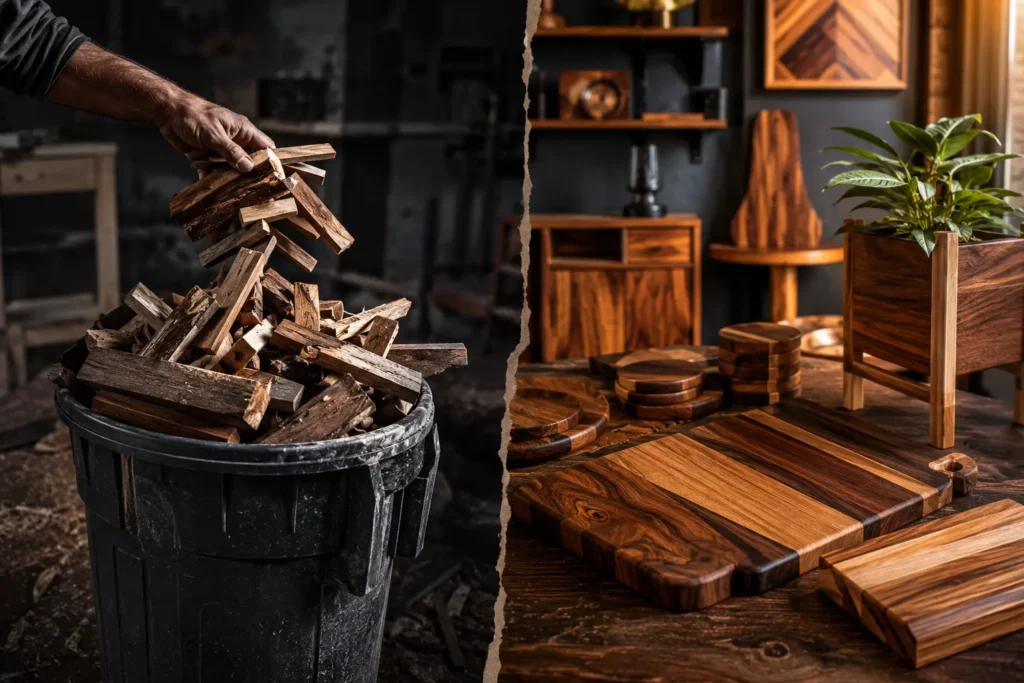
A growing pile of leftovers.
Short boards. Odd cuts. Narrow strips of oak, maple, pine, and walnut that survived a larger project but never quite found a purpose afterward.
Most people look at that pile and see clutter.
Woodworkers see something different.
They see future projects.
They see practice pieces.
They see possibilities.
That’s one of the quiet shifts that happens as your woodworking skills grow. At first, you’re focused on what you need to buy. More lumber. Better tools. Bigger projects. Then, somewhere along the way, your perspective changes. You stop looking at wood for what it is and start seeing what it could become.
A simple offcut becomes a phone stand.
A handful of hardwood scraps becomes a set of handcrafted coasters.
A collection of leftovers eventually becomes a coffee table that guests assume came from a high-end furniture store.
The transformation doesn’t happen overnight. It happens project by project.
This guide is built around that journey.
Instead of throwing fifty random woodworking projects at you, we’ve organized them by skill level so every build becomes a stepping stone toward better craftsmanship. Whether you’re picking up a tape measure for the first time or looking for advanced scrap wood furniture ideas, you’ll find projects that challenge your current abilities while preparing you for what’s next.
And somewhere between your first coaster and your first cabinet, something unexpected happens.
You stop building projects.
You start becoming a woodworker.
Looking for Quick Ideas? Start Here
If you’re searching for woodworking projects using scrap wood and need inspiration fast, these are some of the most practical and rewarding builds.
Beginner Scrap Wood Projects
- Wooden coasters
- Phone stands
- Bookends
- Key holders
- Pencil organizers
- Picture frames
- Small trays
- Wall hooks
- Plant markers
- Tool racks
Intermediate Scrap Wood Projects
- Floating shelves
- Wine racks
- Serving trays
- Mail organizers
- Knife blocks
- Step stools
- Plant stands
- Storage crates
- Entryway organizers
- Floating nightstands
Advanced Scrap Wood Projects
- Coffee tables
- Storage benches
- End tables
- Accent cabinets
- Dining benches
- Media consoles
- Blanket ladders
- Outdoor furniture
- Modular storage systems
- Display cabinets
The best project isn’t necessarily the most impressive one.
It’s the one that teaches you a skill you’ll use again and again.
Before You Build Anything, Understand Your Scrap Wood
One of the biggest mistakes beginners make has nothing to do with cutting, sanding, or assembly.
It happens before the project even begins.
They underestimate their material.
Not all scrap wood is created equal. A pile of hardwood offcuts behaves differently than a stack of construction-grade pine. Understanding the difference will save frustration, improve results, and help you choose projects that actually fit the material you have available.
Hardwood Scraps: Small Pieces, Big Potential
Hardwoods are often where the hidden treasures live.
Common species include:
- Oak
- Maple
- Walnut
- Cherry
- Ash
- Hickory
These woods tend to be denser, stronger, and more visually striking. Even tiny scraps can become premium-looking projects.
Think:
- Cutting boards
- Serving trays
- Decorative wall art
- Jewelry holders
- Handmade gifts
- High-end home décor
A six-inch walnut offcut may not look like much. Turn it into a minimalist phone stand, however, and suddenly it feels like something you’d find in a designer furniture showroom.
That’s the magic of hardwood.
Small pieces still carry value.
Softwood Scraps: The Unsung Workhorse
Softwoods don’t always get the same attention, but they deserve a place in every workshop.
Common examples include:
- Pine
- Cedar
- Fir
- Spruce
These woods are generally easier to cut, easier to shape, and more forgiving for beginners.
They’re perfect for:
- Shop organization projects
- Storage solutions
- Garden projects
- Rustic home décor
- Practice builds
Many experienced woodworkers recommend learning on pine before moving into expensive hardwoods. Mistakes cost less, experimentation feels safer, and the lessons transfer directly into future projects.
The Secret Behind Every Efficient Workshop
Watch a master craftsman work for a day.
You’ll notice something surprising.
They rarely spend time searching for wood.
Beginners often do.
An unorganized scrap pile creates friction. Every project starts with digging, sorting, and guessing.
Professionals remove that friction entirely.
Organize Scrap Wood Like a Professional
The simplest system is usually the best.
Small Scraps
Pieces under 12 inches.
Perfect for:
- Coasters
- Knobs
- Decorative accents
- Practice joints
- Small gifts
Medium Scraps
Pieces between 12 and 36 inches.
Ideal for:
- Shelves
- Organizers
- Plant stands
- Trays
- Wall décor
Large Scraps
Pieces longer than 36 inches.
Best suited for:
- Furniture
- Benches
- Storage systems
- Cabinets
- Outdoor projects
This one habit can dramatically increase productivity because every future project starts with clarity instead of chaos.
And clarity is often the difference between a project that gets built and one that stays in your imagination.
Beginner Woodworking Projects: Where Skill Meets Confidence
Every accomplished woodworker remembers the first project that worked.
Not perfectly.
Just well enough.
The cuts weren’t flawless. The finish wasn’t showroom quality. But something clicked.
The project looked like what it was supposed to be.
That’s a powerful moment.
The projects below focus on foundational woodworking skills while delivering quick wins that keep momentum alive.
1. Wooden Coasters
If there were a woodworking equivalent of learning scales on a piano, coasters would be it.
They’re simple.
They’re practical.
And they teach accuracy.
Skills you’ll develop:
- Precision cutting
- Sanding techniques
- Surface finishing
- Edge treatment
A beautiful set of hardwood coasters often becomes someone’s first glimpse into the satisfaction of fine woodworking.
2. Phone Stand
Few projects deliver as much usefulness with so little material.
A phone stand introduces concepts that appear repeatedly throughout woodworking:
- Layout planning
- Angle cuts
- Stability
- Functional design
Every successful build teaches you how form and function work together.
3. Pencil Holder
Simple on the surface.
More educational than it looks.
Drilling clean, evenly spaced holes teaches control and precision while helping you become comfortable with workshop tools.
Skills learned:
- Drilling accuracy
- Layout marking
- Surface preparation
- Finishing
4. Rustic Picture Frame
Frames introduce one of woodworking’s most valuable lessons:
Small inaccuracies become very noticeable.
A slightly imperfect cut might disappear on a shelf.
It stands out immediately in a frame.
Skills learned:
- Miter cuts
- Clamping
- Assembly
- Detail work
5. Key Holder
One of the most practical scrap wood projects you can build.
A simple key holder introduces:
- Hardware installation
- Wall mounting
- Functional design principles
It also solves a problem people deal with every day.
And practical projects tend to get used, which means they get appreciated.
6. Wall Hooks
At first glance, wall hooks seem almost too simple.
But they’re an excellent introduction to structural thinking.
You’ll learn:
- Weight distribution
- Fastener placement
- Material strength considerations
Concepts that become increasingly important as projects grow larger and more complex.
7. Plant Markers
Small project.
Big opportunity for creativity.
Plant markers allow experimentation with:
- Wood burning
- Decorative shaping
- Lettering
- Outdoor finishing techniques
They’re also one of the fastest projects you’ll ever complete, making them ideal for skill practice sessions.
8. Wooden Bookends
Bookends teach an important lesson:
Looks matter, but stability matters more.
Skills learned:
- Right-angle assembly
- Structural support
- Balancing aesthetics with functionality
A well-built set can last decades.
9. Small Serving Tray
The first time multiple pieces of wood come together to create a finished surface, woodworking begins to feel different.
More intentional.
More sophisticated.
Serving trays introduce:
- Panel glue-ups
- Edge alignment
- Handle installation
- Surface finishing
Many woodworkers trace their interest in furniture making back to projects like this.
Because for the first time, the project starts to feel substantial.
And that’s where the next stage of the journey begins.
From Scrap Pile to Master Craftsman: 50 Woodworking Projects Ranked by Skill Level (Part 2)
Intermediate Woodworking Projects: The Moment Things Start Feeling Real
There’s a distinct point in every woodworker’s journey when the workshop changes.
The tools are familiar now.
The measuring tape no longer feels intimidating.
Basic cuts happen almost automatically.
And the projects sitting on your workbench begin looking less like practice pieces and more like things people genuinely want in their homes.
This is where many hobbyists become deeply invested in woodworking.
Because the reward changes.
You’re no longer building simply to learn.
You’re building because the results are becoming beautiful.
The projects in this section bridge the gap between beginner woodworking and true craftsmanship. They introduce stronger joinery, cleaner design, better finishing techniques, and a deeper understanding of how wood behaves over time.
Most importantly, they teach a lesson that separates amateur work from professional work:
Precision matters.
Not because perfection is the goal.
But because consistency creates quality.
16. Floating Shelves
Few woodworking projects deliver more visual impact with less material.
A well-designed floating shelf can transform an entire room.
What makes this project valuable isn’t the shelf itself. It’s the hidden engineering behind it.
Skills you’ll develop:
- Hidden mounting systems
- Wall anchoring
- Load distribution
- Level installation
For many woodworkers, floating shelves become the first project friends and family request after seeing finished work.
And that request is often the first sign your skills are becoming noticeable.
17. Wine Rack
Wine racks look simple.
They rarely are.
What appears to be a straightforward storage project demands consistent spacing, clean alignment, and precise repetition.
Even minor mistakes become visible immediately.
Skills learned:
- Repetitive accuracy
- Layout planning
- Decorative woodworking
- Precision cutting
The result is a project that feels custom-built while teaching some of woodworking’s most important fundamentals.
18. Mail Organizer
Most people think woodworking is about building furniture.
In reality, woodworking often solves everyday frustrations.
A well-designed mail organizer transforms clutter into order.
More importantly, it introduces compartmentalized construction.
Skills learned:
- Interior dividers
- Functional storage design
- Assembly sequencing
- Wall-mounted construction
Projects like this encourage you to think beyond appearance and focus on usability.
Good woodworking lives at the intersection of both.
19. Storage Crates
Storage crates may not sound exciting.
Build a beautiful set from reclaimed hardwood, however, and you’ll quickly understand their appeal.
These projects teach structural thinking.
How much weight must the crate hold?
Where does stress concentrate?
How should joints be reinforced?
Skills learned:
- Structural joinery
- Load-bearing design
- Repetitive assembly
- Material efficiency
It’s often the first project where woodworkers begin appreciating engineering as much as aesthetics.
20. Floating Nightstand
This is where furniture starts entering the conversation.
A floating nightstand combines functionality, style, and precision in one relatively compact project.
It requires:
- Careful measurements
- Strong joinery
- Accurate installation
- Clean finishing
Because it’s mounted at eye level, every detail matters.
The result feels more sophisticated than many projects several times its size.
21. Entryway Organizer
Every successful project solves a problem.
Entryway organizers solve several.
Keys.
Mail.
Wallets.
Sunglasses.
Daily clutter.
This project teaches how multiple functions can coexist within a single design.
Skills learned:
- Multi-purpose construction
- Space planning
- Hardware installation
- Decorative detailing
It’s also one of the most gifted handmade projects because nearly everyone can use one.
22. Knife Block
At first glance, a knife block seems straightforward.
In practice, it’s an exercise in precision.
Slot placement must be accurate.
Spacing must feel natural.
The finished piece must be both attractive and functional.
Skills learned:
- Precision slot cutting
- Hardwood preparation
- Safe workshop practices
- Fine finishing techniques
Projects like this sharpen your attention to detail in ways larger builds often can’t.
23. Laptop Riser
Modern woodworking increasingly intersects with modern living.
A laptop riser is a perfect example.
It combines clean design, ergonomics, and practical utility.
Skills learned:
- Ergonomic design principles
- Minimalist construction
- Precise layout
- Modern woodworking aesthetics
Simple projects often reveal the hardest truth in design:
Making something look effortless requires significant effort.
24. Step Stool
A decorative tray can hide minor flaws.
A step stool cannot.
The moment someone stands on it, every joint and connection is tested.
Skills learned:
- Weight-bearing construction
- Structural reinforcement
- Joinery under stress
- Long-term durability planning
This project introduces a level of responsibility that elevates your craftsmanship.
You’re not just building something attractive.
You’re building something people trust.
25. Plant Stand
Plant stands represent a fascinating balance between engineering and design.
They need strength.
But they also need elegance.
The best examples feel almost architectural.
Skills learned:
- Decorative joinery
- Balance and proportion
- Stability considerations
- Design refinement
Many woodworkers discover their design preferences while building projects like these.
26. Wall-Mounted Shelf Unit
Now you’re thinking bigger.
Instead of a single shelf, you’re creating a complete storage system.
Skills learned:
- Modular design
- Multi-component assembly
- Long-span support
- Layout planning
This project begins developing the planning mindset required for advanced furniture construction.
27. Decorative Wooden Clock
Woodworking isn’t always about utility.
Sometimes it’s about creating something that simply makes people stop and look.
A wooden clock combines craftsmanship with visual storytelling.
Skills learned:
- Decorative detailing
- Hardware integration
- Design balance
- Finishing techniques
It introduces an important realization:
Objects can be functional and artistic at the same time.
28. Serving Board
Among all woodworking projects using scrap wood, serving boards consistently remain favorites.
Why?
Because they’re practical.
Beautiful.
Giftable.
And highly marketable.
Skills learned:
- Hardwood glue-ups
- Grain selection
- Food-safe finishing
- Surface refinement
A well-made serving board can elevate even small hardwood scraps into something premium.
29. Wooden Toolbox
The irony of woodworking is that eventually you start building things to support more woodworking.
A custom toolbox does exactly that.
Skills learned:
- Functional construction
- Handle integration
- Structural assembly
- Workshop organization
Every time you use it, you’re reminded of how far your skills have progressed.
30. Pet Feeding Station
The best woodworking projects solve personal needs.
Pet feeding stations are highly customizable and incredibly rewarding.
Skills learned:
- Custom sizing
- Ergonomic planning
- Decorative finishing
- User-focused design
And unlike many projects, you’ll have a daily reminder of your work every time your pet uses it.
The Invisible Skills That Separate Good Woodworkers from Great Ones
Projects teach techniques.
But techniques alone don’t create craftsmanship.
The deeper skills often develop quietly.
Almost unnoticed.
Until one day your work simply looks better.
Cleaner.
More intentional.
More professional.
Understanding Grain Direction
Every board tells a story.
Its grain reveals how the tree grew, where stress exists, and how the wood will react to cutting and finishing.
Experienced woodworkers learn to read grain before making a single cut.
That awareness influences:
- Strength
- Appearance
- Stability
- Finish quality
Ignoring grain is often the difference between good results and frustrating ones.
Learning the Art of Glue-Ups
Many intermediate projects require combining multiple pieces into a single panel.
At first, glue-ups seem straightforward.
Spread glue.
Clamp.
Wait.
Reality is more nuanced.
Proper glue-ups require:
- Even pressure
- Correct alignment
- Moisture awareness
- Surface preparation
Master this skill and entire categories of furniture become possible.
Why Sanding Is More Important Than Most Beginners Realize
There’s a reason professional furniture feels different.
It’s rarely because of the wood species.
It’s often because of the surface preparation.
Exceptional sanding creates:
- Better finishes
- Cleaner reflections
- Smoother touch
- Higher perceived quality
People may not consciously notice good sanding.
But they always notice bad sanding.
Developing an Eye for Design
At some point, woodworking stops being purely technical.
You begin making creative decisions.
Should the shelf be thicker?
Should the edges remain sharp or softened?
Would walnut create more contrast than maple?
These questions mark a turning point.
You’re no longer following plans.
You’re beginning to develop a design voice.
And that voice becomes one of the most valuable tools you’ll ever own.
Common Mistakes That Stall Progress
Nearly every woodworker encounters the same obstacles.
The difference is whether they learn from them.
Chasing Complexity Too Early
Advanced furniture can be inspiring.
It can also be discouraging when attempted too soon.
Skill develops in layers.
Every successful coaster, tray, shelf, and organizer creates a foundation for larger projects later.
Progress compounds.
Trust the process.
Ignoring Material Movement
Wood moves.
Always.
Humidity changes.
Seasons change.
Wood responds.
Ignoring that reality often leads to:
- Cracks
- Warping
- Joint failure
- Structural instability
Understanding wood movement is one of the defining characteristics of advanced craftsmanship.
Focusing on Speed Instead of Accuracy
The fastest builders rarely produce the best work.
The best builders develop efficient systems that protect accuracy.
Measure carefully.
Cut deliberately.
Slow down when it matters.
Speed arrives naturally later.
And when it does, quality tends to follow.
From Scrap Pile to Master Craftsman: 50 Woodworking Projects Ranked by Skill Level (Part 3)
Advanced Woodworking Projects: When Skill Becomes Craft
Something changes when you reach this stage.
The projects get larger, certainly.
More complex, too.
But the biggest shift isn’t technical.
It’s mental.
You stop asking, “Can I build this?”
And start asking, “How can I build this better?”
That’s the question craftsmen chase for decades.
Not because there’s a final answer waiting somewhere.
But because the pursuit itself becomes part of the reward.
The projects in this section demand more patience, more planning, and a deeper understanding of woodworking fundamentals. They ask you to think beyond individual cuts and focus on the relationship between design, structure, proportion, and longevity.
These aren’t just projects.
They’re milestones.
31. Coffee Table
Few furniture pieces reveal woodworking skill as honestly as a coffee table.
It’s constantly visible.
Constantly used.
Constantly touched.
Every detail—from grain selection to edge profiles—becomes part of the experience.
Skills developed:
- Furniture-grade joinery
- Design proportion
- Surface preparation
- Structural stability
A great coffee table doesn’t dominate a room.
It quietly belongs there.
32. End Table
Smaller than a coffee table.
Not necessarily easier.
End tables force precision because there’s less space to hide mistakes.
Every line feels more noticeable.
Every angle matters.
Skills developed:
- Fine furniture construction
- Joinery refinement
- Visual balance
- Precision assembly
This is where many woodworkers begin appreciating subtlety.
And subtlety is often what separates good furniture from exceptional furniture.
33. Blanket Ladder
Blanket ladders became popular for a reason.
They’re functional.
Decorative.
And deceptively challenging.
Maintaining perfect spacing while managing angled joinery requires careful planning from start to finish.
Skills developed:
- Angled cuts
- Layout consistency
- Decorative design
- Structural alignment
The finished piece feels simple.
Getting there rarely is.
34. Entry Bench
An entry bench introduces a new level of responsibility.
People trust it with their weight.
Their daily routines.
Their homes.
That changes how you think about construction.
Skills developed:
- Load-bearing design
- Furniture engineering
- Reinforced joinery
- Structural planning
Strong furniture isn’t built by accident.
It’s designed that way from the beginning.
35. Storage Bench
The best furniture often performs multiple jobs.
Storage benches are a perfect example.
Seating.
Organization.
Visual design.
All in one piece.
Skills developed:
- Hinged lid systems
- Multi-function design
- Interior compartment construction
- Advanced assembly
Projects like this encourage you to think beyond objects and toward solutions.
36. Media Console
This is often the first truly ambitious furniture build many woodworkers attempt.
A media console demands planning.
Lots of it.
Every dimension influences something else.
Cable management.
Storage requirements.
Structural support.
Aesthetics.
Skills developed:
- Large-scale project planning
- Cabinet construction
- Material optimization
- Design integration
At this level, woodworking becomes a form of problem-solving.
37. Accent Cabinet
Cabinetry is where precision becomes non-negotiable.
Doors must align.
Gaps must remain consistent.
Everything needs to function smoothly.
Skills developed:
- Door construction
- Cabinet joinery
- Hardware installation
- Fine adjustment techniques
Few projects teach patience more effectively.
38. Modular Storage System
Flexibility is one of the hallmarks of great design.
Modular systems allow spaces to evolve over time.
And they demand repeatable accuracy.
Build one unit slightly off and the entire system reveals it.
Skills developed:
- Repeatable fabrication
- Production-style workflows
- Modular planning
- Dimensional consistency
Professional shops live and die by consistency.
This project teaches why.
39. Garden Bench
Outdoor furniture introduces an entirely new challenge:
Nature.
Rain.
Sunlight.
Temperature changes.
Moisture.
Everything becomes a factor.
Skills developed:
- Exterior joinery
- Weather-resistant design
- Outdoor finishing techniques
- Material selection
A garden bench teaches durability in ways indoor projects never can.
40. Adirondack Chair
Few projects have introduced more woodworkers to compound angles than the Adirondack chair.
The shape looks effortless.
The construction isn’t.
Skills developed:
- Compound-angle cutting
- Ergonomic design
- Structural geometry
- Precision assembly
The first successful Adirondack chair often feels like a genuine breakthrough moment.
41. Bookshelf
Bookshelves seem straightforward until they begin carrying hundreds of pounds of weight.
Then engineering enters the conversation.
Skills developed:
- Long-span support
- Shelf reinforcement
- Load management
- Furniture-scale assembly
A beautiful bookshelf should feel sturdy before a single book touches it.
42. Sideboard
A sideboard combines many of the skills you’ve been developing all along.
Storage.
Cabinetry.
Furniture design.
Joinery.
Proportion.
It’s a comprehensive challenge.
Skills developed:
- Multi-component construction
- Furniture styling
- Advanced planning
- Design cohesion
By now, you’re not just learning techniques.
You’re combining them.
43. Display Cabinet
Display cabinets demand something unusual.
Restraint.
The furniture shouldn’t compete with what’s displayed inside it.
It should elevate it.
Skills developed:
- Glass integration
- Fine detailing
- Precision door alignment
- Visual composition
This project rewards thoughtful craftsmanship more than flashy techniques.
44. Rolling Workshop Cart
Every experienced woodworker eventually realizes something.
An efficient workshop is a force multiplier.
The right storage system saves countless hours over time.
Skills developed:
- Functional design
- Mobility planning
- Tool organization
- Utility-focused construction
Some projects improve your workshop.
Others improve every future project.
This is one of them.
45. Dining Bench
Dining benches challenge both strength and elegance.
They need to withstand years of use while still looking refined.
Skills developed:
- Long-length joinery
- Structural reinforcement
- Furniture finishing
- Design proportion
Simple forms often demand the highest level of execution.
46. Coffee Bar Station
This project combines furniture, storage, and lifestyle design.
Every shelf.
Every compartment.
Every dimension exists for a purpose.
Skills developed:
- User-centered design
- Functional storage planning
- Furniture construction
- Workflow optimization
Woodworking becomes especially rewarding when the project enhances daily routines.
47. Outdoor Planter Box System
At first glance, planter boxes seem simple.
Large-scale planter systems are not.
Drainage.
Moisture management.
Structural integrity.
Material selection.
Everything matters.
Skills developed:
- Outdoor woodworking
- Weather management
- System-based design
- Durable construction
48. Hallway Console Table
Console tables live in highly visible spaces.
People notice them.
Which means details matter.
Skills developed:
- Fine furniture aesthetics
- Decorative joinery
- Surface refinement
- Visual balance
Projects like this sharpen your eye for proportion.
49. Accent Wall Panel System
Woodworking doesn’t have to stop at furniture.
Architectural woodworking opens entirely new creative possibilities.
Skills developed:
- Interior design integration
- Pattern planning
- Installation techniques
- Large-scale layout
This is where woodworking starts influencing entire rooms.
50. Your Signature Scrap-Wood Masterpiece
Every craftsman eventually builds something that doesn’t come from a plan.
Something personal.
Something entirely their own.
Maybe it’s a custom cabinet.
Maybe it’s a family dining table.
Maybe it’s a piece nobody has ever seen before.
Whatever form it takes, it represents something larger than the project itself.
It represents accumulated skill.
Years of mistakes.
Lessons learned.
Techniques mastered.
And confidence earned.
Because at some point, woodworking stops being about following instructions.
And becomes about creating.
The Skills That Quietly Define Master Craftsmanship
The public sees finished projects.
Craftsmen see processes.
The longer you spend in woodworking, the more you realize that extraordinary work often comes from ordinary habits repeated consistently.
Measuring With Intention
Experienced woodworkers don’t rush measurements.
They understand a simple truth:
Every error compounds.
A mistake at the measuring stage often survives every step that follows.
Developing precision with:
- Tape measures
- Combination squares
- Marking knives
- Story sticks
creates a foundation that improves every project.
Understanding Joinery Beyond Strength
Most beginners think joinery exists to hold wood together.
That’s only part of the story.
Good joinery also influences:
- Longevity
- Appearance
- Seasonal movement
- Structural integrity
As your skills advance, you’ll naturally explore:
- Mortise-and-tenon joints
- Dovetails
- Rabbets
- Dados
- Dowels
- Floating tenons
The goal isn’t using the most complex joint.
The goal is using the right one.
Learning to Read Wood
Wood isn’t a manufactured material.
It’s organic.
It moves.
It reacts.
It contains history.
Growth patterns influence strength.
Grain direction affects cutting performance.
Moisture impacts stability.
The ability to read these characteristics becomes one of the most valuable woodworking skills you’ll ever develop.
Why Great Finishing Separates Good Work From Exceptional Work
Many woodworkers spend hours perfecting joinery and minutes applying finish.
The best craftsmen often reverse that ratio.
A finish influences:
- Color depth
- Durability
- Touch
- Visual character
Whether you prefer oil finishes, polyurethane, hard wax oils, or lacquer, learning finishing techniques can elevate even simple projects into pieces that feel professionally made.
Questions Woodworkers Usually Ask Themselves
“What’s the easiest project to build when I’m just getting started?”
Start smaller than you think.
Coasters.
Phone stands.
Simple key holders.
Projects like these create quick wins and teach foundational skills without overwhelming you.
The goal isn’t impressing anyone.
The goal is building momentum.
“Can scrap wood actually become something worth selling?”
Absolutely.
In fact, many profitable woodworking businesses began with leftover material.
Serving boards, cutting boards, coasters, plant stands, wall décor, and personalized gifts often originate from scraps that would otherwise be discarded.
What customers value isn’t the size of the board.
It’s the quality of the craftsmanship.
“Do I need expensive tools before I can make good projects?”
Not at all.
Some of the most skilled woodworkers developed remarkable abilities using basic equipment.
A reliable drill, quality measuring tools, clamps, a circular saw, and a sander can take you surprisingly far.
Skill scales faster than tool collections.
“What’s the best wood for woodworking projects using scrap wood?”
That depends on the project.
Hardwoods such as walnut, oak, maple, and cherry excel in decorative projects, serving boards, furniture accents, and premium gifts.
Pine remains one of the best materials for learning because it’s affordable, forgiving, and widely available.
Products / Tools / Resources
The right tools won’t make someone a master craftsman.
They will, however, make the learning process smoother, safer, and far more enjoyable.
Essential Measuring & Layout Tools
- Tape Measure
- Combination Square
- Marking Knife
- Speed Square
- Digital Angle Gauge
- Story Sticks for repeatable layouts
Core Cutting Tools
- Circular Saw
- Miter Saw
- Jigsaw
- Table Saw
- Japanese Pull Saw
- Flush-Cut Saw
Drilling & Assembly Tools
- Cordless Drill
- Impact Driver
- Pocket Hole Jig
- Brad Nailer
- Countersink Bit Set
- Drill Guide
Sanding & Surface Preparation
- Random Orbital Sander
- Sanding Blocks
- Sandpaper Assortment (80–320 grit)
- Detail Sander
- Shop Vacuum with Dust Collection
Clamping Equipment
- Bar Clamps
- Parallel Clamps
- Spring Clamps
- Corner Clamps
- F-Style Clamps
Many woodworkers eventually discover there’s no such thing as too many clamps.
Finishing Supplies
- Hard Wax Oil
- Danish Oil
- Wipe-On Polyurethane
- Paste Wax
- Tack Cloths
- Foam Applicators
Recommended Materials for Scrap Wood Projects
Beginner-Friendly Woods
- Pine
- Poplar
- Spruce
Furniture Woods
- Oak
- Maple
- Cherry
- Walnut
- Ash
Outdoor Project Woods
- Cedar
- Redwood
- Pressure-Treated Lumber
Workshop Organization Resources
- Vertical Lumber Racks
- Scrap Wood Storage Bins
- Mobile Tool Carts
- Wall-Mounted Clamp Racks
- Hardware Storage Systems
An organized workshop doesn’t just save space.
It creates opportunities.
Because the easier it is to find the right piece of wood, the more likely that forgotten offcut becomes your next great project.