What Is the Best DIY Furniture for a Tiny Home?
Ask ten tiny-home owners what they wish they had done differently, and you’ll hear a surprisingly similar answer.
Not bigger rooms.
Not higher ceilings.
Better furniture.
In a tiny home, furniture isn’t decoration. It’s infrastructure. Every piece either contributes to your freedom or quietly steals it.
The most effective DIY woodworking furniture projects are the ones that perform multiple jobs at once. A Murphy bed becomes a wall. A staircase becomes storage. A coffee table transforms into a workstation. A platform bed hides an entire closet beneath the mattress.
When every square foot matters, multifunctional furniture stops being a clever design trend and becomes a survival skill.
If you’re looking for the biggest impact, start with projects that combine storage, flexibility, and adaptability. A well-designed storage bed platform, fold-down dining table, or built-in shelving system can completely change how a small home feels without changing its footprint.
And that’s the real goal.
Not more space.
The feeling of more space.
Why Tiny Homes Don’t Feel Small—Bad Furniture Does
Walk into some 300-square-foot homes and they feel surprisingly open.
Walk into others twice the size and they feel crowded before you’ve taken three steps.
The difference rarely comes down to architecture.
It’s almost always the furniture.
Traditional furniture was designed for traditional homes. Large sofas. Oversized coffee tables. Bulky dressers. Deep cabinets.
Place those same pieces inside a tiny home and they begin competing with the room itself.
Movement becomes restricted.
Storage disappears.
Sightlines get blocked.
The space starts working against you.
The most successful tiny-home builders understand something that most furniture retailers never talk about:
Furniture should create space, not consume it.
That’s why custom woodworking has become such a powerful tool inside the tiny-living movement.
Instead of forcing your life around mass-produced furniture, you build furniture around your life.
Every inch becomes intentional.
Every corner earns its keep.
Every piece solves a problem.
And when enough of those solutions work together, something remarkable happens.
A small home begins to feel expansive.
The Hidden Psychology Behind Space-Saving Furniture
Most discussions about tiny-home furniture focus on measurements.
Width.
Depth.
Storage volume.
Weight capacity.
Those things matter.
But there’s another layer that’s often overlooked.
Human perception.
The brain doesn’t measure space the way a tape measure does.
It responds to openness.
It responds to visibility.
It responds to clutter—or the absence of it.
That’s why two homes with identical dimensions can feel completely different.
When visual noise disappears, the brain interprets the environment as larger.
When possessions have dedicated places, stress levels decrease.
When surfaces remain clear, rooms feel calmer.
The result is more than organization.
It’s psychological breathing room.
Many of the projects in this guide are designed around that principle.
Not simply storing things.
Hiding complexity.
Creating calm.
Allowing the room itself to become the focal point.
The Three Principles That Make Tiny-Home Furniture Work
Before diving into specific woodworking projects, it helps to understand the design philosophy behind them.
The best tiny-home furniture follows three simple rules.
Ignore them and even expensive custom builds can fail.
Follow them and modest projects can transform an entire home.
Every Piece Must Earn Its Footprint
In a conventional house, a chair can simply be a chair.
A table can simply be a table.
Tiny homes don’t have that luxury.
Every object occupies valuable real estate.
The most effective furniture pieces perform multiple functions simultaneously.
A bench stores blankets.
A staircase hides drawers.
A dining table becomes a workstation.
A bed houses seasonal storage.
The question is no longer, “What does this furniture do?”
The better question is:
“What else can it do?”
Vertical Space Is Your Most Undervalued Asset
Most people think horizontally.
They see the floor.
Tiny-home designers think vertically.
They see opportunity.
Empty walls can become storage systems.
Ceilings can support shelving.
Corners can hold floating cabinetry.
Unused vertical space is often the single biggest source of untapped square footage inside a small home.
This is why projects such as wall-mounted workstations, floating shelves, and Murphy beds consistently deliver such dramatic results.
They don’t require additional floor space.
They simply reclaim space that was already there.
Hidden Storage Creates Instant Breathing Room
There’s a reason luxury interiors often feel larger than they are.
They hide things.
Clutter has weight.
Not physical weight.
Mental weight.
Every visible object competes for attention.
Every exposed item contributes to visual complexity.
When storage becomes integrated into furniture, something subtle changes.
The room feels lighter.
Calmer.
More intentional.
That’s why built-in storage consistently outperforms standalone storage solutions in tiny-home environments.
The less your eye has to process, the larger the room feels.
Project #1: The Murphy Bed That Gives You Back an Entire Room
There may be no furniture project more closely associated with space optimization than the Murphy bed.
For good reason.
A traditional bed occupies valuable floor space twenty-four hours a day.
A Murphy bed occupies that same space only when you need it.
The transformation can feel almost magical.
A bedroom becomes a living room.
A sleeping area becomes a workspace.
A compact home suddenly gains flexibility that wasn’t there before.
The smartest DIY builders take the concept even further by integrating shelving, cabinetry, and display storage into the surrounding frame.
Now the wall isn’t simply storing a bed.
It’s functioning as a complete organizational system.
Why Tiny-Home Owners Love It
- Frees significant floor space during the day
- Creates multi-use rooms
- Increases storage opportunities
- Improves room flexibility
- Enhances visual openness
Ideal Materials
- Baltic birch plywood
- Maple plywood
- White oak face frames
- Heavy-duty Murphy bed hardware kits
Project #2: The Storage Bed Platform That Replaces an Entire Closet
If the Murphy bed is the king of flexibility, the storage bed platform is the king of efficiency.
Look beneath a conventional mattress and you’ll usually find wasted space.
In a tiny home, wasted space is a luxury few people can afford.
A platform bed transforms that forgotten area into one of the largest storage zones in the house.
Clothing.
Extra bedding.
Outdoor equipment.
Seasonal items.
Tools.
Everything suddenly has a place.
The beauty of this project lies in its simplicity.
Unlike more complex transforming furniture, a storage bed works constantly.
No folding.
No moving parts.
No daily setup.
Just hidden capacity integrated directly into a piece you already need.
Storage Ideas for Platform Beds
- Pull-out drawers
- Lift-up compartments
- Sliding cubbies
- Open shelf sections
- Hidden valuables storage
Best Woods for Durability
- Baltic birch plywood
- White oak
- Maple
- Cabinet-grade plywood
Project #3: The Lift-Top Coffee Table That Works Harder Than Most Furniture
At first glance, it looks like a standard coffee table.
That’s the point.
Then the top rises.
Suddenly you’re looking at a dining surface.
A laptop workstation.
A reading desk.
A hidden storage compartment.
All occupying the footprint of a single table.
For tiny-home owners who work remotely, eat casually, and value flexibility, few projects provide as much utility per square foot.
It represents one of the core principles of tiny-home design:
The best furniture changes with you.
Not the other way around.
Project #4: The Fold-Down Dining Table That Appears Only When You Need It
One of the most frustrating realities of small-space living is how often large furniture sits unused.
A dining table is a perfect example.
For most households, it’s actively used for perhaps an hour or two each day. Yet it occupies valuable floor space around the clock.
A fold-down dining table solves that imbalance.
Mounted directly to a wall, it stays out of sight when not needed. Then, with a simple movement, it becomes a full dining surface, workstation, hobby table, or meal-prep station.
What makes this project particularly powerful isn’t the square footage it saves. It’s the flexibility it creates.
A room no longer has a single identity.
Breakfast area in the morning.
Office during the afternoon.
Creative studio in the evening.
That kind of adaptability is what makes tiny homes feel surprisingly capable.
Why This Project Delivers Outsized Value
- Creates usable workspace without permanent footprint
- Supports dining, remote work, and hobbies
- Reduces visual clutter
- Works well in homes under 400 square feet
- Can be customized to fit awkward wall dimensions
Smart Additions
- Built-in shelving above the table
- Fold-away stools
- Integrated cable management
- Hidden charging station
- Chalkboard or corkboard backing
Project #5: The Convertible Sofa Bed That Eliminates Dedicated Guest Space
Guest rooms are a luxury few tiny homes can accommodate.
Yet guests still arrive.
Family visits.
Friends stay over.
Life happens.
A convertible sofa bed bridges that gap without forcing you to sacrifice precious living space.
The best DIY versions are designed specifically for your layout rather than generic furniture dimensions.
That’s where woodworking creates an advantage.
You control:
- Seat depth
- Mattress size
- Storage integration
- Frame strength
- Aesthetic consistency
Instead of buying a compromise, you’re building a solution.
Many tiny-home owners incorporate hidden compartments beneath the seating area, creating another layer of storage while maintaining a clean design.
The result is furniture that earns every inch it occupies.
Project #6: Staircase Storage Drawers—The Secret Storage Giant
Few areas in a tiny home hold more untapped potential than the staircase leading to a loft.
Most people see stairs.
Experienced builders see cabinets.
Every stair tread represents an opportunity.
Every riser hides volume.
Every cavity can become storage.
When designed thoughtfully, a staircase can replace an entire dresser, pantry, or storage closet.
That’s why this project consistently ranks among the highest-return investments in tiny-home design.
Not because it’s flashy.
Because it’s efficient.
What Can Be Stored Inside Stair Drawers?
- Clothing
- Shoes
- Linens
- Pantry items
- Pet supplies
- Seasonal decorations
- Emergency equipment
Design Considerations
Pay close attention to:
- Drawer slide quality
- Weight distribution
- Structural support
- Accessibility
- Ventilation
Well-built staircase storage often becomes one of the most-used systems in the entire house.
Project #7: The Wall-Mounted Workstation Built for Modern Living
The rise of remote work changed tiny-home design forever.
A decade ago, many homeowners could rely on external offices.
Today, work often happens inside the home itself.
That creates a challenge.
How do you create a productive workspace without dedicating an entire room to it?
The answer is often a wall-mounted workstation.
Unlike a traditional desk, a fold-away workstation disappears when the workday ends.
The room returns to its original purpose.
The psychological benefit is significant.
Closing the workstation creates a clear separation between work and personal life, something many remote workers struggle to achieve.
Features Worth Including
- Floating shelves
- Hidden cable routing
- Monitor mounting systems
- Built-in task lighting
- Fold-out keyboard trays
Best Placement Options
- Living room walls
- Loft landings
- Hallway alcoves
- Under-stair areas
- Kitchen-adjacent nooks
A well-designed workstation isn’t just functional.
It protects your focus.
Project #8: The Floating Entry Bench That Makes Small Spaces Feel Bigger
Tiny homes rarely have formal entryways.
Instead, transitions happen quickly.
You open the door and you’re immediately inside the living space.
That reality makes organization even more important.
A floating entry bench creates a dedicated arrival zone without adding visual weight.
Because the bench is elevated above the floor, your eye continues underneath it.
This subtle design trick creates a stronger sense of openness.
Interior designers have used this principle for decades.
The more floor you can see, the larger a room tends to feel.
Functions Combined Into One Build
- Seating
- Shoe storage
- Bag organization
- Mail collection
- Charging station
Recommended Materials
- White oak
- Maple
- Birch plywood
- Powder-coated steel brackets
Simple.
Elegant.
Exceptionally practical.
Project #9: The Expandable Dining Table for Homes That Need to Adapt
Tiny-home living doesn’t mean giving up hospitality.
It simply requires smarter design.
An expandable dining table remains compact during everyday use but expands when guests arrive.
This flexibility is invaluable.
Most households don’t need a six-person dining table every day.
They need it occasionally.
Expandable furniture aligns perfectly with that reality.
Expansion Mechanisms to Consider
- Butterfly leaf systems
- Drop-leaf extensions
- Slide-out panels
- Folding wings
- Telescoping designs
Each approach balances complexity, durability, and storage requirements differently.
For many DIY builders, drop-leaf systems offer the ideal combination of simplicity and functionality.
Project #10: The Modular Cube Storage Bench That Evolves With Your Life
One of the biggest mistakes people make when furnishing a tiny home is assuming their needs will stay the same.
They won’t.
Storage needs change.
Work habits change.
Family situations change.
Furniture should be able to change too.
That’s why modular cube systems remain one of the smartest woodworking projects available.
Individual cubes can function as:
- Shelving
- Seating
- Storage bins
- Display areas
- Room dividers
As your needs evolve, the configuration evolves with you.
Few projects offer that level of long-term flexibility.
Why Modular Furniture Performs So Well
It creates a system rather than a single solution.
Systems adapt.
Single-purpose furniture usually doesn’t.
Project #11: The Rolling Kitchen Island That Adds Space Without Taking It
Counter space is one of the first things people miss when moving into a tiny home.
Suddenly every meal feels like a puzzle.
Where do you prep ingredients?
Where does the cutting board go?
Where do serving dishes sit?
A rolling kitchen island answers those questions while remaining mobile enough to move when space is needed elsewhere.
Mobility is the key advantage.
Fixed furniture is restrictive.
Movable furniture adapts.
Features Worth Building Into Your Island
- Locking casters
- Open shelving
- Deep drawers
- Pull-out trash storage
- Fold-out countertop extensions
- Towel racks
A well-designed island often becomes the hardest-working piece of furniture in the house.
Project #12: Floating Nightstands That Eliminate Visual Clutter
Traditional nightstands tend to be surprisingly bulky.
They occupy floor space.
Collect clutter.
Interrupt sightlines.
Floating nightstands solve all three problems.
Mounted directly to the wall, they provide the functionality people need while maintaining an open, minimalist appearance.
Their impact is subtle but significant.
Small spaces are influenced by perception as much as dimensions.
Removing unnecessary visual mass helps bedrooms feel calmer and more spacious.
What to Include
- Small drawer storage
- Hidden charging access
- Integrated reading light
- Open shelf compartment
- Cable management channels
Why They Work So Well
Because they provide exactly what’s needed—and nothing more.
That principle sits at the heart of every successful tiny-home furniture project.
Purpose without excess.
Function without waste.
Utility without clutter.
Project #13: The Under-Stair Pantry System That Turns Empty Space Into Everyday Convenience
Ask most tiny-home owners where storage becomes a daily challenge, and the kitchen usually enters the conversation almost immediately.
Food occupies more space than people expect.
Dry goods. Coffee supplies. Baking ingredients. Small appliances. Bulk purchases that seemed like a smart idea at the store.
It all has to live somewhere.
That’s what makes an under-stair pantry one of the most transformative woodworking projects in a tiny home.
The space already exists.
Most homeowners simply aren’t using it.
A well-designed pantry system converts those hidden cavities into organized, accessible storage that feels intentionally built rather than improvised.
Instead of opening five different cabinets to find what you need, everything lives in one carefully planned location.
The result isn’t just efficiency.
It’s relief.
Features Worth Building Into an Under-Stair Pantry
- Full-extension drawer slides
- Pull-out shelving
- Adjustable compartments
- Vertical spice storage
- Bulk-food bins
- Hidden appliance storage
- Label-friendly organization systems
The best storage solutions don’t simply hold more.
They make daily life feel easier.
Project #14: The Wall-Mounted Bookshelf Ladder That Uses Space Most People Ignore
Many tiny-home owners focus entirely on floor-level storage.
It’s understandable.
That’s where most furniture traditionally lives.
But once you begin looking upward, a different picture emerges.
Suddenly, empty walls start looking like opportunity.
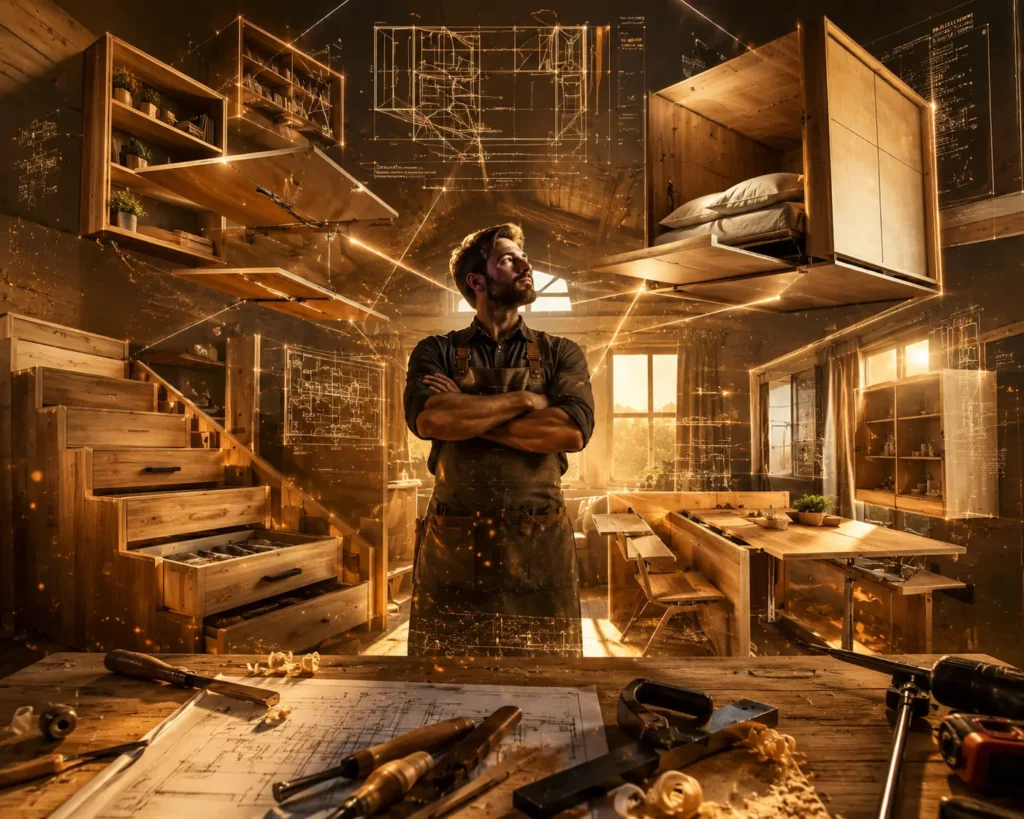
A wall-mounted bookshelf ladder takes advantage of vertical real estate while adding character and architectural interest to a room.
Instead of treating storage as something that must be hidden, this project turns storage into part of the design itself.
Books.
Plants.
Decor.
Office supplies.
Kitchen overflow.
Everything gains a dedicated home.
Why Vertical Storage Feels So Powerful
There’s a psychological effect at work here.
When the eye travels upward, rooms often feel larger.
Taller.
More open.
That’s one reason designers frequently use floor-to-ceiling shelving in compact spaces.
They’re not simply adding storage.
They’re shaping perception.
Best Materials for Bookshelf Ladder Projects
- White oak
- Maple
- Birch plywood
- Powder-coated steel supports
Done well, this project feels less like furniture and more like architecture.
Project #15: The Hidden Storage Ottoman That Quietly Solves Clutter
Some furniture earns attention.
Others earn appreciation.
The hidden storage ottoman belongs firmly in the second category.
It’s rarely the centerpiece of a room.
It doesn’t command attention.
Yet over time, it becomes one of the most useful pieces you own.
That’s because it solves multiple problems at once.
A place to sit.
A place to rest your feet.
A place to hide everyday clutter.
And in a tiny home, those small victories matter.
Because clutter rarely appears all at once.
It accumulates gradually.
One item here.
Another there.
Until surfaces begin disappearing beneath things that have nowhere else to go.
A storage ottoman interrupts that cycle.
Ideal Uses
- Blankets
- Electronics
- Board games
- Books
- Pet supplies
- Seasonal accessories
Tiny-home living often comes down to finding better places for everyday things.
This project does exactly that.
Project #16: The Fold-Out Craft Station That Protects Your Creative Life
One of the most overlooked challenges of living small has nothing to do with storage.
It’s identity.
People move into tiny homes and discover there’s less room for the activities they love.
Painting.
Sewing.
Model building.
Journaling.
Photography.
Creative work slowly becomes inconvenient.
And inconvenient hobbies tend to disappear.
A fold-out craft station prevents that from happening.
Rather than dedicating an entire room to creativity, it creates an expandable workspace that appears when needed and disappears when it’s not.
The room stays flexible.
Your hobbies stay alive.
Smart Features to Include
- Pegboard tool organization
- Fold-down work surfaces
- Integrated lighting
- Supply drawers
- Charging outlets
- Magnetic storage strips
The goal isn’t simply creating workspace.
It’s removing friction between inspiration and action.
Project #17: The Multi-Purpose Media Console That Replaces Three Pieces of Furniture
Many media consoles were designed for houses with abundant space.
Tiny homes require a different approach.
Every furniture decision carries consequences.
A bulky entertainment center might consume valuable storage opportunities.
A separate desk may occupy space that could serve multiple purposes.
This is where a custom-built media console excels.
Done correctly, it becomes an integrated system rather than a standalone object.
Functions It Can Combine
- Television stand
- Storage cabinet
- Workspace
- Display shelving
- Charging station
- Device management center
Instead of filling a room with separate furniture pieces, you’re consolidating functionality into a single footprint.
That’s one of the defining principles behind successful tiny-home design.
Fewer objects.
More capability.
Choosing the Best Wood for Tiny-Home Furniture
Not all materials perform equally in small-space environments.
The right choice depends on weight, durability, aesthetics, and budget.
Because tiny-home furniture works harder than traditional furniture, material selection deserves careful attention.
Baltic Birch Plywood
Widely considered the gold standard for custom cabinetry and built-ins.
Why builders love it:
- Exceptional strength
- Stable construction
- Attractive exposed edges
- Excellent screw-holding ability
- Relatively lightweight
For storage systems, platform beds, and custom furniture, few materials offer a better balance of performance and value.
Maple
Maple delivers durability without excessive visual heaviness.
It’s often used for:
- Tabletops
- Benches
- Shelving
- Workstations
- Drawer fronts
Its clean grain pattern works equally well in modern and traditional interiors.
White Oak
White oak remains a favorite among furniture makers for good reason.
It offers:
- Excellent durability
- Moisture resistance
- Timeless appearance
- Long-term structural reliability
If you’re building furniture intended to last decades, white oak deserves serious consideration.
Pine
For beginners, pine remains one of the most approachable materials available.
It’s:
- Affordable
- Easy to machine
- Widely available
- Forgiving during assembly
While it may dent more easily than hardwoods, it’s an excellent material for learning and experimentation.
Essential Woodworking Tools for Tiny-Home Furniture Projects
One of the biggest misconceptions surrounding custom furniture building is that it requires a professional workshop.
In reality, many high-impact projects can be completed with a relatively modest tool collection.
Beginner Tool Kit
Start with:
- Circular saw
- Cordless drill
- Impact driver
- Orbital sander
- Measuring tape
- Combination square
- Clamps
- Pocket-hole jig
These tools alone can handle a surprising number of furniture builds.
Intermediate Workshop Upgrades
As projects become more advanced, consider adding:
- Table saw
- Router
- Miter saw
- Track saw
- Brad nailer
These tools improve accuracy, efficiency, and overall finish quality.
Professional-Level Equipment
For serious furniture builders:
- Cabinet saw
- Drill press
- Domino joiner
- CNC router
- Dust collection system
They’re not essential, but they can dramatically improve workflow and consistency.
Questions Tiny-Home Owners Commonly Ask
What’s the single best furniture project for saving space?
For most people, a storage bed platform or Murphy bed delivers the largest immediate impact.
Both projects reclaim valuable square footage while solving storage challenges at the same time.
Is expensive hardwood necessary?
Not at all.
Many outstanding furniture projects use cabinet-grade plywood, pine, or mixed-material construction.
Good design often matters more than premium materials.
Can beginners realistically build these projects?
Absolutely.
Many projects—including storage benches, floating shelves, platform beds, and fold-down tables—are beginner-friendly with patience and careful planning.
The key is starting simple and building confidence over time.
How much money can DIY furniture save?
Custom tiny-home furniture often carries a significant markup.
Building your own pieces can substantially reduce costs while giving you complete control over dimensions, materials, and functionality.
Why do some tiny homes feel spacious while others feel cramped?
Because square footage tells only part of the story.
Storage design, furniture layout, lighting, visual clutter, and multifunctionality all influence how a space feels.
Smart furniture expands possibility.
Poor furniture creates limitations.
Products / Tools / Resources
If you’re serious about building DIY woodworking furniture for a tiny home, these are the resources and tools worth keeping on your radar.
Recommended Materials
- Baltic birch plywood
- Cabinet-grade plywood
- White oak
- Maple
- Pine
- Furniture-grade hardwood panels
Essential Hardware
- Soft-close drawer slides
- Full-extension runners
- Concealed hinges
- Murphy bed hardware kits
- Folding table brackets
- Locking casters
- Adjustable furniture feet
- Heavy-duty shelf supports
Must-Have Woodworking Tools
- Circular saw
- Cordless drill
- Impact driver
- Orbital sander
- Pocket-hole jig
- Miter saw
- Router
- Track saw
- Quality clamps
- Moisture meter
Helpful Organization Products
- Drawer dividers
- Pull-out pantry systems
- Cable-management kits
- Label makers
- Storage baskets
- Magnetic tool holders
Learning Resources
- Furniture design sketchbooks
- Woodworking project plan libraries
- Tiny-home layout software
- Material calculators
- Workshop safety guides
- 3D furniture modeling tools
Great Next Projects
Once you’ve completed the furniture builds in this guide, consider tackling:
- Built-in wardrobes
- Window-seat storage benches
- Sliding storage walls
- Custom kitchen cabinetry
- Loft organization systems
- Fold-away guest beds
- Integrated home-office furniture
- Modular wall-storage networks