
There comes a point in every woodworker’s journey when the workbench stops being “just another piece of shop furniture.”
It becomes the center of everything.
Every board you flatten. Every dovetail you cut. Every cabinet you assemble. Every project that begins as a rough stack of lumber eventually finds its way onto that one surface. Long before the finish goes on, before the hardware is installed, before a piece is ready to leave the shop, it spends hours resting on your bench.
That’s why choosing the right one matters so much.
Ironically, it’s also one of the purchases people rush through the fastest.
Many buyers compare dimensions, glance at a few photos, scan a list of features, and assume they’re looking at similar products with different price tags. On paper, they often do seem alike. Most have thick wooden tops, sturdy-looking legs, a vise or two, and promises of professional quality.
But spend a weekend building on each one, and the differences become impossible to ignore.
One stays rock solid while you’re planing a hardwood board. Another creeps across the floor with every stroke.
One keeps your workpiece locked exactly where you need it. Another constantly demands adjustment, stealing both time and patience.
One quietly disappears beneath your work, allowing you to focus entirely on craftsmanship. The other never lets you forget its shortcomings.
Those differences rarely show up in marketing photos.
They reveal themselves only after months—or years—of use.
That’s why this guide exists.
Rather than telling you which bench to buy, it’s designed to teach you how professionals evaluate a woodworking bench before spending a single dollar. Once you understand what truly matters, glossy advertisements lose much of their influence. You’ll begin seeing benches through the eyes of experienced furniture makers, cabinet builders, and lifelong craftsmen who depend on absolute reliability every day.
Whether you’re upgrading from your first bench or investing in what you hope will be your last, the goal is the same: make a decision you’ll still appreciate years from now, when today’s excitement has faded but your bench remains the foundation of every project.
Quick Answer
A professional woodworking bench should provide exceptional stability, a flat and durable hardwood work surface, dependable workholding, quality vises, substantial weight, and a design that supports both your current projects and the skills you’ll develop over time. The best bench isn’t necessarily the largest or the most expensive—it’s the one that allows you to work with greater accuracy, confidence, and efficiency every time you step into the shop.
Table of Contents
- Why Your Workbench Deserves More Attention Than Any Other Tool
- Why the Right Workbench Changes Everything
- Why This Guide Is About More Than Buying a Bench
- Why Stability, Weight, and Workholding Matter More Than Price
- The One Tool That Makes Every Other Tool Better
- Stability Is the Secret Ingredient Behind Precision
- Why Weight Matters More Than Most People Realize
- Accuracy Begins Long Before the First Cut
- A Professional Bench Is Really a Workholding System
- Matching a Bench to Different Styles of Woodworking
- Comfort Is More Important Than You Think
- Why Cheap Can Become Surprisingly Expensive
- Buy for the Woodworker You’re Becoming
- The Costly Buying Mistakes That Catch Even Experienced Woodworkers
- Falling in Love With the Photo Instead of the Bench
- Thinking “Professional” Is a Meaningful Specification
- Buying the Largest Bench You Can Afford
- Underestimating the Importance of Weight
- Ignoring the Workholding System
- Forgetting That Comfort Affects Craftsmanship
- Buying for Today’s Projects Instead of Tomorrow’s
- Overlooking the Workshop Around the Bench
- Assuming Every Hardwood Performs the Same
- Looking Only at the Top
- Believing Accessories Can Fix a Weak Bench
- Forgetting That a Workbench Is Meant to Age
- Looking Beneath the Surface: Every Part of a Professional Workbench Explained
- The Work Surface: Where Every Project Begins
- Choosing the Right Hardwood
- Why Laminated Tops Often Outperform Solid Slabs
- Why Top Thickness Matters
- The Base: The Foundation of Stability
- Heavy Legs and Strong Stretchers
- Joinery That Stands the Test of Time
- Why Bench Weight Changes the Entire Experience
- Understanding Face, Tail, Leg, and Twin-Screw Vises
- Bench Dogs and Dog Holes Explained
- Why Storage Is Secondary to Stability
- Viewing the Bench as a Complete System
- Choosing the Right Bench for Your Workshop, Your Projects, and Your Future
- Match the Bench to the Way You Work
- Furniture Makers vs. Cabinet Makers vs. Hand-Tool Woodworkers
- Why Hybrid Woodworkers Need Versatility
- Buy for the Skills You’ll Have Tomorrow
- Planning Your Workshop Around the Bench
- Evaluating Build Quality Like an Experienced Craftsman
- Checking Rigidity, Flatness, Vises, and Hardware
- Thinking in Terms of Long-Term Ownership
- Living With Your Bench: Maintenance, Longevity, and Frequently Asked Questions
- Why Great Workbenches Improve With Age
- Accepting Honest Wear and Tear
- Cleaning and Caring for the Work Surface
- Maintaining Flatness
- Protecting Against Moisture
- Caring for Vises and Hardware
- Repairing Instead of Replacing
- Useful Accessories That Expand Your Bench
- Frequently Asked Questions
- Bonus: The Professional Workbench Buying Checklist + Products / Tools / Resources
Why the Right Workbench Changes Everything
Ask a dozen experienced woodworkers which tool has had the greatest impact on their craftsmanship, and you might expect to hear names like a cabinet saw, a premium hand plane, or a precision router.
Surprisingly often, the answer is much simpler.
“The bench.”
That answer catches many beginners off guard.
After all, a workbench doesn’t cut wood. It doesn’t shape joinery or sand a tabletop smooth. It has no motor, no blade, and no electronic display.
Yet it influences every one of those tasks.
A stable bench gives you control before the tool ever touches the wood. It keeps a board from shifting under the pressure of a hand plane. It prevents vibration while you’re chopping a mortise. It holds a cabinet square during assembly and turns delicate fitting work into something that feels calm instead of frustrating.
It’s easy to underestimate something so ordinary.
Until you’ve worked on one that isn’t.
Anyone who has tried cutting precise joinery on a lightweight, wobbling bench knows the feeling. You compensate without realizing it. You tighten your grip, slow your movements, adjust your body position, and fight the bench instead of focusing on the work itself.
Over time, those small compromises become habits.
The opposite is equally true.
A well-built professional woodworking bench almost disappears beneath your hands. It doesn’t demand attention because it simply does its job. Every clamp holds securely. Every mallet strike feels solid. Every measurement begins from a dependable reference surface.
That’s when woodworking becomes noticeably more enjoyable.
Not because the projects suddenly become easier—but because the obstacles quietly disappear.
This Guide Is About More Than Buying a Bench
The words professional woodworking bench buying guide suggest a simple shopping article.
This isn’t one.
Think of it as a roadmap for understanding why certain benches earn the trust of skilled craftsmen while others end up collecting dust in the corner of a garage.
We’ll explore what separates genuine quality from clever marketing, why some features matter far more than others, and how to evaluate a bench based on the kind of work you actually enjoy doing—not the work someone else assumes you’ll do.
Along the way, you’ll learn how bench design affects accuracy, comfort, workflow, durability, and even the way your woodworking skills develop over time.
By the time you reach the end, you’ll no longer be asking, “Which workbench is the best?”
You’ll be asking a much better question:
“Which professional woodworking bench is built for the way I work—and the woodworker I want to become?”
Part 2: Why Your Workbench Deserves More Attention Than Any Other Tool
Every workshop has a focal point.
It isn’t always the biggest machine. It isn’t necessarily the newest tool. More often than not, it’s the place where everything comes together—the workbench.
Watch an experienced woodworker for an afternoon and you’ll notice a pattern. Boards are measured there. Joinery is laid out there. Parts are dry-fitted, glued, sanded, inspected, and adjusted there. Even projects that spend time on the table saw or drill press almost always return to the bench.
That’s because the workbench isn’t just another workstation.
It’s the foundation beneath every operation.
When that foundation is solid, the rest of the process feels smoother. When it isn’t, every task becomes just a little harder than it should be.
The One Tool That Makes Every Other Tool Better
It’s easy to get excited about buying new equipment.
A premium hand plane promises whisper-thin shavings.
A powerful table saw offers cleaner cuts.
A new router opens the door to more complex joinery.
Those upgrades are exciting because they’re easy to see.
A workbench is different.
Its value is quieter.
You don’t notice it because it performs one dramatic task. You notice it because it quietly improves every task that follows.
Think about the difference between writing on a sturdy desk and trying to write on a folding card table.
The pen hasn’t changed.
Your handwriting hasn’t changed.
Only the surface beneath your hands has.
Woodworking works much the same way.
Stability Is the Secret Ingredient Behind Precision
When people compare professional woodworking benches, they often focus on obvious features.
How thick is the top?
How many drawers does it have?
What species of hardwood is used?
How many vises are included?
Those details certainly matter.
But underneath them all is one characteristic that affects everything else:
Stability.
A stable bench doesn’t fight you.
It stays exactly where you expect it to be.
When you’re pushing a hand plane across a long maple board, the energy goes into cutting wood—not into making the bench slide across the floor.
When you’re chopping a mortise with a mallet, the force drives the chisel where you want it instead of disappearing into unwanted movement.
The less your bench moves, the more control you gain.
That simple principle explains why experienced woodworkers often choose heavier benches, even when lighter models are easier to transport.
Why Weight Matters More Than Most People Realize
Walk up to a true professional workbench and one thing becomes obvious almost immediately.
It’s heavy.
Not because manufacturers want impressive numbers on a specification sheet.
Because mass works in your favor.
Every woodworking operation creates force.
Planing pushes forward.
Sawing pulls back.
Chiseling sends repeated impacts through the structure.
Clamping creates tremendous pressure.
A lightweight bench reacts to those forces.
A heavy bench absorbs them.
That’s why substantial weight contributes to:
- smoother hand planing
- cleaner joinery
- better vibration control
- improved safety
- greater confidence during precision work
Weight alone doesn’t guarantee quality, but it’s rare to find a truly professional bench that’s unusually light.
Accuracy Begins Long Before the First Cut
Most woodworking mistakes don’t start with the saw.
They start before the tool is even picked up.
Imagine trying to mark a perfectly square line while the workpiece shifts beneath your hand.
Or attempting to glue up a cabinet on a surface that’s slightly twisted.
Tiny inaccuracies introduced early in a project have a habit of multiplying.
A bench with a reliably flat surface becomes more than a place to work.
It becomes a trusted reference.
Measurements stay consistent.
Assemblies remain square.
Panels align more naturally.
That kind of reliability builds confidence, especially during complex projects where small errors can become expensive.
A Professional Bench Is Really a Workholding System
Many beginners think of a workbench as little more than a heavy table.
Experienced woodworkers see something entirely different.
They see a complete workholding system.
The combination of vises, dog holes, holdfasts, and bench accessories transforms an ordinary surface into a versatile platform capable of securing almost any workpiece.
Whether you’re edge-planing a board, carving delicate details, sanding a tabletop, or fitting drawer fronts, effective workholding allows both hands to focus on the task instead of constantly trying to keep the material from moving.
That alone can dramatically improve both accuracy and safety.
Every Woodworking Discipline Asks Something Different From a Bench
One reason there’s no universal “best” woodworking bench is that woodworking itself isn’t a single activity.
A furniture maker has different priorities than a cabinet installer.
A hand-tool enthusiast works differently from someone who relies primarily on power tools.
Consider just a few examples.
Furniture Builders
They often need:
- exceptional flatness
- maximum rigidity
- precise workholding
- dependable vises
Fine joinery leaves little room for movement.
Cabinet Makers
Large panels and repeated assemblies make generous workspace especially valuable.
Efficient clamping and reliable support become essential.
Hand-Tool Woodworkers
Hand planing, chiseling, and sawing transfer significant force into the bench.
Weight and rigidity become critical.
Hybrid Woodworkers
Those who combine machines with hand tools benefit from versatility above all else.
Their bench needs to adapt to many different tasks throughout a single project.
Comfort Is More Important Than You Think
People often judge a workbench by its dimensions.
Professionals also judge how it feels after several hours of work.
A bench that’s too low encourages constant bending.
Too high, and you’ll lose leverage while planing or find delicate handwork awkward.
Good ergonomics don’t simply reduce discomfort.
They help preserve concentration.
When your back isn’t aching and your shoulders aren’t constantly compensating, you can devote your attention to grain direction, fit, and finish instead of physical fatigue.
That subtle difference becomes surprisingly important during longer sessions in the shop.
Cheap Can Become Surprisingly Expensive
There’s nothing wrong with shopping carefully.
Every woodworker has a budget.
The mistake is assuming that saving money today automatically saves money in the long run.
Many inexpensive benches eventually require:
- stronger vises
- additional bracing
- replacement hardware
- extra weight
- surface flattening
- structural repairs
Some owners spend years trying to improve a bench that never quite performs the way they hoped.
Others replace it entirely.
Viewed over twenty years of woodworking, buying well the first time is often the less expensive decision.
Buy for the Woodworker You’re Becoming
One of the most common regrets isn’t buying a bench that’s too expensive.
It’s buying one that’s too limiting.
Perhaps today you’re building cutting boards, small shelves, or simple boxes.
Five years from now, you may find yourself tackling dining tables, custom cabinetry, heirloom furniture, or intricate hand-cut joinery.
Your skills will evolve.
Your ambitions almost certainly will too.
A bench should have enough capability to grow alongside you.
That’s one of the defining characteristics of a true professional woodworking bench—it continues meeting your needs long after your projects have become more ambitious than you ever imagined when you first walked into the workshop.
Part 3: The Costly Buying Mistakes That Catch Even Experienced Woodworkers
Buying a professional woodworking bench should feel exciting.
Instead, it often becomes surprisingly confusing.
Browse enough manufacturers’ websites and you’ll notice a pattern. Nearly every bench claims to be professional grade. Almost all promise outstanding durability, superior craftsmanship, and rock-solid stability. Product photos showcase flawless hardwood tops glowing under perfect lighting, surrounded by carefully arranged hand tools that suggest generations of craftsmanship.
It all looks convincing.
Until you begin comparing benches that have actually been used for years.
That’s when the marketing fades into the background, and the details that truly matter begin to stand out.
Most buying mistakes don’t happen because people ignore quality.
They happen because they judge quality by the wrong things.
Mistake #1: Falling in Love With the Photo Instead of the Bench
A beautifully photographed workbench can be incredibly persuasive.
Rich maple grain.
Perfectly machined edges.
Polished hardware.
An immaculate workshop.
It’s easy to imagine that owning the bench will somehow make your own shop feel the same.
But woodworking benches aren’t display furniture.
They’re working tools.
Their real personality only appears after months of planing, clamping, chiseling, sanding, assembling, and finishing.
Before being impressed by appearance, ask questions that photographs can’t answer.
Does it rack under pressure?
Does the top stay flat?
Do the vises still operate smoothly after years of use?
Is the frame engineered to resist movement?
Those answers matter far more than beautiful lighting and carefully staged product images.
Mistake #2: Thinking “Professional” Is a Meaningful Specification
The word professional appears everywhere.
Professional quality.
Professional construction.
Professional performance.
The reality is that the word itself tells you almost nothing.
Instead of relying on labels, look for measurable characteristics such as:
- overall weight
- top thickness
- hardwood species
- joinery methods
- vise construction
- weight capacity
- warranty
- replacement part availability
Specific information almost always reveals more than impressive-sounding marketing language.
Mistake #3: Buying the Largest Bench You Can Afford
Many buyers assume bigger automatically means better.
Sometimes that’s true.
Often it isn’t.
A massive workbench can become frustrating if it dominates a small workshop, blocks walkways, or limits how you move around your tools.
Conversely, choosing a bench that’s too small creates its own problems.
Large glue-ups become awkward.
Long boards lack support.
Cabinet assemblies feel cramped.
Instead of asking,
“What’s the biggest bench available?”
Ask,
“What’s the right size for my workshop and the projects I actually build?”
The answer is rarely the same for everyone.
Mistake #4: Underestimating the Importance of Weight
Weight rarely receives the attention it deserves.
Yet it’s one of the easiest ways to separate a serious woodworking bench from one built primarily to meet a lower price point.
Every woodworking operation transfers energy into the bench.
If the bench is too light, it responds by moving.
If it’s properly engineered and sufficiently heavy, it absorbs that force instead.
The difference becomes obvious during tasks like:
- hand planing
- chopping mortises
- edge jointing
- aggressive sanding
- heavy clamping
A stable bench allows you to work with confidence instead of constantly compensating for unwanted movement.
Mistake #5: Ignoring the Workholding System
Many first-time buyers pay close attention to the tabletop while barely considering the vises.
That’s like buying a drill press without checking whether the chuck works properly.
A professional woodworking bench depends on effective workholding.
Without it, even the flattest surface quickly becomes frustrating.
Good vises should provide:
- smooth operation
- consistent clamping pressure
- minimal racking
- easy adjustment
- long-term reliability
Combined with well-positioned dog holes and quality bench dogs, they transform the bench from a heavy table into a precision workstation.
Mistake #6: Forgetting That Comfort Affects Craftsmanship
Woodworking isn’t measured in minutes.
Many projects involve hours—or entire weekends—spent standing at the bench.
If the height is wrong, your body notices long before your mind does.
Too low, and you’ll spend the day bending over.
Too high, and tasks requiring downward pressure become awkward and tiring.
Proper ergonomics contribute to:
- better posture
- greater leverage
- reduced fatigue
- improved control
- more enjoyable work sessions
A comfortable woodworker usually becomes a more accurate woodworker.
Mistake #7: Buying for Today’s Projects Instead of Tomorrow’s
This mistake is almost invisible at first.
You buy a bench that perfectly suits your current needs.
At the time, you’re building:
- cutting boards
- birdhouses
- shelves
- small boxes
Two years later, you’re fascinated by:
- dining tables
- custom cabinets
- hardwood doors
- built-in furniture
- traditional joinery
Suddenly, the bench that once seemed generous now feels restrictive.
Woodworking has a way of expanding your ambitions.
Choosing a bench with room to grow is often one of the smartest investments you can make.
Mistake #8: Overlooking the Workshop Around the Bench
A workbench doesn’t exist in isolation.
It becomes the center of an entire workflow.
Before buying, imagine moving through an actual project.
Can you comfortably walk around all four sides?
Can you handle long boards without hitting a wall?
Will the vise open fully?
Is there enough room to assemble a cabinet without constantly moving clamps and tools?
A well-planned workshop feels surprisingly spacious.
A poorly planned one feels crowded no matter how large it is.
Mistake #9: Assuming Every Hardwood Performs the Same
At first glance, hardwood is simply hardwood.
In reality, different species behave differently over decades of use.
Hard maple is prized for its durability and wear resistance.
European beech has earned generations of trust for its stability and workability.
White oak offers exceptional strength.
Birch provides an excellent balance between performance and affordability.
Quality laminated hardwood reduces seasonal movement while maintaining excellent rigidity.
Understanding these differences allows you to choose a bench that fits both your environment and the type of woodworking you enjoy most.
Mistake #10: Looking Only at the Top
The top naturally attracts attention.
It’s the most visible part of the bench.
Ironically, some of the most important engineering is hidden underneath.
Pay close attention to:
- leg construction
- stretcher design
- frame rigidity
- joinery methods
- reinforcement
- hardware attachment
Two benches may appear nearly identical from above while performing completely differently under real working conditions.
The strength of the base ultimately determines how effectively the entire structure handles force.
Mistake #11: Believing Accessories Can Fix a Weak Bench
It’s tempting to think that a few upgrades will transform an average bench into an exceptional one.
Additional storage.
Better clamps.
Aftermarket vises.
Bench accessories.
While these additions can certainly improve functionality, they cannot compensate for poor fundamentals.
No accessory can eliminate:
- structural flex
- inadequate weight
- poor joinery
- unstable legs
- inferior engineering
Start with a strong foundation.
Accessories should enhance a good bench—not rescue a weak one.
Mistake #12: Forgetting That a Workbench Is Meant to Age
Many buyers treat a new workbench almost like fine furniture.
They worry about the first dent.
The first glue stain.
The first accidental saw mark.
Experienced woodworkers tend to smile when that happens.
Those marks aren’t flaws.
They’re evidence that the bench is fulfilling its purpose.
A professional woodworking bench isn’t meant to remain pristine.
It’s meant to remain dependable.
Long after the finish has faded and the corners have softened from years of use, a truly well-built bench continues doing exactly what it was designed to do: provide a stable, trustworthy foundation for better woodworking.
In the next part, we’ll move beyond buying mistakes and take a close look at the anatomy of a professional woodworking bench, examining every major component—from the hardwood top and base to the vises, dog holes, hardware, and joinery—to understand what truly separates an ordinary bench from one built for a lifetime of craftsmanship.
Part 4: Looking Beneath the Surface: Every Part of a Professional Workbench Explained
From a distance, most woodworking benches appear remarkably alike.
A thick wooden top.
Four sturdy legs.
One or two vises.
Perhaps a shelf or a few drawers underneath.
At first glance, it doesn’t seem like there’s much to compare.
Look closer.
Really closer.
The details hiding beneath the surface are what separate a bench that becomes the centerpiece of a workshop from one that slowly becomes a source of irritation. Every component plays a role. Remove enough small advantages, and even an expensive bench begins to feel ordinary. Get those details right, however, and the entire experience of woodworking changes in subtle but meaningful ways.
The best professional woodworking benches aren’t exceptional because of one standout feature.
They’re exceptional because every part works together.
The Work Surface: Where Every Project Begins
If the workbench has a soul, it’s the top.
Every board you measure.
Every joint you fit.
Every cabinet you assemble.
Every finish you inspect under good lighting.
It all happens here.
That makes the work surface far more than a slab of wood. It’s your reference point. Your assembly table. Your measuring station. Your finishing platform.
A quality top should deliver four things consistently:
- Lasting flatness
- Structural rigidity
- Resistance to wear
- Easy maintenance
Perfection isn’t the goal.
In fact, a perfectly untouched workbench usually means it hasn’t seen much woodworking.
Small dents, glue stains, pencil marks, and shallow saw cuts are part of the story. They’re reminders that the bench has done exactly what it was built to do.
Choosing the Right Hardwood
Not all hardwoods behave the same over years of use.
Some resist dents exceptionally well. Others remain stable through changing seasons. Some are easier to flatten when maintenance eventually becomes necessary.
Understanding the differences helps you look beyond simple marketing descriptions.
Hard Maple
Hard maple has earned its reputation honestly.
It’s dense without being brittle, durable without becoming difficult to maintain, and capable of standing up to decades of heavy shop use.
Its strengths include:
- excellent wear resistance
- smooth working surface
- impressive durability
- dependable long-term stability
It’s one of the reasons many premium benches continue performing well after thousands of hours of use.
European Beech
For generations, European cabinetmakers have trusted beech for one simple reason.
It works.
Beech offers an excellent combination of hardness, stability, and predictable movement, making it one of the most respected materials for traditional woodworking benches.
It also resurfaces beautifully when the top eventually needs refreshing.
White Oak
White oak brings tremendous strength to a workbench.
Its dense structure provides:
- outstanding rigidity
- excellent moisture resistance
- exceptional durability
- remarkable longevity
The added weight is rarely viewed as a disadvantage. Quite the opposite.
It often becomes one of the bench’s greatest strengths.
Birch
Birch often receives less attention than maple or beech, but it deserves consideration.
Quality laminated birch provides:
- dependable performance
- consistent grain
- good hardness
- attractive appearance
- excellent value
For many workshops, it strikes an appealing balance between cost and capability.
Rubberwood
Rubberwood has become increasingly common in modern workbench construction.
When properly manufactured, it offers:
- sustainable sourcing
- stable performance
- affordable pricing
- attractive appearance
Although generally softer than maple or beech, it remains a practical option for many serious hobbyists.
Why Laminated Tops Often Outperform Solid Slabs
Many first-time buyers assume that a single massive slab of hardwood must be superior.
It’s an understandable assumption.
It’s also often incorrect.
Most professional woodworking benches use laminated tops made from multiple hardwood strips bonded together under significant pressure.
The benefits are substantial.
Laminated construction helps reduce:
- seasonal movement
- twisting
- warping
- internal stress
The result is a work surface that remains flatter and more predictable over many years.
Sometimes the strongest solution isn’t the simplest-looking one.
Thickness Matters—But Only as Part of the Bigger Picture
A thicker top generally provides greater rigidity.
That’s valuable.
But thickness alone isn’t enough.
A thick top sitting on a weak base won’t perform like a thinner top supported by excellent engineering.
When evaluating a bench, think of thickness as one contributor to overall performance rather than the defining feature.
Still, additional mass in the work surface does offer clear advantages:
- reduced vibration
- greater stiffness
- improved planing performance
- better support for heavy workpieces
Combined with a rigid frame, it creates the solid feel professionals appreciate immediately.
The Base: Quietly Carrying the Entire Workload
The top attracts attention.
The base earns trust.
Every force generated during woodworking eventually travels downward into the frame.
If the base flexes, the entire bench feels unstable.
If it remains rigid, everything above it benefits.
A professional base should resist:
- twisting
- racking
- vibration
- lateral movement
- long-term fatigue
It’s easy to overlook these qualities in a showroom.
They’re impossible to ignore after years of daily use.
Heavy Legs Create Quiet Confidence
Oversized legs aren’t simply decorative.
They perform real structural work.
Large legs:
- distribute force efficiently
- improve rigidity
- support greater loads
- reduce movement during demanding operations
The result isn’t just better engineering.
It’s a different feeling while working.
Everything becomes calmer.
More controlled.
More predictable.
Stretchers: The Structural Heroes Nobody Talks About
Stretchers connect the legs into one unified structure.
Without them, the frame would struggle to resist side-to-side forces generated during planing, chiseling, or heavy clamping.
Strong stretchers help:
- maintain alignment
- increase rigidity
- distribute weight evenly
- prevent long-term loosening
They rarely appear in marketing headlines.
They absolutely deserve your attention.
Joinery: Where Craftsmanship Reveals Itself
Look closely at how the bench is assembled.
Good joinery tells an important story.
Professional woodworking benches rely on construction methods designed to remain solid through years of repeated stress.
Quality joinery improves:
- structural integrity
- durability
- resistance to loosening
- long-term stability
It’s one of those details you may never consciously notice—until it’s missing.
Why Bench Weight Changes the Entire Experience
Weight deserves another mention because its influence extends throughout the entire bench.
Every push of a hand plane.
Every strike of a mallet.
Every clamp tightened across a panel.
Every sanding session.
All of that energy has to go somewhere.
A lightweight bench reacts.
A heavy bench absorbs.
That’s why increased mass contributes to:
- smoother hand-tool work
- cleaner cuts
- reduced vibration
- greater safety
- improved precision
It’s one of the few specifications that consistently affects almost every woodworking operation.
Vises: The Hands That Never Get Tired
Without effective workholding, even the finest workbench quickly loses its value.
Vises aren’t optional conveniences.
They’re essential working components.
Different styles serve different purposes, and understanding them helps you choose a bench that matches your workflow.
Face Vise
Mounted along the front edge, the face vise handles many everyday woodworking tasks.
Ideal for:
- edge planing
- sawing
- chiseling
- carving
- sanding
For many woodworkers, it’s the most frequently used vise on the bench.
Tail Vise
Installed at the end of the bench, the tail vise works alongside bench dogs to secure boards flat against the surface.
It’s especially useful for:
- surface planing
- flattening panels
- repetitive hand-tool work
Leg Vise
Traditional doesn’t mean outdated.
Leg vises remain popular because they provide:
- exceptional clamping force
- impressive capacity
- simple mechanics
- long-term durability
Many hand-tool specialists still consider them difficult to beat.
Twin-Screw Vise
Wide workpieces require balanced support.
Twin-screw vises excel when working with:
- cabinet doors
- wide panels
- table aprons
- large assemblies
Their ability to clamp broad material evenly makes them particularly useful for furniture builders.
Bench Dogs and Dog Holes: Small Features, Huge Versatility
At first glance, dog holes appear almost insignificant.
They’re anything but.
Combined with bench dogs, holdfasts, and vises, they transform the entire work surface into a flexible workholding system.
They allow you to secure workpieces for:
- hand planing
- sanding
- routing
- carving
- assembly
- edge work
A thoughtfully designed dog hole layout greatly expands what a bench can do without adding unnecessary complexity.
Storage Is Useful—But Never the Main Attraction
Drawers.
Shelves.
Cabinets.
Tool trays.
They’re all helpful.
A tidy workshop is certainly a more enjoyable place to work.
But storage should always remain secondary to structural performance.
If adding drawers compromises rigidity, the trade-off isn’t worth making.
Professional woodworkers consistently prioritize:
- Stability
- Accuracy
- Durability
Storage comes after those essentials have already been satisfied.
Every Great Workbench Functions as a Complete System
One specification never tells the whole story.
Not the hardwood.
Not the weight.
Not the vises.
Not the thickness.
The finest professional woodworking benches succeed because every element complements the others.
A rigid base supports a stable top.
Quality joinery strengthens the frame.
Reliable vises work seamlessly with well-positioned dog holes.
The entire structure behaves as one unified tool.
That’s the difference between a bench that simply looks impressive and one that quietly earns your trust every time you step into the workshop.
Part 5: Choosing the Right Bench for Your Workshop, Your Projects, and Your Future
By now, one thing should be clear.
There is no such thing as the perfect woodworking bench.
There is only the perfect bench for the way you work.
That’s an important distinction.
A bench designed for a professional furniture maker may be excessive for someone who primarily builds small household projects. Likewise, a compact bench that feels ideal in a one-car garage may become a constant limitation if your passion eventually turns toward custom cabinetry or heirloom dining tables.
The smartest purchase isn’t the bench with the longest feature list.
It’s the one that feels like a natural extension of your workflow from the first project to the hundredth.
Start With the Work You Actually Love Building
Before comparing dimensions or hardwood species, take a step back.
Ask yourself a much simpler question:
What do I genuinely enjoy making?
Your answer should influence nearly every buying decision that follows.
The way a woodturner works is different from a cabinet maker.
A furniture builder approaches a project differently than someone restoring antiques.
Those differences matter because they determine what your workbench needs to do every single day.
Furniture Makers Need Stability Above Everything Else
Building fine furniture demands patience.
Small inaccuracies become painfully visible when you’re fitting drawers, aligning doors, or cutting traditional joinery.
A furniture maker benefits from a bench that offers:
- exceptional rigidity
- dependable workholding
- a perfectly flat surface
- premium vises
- generous working space
When tolerances become tighter, stability becomes increasingly valuable.
Cabinet Makers Need Room to Think
Cabinet work often involves large components.
Side panels.
Face frames.
Long shelves.
Wide doors.
The bench becomes less of a work surface and more of an assembly station.
That makes features like these especially valuable:
- larger work area
- efficient clamping
- reliable support
- durable top
- organized workspace
Space isn’t simply convenient.
It allows complex assemblies to come together with less frustration.
Hand-Tool Woodworkers Ask More From a Bench
If your favorite sound in the workshop is the whisper of a hand plane instead of the hum of a machine, your expectations should be different.
Hand tools generate tremendous force.
Every stroke transfers energy into the workbench.
That’s why traditional hand-tool woodworkers often prioritize:
- maximum weight
- thick hardwood tops
- exceptional rigidity
- leg vises
- face vises
- extensive dog hole layouts
A bench that shifts during hand planing quickly becomes exhausting.
One that remains absolutely still almost disappears beneath your hands.
Hybrid Woodworkers Need Versatility
Many modern workshops combine the best of both worlds.
Machines prepare the stock.
Hand tools refine the details.
Projects move naturally between equipment and the workbench.
For this style of woodworking, flexibility becomes more important than specialization.
A hybrid bench should comfortably support:
- precision joinery
- assembly work
- sanding
- routing
- finishing
- layout
- light machine support
Versatility often becomes its greatest strength.
Don’t Buy for Today’s Skill Level
One of the easiest mistakes to make is buying a bench that perfectly suits the woodworker you are today.
The problem is that woodworking has a habit of changing people.
Projects become more ambitious.
Techniques become more refined.
Confidence grows.
A person who starts by building simple shelves often ends up fascinated by hand-cut dovetails, custom cabinets, or full dining room furniture a few years later.
The bench that once seemed enormous suddenly feels restrictive.
When possible, buy with tomorrow in mind.
Future growth is almost always easier than future replacement.
Think Beyond the Bench Itself
A woodworking bench doesn’t exist in isolation.
It becomes part of an ecosystem.
Every tool.
Every machine.
Every project.
Every movement through the shop revolves around it.
Before making a final decision, picture an ordinary day in your workshop.
Can you comfortably walk around the bench?
Can you handle long boards without constantly turning them?
Will clamps have enough room?
Can cabinet doors open fully during assembly?
Does the bench naturally fit into your workflow?
These practical questions often reveal more than another hour spent comparing specifications online.
Plan for the Largest Project You’ll Build
Many buyers measure only the footprint of the bench.
A better approach is to measure the workpiece.
Imagine building:
- an eight-foot dining table
- a tall bookcase
- a kitchen cabinet
- a hardwood entry door
- a large workbench top
Now imagine moving around those projects inside your workshop.
Clearance matters just as much as bench size.
A workshop that feels comfortable during small projects can quickly become frustrating once larger work enters the picture.
How Experienced Woodworkers Evaluate Build Quality
Once you’ve identified benches that suit your workshop, it’s time to judge how well they’re actually built.
This is where experienced craftsmen often notice details that casual buyers overlook.
Rather than asking whether a bench looks professional, they ask whether it’s engineered to remain professional after years of use.
Begin With Rigidity
Nothing influences performance more consistently than rigidity.
A truly professional woodworking bench should resist:
- rocking
- twisting
- flexing
- vibration
- lateral movement
Try to imagine heavy hand planing.
Aggressive sanding.
Mortise chopping.
Large glue-ups.
If the structure can handle those tasks without complaint, it’s probably built on the right foundation.
Study the Work Surface Carefully
A quality hardwood top tells a story before you ever begin working.
Look for:
- consistent flatness
- clean laminations
- substantial thickness
- careful machining
- durable construction
Small details often reveal the level of craftsmanship invested during manufacturing.
Don’t Ignore the Base
Many buyers spend nearly all their attention evaluating the top.
Professionals often do the opposite.
They crouch down.
They study the frame.
They inspect the legs, stretchers, and joinery.
Because they know one simple truth:
A magnificent top mounted on a weak base will never become a magnificent workbench.
Test Every Vise
If possible, operate every vise from fully open to fully closed.
Pay attention to how it feels.
A quality vise should move with confidence.
Look for:
- smooth travel
- even pressure
- minimal play
- positive locking
- accurate alignment
If the vise feels sloppy before you’ve even used it, it probably won’t improve with time.
Examine the Dog Hole Layout
Dog holes seem insignificant until you begin using them.
Their placement influences how easily you can secure different workpieces across the bench.
A thoughtful layout increases flexibility while reducing unnecessary repositioning during projects.
Simple details often produce surprisingly large improvements in everyday workflow.
Hardware Should Inspire Confidence
Hardware is easy to overlook.
It shouldn’t be.
Handles, guide rods, adjustment mechanisms, bolts, and fasteners experience constant stress over many years.
Well-made hardware feels precise.
It operates smoothly.
It gives the impression that it was built for long-term use rather than short-term convenience.
That confidence matters every time you reach for it.
Flatness Is Never Optional
Perhaps the simplest test of quality is also one of the most important.
Is the top truly flat?
A reliable reference surface affects nearly everything:
- layout work
- panel glue-ups
- cabinet assembly
- joinery
- measuring
- finishing
Tiny imperfections may not seem important on day one.
Years later, you’ll appreciate every fraction of accuracy preserved by a consistently flat work surface.
Imagine Owning the Bench Twenty Years From Now
Here’s a question that rarely appears in buying guides.
Close your eyes for a moment.
Picture yourself walking into your workshop twenty years from today.
Would this bench still be there?
Would you trust it with your most important project?
Could it be resurfaced if necessary?
Would replacement parts still make sense?
Would it continue supporting your work with the same quiet reliability?
The finest professional woodworking benches aren’t designed for a season of woodworking.
They’re designed for a lifetime.
And perhaps that’s the most valuable test of all.
Part 6: Living With Your Bench: Maintenance, Longevity, and Frequently Asked Questions
The excitement of buying a professional woodworking bench eventually fades.
That’s inevitable.
The delivery truck leaves. The packaging disappears. The smell of fresh hardwood slowly blends into the familiar scent of sawdust and cut lumber.
Then something interesting happens.
The bench simply becomes part of your life.
It waits quietly in the center of the shop, project after project, year after year. You stop thinking about it because it’s always there—steady, dependable, ready for whatever you’re building next.
In many ways, that’s the highest compliment a workbench can receive.
The best ones don’t demand attention.
They earn trust.
A Great Workbench Ages Like a Favorite Hand Plane
Some workshop tools have a limited lifespan.
Motors wear out.
Batteries lose capacity.
Electronics eventually become outdated.
A professional woodworking bench follows a different path.
With reasonable care, it doesn’t become obsolete.
It becomes familiar.
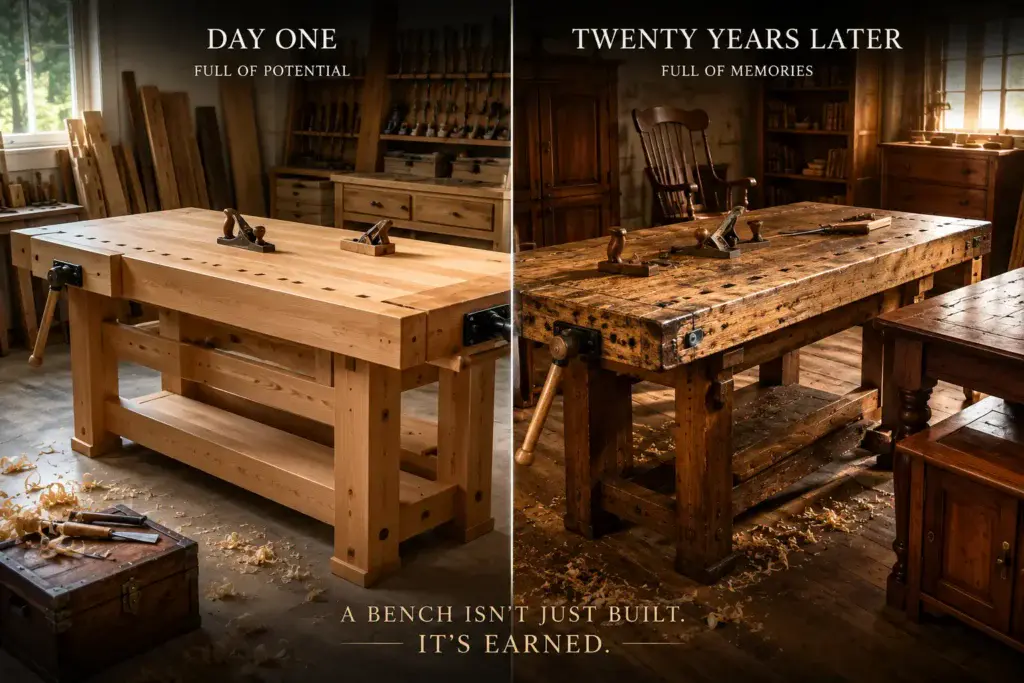
Over time, the top develops a history that no new bench can replicate.
A faint glue stain from your first dining table.
A small dent from the chisel that slipped during a cabinet build.
Tiny pencil marks that resisted every attempt to sand them away.
These aren’t imperfections.
They’re evidence of work well done.
Walk into the workshop of an experienced craftsperson, and you’ll rarely find a spotless bench. Instead, you’ll find one that looks confidently used—scarred in places, softened at the edges, yet still perfectly capable of producing precise work.
Your Bench Is Meant to Work, Not Stay Perfect
There’s a moment every new owner remembers.
The first scratch.
Maybe it’s from a clamp.
Maybe a dropped tape measure.
Maybe the corner of a freshly cut board.
For a second, it feels painful.
Then you realize something important.
The bench has done its job.
Unlike a dining table or a kitchen countertop, a woodworking bench is designed to absorb abuse so your projects don’t have to.
That shift in perspective changes everything.
Instead of worrying about preserving the bench, you begin focusing on preserving the quality of your work.
Exactly as it should be.
Keep the Surface Clean—Not Pristine
Maintenance doesn’t need to become another woodworking project.
Simple habits make an enormous difference over time.
Brush away sawdust before it accumulates.
Remove excess glue while it’s still soft.
Wipe away finishes before they harden.
Clear metal filings that could stain the wood.
Keep dog holes free of packed debris.
None of these tasks takes more than a few minutes.
Together, they help the bench remain pleasant to work on every single day.
Flatness Is Worth Protecting
The most valuable quality of a professional woodworking bench isn’t its appearance.
It’s its accuracy.
Even the finest hardwood reacts to changes in humidity over the years. Seasonal expansion and contraction are natural.
Fortunately, hardwood benches are built with maintenance in mind.
If the surface eventually develops slight irregularities, it can usually be restored through careful resurfacing.
Maintaining a flat work surface protects the accuracy of:
- layout work
- panel glue-ups
- furniture assembly
- cabinet construction
- precision joinery
- hand-planing
A few hours of maintenance every several years can preserve decades of dependable performance.
Moisture Is the Quiet Enemy
Wood is remarkably durable.
It’s also alive in one important sense—it continues responding to its environment long after the tree has been cut.
Extreme humidity swings can encourage movement.
Standing water can damage even dense hardwoods.
Simple precautions help avoid unnecessary problems:
- wipe up spills promptly
- avoid prolonged moisture exposure
- maintain reasonable workshop humidity
- allow good airflow around the bench
- avoid storing the bench in damp conditions
Consistency matters far more than perfection.
Give the Vises a Little Attention
Most people remember to maintain their machines.
Few think about the vises.
Yet they’re among the hardest-working components on the entire bench.
Occasional inspection goes a long way.
Check that:
- movement remains smooth
- guide rods stay clean
- hardware remains tight
- jaws remain aligned
- clamping pressure feels even
Small adjustments today often prevent larger repairs years from now.
Tighten Things Before They Become Problems
Woodworking naturally creates vibration.
Thousands of planing strokes.
Countless mallet blows.
Repeated clamping pressure.
Over time, fasteners may loosen slightly.
Make it a habit to inspect:
- bolts
- vise hardware
- stretchers
- shelf supports
- drawer hardware
- mounting points
Preventive maintenance almost always proves easier than corrective repairs.
One of the Greatest Advantages of Hardwood
Unlike many workshop products, a professional woodworking bench isn’t disposable.
If the top becomes worn, it can often be resurfaced.
If hardware wears out, replacement parts are usually available.
If a vise jaw becomes damaged, it can typically be rebuilt.
The bench evolves rather than expires.
That’s one reason experienced woodworkers often view a quality bench as a lifetime purchase instead of another workshop expense.
Small Accessories Can Transform the Way You Work
You don’t need dozens of accessories.
A few carefully chosen additions can dramatically increase versatility.
Many experienced woodworkers rely on:
- bench dogs
- holdfasts
- planing stops
- bench hooks
- shooting boards
- auxiliary clamping fixtures
- carving supports
These simple tools allow the same bench to adapt to hundreds of different tasks without adding unnecessary complexity.
When Is It Actually Time to Replace a Workbench?
Surprisingly, the answer is rarely.
Most professional benches don’t wear out.
They simply continue working.
Replacement usually becomes necessary only when:
- the structure has suffered severe damage
- repairs are no longer practical
- your projects have outgrown its size
- your workshop has changed dramatically
For most woodworkers, thoughtful maintenance extends the life of a quality bench far beyond the lifespan of many power tools.
Frequently Asked Questions
Do I really need a professional woodworking bench if I’m still learning?
If you see woodworking becoming a lasting hobby—or perhaps even more than a hobby—a quality bench is one of the smartest investments you can make. A stable work surface makes learning easier because you’re solving woodworking problems instead of fighting equipment problems.
How heavy should a woodworking bench actually be?
There’s no perfect number, but heavier benches generally provide greater stability. More weight helps resist movement during planing, chiseling, sanding, and assembly, allowing you to work with greater precision and confidence.
Is hard maple better than European beech?
Both have earned outstanding reputations. Hard maple offers exceptional wear resistance, while European beech is valued for its stability, workability, and long history in traditional woodworking. Either can make an outstanding workbench when combined with quality construction.
Do I need drawers built into my workbench?
Only if they support the way you work. Storage is convenient, but it should never come at the expense of rigidity or stability. A simpler bench with excellent structural performance is usually a better investment than one filled with storage but lacking strength.
Can one bench handle both hand tools and power tools?
Absolutely. Many professional woodworking benches are designed specifically for hybrid workflows, making them equally comfortable for machine-assisted projects, hand-cut joinery, assembly, routing, sanding, and finishing.
How often should I flatten the top?
That depends on how heavily the bench is used and the conditions in your workshop. Many woodworkers go years without needing significant resurfacing, while heavily used benches may benefit from occasional flattening to maintain peak accuracy.
Is building my own workbench better than buying one?
Building a workbench can be an incredibly rewarding project if you already possess the necessary skills, tools, and time. Buying a professionally built bench, however, often allows you to begin woodworking immediately while benefiting from proven engineering and precision manufacturing.
Can a good workbench really last a lifetime?
Yes.
A well-built hardwood woodworking bench that receives basic maintenance can easily remain in service for decades. In many workshops, the workbench becomes one of the few pieces of equipment that survives multiple generations of tools, projects, and even woodworkers themselves.
Part 7: Bonus – The Professional Workbench Buying Checklist
Most buying guides leave you with information.
This bonus is designed to leave you with confidence.
Whether you’re comparing two benches online, walking through a woodworking store, or evaluating a custom-built bench from a local craftsman, the checklist below gives you a practical way to separate genuine quality from clever marketing.
Professional woodworkers rarely make purchasing decisions based on excitement alone.
They evaluate.
They compare.
They ask better questions.
This checklist helps you do exactly that.
The Professional Workbench Buying Checklist
Print it. Save it. Keep it on your phone.
The next time you’re comparing benches, work through each section carefully.
Construction Quality
A professional woodworking bench should feel like a permanent fixture—not temporary shop furniture.
Look for:
- □ Solid hardwood or premium laminated hardwood top
- □ Thick, rigid work surface
- □ Heavy-duty base construction
- □ Large structural legs
- □ Strong stretchers joining the frame
- □ High-quality joinery
- □ Minimal flex under load
- □ Overall feeling of structural confidence
If the bench feels solid before you begin working, that’s an excellent sign.
Stability
Everything begins here.
Ask yourself:
- □ Does the bench resist rocking?
- □ Does it remain steady during heavy planing?
- □ Does it stay planted while chiseling?
- □ Is vibration kept to a minimum?
- □ Does it inspire confidence under pressure?
Every woodworking operation benefits from a stable foundation.
The Work Surface
Look beyond appearance.
A truly professional work surface should provide:
- □ Excellent flatness
- □ Durable hardwood construction
- □ Clean laminations
- □ Comfortable texture
- □ Sufficient thickness
- □ Easy future resurfacing
Remember:
A bench doesn’t have to remain beautiful forever.
It does need to remain accurate.
Workholding
The workpiece should stay exactly where you place it.
Evaluate:
- □ Face vise quality
- □ Tail vise performance
- □ Smooth adjustment
- □ Even clamping pressure
- □ Minimal movement
- □ Comfortable handles
- □ Secure locking
Reliable workholding reduces frustration and improves precision.
Dog Holes and Bench Accessories
Consider whether the layout supports your workflow.
Look for:
- □ Logical spacing
- □ Good alignment
- □ Compatibility with bench dogs
- □ Support for holdfasts
- □ Flexibility for different project sizes
These simple features dramatically expand what the bench can accomplish.
Ergonomics
You’ll spend countless hours standing at your bench.
Comfort matters.
Check that the bench allows:
- □ Comfortable working height
- □ Natural posture
- □ Easy access from multiple sides
- □ Good leverage during hand-tool work
- □ Reduced fatigue during long sessions
A comfortable bench helps maintain concentration throughout the day.
Workshop Compatibility
Picture the bench inside your own workshop.
Ask yourself:
- □ Can I walk around it comfortably?
- □ Will long boards clear nearby walls?
- □ Is there enough room for clamps?
- □ Will it improve workflow?
- □ Does it leave enough space for machinery and storage?
The best bench is one that fits naturally into the way your shop functions.
Hardwood Selection
Different hardwoods offer different strengths.
Common professional choices include:
- □ Hard maple
- □ European beech
- □ White oak
- □ Birch
- □ High-quality laminated hardwood
Focus on overall construction rather than species alone.
Excellent engineering often matters more than choosing one premium hardwood over another.
Hardware
Don’t overlook the small details.
Inspect:
- □ Guide rods
- □ Handles
- □ Fasteners
- □ Bolts
- □ Adjustment mechanisms
- □ Mounting hardware
These components receive constant use throughout the life of the bench.
Quality hardware should feel smooth, tight, and dependable.
Long-Term Ownership
Finally, ask the question that matters most.
Can you imagine using this same bench ten—or even twenty—years from now?
Will it still support:
- □ Larger furniture projects?
- □ Cabinet building?
- □ Advanced joinery?
- □ More demanding woodworking?
- □ Future skill development?
The answer often determines whether you’re buying a bench—or making a long-term investment.
Warning Signs Worth Paying Attention To
A few red flags should make you pause before committing to any purchase.
Be cautious if you notice:
- unusually lightweight construction
- excessive flex
- thin work surfaces
- rough or sloppy vise operation
- weak hardware
- poor fit beneath the bench
- vague marketing claims with few measurable specifications
- difficult or impossible maintenance
- no clear repair options
Sometimes what isn’t advertised tells you more than what is.
Bonus: Questions to Ask Before You Spend a Single Dollar
Before making your final decision, take a few quiet minutes and answer these questions honestly.
- What types of projects do I want to build five years from now?
- Will this bench encourage me to improve my skills?
- Is it built to withstand thousands of hours of use?
- Can I maintain and repair it easily?
- Does it solve problems—or create new ones?
- Would I still choose this bench if the marketing photos disappeared?
Those answers often provide more clarity than another evening spent reading product reviews.
Products / Tools / Resources
The following tools and accessories pair exceptionally well with a professional woodworking bench and can make everyday work more accurate, efficient, and enjoyable.
Bench Dogs
Simple but incredibly versatile, bench dogs improve workholding for planing, sanding, routing, and assembly. They’re one of the easiest ways to get more from any workbench.
Holdfasts
A quality holdfast secures workpieces quickly without complicated adjustments, making repetitive tasks faster and more enjoyable.
Planing Stop
For hand-tool woodworking, a planing stop speeds up stock preparation while reducing reliance on constant clamping.
Bench Hook
An inexpensive accessory that provides safer, more accurate support for hand sawing, small joinery, and detail work.
Shooting Board
Ideal for producing perfectly square end grain, refining miters, and improving the accuracy of hand-plane work.
Precision Combination Square
One of the most frequently used measuring tools in any workshop. Accurate layout begins with accurate measuring.
Marking Gauge
Essential for consistent joinery, helping create clean, repeatable layout lines for mortise-and-tenon joints, dovetails, and other precision work.
High-Quality Clamps
Even the best workbench performs better when paired with reliable clamps. A varied selection of bar clamps, parallel clamps, F-style clamps, and spring clamps will handle nearly every assembly task.
Protective Bench Pad or Sacrificial Surface
When working with finishes, glue, or delicate materials, a removable protective surface helps preserve the bench while protecting your workpiece.
Sharpening System
Sharp tools and a stable workbench complement each other perfectly. Whether you prefer water stones, diamond stones, or a guided sharpening system, keeping edge tools razor-sharp makes every operation easier and safer.
Workshop Lighting
Even the finest workbench can’t compensate for poor visibility. Bright, even lighting improves layout accuracy, finish inspection, and overall comfort during long sessions in the shop.
Moisture Meter
Understanding the moisture content of your lumber helps prevent movement, warping, and fitting problems before they affect your projects, making it a valuable companion to any serious woodworking setup.