
Quick Answer: Which Outdoor Storage Bench Plan Is Actually Worth Building?
If you’re looking for the shortest path to a great result, start here.
For most homeowners, a cedar outdoor storage bench with a hinged lid hits the sweet spot. It’s durable, naturally resistant to moisture and insects, attractive enough to become part of your outdoor décor, and simple enough for a motivated beginner to build over a weekend.
That said, the “best” outdoor storage bench plan depends on three things:
- How comfortable you are with tools
- How much you want to spend
- How much storage your outdoor space actually needs
A compact patio bench serves an entirely different purpose than a large deck storage bench designed to swallow cushions, garden equipment, and pool accessories.
The goal isn’t finding the most impressive plan.
The goal is finding the one you’ll still be happy with five years from now.
Why Outdoor Storage Benches Solve a Problem Most Backyards Never Quite Fix
Walk through almost any backyard at the end of summer.
You’ll notice the same pattern.
A stack of cushions tucked awkwardly into a corner. Gardening tools leaning against a fence. Pool toys scattered across the deck. Outdoor games that somehow never make it back inside.
None of it feels like a major problem at first.
Until it does.
Because clutter has a strange effect on outdoor spaces. It quietly changes how often you use them.
A patio that should feel relaxing starts feeling unfinished. A deck designed for entertaining becomes a storage zone. The backyard gradually turns into a collection of loose items instead of a place people want to spend time.
That’s why outdoor storage benches have become one of the most practical woodworking projects homeowners build today.
They don’t just create storage.
They restore order.
One structure delivers comfortable seating, concealed storage, and visual cohesion all at once. Instead of adding another object to your yard, it removes several.
And unlike plastic storage bins that fade, crack, and eventually look like an afterthought, a well-built storage bench feels permanent—as though it always belonged there.
Outdoor Storage Bench Plans at a Glance
Before diving into detailed designs, it’s helpful to see the landscape.
| Plan Type | Skill Level | Budget | Build Time | Best For |
|---|---|---|---|---|
| Simple Patio Bench | Beginner | $75-$150 | Weekend | Small patios |
| Garden Tool Bench | Beginner | $100-$175 | Weekend | Tool organization |
| Deck Storage Bench | Intermediate | $150-$350 | 2 weekends | Large outdoor spaces |
| Cushion Storage Bench | Intermediate | $200-$400 | Weekend | Outdoor furniture storage |
| Waterproof Storage Bench | Advanced | $250-$500 | 2–3 weekends | All-weather environments |
| Built-In Storage Bench | Advanced | $300-$800+ | Multiple weekends | Permanent installations |
At first glance, these categories may seem similar.
They’re not.
The difference between a compact patio bench and a fully waterproof storage bench is often measured in years of durability, hundreds of dollars in materials, and countless hours of future maintenance.
Choosing wisely upfront matters.
What Makes an Outdoor Storage Bench Work So Well?
The most successful outdoor storage bench plans aren’t accidental.
Behind every design that lasts a decade or more, you’ll find the same four principles working together.
Ignore one of them and problems tend to appear sooner rather than later.
Storage Capacity: Think Beyond Today’s Needs
Most people underestimate how much storage they need.
Not by a little.
By a lot.
A bench that seems oversized during construction often feels perfectly sized within months. Outdoor living has a way of expanding. New cushions appear. Garden tools multiply. Seasonal decorations need a home.
What starts as a place to store a few essentials quickly becomes the organizational center of the entire yard.
Small benches are ideal for:
- Gardening gloves
- Hand tools
- Small accessories
- Outdoor candles
Medium-sized benches handle:
- Chair cushions
- Outdoor games
- Pool supplies
- Patio accessories
Large storage benches can accommodate:
- Multiple cushion sets
- Garden equipment
- Seasonal décor
- Bulky outdoor gear
When in doubt, build slightly larger than you think you’ll need.
Very few people regret having extra storage.
Structural Strength: The Part Nobody Notices Until It Fails
A beautiful bench that sags after two summers isn’t really a beautiful bench.
It’s a future repair project.
The strongest outdoor storage benches are designed around load distribution. Every component works together to support weight from multiple directions.
Consider what a bench experiences throughout its life:
- People sitting down abruptly
- Children climbing on it
- Heavy storage loads
- Seasonal expansion and contraction
- Rain, snow, and temperature swings
The plans that survive these stresses typically include:
- Reinforced framing
- Cross-bracing
- Quality joinery
- Exterior-rated fasteners
- Strategic support placement
Strength rarely attracts attention.
Failure always does.
Weather Resistance: The Battle Happens Every Day
The harshest test of outdoor furniture isn’t a storm.
It’s repetition.
Day after day. Season after season.
Sunlight slowly breaks down finishes. Moisture finds microscopic openings. Temperature changes force wood fibers to expand and contract repeatedly.
The process is gradual.
Almost invisible.
Until one year you notice warped boards, peeling finishes, or a lid that no longer closes correctly.
Quality outdoor storage bench plans anticipate these challenges from the beginning.
They incorporate drainage. They encourage airflow. They account for wood movement instead of fighting against it.
The difference between a five-year bench and a twenty-year bench often comes down to these details.
Comfort Matters More Than Most Builders Expect
Storage may be the reason someone searches for an outdoor storage bench plan.
Comfort is the reason they continue using it.
Human bodies tend to prefer a surprisingly narrow range of dimensions.
For most outdoor benches:
- Seat height should fall between 17 and 19 inches
- Seat depth works best between 16 and 20 inches
- Backrests typically range from 30 to 36 inches overall
These measurements aren’t arbitrary.
They’re rooted in ergonomics and decades of furniture design.
A bench that stores everything but feels uncomfortable eventually becomes storage with a seat attached.
A bench that feels inviting becomes part of everyday life.
Choosing the Best Wood for Outdoor Storage Bench Plans
The material you choose today will quietly determine how much maintenance you’ll perform for the next decade.
Wood selection isn’t simply about appearance.
It’s about lifespan.
It’s about weather resistance.
It’s about how the bench ages.
And perhaps most importantly, it’s about whether you’ll still enjoy looking at it years from now.
Cedar: The Material Most Builders Return To
Ask experienced outdoor woodworkers what they’d use if they could only choose one material.
Cedar often tops the list.
There’s a reason for that.
Cedar naturally resists:
- Rot
- Moisture damage
- Insect activity
- Fungal growth
It also offers something harder to quantify.
Character.
Fresh cedar carries a distinctive aroma. Its grain develops richness over time. Left unfinished, it weathers into a soft silver-gray that many homeowners intentionally try to replicate.
From a practical standpoint, cedar is also easier to handle than many alternatives because it’s relatively lightweight.
For patio benches, garden benches, and premium DIY furniture, it’s difficult to beat.
Redwood: Premium Performance With Premium Presence
Redwood occupies a different category.
It isn’t simply functional.
It’s aspirational.
Its rich color, dimensional stability, and natural resistance to decay make it one of the finest materials available for outdoor furniture.
The trade-off, of course, is cost.
For homeowners creating a centerpiece rather than a utility project, redwood often justifies the investment.
The visual impact alone can elevate an entire outdoor space.
Pressure-Treated Lumber: Maximum Value, Minimum Cost
Not every outdoor storage bench needs to become a showpiece.
Sometimes practicality wins.
Pressure-treated lumber remains one of the most affordable ways to build a durable storage bench capable of handling years of outdoor exposure.
It’s widely available.
It’s strong.
And it’s forgiving on tight budgets.
The downside is aesthetic. While finishes and stains can improve appearance considerably, pressure-treated lumber rarely matches the natural beauty of cedar or redwood.
Still, for utility-focused builds, few materials deliver more value per dollar.
Composite Materials: The Low-Maintenance Alternative
Some homeowners would gladly trade a traditional woodworking experience for one thing:
Never having to refinish their bench again.
Composite materials answer that demand.
Modern composite products resist rot, moisture, insects, and fading while requiring minimal upkeep.
They’re particularly attractive for:
- Coastal climates
- Poolside installations
- High-moisture environments
- Low-maintenance households
The initial investment is higher, but the long-term convenience can be substantial.
And for many people, convenience is part of durability.
A finish only protects wood if someone remembers to apply it.
The 27 Outdoor Storage Bench Plans Ranked by Skill Level, Budget & Yard Size
Not every outdoor storage bench serves the same purpose.
Some are designed to disappear quietly into a corner and solve a storage problem. Others become focal points—pieces that shape the entire feel of a patio, deck, or garden.
That’s why comparing plans purely by appearance rarely works.
The better question is this:
What problem are you trying to solve?
Do you need hidden storage for outdoor cushions? A place to organize gardening equipment? Additional seating for guests? Protection from harsh weather?
The right plan begins with the answer.
Beginner Outdoor Storage Bench Plans (Plans 1–9)
These projects prioritize simplicity, affordability, and confidence-building. If you’ve never built outdoor furniture before, start here.
The goal isn’t perfection.
The goal is momentum.
1. Basic Cedar Patio Storage Bench
If there were a universal recommendation, this would be it.
Simple joinery. Straight cuts. Readily available materials.
What makes this plan so popular is that it delivers professional-looking results without demanding advanced woodworking skills.
Best for:
- Small patios
- Front porches
- Beginner woodworkers
- Cushion storage
Estimated budget:
$100–$200
2. Compact Balcony Storage Bench
Outdoor space is valuable when you don’t have much of it.
This design focuses on maximizing function within a small footprint.
Ideal for:
- Apartments
- Condos
- Small patios
- Urban outdoor spaces
Despite its smaller dimensions, the storage capacity often surprises first-time builders.
The secret is efficient internal layout.
3. Pressure-Treated Utility Storage Bench
Some projects aren’t built to impress neighbors.
They’re built to solve problems.
This bench falls squarely into that category.
Rugged. Durable. Affordable.
Perfect for:
- Tool storage
- Utility areas
- Workshop overflow
- Backyard organization
What it lacks in elegance, it makes up for in usefulness.
4. Farmhouse Outdoor Storage Bench
The appeal here isn’t just storage.
It’s personality.
Farmhouse-inspired designs blend practical functionality with visual warmth, making them especially popular on porches and cottage-style properties.
Design elements often include:
- Decorative trim
- Cross-brace details
- Rustic finishes
- Warm stain colors
This is one of the few storage benches people regularly compliment.
5. Garden Supply Storage Bench
Every gardener reaches the same point eventually.
Tools accumulate.
Gloves disappear.
Twine, pruners, fertilizer, seed packets, and hand trowels seem to migrate constantly.
This bench creates a dedicated home for all of it.
Particularly useful near:
- Raised beds
- Vegetable gardens
- Greenhouses
- Potting stations
Convenience becomes its greatest feature.
6. Kids’ Toy Storage Bench
Outdoor toys have a remarkable ability to spread across an entire yard.
This design helps contain the chaos.
Most successful versions include:
- Rounded edges
- Soft-close hinges
- Easy-access lids
- Durable finishes
Parents often build this project for storage.
They end up appreciating the sanity it creates.
7. Portable Outdoor Storage Bench
Permanent isn’t always better.
Sometimes flexibility matters more.
Portable storage benches feature lighter construction and easier mobility, allowing homeowners to reposition seating and storage as seasons change.
Excellent for:
- Rental properties
- Multi-use patios
- Flexible entertaining spaces
8. Porch Entry Storage Bench
First impressions matter.
This bench combines outdoor seating with practical storage near entrances.
Perfect for storing:
- Gardening shoes
- Small tools
- Outdoor accessories
- Seasonal décor
It turns a transition space into something more intentional.
9. Weekend Warrior Storage Bench
Designed specifically for builders with limited time.
Minimal cuts.
Minimal complexity.
Maximum progress.
Many people begin construction on Saturday morning and enjoy their finished bench by Sunday evening.
There’s something deeply satisfying about that.
Intermediate Outdoor Storage Bench Plans (Plans 10–18)
This is where projects become more customized.
The storage gets smarter.
The design becomes more refined.
The finished product starts looking less like a DIY project and more like professionally built outdoor furniture.
10. Outdoor Cushion Storage Bench
Outdoor cushions are expensive.
Replacing them because of moisture damage is frustrating.
This design prioritizes protection through:
- Increased depth
- Improved airflow
- Weather-resistant construction
- Large-access lids
For homeowners with outdoor sofas or sectional seating, this bench often becomes indispensable.
11. Deck Entertainment Storage Bench
Think beyond storage.
Imagine a bench designed around how people actually use outdoor spaces.
This plan accommodates:
- Board games
- Bluetooth speakers
- Outdoor lighting
- Blankets
- Entertaining accessories
The result feels less like furniture and more like infrastructure for outdoor living.
12. Modern Horizontal Slat Storage Bench
Clean lines have a different kind of appeal.
They feel intentional.
Architectural.
Timeless.
Horizontal slat designs pair especially well with:
- Contemporary homes
- Minimalist landscapes
- Modern outdoor kitchens
- Composite decking
A simple shape becomes a design statement.
13. Deep Storage Utility Bench
When storage volume becomes the priority, this plan rises quickly to the top.
The oversized compartment handles items that smaller benches simply cannot accommodate.
Popular uses include:
- Pool equipment
- Large cushions
- Gardening supplies
- Seasonal decorations
Bigger isn’t always better.
In this case, it often is.
14. Pool Equipment Storage Bench
Poolside organization presents unique challenges.
Moisture.
Chemical exposure.
Frequent use.
This design incorporates enhanced ventilation and durable materials specifically chosen for aquatic environments.
Best for storing:
- Towels
- Pool toys
- Maintenance equipment
- Safety accessories
15. Garden Bench With Backrest Storage
Some storage benches prioritize function.
Others prioritize comfort.
This one aims for both.
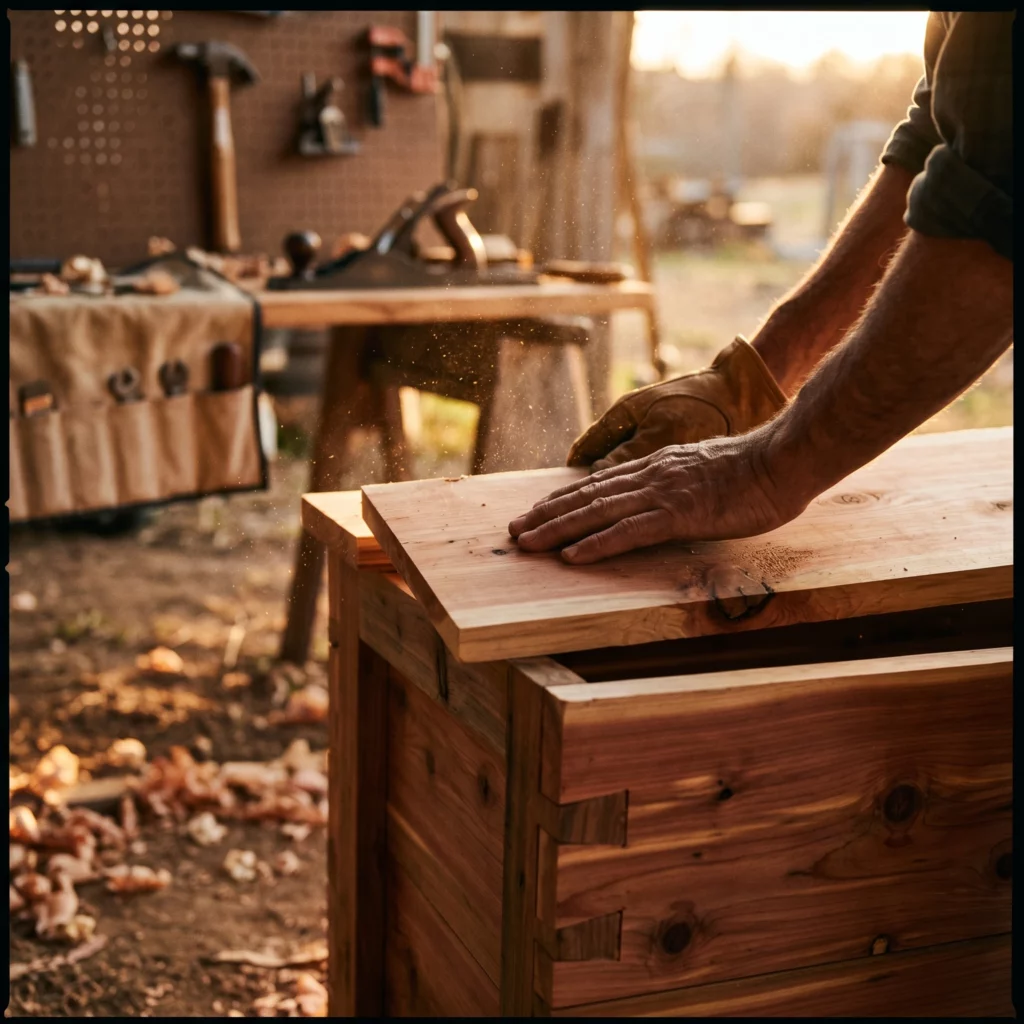
The integrated backrest transforms the bench from a utility piece into a destination.
People linger longer.
Conversations last longer.
The bench becomes part of the outdoor experience rather than simply supporting it.
16. Double-Lid Storage Bench
Large storage compartments often create an unexpected problem.
Access.
A single oversized lid can become heavy, awkward, and inconvenient.
Double-lid designs solve this elegantly.
Benefits include:
- Easier access
- Improved organization
- Reduced lid weight
- Better user experience
It’s a small design choice that dramatically changes daily usability.
17. Corner Outdoor Storage Bench
Corners are frequently wasted space.
This design converts overlooked areas into productive square footage.
Particularly effective for:
- Small decks
- Compact patios
- Urban yards
- Outdoor dining areas
Space efficiency is its superpower.
18. Premium Cedar Storage Bench
At this level, craftsmanship starts taking center stage.
Expect features such as:
- Hidden fasteners
- Premium cedar stock
- Refined joinery
- Architectural detailing
This isn’t simply storage furniture.
It’s heirloom-quality outdoor woodworking.
Advanced Outdoor Storage Bench Plans (Plans 19–27)
These projects demand more skill, more planning, and greater attention to detail.
In return, they deliver custom results that often rival high-end outdoor furniture costing thousands of dollars.
19. Fully Waterproof Outdoor Storage Bench
Most benches resist weather.
This one actively fights it.
Advanced waterproof designs include:
- Drainage channels
- Sealed joints
- Ventilation systems
- Elevated floor construction
Ideal for climates where rain isn’t an occasional visitor—it’s a regular resident.
20. Built-In Deck Storage Bench
A built-in bench changes how a deck feels.
Instead of furniture sitting on a deck, the bench becomes part of the deck itself.
Benefits include:
- Seamless appearance
- Increased seating
- Maximum storage
- Enhanced property value
Custom integration creates a level of polish difficult to replicate with standalone furniture.
21. Outdoor Kitchen Storage Bench
Outdoor kitchens generate surprising amounts of equipment.
Serving trays.
Utensils.
Covers.
Accessories.
This design creates storage exactly where it’s needed most.
Function follows behavior.
That’s what makes it work.
22. Pergola-Integrated Storage Bench
This plan combines multiple outdoor elements into a unified structure.
The result feels architectural rather than decorative.
It creates:
- Seating
- Storage
- Shade support
- Visual definition
Large outdoor spaces benefit particularly well from this approach.
23. Multi-Zone Storage Bench System
Organization enthusiasts tend to love this design.
Instead of one large compartment, multiple storage zones separate items by purpose.
Examples include:
- Garden tools
- Cushions
- Outdoor games
- Pool accessories
Finding things becomes easier.
Keeping things organized becomes easier too.
24. Hidden Tool Storage Bench
Security meets functionality.
Designed with concealed compartments and reinforced construction, this bench keeps valuable equipment out of sight.
Ideal for:
- Expensive garden tools
- Battery-powered equipment
- Outdoor electronics
Sometimes the best storage is storage nobody notices.
25. Cedar and Steel Luxury Bench
Few outdoor furniture combinations age as gracefully as wood and metal.
Cedar provides warmth.
Steel provides structure.
Together, they create a bench that feels simultaneously modern and timeless.
This design frequently becomes the centerpiece of an outdoor space.
26. Landscape-Integrated Storage Bench
Rather than adding furniture to a landscape, this design becomes part of the landscape itself.
Often incorporated alongside:
- Retaining walls
- Raised planters
- Garden pathways
- Hardscape features
The storage disappears visually while remaining fully functional.
27. The Ultimate Family Storage Bench
Every category converges here.
Maximum seating.
Maximum storage.
Maximum versatility.
Designed for households that genuinely use their outdoor spaces every week, this plan serves as a command center for backyard life.
It stores nearly everything.
And because of that, it quietly improves everything around it.
The Tools That Make Outdoor Storage Bench Building Easier
The difference between a frustrating project and an enjoyable one is rarely talent.
More often, it’s preparation.
Having the right tools doesn’t guarantee success.
But lacking them can certainly slow progress.
Essential Tools Every Builder Should Have
Most outdoor storage bench plans require only a handful of basics:
- Circular saw
- Drill and driver
- Tape measure
- Speed square
- Clamps
- Orbital sander
These tools can handle the majority of beginner and intermediate builds.
Skill matters.
Accuracy matters.
But consistent measuring matters even more.
Remember the old woodworking rule:
Measure twice. Cut once.
Then measure again if the board is expensive.
The Upgrades That Save Time and Improve Results
As projects become more ambitious, certain tools begin earning their place in the workshop.
Popular upgrades include:
- Miter saw
- Pocket-hole jig
- Router
- Table saw
- Random orbital sander
- Bar clamps
None are mandatory.
All are helpful.
Especially when precision and efficiency become priorities.
Building an Outdoor Storage Bench: The Process That Separates Lasting Projects From Future Repairs
There is a moment in almost every woodworking project when excitement gives way to uncertainty.
The lumber is stacked.
The plans are printed.
The tools are ready.
And suddenly a simple project feels surprisingly complex.
The good news?
Nearly every successful outdoor storage bench follows the same sequence.
Experienced builders may use different joinery methods, premium materials, or custom dimensions, but the underlying process rarely changes.
Understanding that process before making the first cut eliminates a remarkable amount of frustration.
Step 1: Start With Better Lumber Than You Think You Need
A storage bench can only be as stable as the material used to build it.
This sounds obvious until you’re standing in a lumber aisle trying to decide whether a slightly warped board is “good enough.”
Usually, it isn’t.
Take time to inspect each board for:
- Twisting
- Bowing
- Splitting
- Excessive knots
- Moisture damage
Straight lumber creates easier assembly, cleaner joints, and a more professional finished appearance.
Many beginner frustrations actually begin long before construction starts.
They begin with material selection.
Step 2: Build the Frame Like It Will Be There for Twenty Years
Because ideally, it will.
The frame is the hidden skeleton of the bench.
Nobody compliments it.
Nobody photographs it.
Yet it determines nearly everything that follows.
Strong frames prioritize:
- Load distribution
- Reinforced corners
- Structural rigidity
- Long-term durability
When people describe outdoor furniture as “solid,” they’re usually describing the quality of the frame, even if they don’t realize it.
This is not the stage to rush.
Future stability depends on decisions made here.
Step 3: Design Storage Around Real Life
This is where many plans become interesting.
And where great storage benches separate themselves from average ones.
Instead of simply creating an empty box, think about how the space will actually be used.
Questions worth asking:
- Will you store cushions?
- Garden tools?
- Pool accessories?
- Children’s toys?
- Seasonal decorations?
The answers influence everything from depth and compartment design to lid size and ventilation requirements.
Storage becomes significantly more useful when it reflects actual habits rather than assumptions.
Step 4: Give Special Attention to the Lid
The lid is the hardest-working component on the entire bench.
It opens.
Closes.
Supports weight.
Protects contents.
Resists weather.
And often serves as the seat itself.
Because of this, lid construction deserves more attention than most builders initially expect.
Key considerations include:
- Weight distribution
- Hinge placement
- Ease of lifting
- Structural support
- Water management
Soft-close hinges are one of those upgrades people rarely regret.
They make the bench feel more refined every single day it’s used.
Step 5: Finishing Is Protection, Not Decoration
Many DIY builders view finishing as the final cosmetic step.
In reality, it’s the first line of defense.
A quality finish protects against:
- Moisture
- UV damage
- Mold growth
- Surface degradation
Popular options include:
- Exterior wood stain
- Penetrating outdoor oils
- Marine-grade sealants
- UV-resistant protective coatings
The best finish depends on climate, wood species, and maintenance expectations.
What matters most is consistency.
Protection works when it’s maintained.
The Mistakes That Shorten the Life of Outdoor Storage Benches
Most outdoor storage bench failures aren’t mysterious.
They’re predictable.
And almost always avoidable.
Let’s look at the problems that show up repeatedly.
Mistake #1: Forgetting That Water Always Wins
Water is patient.
That’s what makes it dangerous.
It doesn’t need a large opening.
A tiny gap is enough.
Without proper drainage, moisture accumulates inside storage compartments and begins a slow chain reaction:
- Mold develops
- Wood swells
- Fasteners corrode
- Structural integrity declines
Good outdoor storage bench plans account for water movement from the beginning.
Great plans assume water will get inside eventually and provide a way for it to leave.
Mistake #2: Building a Sealed Box Instead of a Ventilated One
People often assume airtight storage is the goal.
Outdoors, the opposite is frequently true.
Stored cushions, fabrics, and accessories benefit from airflow.
Without ventilation:
- Condensation builds
- Odors develop
- Mildew spreads
- Moisture lingers
Small ventilation gaps dramatically improve long-term performance.
Sometimes the smartest design features are the ones you barely notice.
Mistake #3: Saving Money on Hardware
Cheap screws can quietly sabotage an otherwise excellent build.
Outdoor furniture experiences constant expansion, contraction, vibration, and environmental exposure.
Interior-grade fasteners simply weren’t designed for those conditions.
Invest in:
- Exterior-rated screws
- Galvanized hardware
- Stainless steel hinges
- Waterproof adhesives
The cost difference is small.
The durability difference is enormous.
Mistake #4: Choosing Wood Based Solely on Price
Budget matters.
But replacing a failed bench is expensive too.
Pressure-treated lumber, cedar, redwood, and composite materials each serve different priorities.
The right choice depends on:
- Climate
- Maintenance expectations
- Aesthetic goals
- Budget constraints
Short-term savings don’t always translate into long-term value.
Mistake #5: Ignoring Seasonal Wood Movement
Wood is alive in a sense.
Even after milling.
It responds to humidity.
It responds to temperature.
It expands.
It contracts.
Plans that ignore this reality often develop:
- Cracks
- Warping
- Binding lids
- Joint failure
The best outdoor furniture works with wood movement instead of trying to prevent it entirely.
DIY vs Buying: Which Option Makes More Sense?
This question appears in nearly every outdoor furniture discussion.
The answer depends less on woodworking ability and more on priorities.
Why Some Homeowners Choose to Buy
There are obvious advantages.
Immediate availability.
No construction.
No tools.
No sawdust.
A purchased bench can be assembled and used the same day.
For busy homeowners, convenience has real value.
Why So Many People Still Choose to Build
Building offers something that stores rarely provide.
Control.
You choose:
- Dimensions
- Materials
- Hardware
- Design style
- Storage configuration
- Finish
The result fits your space rather than forcing your space to fit the furniture.
And while customization is valuable, it isn’t the only reward.
Many builders discover something unexpected during the process.
Satisfaction.
Not the quick satisfaction of buying something.
The deeper satisfaction that comes from creating something useful with your own hands.
Frequently Asked Questions
“If I only build one outdoor storage bench in my life, what wood should I choose?”
For most homeowners, cedar remains the safest recommendation.
It balances durability, appearance, workability, and natural resistance to rot better than almost any other commonly available option.
Unless you have highly specific requirements, cedar is difficult to regret.
“Can a storage bench really hold several adults?”
Absolutely.
A properly designed bench with reinforced framing can support several hundred pounds without issue.
Many quality designs comfortably handle 400 to 800 pounds or more.
The strength comes from the frame—not just the seating surface.
“What’s the biggest mistake first-time builders make?”
Building a beautiful bench that traps moisture.
It looks perfect at first.
Then seasons pass.
Mold appears.
Wood begins swelling.
Hardware deteriorates.
Ventilation and drainage rarely get the attention they deserve, but they often determine whether a bench lasts five years or twenty.
“Do outdoor cushions actually stay dry inside a storage bench?”
They can.
But only if the bench is designed correctly.
Good storage benches combine weather protection with airflow.
Protection without ventilation creates one set of problems.
Ventilation without protection creates another.
The goal is balance.
“How long should a well-built outdoor storage bench last?”
That depends on materials, climate, and maintenance.
As a general guideline:
- Pressure-treated lumber: 10–15 years
- Cedar: 15–25+ years
- Redwood: 20+ years
- Composite materials: 20–30+ years
Good design extends lifespan just as much as good materials.
“Is a built-in storage bench worth the extra work?”
If you’re planning to stay in your home for years, often yes.
Built-in benches create a custom appearance that standalone furniture struggles to match.
They maximize seating, maximize storage, and frequently enhance the overall feel of the outdoor space.
The construction effort is greater.
The payoff often is too.
Products / Tools / Resources
The right plan matters.
The right materials matter too.
These are the products, tools, and resources most builders find themselves returning to again and again.
Recommended Wood Choices
Cedar Lumber
Best overall combination of durability, appearance, and workability.
Ideal for:
- Patio benches
- Garden benches
- Premium outdoor furniture
Redwood
Premium option for long-term beauty and weather resistance.
Ideal for:
- High-end builds
- Feature pieces
- Luxury outdoor spaces
Pressure-Treated Lumber
Budget-friendly and widely available.
Ideal for:
- Utility storage benches
- Tool storage
- Functional backyard projects
Composite Decking Boards
Low-maintenance alternative to traditional wood.
Ideal for:
- Coastal climates
- Poolside installations
- Homeowners seeking minimal upkeep
Essential Hardware
Stainless Steel Hinges
Resist rust and improve long-term durability.
Soft-Close Lid Supports
Prevent slamming and improve everyday usability.
Exterior-Rated Deck Screws
Designed specifically for outdoor environments.
Waterproof Wood Glue
Adds structural strength while resisting moisture.
Galvanized Brackets and Reinforcement Plates
Helpful for larger storage bench designs.
Recommended Power Tools
Circular Saw
The foundational cutting tool for most outdoor storage bench plans.
Drill and Driver Set
Essential for assembly and hardware installation.
Orbital Sander
Creates smoother finishes and professional-looking results.
Miter Saw
Improves cutting accuracy and speeds up production.
Pocket-Hole Jig
Excellent for hidden joinery and stronger assemblies.
Helpful Design Resources
Outdoor Furniture Dimension Guides
Useful for verifying ergonomic seating measurements.
Lumber Calculators
Help estimate material requirements and project costs.
Deck and Patio Design Inspiration
Useful when integrating benches into larger outdoor living spaces.
Exterior Finish Comparison Charts
Helpful for selecting stains, oils, and sealants based on climate conditions.
Related Outdoor Projects Worth Exploring
If you’re building an outdoor storage bench, these projects often complement it well:
- Built-in deck seating
- Outdoor coffee tables
- Garden potting benches
- Raised garden beds
- Pergola seating systems
- Outdoor cushion storage cabinets
- Deck privacy screens
- Patio organization stations
Many homeowners begin with a storage bench and gradually build an entire outdoor furniture collection around it.