
The Day Most Homeowners Realize Luxury Is Mostly an Illusion
Spend fifteen minutes browsing luxury outdoor furniture galleries and a strange realization begins to emerge.
The teak sofa priced at $12,000.
The dining table listed for $8,500.
The resort-style sectional commanding nearly the price of a small car.
At first glance, it feels like those pieces belong to another world—a world reserved for boutique designers, oceanfront estates, and luxury resorts hidden behind private gates.
Then you look closer.
The materials aren’t magical.
The joinery isn’t impossible.
The construction methods aren’t guarded secrets passed down through generations of master craftsmen.
In fact, many of the world’s most desirable outdoor furniture collections are built from the same raw ingredients available to skilled woodworkers every day: teak, ipe, white oak, marine-grade stainless steel, and carefully considered design.
The real difference isn’t what they’re made from.
It’s how they’re designed.
That’s where the gap lives.
And once you understand that gap, something shifts.
You stop looking at luxury outdoor furniture as something you buy.
You begin seeing it as something you can create.
What Makes Outdoor Furniture Look Expensive?
Before discussing woodworking plans, materials, or joinery, it’s worth answering the question most people are actually asking:
Why does one piece look like it belongs in a luxury resort while another looks unmistakably DIY?
The answer has very little to do with cost.
High-end outdoor furniture typically shares five defining characteristics:
- Premium hardwoods such as teak, ipe, and white oak
- Architectural proportions
- Refined or hidden joinery
- Commercial-grade hardware
- Professional outdoor finishing systems
Notice what’s missing from that list.
Complexity.
Luxury furniture often appears deceptively simple.
The best designers remove distractions until only the essential remains.
Every line serves a purpose.
Every dimension feels intentional.
Every angle contributes to a larger visual story.
That restraint is what creates perceived value.
The Hidden DNA of Luxury Outdoor Furniture
Most mass-market furniture is engineered around manufacturing efficiency.
Luxury furniture is engineered around experience.
The distinction sounds subtle.
It isn’t.
One approach asks:
“How quickly can we produce this?”
The other asks:
“How will someone feel when they sit down?”
That single shift changes everything.
It affects proportions.
It influences material selection.
It determines comfort, durability, and visual presence.
And perhaps most importantly, it creates emotional connection.
Because the furniture people remember rarely impresses them with features.
It impresses them with feeling.
Why Cheap Furniture Feels Cheap
We’ve all experienced it.
A chair looks decent online.
The photos are convincing.
The marketing sounds premium.
Then it arrives.
The frame feels lightweight.
The proportions seem slightly off.
The hardware catches your eye in all the wrong ways.
Nothing is technically broken.
Yet something feels wrong.
That feeling usually comes from a collection of small compromises:
- Thin stock lumber
- Weak structural geometry
- Visible fasteners
- Inconsistent spacing
- Generic silhouettes
- Poor weight distribution
Individually, these details appear insignificant.
Together, they instantly communicate lower value.
Luxury furniture works in the opposite direction.
Every decision compounds toward a stronger impression.
The Material Hierarchy: Where Luxury Begins
Luxury outdoor furniture starts long before assembly.
It begins with material selection.
The wood you choose influences durability, appearance, maintenance requirements, and long-term value.
More importantly, it establishes the visual language of the project.
Different woods tell different stories.
Teak: The Benchmark Every Other Wood Is Compared Against
Few materials have earned the reputation teak enjoys.
For decades, it has remained the preferred choice for luxury outdoor furniture, high-end yachts, coastal estates, and five-star hospitality environments.
There is a reason for that.
Actually, several.
Teak naturally contains oils that help resist moisture, insects, decay, and weather exposure. Its dimensional stability allows it to endure changing climates with remarkable consistency.
Yet the practical advantages only tell part of the story.
Teak simply looks expensive.
The grain carries a warmth that feels sophisticated without being flashy.
Over time, it develops the soft silver-gray patina that has become synonymous with luxury outdoor living.
It ages gracefully.
And that matters.
Because true luxury isn’t about remaining untouched.
It’s about becoming more beautiful with time.
Ipe: The Wood Built for Generations
If teak is elegance, ipe is endurance.
Known by many as Brazilian Walnut, ipe ranks among the densest and most durable hardwoods available for outdoor construction.
Holding a piece of ipe feels different.
Heavier.
More substantial.
More permanent.
Its natural resistance to moisture, insects, rot, and environmental stress makes it one of the longest-lasting materials available for outdoor furniture projects.
For builders seeking maximum longevity, ipe offers something increasingly rare in modern products:
Confidence.
The confidence that the furniture you’re building today may still be standing decades from now.
White Oak: The Quiet Favorite of Contemporary Designers
Walk through modern furniture showrooms and you’ll notice white oak appearing almost everywhere.
Not because it’s trendy.
Because it strikes a remarkable balance.
White oak offers strength, durability, workability, and visual sophistication without feeling overly formal.
Its grain patterns create movement without becoming distracting.
Its color complements both traditional and contemporary environments.
And perhaps most importantly, it supports the minimalist aesthetic dominating luxury outdoor design today.
For builders seeking a clean architectural look, white oak often becomes the sweet spot between performance and visual refinement.
The Secret Most DIY Projects Miss
Here’s where many woodworking projects go wrong.
The builder becomes obsessed with construction.
The designer becomes obsessed with proportion.
Those are not the same thing.
A flawless joint cannot rescue poor proportions.
A perfect finish cannot compensate for awkward geometry.
Luxury furniture succeeds because it prioritizes visual balance first and craftsmanship second.
Not because craftsmanship isn’t important.
Because craftsmanship only becomes visible after design succeeds.
The eye notices proportions before it notices joinery.
Every time.
That’s why understanding design principles creates more dramatic improvements than simply learning new woodworking techniques.
And that’s exactly where the transformation begins.
Luxury Design Principles That Separate Designer Furniture From DIY Furniture
There is a moment that happens in every luxury furniture showroom.
Most people don’t consciously notice it.
They walk past dozens of pieces. Some are beautiful. Some are forgettable. A few stop them in their tracks.
Not because the furniture is complicated.
Quite the opposite.
The pieces that command attention often look effortless.
Clean lines.
Balanced proportions.
A sense of calm.
The furniture doesn’t compete for attention. It owns it.
This is where luxury design separates itself from ordinary construction.
The goal isn’t to build more.
The goal is to remove everything that doesn’t belong.
The Power of Negative Space
Many first-time furniture builders focus entirely on the object itself.
Luxury designers focus equally on the space around it.
This concept is known as negative space, and it is one of the most overlooked principles in outdoor furniture design.
Imagine two outdoor sofas.
The first is packed with decorative elements, extra supports, visible braces, and unnecessary visual noise.
The second features clean horizontal lines, generous spacing, and uninterrupted surfaces.
The materials may be identical.
The craftsmanship may be equal.
Yet the second piece feels dramatically more expensive.
Why?
Because the human brain associates clarity with confidence.
Visual clutter suggests compromise.
Open space suggests intention.
Luxury furniture allows the eye to rest.
And that creates a powerful emotional response.
Why Bigger Often Looks Better
One of the fastest ways to elevate outdoor furniture is surprisingly simple:
Increase visual mass.
Not bulk.
Mass.
There’s a difference.
Luxury furniture often uses thicker components because they create a feeling of permanence.
Wide armrests.
Substantial table tops.
Deep seating platforms.
Large-scale structural members.
These design choices communicate stability before anyone even touches the furniture.
It’s the same reason stone architecture feels different from drywall construction.
Weight influences perception.
When furniture appears substantial, it immediately feels more valuable.
Architectural Lines: The Language of Luxury
Spend time studying luxury outdoor furniture collections and you’ll begin to notice recurring visual patterns.
Long horizontal planes.
Consistent spacing.
Sharp geometry.
Balanced symmetry.
Everything feels deliberate.
Nothing appears accidental.
This architectural approach creates furniture that feels connected to the surrounding environment rather than simply placed inside it.
The best outdoor furniture doesn’t compete with landscape architecture.
It complements it.
The furniture becomes part of the larger composition.
That harmony is often what people describe as “designer quality,” even if they can’t explain exactly why.
Hidden Hardware and Invisible Complexity
One of the defining characteristics of premium furniture is what you don’t see.
Visible screws.
Exposed brackets.
Bulky reinforcement plates.
These details instantly reveal construction methods.
Luxury furniture takes a different approach.
The engineering disappears.
Structural strength remains.
Visual distractions vanish.
This is where advanced joinery techniques become so valuable.
Mortise and tenon construction.
Floating tenons.
Precision domino joinery.
Concealed fasteners.
All of these methods allow the furniture to maintain visual purity while delivering exceptional strength.
The result feels effortless.
In reality, it often requires more skill, more planning, and greater attention to detail.
And that’s precisely why it looks expensive.
Building a Luxury Outdoor Furniture Collection Instead of Random Projects
Most homeowners approach outdoor furniture one piece at a time.
A chair this year.
A table next year.
Maybe a bench somewhere in between.
The result usually feels disconnected.
Luxury outdoor spaces are built differently.
They are designed as systems.
Every piece speaks the same visual language.
Materials match.
Proportions relate.
Details repeat.
The furniture feels curated rather than accumulated.
That distinction matters.
Because luxury isn’t merely about individual pieces.
It’s about cohesion.
The Luxury Outdoor Sofa: The Centerpiece of the Entire Backyard
If outdoor furniture has a flagship piece, it’s the sofa.
Everything else tends to orbit around it.
Conversations happen there.
Guests gather there.
The visual identity of the space is often defined by it.
Which means its design deserves extraordinary attention.
What Makes a Luxury Outdoor Sofa Feel Expensive?
The answer begins with scale.
Many retail sofas are undersized.
They prioritize shipping efficiency and manufacturing costs.
Luxury outdoor sofas prioritize experience.
That changes the dimensions dramatically.
Characteristics often include:
- Deep seating between 24 and 30 inches
- Wide armrests
- Low-profile frames
- Thick cushions
- Generous lounging positions
These proportions create an emotional response.
The furniture feels welcoming before anyone sits down.
Comfort becomes visible.
And visible comfort is one of the strongest signals of luxury.
Cushion Design: The Detail Most Builders Underestimate
Ask people what they notice first about outdoor furniture.
Many will say the wood.
The truth is often different.
They notice the cushions.
Poor cushions can make extraordinary furniture feel cheap.
Premium cushions instantly elevate average furniture.
Luxury outdoor collections typically feature:
- Thick cushion profiles
- Performance fabrics
- Fast-drying foam systems
- Tailored seams
- Consistent proportions
The relationship between cushion thickness and frame design dramatically influences perceived value.
The best outdoor furniture treats cushions as part of the architecture—not an afterthought.
Modern Outdoor Lounge Chairs: Small Pieces With Outsized Impact
A single luxury lounge chair can transform the feeling of an outdoor space.
It acts as both seating and sculpture.
The best designs achieve something unusual.
They look comfortable before they’re occupied.
That visual comfort comes from carefully engineered angles, reclined posture, and balanced proportions.
Luxury lounge chairs often feature:
- Wide seat platforms
- Reclined back angles
- Continuous flowing lines
- Strong side profiles
- Minimal visual interruption
Every angle should feel intentional.
Every surface should contribute to the overall experience.
Because lounge chairs often sit independently within a landscape, they become focal points more quickly than larger furniture pieces.
The Designer Outdoor Dining Table: Where Craftsmanship Becomes Visible
Unlike sofas or sectionals, dining tables expose more of their structure.
That means every design decision becomes more noticeable.
Luxury outdoor dining tables typically emphasize three things:
Scale.
Simplicity.
Material quality.
The most successful designs rarely rely on decorative elements.
Instead, they allow the wood itself to become the feature.
Features Commonly Found in Premium Dining Tables
Luxury outdoor dining tables frequently incorporate:
- Thick slab-inspired tops
- Architectural pedestal bases
- Floating edge details
- Hidden structural support
- Precise grain matching
These elements create visual confidence.
Nothing appears overworked.
Nothing feels forced.
The table simply looks like it belongs.
And that feeling is incredibly difficult to fake.
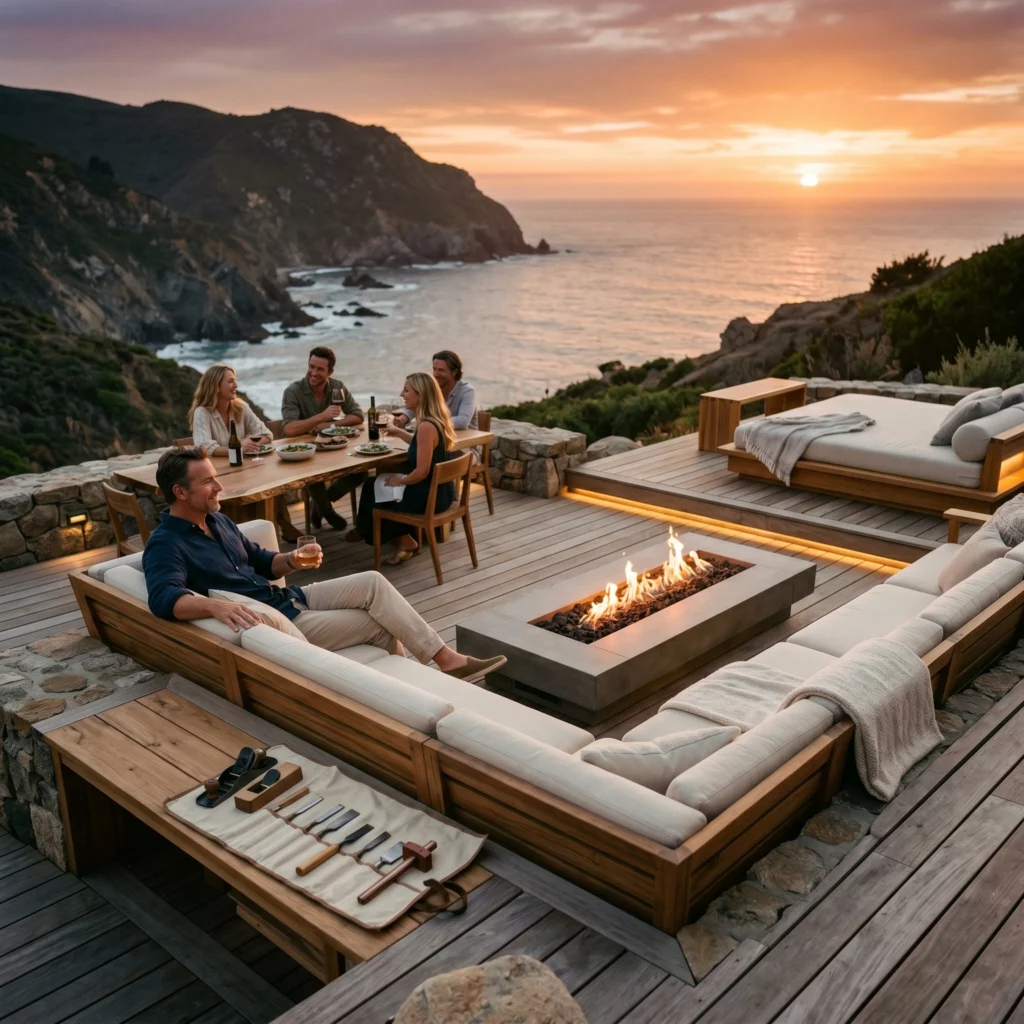
Resort-Style Daybeds: The Ultimate Luxury Statement Piece
Few pieces communicate luxury more effectively than a well-designed outdoor daybed.
The moment people see one, they understand the intention behind the space.
This isn’t merely a backyard.
It’s a destination.
Luxury resorts have understood this principle for decades.
Daybeds create emotional associations with relaxation, exclusivity, and escape.
They suggest slowing down.
Disconnecting.
Spending an afternoon doing absolutely nothing.
That emotional promise is part of what makes them so powerful.
Key Design Elements of Premium Outdoor Daybeds
Luxury daybeds often include:
- Oversized platforms
- Deep cushions
- Integrated side surfaces
- Canopy structures
- Architectural framing
Every design choice supports a single objective:
Creating a private retreat within a larger outdoor environment.
When executed properly, a daybed becomes more than furniture.
It becomes an experience.
Why Outdoor Sectionals Dominate Modern Luxury Design
There is a reason luxury resorts, contemporary homes, and hospitality environments increasingly rely on sectionals.
Flexibility.
Outdoor living has become more social.
People want spaces that adapt.
They want furniture capable of supporting intimate conversations one day and larger gatherings the next.
Sectionals solve that challenge elegantly.
They offer:
- Modular layouts
- Expandable configurations
- Strong visual presence
- Exceptional comfort
- Efficient use of space
More importantly, they create environments rather than isolated seating positions.
That distinction has become central to modern luxury outdoor living.
Because today’s homeowners aren’t simply buying furniture.
They’re designing experiences.
And the furniture that succeeds is the furniture that understands that.
The Craftsmanship Layer: Where Luxury Furniture Earns Its Reputation
At a distance, luxury outdoor furniture is judged by design.
Up close, it is judged by craftsmanship.
This is the point where casual observers stop admiring a piece and begin studying it.
They run their hands across an armrest.
They notice how components intersect.
They look for imperfections and fail to find them.
The closer they get, the better the furniture becomes.
That’s the hallmark of premium craftsmanship.
Mass-market furniture often works in reverse.
It photographs well.
It impresses from twenty feet away.
But every step closer reveals another compromise.
Luxury furniture is built to reward scrutiny.
And that begins with joinery.
Joinery Techniques That Instantly Elevate Outdoor Furniture
Most homeowners never consciously think about joinery.
They simply experience the result.
Furniture either feels solid or it doesn’t.
It either inspires confidence or it creates hesitation.
The strongest luxury furniture collections are built around structural systems that prioritize longevity as much as appearance.
Recommended reading: The 25 Best Woodworking Joinery Books Every Woodworker Should Own (From Beginner to Master Craftsman)
Mortise and Tenon: The Gold Standard of Furniture Construction
Long before power tools existed, master craftsmen relied on mortise and tenon joinery.
Not because it was traditional.
Because it worked.
Centuries later, it still does.
A properly executed mortise and tenon joint creates remarkable strength while preserving clean visual lines.
No bulky hardware.
No distracting brackets.
No visible shortcuts.
Just wood meeting wood in a way that feels timeless.
This is one of the strongest signals of heirloom-quality furniture.
Floating Tenons and Modern Precision
Luxury furniture doesn’t have to rely exclusively on traditional methods.
Many contemporary furniture makers use floating tenons to achieve similar structural benefits with greater efficiency.
Advantages include:
- Exceptional strength
- Precise alignment
- Faster assembly
- Consistent repeatability
For builders creating an entire outdoor furniture collection, floating tenons often represent the ideal balance between craftsmanship and practicality.
Domino Joinery and Professional-Level Results
In many high-end workshops, domino systems have become the preferred method for producing furniture with remarkable accuracy.
What makes these systems valuable isn’t speed alone.
It’s consistency.
Every joint fits exactly as intended.
Every alignment remains precise.
Every component contributes to a cleaner final product.
Luxury furniture often feels effortless.
Behind the scenes, precision tools help make that possible.
The Finishing Systems That Separate Luxury Furniture From Everything Else
A beautiful piece of furniture can fail outdoors for one simple reason:
The finish wasn’t designed for the environment.
Sunlight.
Rain.
Humidity.
Temperature fluctuations.
Salt air.
Every outdoor furniture project faces an ongoing battle against the elements.
The finish becomes the first line of defense.
And the strategy you choose will shape both appearance and maintenance requirements for years to come.
The Natural Weathering Approach
Some of the most expensive outdoor furniture in the world receives very little surface treatment.
That surprises many people.
Yet luxury designers often embrace natural aging.
Teak is a perfect example.
Over time, untreated teak develops a silver-gray patina that has become synonymous with luxury outdoor living.
It appears on:
- Coastal estates
- Luxury resorts
- Yacht decks
- Architectural landscapes
The weathering becomes part of the story.
Instead of fighting time, the furniture evolves with it.
Penetrating Oils: Preserving Warmth and Character
For homeowners who love the natural richness of hardwood, penetrating oil systems remain a popular choice.
These finishes enhance grain definition while maintaining a more authentic appearance than heavy film-forming coatings.
Benefits include:
- Easy maintenance
- Natural texture
- Rich color retention
- Repairability
The result feels organic rather than manufactured.
And that subtle distinction often aligns perfectly with modern luxury design.
Marine-Grade Protection Systems
Certain environments demand maximum protection.
Coastal regions.
Poolside installations.
Harsh seasonal climates.
In these situations, marine-grade finishing systems provide superior resistance to environmental stress.
They help defend against:
- UV degradation
- Moisture intrusion
- Salt exposure
- Seasonal expansion and contraction
While maintenance requirements may increase, the level of protection can be extraordinary.
What Does It Actually Cost to Build Luxury Outdoor Furniture?
This is usually the moment homeowners lean forward.
Because regardless of aesthetics, craftsmanship, or materials, everyone eventually asks the same question:
Is building luxury furniture actually worth it?
The numbers are revealing.
Luxury Outdoor Sofa
Designer retail collection:
$8,000–$15,000+
DIY luxury build:
$1,500–$4,000
Premium Dining Set
Designer retail collection:
$10,000–$20,000+
DIY luxury build:
$2,000–$6,000
Full Backyard Collection
Luxury retail purchase:
$20,000–$50,000+
Custom-built equivalent:
$5,000–$15,000
Of course, money tells only part of the story.
What you’re really gaining is control.
Control over dimensions.
Control over materials.
Control over quality.
Control over details that mass-market manufacturers simply can’t prioritize.
That level of customization is often impossible to purchase, regardless of budget.
The Small Mistakes That Quietly Destroy a Luxury Look
Here’s the frustrating truth.
A project can use premium lumber, professional tools, and advanced joinery—and still fail to look expensive.
Not because of major errors.
Because of small ones.
Luxury is often determined by details.
And details compound.
Visible Fasteners Everywhere
Nothing undermines premium furniture faster than a surface covered in visible screws.
One or two may be necessary.
Dozens rarely are.
Whenever possible, luxury furniture conceals its engineering.
The structure remains.
The distractions disappear.
Undersized Components
Furniture that looks lightweight often feels lightweight.
Even before someone touches it.
Thin armrests.
Narrow table tops.
Weak visual proportions.
All of these diminish perceived value.
Luxury furniture communicates confidence through presence.
Inconsistent Spacing
The human eye notices rhythm instinctively.
When spacing varies between slats, supports, or structural elements, something feels off—even if the observer can’t explain why.
Consistency creates harmony.
Harmony creates sophistication.
Cheap Hardware
A premium hardwood frame paired with low-quality hardware creates visual conflict.
Luxury outdoor furniture typically relies on:
- Marine-grade stainless steel
- Architectural hardware
- Corrosion-resistant fasteners
- Hidden connection systems
Details matter because people notice more than they realize.
Frequently Asked Questions
Is teak really worth the premium price?
For many homeowners, yes.
Teak combines durability, weather resistance, dimensional stability, and timeless beauty in a way few materials can match. While the upfront investment is higher, its longevity often offsets the cost over time.
If I only build one piece, what should it be?
A luxury outdoor sofa is often the best starting point.
It serves as the visual anchor of the entire space and delivers the greatest impact on both appearance and functionality.
What’s the biggest difference between luxury furniture and regular outdoor furniture?
Proportion.
Many people assume the answer is material quality.
Materials matter, but proportions influence perception first.
Luxury furniture feels balanced, intentional, and comfortable before anyone notices the wood species or construction methods.
How long can premium outdoor furniture last?
Properly constructed furniture built from teak, ipe, or white oak can remain functional and beautiful for decades.
Many high-end pieces continue performing well after twenty years or more with routine maintenance.
Do I need advanced woodworking skills to achieve a luxury look?
Not necessarily.
Design decisions often have a greater impact than technical complexity.
Clean lines, thoughtful proportions, premium materials, and careful finishing can dramatically elevate a project even when construction methods remain relatively straightforward.
Products / Tools / Resources
The difference between a good outdoor furniture project and an exceptional one often comes down to the resources behind it. These are the categories worth investing in if your goal is creating furniture that feels genuinely high-end.
Premium Lumber Sources
Consider sourcing:
- Teak lumber
- Ipe hardwood
- Quarter-sawn white oak
- FSC-certified hardwoods
Whenever possible, purchase from specialty hardwood suppliers rather than general construction lumber yards. Material quality becomes highly visible in luxury furniture projects.
Recommended reading: The Ultimate Wood Buying Guide: How to Choose the Perfect Lumber for Every Woodworking Project (Without Wasting Money)
Essential Joinery Tools
For cleaner construction and tighter tolerances:
- Domino joinery systems
- Mortising jigs
- Precision doweling systems
- High-quality chisels
- Professional marking gauges
These tools help eliminate many of the inconsistencies that separate average furniture from premium furniture.
Outdoor Hardware Worth Upgrading
Don’t overlook hardware.
Look for:
- 316 marine-grade stainless steel fasteners
- Hidden fastening systems
- Corrosion-resistant brackets
- Exterior-rated structural connectors
Hardware is often invisible when done correctly—which is exactly the point.
Outdoor Cushion and Fabric Resources
Luxury furniture relies heavily on comfort.
Prioritize:
- Performance fabrics
- Solution-dyed acrylic textiles
- Quick-dry foam systems
- Commercial outdoor upholstery materials
The quality of the cushions often determines the perceived quality of the entire furniture collection.
Finishing Products for Long-Term Protection
Depending on your desired aesthetic:
For natural aging:
- Teak left unfinished
- Weathering-friendly hardwoods
For color retention:
- Premium penetrating oils
- UV-resistant hardwood treatments
For maximum protection:
- Marine-grade varnish systems
- Exterior furniture sealers
- High-performance outdoor coatings
Design Inspiration Sources
Before building, spend time studying:
- Luxury resort furniture layouts
- Contemporary landscape architecture
- Boutique hotel outdoor spaces
- High-end residential backyard projects
- Architectural outdoor living collections
The more examples you analyze, the easier it becomes to recognize the design patterns that consistently create a luxury appearance.
Recommended Next Builds
If you’re developing a complete outdoor furniture collection, a logical progression is:
- Outdoor coffee table
- Lounge chair
- Outdoor sofa
- Dining table
- Modular sectional
- Resort-style daybed
Each project builds new skills while contributing to a cohesive luxury outdoor living environment.