
Snippet
Searching for the best woodworking joinery books can feel overwhelming when hundreds of titles promise to make you a better craftsman. This carefully curated guide highlights 25 outstanding books that have earned lasting respect among hobbyists, cabinetmakers, and professional furniture builders. Whether you’re learning your first dovetail or refining museum-quality joinery, these books will help you build stronger skills, make smarter woodworking decisions, and create furniture you’ll be proud of for years to come.
Table of Contents
- Why Joinery Books Still Matter
- What Makes a Great Woodworking Joinery Book?
- How These Books Were Selected
- The 25 Best Woodworking Joinery Books
- Traditional Joinery Books
- Modern Joinery and Machine Techniques
- Best Books for Furniture Makers
- Essential Books for Hand Tool Woodworkers
- Top Joinery Books for Cabinetmakers
- Choosing the Right Book for Your Skill Level
- Building Your Woodworking Library
- Frequently Asked Questions
- Products / Tools / Resources
Some of the Best Lessons in Woodworking Are Still Found on Paper
Every experienced woodworker remembers a project that taught them an unforgettable lesson.
Maybe it was a drawer that refused to slide because the joinery was just slightly off. Perhaps it was a table that twisted after the seasons changed, or a chair that developed a wobble months after it left the workshop.
Moments like these remind us that woodworking isn’t simply about cutting wood. It’s about understanding how every joint, every grain direction, and every design decision works together.
That kind of understanding rarely comes from watching a few short videos.
It grows through study, repetition, and learning from people who have already spent decades solving the problems you’re about to encounter.
That’s where great woodworking books become invaluable.
The finest joinery books don’t just teach techniques—they teach judgment.
They explain why one joint is stronger than another. They show when traditional methods outperform modern shortcuts. They reveal the subtle details that transform ordinary woodworking into lasting craftsmanship.
Many of the titles you’ll discover in this guide have earned permanent places on workshop shelves around the world. They’ve been recommended from one generation of woodworkers to the next because their advice continues to hold true, even as tools and technology evolve.
Whether you’re assembling your very first workbench or designing heirloom-quality furniture, these books can become trusted companions throughout your woodworking journey.
Why Joinery Books Still Matter in a World Full of Online Tutorials
There’s no shortage of woodworking content online.
You can watch someone cut a dovetail in under five minutes, skim through dozens of project photos on social media, or find quick answers to almost any woodworking question with a simple search.
Yet something important often gets lost in that endless stream of information.
Context.
A good woodworking book doesn’t simply tell you how to make a joint.
It explains why that joint exists.
It explores where it performs best, how wood movement affects it, which tools produce the cleanest results, and what experienced craftsmen have learned after making the same joint hundreds—or even thousands—of times.
Those lessons are difficult to compress into a short video.
Books also encourage a different pace of learning.
Instead of jumping between random tips and techniques, you move through ideas in a logical progression. One chapter prepares you for the next, allowing knowledge to build naturally rather than arriving in disconnected pieces.
That slower rhythm has real value.
Over time, techniques become habits.
Habits become confidence.
Confidence becomes craftsmanship.
Another advantage is reliability.
Excellent woodworking books don’t disappear because an account closes or a website changes direction. They’re always there when you’re halfway through a cabinet build, puzzled by a difficult glue-up, or searching for the strongest joint for an unfamiliar project.
Many professionals still keep their favorite books within arm’s reach of the bench, pages marked with notes, corners folded, and margins filled with observations gathered over years of work.
Those books become something far more valuable than references.
They become silent teachers.
What Makes a Woodworking Joinery Book Truly Worth Owning?
Not every woodworking book deserves permanent space on your shelf.
Some are filled with beautiful photography but offer very little practical instruction.
Others contain remarkable technical information yet assume readers already possess years of experience.
The books that stand the test of time strike a rare balance.
They inspire without overwhelming.
They educate without becoming dry.
Most importantly, they leave you feeling more capable each time you return to them.
Here are the qualities that separate exceptional joinery books from the rest.
They Teach Step by Step Without Talking Down to You
Learning joinery shouldn’t feel like decoding another language.
The best authors understand that woodworking can be challenging enough without confusing explanations.
Instead of skipping important details, they guide readers through every stage of the process.
That usually includes:
- Preparing the tools
- Accurate marking and layout
- Cutting techniques
- Fine-tuning the fit
- Dry assembly
- Gluing and clamping
- Final adjustments
The result is a learning experience that builds confidence one successful joint at a time.
The Illustrations Work Just as Hard as the Words
Woodworking is visual by nature.
Sometimes a single well-drawn diagram explains more than three pages of written instruction.
The finest joinery books combine detailed drawings, exploded views, close-up photography, and cross-sections that make even complicated joints easy to understand.
Good illustrations don’t merely decorate a page.
They teach.
They Come From Craftsmen Who Have Solved Real Problems
There’s a noticeable difference between reading theory and learning from someone who’s spent decades at the workbench.
Experienced authors share insights that only come from making mistakes, correcting them, and repeating the process until it becomes second nature.
You’ll often find practical advice such as:
- How to prevent tear-out before it happens
- Why certain woods behave differently
- How seasonal humidity changes affect furniture
- Small adjustments that dramatically improve joint fit
- Ways to recover from common mistakes instead of starting over
Those lessons often become the most valuable pages in the entire book.
They Focus on the Joints You’ll Use Again and Again
While unusual joints can be fascinating, most furniture relies on a handful of proven techniques.
The strongest books spend time mastering those essentials.
Expect thorough coverage of joints like:
- Mortise and tenon
- Dovetails
- Box joints
- Bridle joints
- Lap joints
- Dowel joints
- Sliding dovetails
- Miters
- Tongue-and-groove joints
- Frame-and-panel construction
Once you understand these thoroughly, you’ll discover they appear in countless woodworking projects.
They Respect Both Tradition and Modern Innovation
Today’s woodworkers have access to tools previous generations could only dream about.
Yet many traditional methods remain just as effective as they were hundreds of years ago.
The best woodworking books don’t force readers to choose one philosophy over another.
Instead, they explain when a hand-cut joint offers advantages, when machinery saves valuable time, and how combining both approaches often produces the best results.
That balanced perspective makes a book useful for far longer than any passing trend.
How These Twenty-Five Books Earned Their Place
There are hundreds of woodworking books available today, and many of them are genuinely excellent.
Selecting only twenty-five wasn’t about choosing the newest releases or the biggest bestsellers.
The focus was much simpler than that.
Which books continue helping woodworkers year after year?
Each recommendation was judged using several practical standards.
Depth of Instruction
Does the author explain the thinking behind each technique instead of simply presenting finished results?
Practical Value
Can readers take what they’ve learned directly into the workshop?
Clarity
Are the photographs, diagrams, and explanations easy to follow regardless of experience?
Long-Term Usefulness
Will this still be a valuable reference five or ten years from now?
Reputation Among Skilled Woodworkers
Has the book earned genuine respect from furniture makers, cabinetmakers, and experienced craftsmen?
Every title that follows has proven itself through years of recommendation, workshop use, and practical results.
Some have become modern classics.
Others have quietly shaped generations of woodworkers without ever becoming household names.
In the next section, we’ll begin exploring the first group of books that deserve a place in virtually every woodworking library, starting with essential titles that continue to teach, inspire, and reward readers long after the first cover-to-cover read.
The 25 Best Woodworking Joinery Books Every Woodworker Should Own
A truly great woodworking book doesn’t become valuable because it’s new.
It becomes valuable because you keep reaching for it.
Years from now, when you’re halfway through building a cabinet or trying to perfect a stubborn dovetail, these are the books you’ll pull from the shelf. Their pages may become dusty, their corners bent, and their margins filled with your own notes—but that’s exactly what makes them worthwhile.
The following collection brings together some of the most respected woodworking joinery books ever published. Some focus on traditional hand-cut joints, while others explore cabinetmaking, furniture design, wood science, or modern workshop techniques.
Read them in order, or choose the ones that match where you are today. Either way, every one of these books has something meaningful to teach.
1. The Complete Illustrated Guide to Joinery by Gary Rogowski
If you could own only one book devoted entirely to woodworking joinery, this would be an outstanding choice.
Gary Rogowski has a gift for making complex subjects feel approachable without oversimplifying them. Every chapter builds naturally on the last, helping readers understand not just how to make a joint, but why certain joints perform better in different situations.
Rather than treating joinery as a list of techniques to memorize, Rogowski presents it as a system of thoughtful decisions that shape every successful woodworking project.
What You’ll Learn
- Mortise and tenon joints
- Dovetails
- Bridle joints
- Frame construction
- Cabinet joinery
- Edge joints
- Mechanical fasteners
- Modern woodworking methods
Why It Deserves a Place on Your Shelf
The illustrations alone are worth studying.
Detailed drawings and crisp workshop photography remove much of the uncertainty that beginners often experience, while advanced woodworkers will appreciate the book’s depth and practical insight.
Ideal for: Beginners, intermediate builders, and experienced furniture makers.
2. The Joint Book by Terrie Noll
Not every woodworking reference needs to be hundreds of pages long.
Sometimes you simply need a clear answer while standing in the workshop.
That’s exactly where The Joint Book shines.
Its compact format makes it easy to browse, compare joints, and quickly understand which option fits your project. The explanations are concise without feeling incomplete, making it one of those books you’ll find yourself opening again and again.
What You’ll Learn
- More than 70 woodworking joints
- Joint strength comparisons
- Typical applications
- Construction methods
- Helpful visual diagrams
Why It Deserves a Place on Your Shelf
It’s less like reading a textbook and more like having an experienced craftsman quietly pointing you in the right direction whenever questions arise.
Ideal for: Beginners and hobby woodworkers.
3. The Complete Manual of Woodworking by Albert Jackson, David Day, and Simon Jennings
Some books teach individual techniques.
Others help you understand how everything fits together.
This classic belongs firmly in the second category.
Although joinery occupies only part of the book, the surrounding chapters on materials, design, tools, and construction give readers a much broader understanding of woodworking as a complete craft.
That larger perspective becomes increasingly valuable as your projects become more ambitious.
What You’ll Learn
- Woodworking fundamentals
- Joinery basics
- Tool selection
- Furniture construction
- Workshop techniques
- Project planning
Why It Deserves a Place on Your Shelf
Instead of viewing joints as isolated skills, you’ll begin seeing how they support stronger furniture and better craftsmanship overall.
Ideal for: Beginners building a solid foundation.
4. Tage Frid Teaches Woodworking – Book One: Joinery
Few names carry as much respect in woodworking education as Tage Frid.
His teaching style is refreshingly practical.
He doesn’t chase perfection for its own sake, nor does he encourage unnecessary shortcuts. Instead, he shows readers how experienced craftsmen actually work—efficiently, thoughtfully, and with confidence built through repetition.
Many of his lessons remain just as relevant today as when they were first published.
What You’ll Learn
- Traditional hand-cut joints
- Machine-assisted joinery
- Layout accuracy
- Tool control
- Professional workshop methods
- Efficient workflows
Why It Deserves a Place on Your Shelf
This book rewards repeated reading.
Each time your skills improve, you’ll notice another practical insight that previously slipped past unnoticed.
Ideal for: Intermediate and advanced woodworkers.
5. The Essential Woodworker by Robert Wearing
There’s something wonderfully calm about Robert Wearing’s approach.
Rather than rushing readers toward complicated furniture projects, he focuses on mastering the small skills that eventually make difficult work feel surprisingly straightforward.
His philosophy is simple.
Learn the fundamentals well.
Everything else becomes easier.
That mindset has helped generations of woodworkers develop confidence with hand tools before relying on machines.
What You’ll Learn
- Accurate marking techniques
- Chisel control
- Mortise and tenon joints
- Housing joints
- Drawer construction
- Traditional furniture methods
Why It Deserves a Place on Your Shelf
The lessons encourage patience, precision, and craftsmanship—qualities that improve every woodworking project, regardless of style.
Ideal for: Beginners interested in traditional woodworking.
6. Joinery by Gary Rogowski
While Rogowski’s illustrated guide explores an enormous range of joints, this book takes a more reflective approach.
Instead of asking, “How do I make this joint?”
It asks something far more useful.
“Why is this the right joint?”
That shift in thinking changes everything.
As your woodworking skills grow, choosing the correct joint often becomes more important than simply knowing how to cut one.
What You’ll Learn
- Structural decision-making
- Joint selection
- Furniture applications
- Wood movement considerations
- Strength comparisons
- Design thinking
Why It Deserves a Place on Your Shelf
It teaches judgment, not just technique—a skill that separates experienced furniture makers from confident beginners.
Ideal for: Intermediate woodworkers.
7. Understanding Wood by R. Bruce Hoadley
Strictly speaking, this isn’t a joinery book.
Yet leaving it off a list like this would be almost impossible.
Every woodworking joint depends on understanding the material itself.
Wood is constantly changing.
It absorbs moisture.
It expands.
It contracts.
It moves with the seasons.
Ignoring those realities can cause beautifully crafted joints to fail months after a project is completed.
What You’ll Learn
- Wood movement
- Moisture content
- Grain direction
- Seasonal expansion
- Structural behavior
- Species characteristics
Why It Deserves a Place on Your Shelf
The better you understand wood, the better every joint you build will perform.
Many costly woodworking mistakes become completely avoidable after reading this book.
Ideal for: Every woodworker, regardless of experience.
8. The Anarchist’s Tool Chest by Christopher Schwarz
This book has earned an almost legendary reputation among hand-tool enthusiasts.
Part practical guide, part philosophy, and part celebration of craftsmanship, Christopher Schwarz encourages readers to slow down and focus on skills that remain valuable for a lifetime.
Rather than constantly searching for the newest tool or the fastest shortcut, he reminds us that good workmanship has never gone out of style.
What You’ll Learn
- Traditional joinery
- Hand-tool techniques
- Essential tool selection
- Workshop philosophy
- Furniture construction
- Skill development
Why It Deserves a Place on Your Shelf
Even readers who don’t share every opinion will come away with a deeper appreciation for careful craftsmanship and timeless woodworking principles.
Ideal for: Intermediate woodworkers and anyone interested in hand tools.
9. Japanese Joinery by Kiyosi Seike
Few areas of woodworking inspire as much fascination as Japanese joinery.
The remarkable precision, elegant engineering, and ability to connect timber without nails or screws have amazed woodworkers for generations.
This beautifully presented book introduces readers to those techniques while also exploring the culture and philosophy that shaped them.
It’s as inspiring as it is educational.
What You’ll Learn
- Traditional Japanese joints
- Timber-frame construction
- Precision layout
- Interlocking joinery
- Historic woodworking methods
- Joinery design principles
Why It Deserves a Place on Your Shelf
Even if you never build Japanese furniture, studying these joints will deepen your appreciation for accuracy, craftsmanship, and thoughtful design.
Ideal for: Experienced woodworkers seeking new inspiration.
10. Japanese Woodworking Tools by Toshio Odate
Outstanding joinery begins long before the first cut.
It starts with understanding the tools in your hands.
Toshio Odate combines technical instruction with memorable personal stories, creating a book that’s every bit as engaging as it is informative.
Readers gain insight into Japanese saws, planes, chisels, sharpening methods, and the traditions behind their development.
By the final chapter, you’ll likely look at every woodworking tool a little differently.
What You’ll Learn
- Japanese hand tools
- Sharpening techniques
- Tool maintenance
- Traditional workshop practices
- Precision cutting
- Craftsmanship principles
Why It Deserves a Place on Your Shelf
Whether you primarily use Western or Japanese tools, the lessons on precision and preparation translate directly into stronger, cleaner joinery.
Ideal for: Woodworkers who enjoy expanding both their skills and their understanding of traditional craftsmanship.
These first ten books create a remarkable foundation for any woodworking library. Together they cover joinery, furniture construction, wood science, traditional techniques, and the disciplined habits that lead to consistently better work.
In the next part, we’ll continue with books eleven through eighteen, exploring exceptional resources on cabinetmaking, advanced furniture construction, workshop precision, and the timeless woodworking knowledge that experienced craftsmen continue to rely on year after year.
Books 11–18: Where Good Woodworkers Become Great Craftsmen
The first ten books establish a strong foundation.
The next group takes you further.
These are the books that begin answering questions you didn’t even know to ask when you first picked up a chisel or switched on a table saw. Instead of simply explaining how to make a joint, they encourage you to think about proportion, efficiency, structural integrity, and craftsmanship as a whole.
At this stage, woodworking becomes less about following instructions and more about understanding the decisions behind every cut.
That’s where real growth happens.
11. The Complete Book of Woodworking by Tom Carpenter
Every woodworker needs at least one book they can recommend without hesitation to someone who’s just starting out.
This is that book.
Tom Carpenter introduces woodworking in a way that feels welcoming rather than intimidating. He covers tools, materials, safety, project planning, and, of course, the essential joints every beginner should know.
Instead of overwhelming readers with technical language, he explains each concept clearly, allowing confidence to grow naturally with every chapter.
What You’ll Learn
- Basic woodworking joints
- Workshop safety
- Measuring and layout
- Tool selection
- Furniture construction
- Project planning
Why It Belongs in Your Library
It’s one of the easiest woodworking books to revisit whenever you need a refresher. Even experienced woodworkers occasionally return to the fundamentals, and this book presents them exceptionally well.
Ideal for: Complete beginners and hobbyists.
12. The Why & How of Woodworking by Michael Pekovich
Some books teach techniques.
Michael Pekovich teaches thought processes.
That subtle difference is what makes this book stand out.
Throughout the pages, readers are encouraged to slow down and consider every decision before making a cut. Material choice, grain direction, proportions, and joinery all become part of a larger conversation rather than isolated skills.
By the end, you’re not simply building projects.
You’re learning to think like a furniture maker.
What You’ll Learn
- Joinery planning
- Design principles
- Material selection
- Hand-tool techniques
- Furniture aesthetics
- Precision craftsmanship
Why It Belongs in Your Library
It develops confidence in decision-making, one of the most valuable abilities any woodworker can possess.
Ideal for: Intermediate woodworkers ready to move beyond project plans.
13. Making and Mastering Wood Planes by David Finck
At first glance, a book about hand planes might seem slightly out of place in a guide devoted to joinery.
Spend a little time at the workbench, though, and you’ll quickly discover how closely the two are connected.
Perfect joints begin with perfectly prepared surfaces.
A tenon fits more cleanly.
Panels glue together more smoothly.
Edges become straighter.
Shoulders close without gaps.
Every one of those improvements begins with mastering a hand plane.
What You’ll Learn
- Plane setup and tuning
- Blade sharpening
- Surface preparation
- Precision fitting
- Traditional hand-tool methods
Why It Belongs in Your Library
Many joinery problems aren’t caused by the joint itself—they’re caused by poorly prepared stock. This book helps eliminate those issues before they appear.
Ideal for: Woodworkers interested in traditional hand tools.
14. The Technique of Furniture Making by Ernest Joyce
Few woodworking books enjoy the reputation of this classic.
It’s often described as an encyclopedia rather than a casual read, and for good reason.
Packed with decades of accumulated knowledge, it explores furniture construction in extraordinary depth. Joinery is only one part of the story, but it’s presented alongside wood technology, design principles, veneering, and workshop practices that professional furniture makers rely on every day.
This isn’t the kind of book you finish once.
It’s the kind you keep within easy reach for the rest of your woodworking life.
What You’ll Learn
- Advanced furniture joinery
- Cabinet construction
- Veneering techniques
- Wood technology
- Workshop methods
- Structural design
Why It Belongs in Your Library
Whenever an unfamiliar challenge appears in the workshop, there’s a good chance this book has already answered it.
Ideal for: Advanced woodworkers, cabinetmakers, and professionals.
15. Cabinet Making and Millwork by John Feirer
Cabinetmaking leaves very little room for error.
A drawer that’s just a fraction too large won’t slide properly.
A face frame that’s slightly out of square becomes obvious the moment the doors are installed.
Precision matters.
John Feirer’s book explains the methods professional cabinetmakers use to achieve reliable, repeatable results, making it one of the strongest references for anyone interested in built-in furniture or kitchen cabinetry.
What You’ll Learn
- Cabinet joinery
- Face-frame construction
- Drawer building
- Panel construction
- Shelving systems
- Millwork techniques
Why It Belongs in Your Library
The principles taught here improve accuracy across virtually every type of woodworking project—not just cabinets.
Ideal for: Cabinetmakers and furniture builders.
16. Fine Woodworking on Joinery
One of the greatest advantages of this compilation is perspective.
Rather than learning from a single author, readers benefit from the experience of numerous respected furniture makers and woodworking instructors.
Each contributor approaches problems slightly differently.
Some rely heavily on hand tools.
Others embrace machinery.
Some prioritize speed, while others focus almost entirely on precision.
Seeing those different viewpoints helps readers realize that woodworking rarely has only one correct answer.
What You’ll Learn
- Joinery techniques
- Tool selection
- Professional workshop tips
- Problem-solving strategies
- Furniture applications
- Alternative methods
Why It Belongs in Your Library
The variety of opinions encourages flexibility and helps you develop your own preferred working style instead of simply copying someone else’s.
Ideal for: Intermediate and advanced woodworkers.
17. Woodwork Joints by William Fairham
Sometimes the oldest books remain the clearest.
Despite its age, Woodwork Joints continues to be recommended because it strips away unnecessary complexity and focuses on the mechanics of woodworking itself.
The line drawings are simple.
The explanations are concise.
And the lessons remain just as practical today as when they were first published.
It’s proof that good craftsmanship doesn’t become outdated.
What You’ll Learn
- Traditional woodworking joints
- Structural principles
- Joint selection
- Layout methods
- Strength comparisons
Why It Belongs in Your Library
Its compact size and straightforward approach make it an excellent quick-reference guide whenever you need to compare different joint options.
Ideal for: Beginners, traditional woodworkers, and anyone who appreciates classic woodworking literature.
18. The Practical Woodworker (Multi-Volume Set)
Some books teach techniques.
Others preserve an entire era of craftsmanship.
The Practical Woodworker belongs firmly in the second category.
Spanning multiple volumes, it captures an astonishing range of woodworking knowledge, from furniture construction and joinery to decorative details and workshop practices that have been passed from one generation to the next.
Although certain tools and materials have evolved over time, the underlying principles remain remarkably relevant.
Strong joints.
Thoughtful design.
Careful workmanship.
Those qualities never go out of fashion.
What You’ll Learn
- Traditional joinery
- Furniture construction
- Decorative woodworking
- Workshop methods
- Historic techniques
- Structural design
Why It Belongs in Your Library
Reading it feels like stepping into the workshop of an experienced craftsman from another century—a reminder that great woodworking has always been built on patience, skill, and attention to detail.
Ideal for: Woodworkers interested in traditional craftsmanship and woodworking history.
Traditional Joinery Books That Continue to Stand the Test of Time
Long before power tools, pocket-hole jigs, and loose-tenon systems transformed modern workshops, furniture makers relied on carefully shaped wooden joints to create pieces that could survive generations of daily use.
Many of those pieces still exist today.
That’s no accident.
Traditional joinery isn’t simply beautiful.
It’s remarkably effective.
Studying these methods teaches more than technique. It changes the way you approach woodworking.
Instead of looking for the quickest assembly method, you begin asking deeper questions.
How will this joint respond to seasonal movement?
Where will stress be concentrated?
Can the joint become part of the design rather than something hidden inside it?
The books devoted to traditional joinery encourage that kind of thinking.
They place emphasis on:
- Accurate layout and marking
- Chisel control
- Sawing precision
- Hand-tool skills
- Strong mechanical joints
- Respect for wood movement
- Lasting craftsmanship
Even if your workshop is filled with modern machinery, understanding these principles will improve every project you build.
Modern Joinery and Machine-Based Techniques
Today’s woodworking shops look very different from those of a hundred years ago.
Routers cut perfect dados in minutes.
Table saws produce repeatable tenons with remarkable accuracy.
Domino joiners simplify loose-tenon construction.
Biscuit joiners make large glue-ups easier to manage.
Yet modern equipment hasn’t replaced traditional joinery.
It has expanded the options available to today’s woodworkers.
The strongest books recognize this balance.
Rather than promoting one method as universally superior, they explain when machine-assisted joinery offers practical advantages and when traditional techniques remain the better choice.
You’ll commonly find discussions covering:
Router Joinery
Including:
- Dados
- Rabbets
- Grooves
- Mortises
- Sliding dovetails
- Decorative profiles
Table Saw Joinery
Such as:
- Box joints
- Lap joints
- Tenons
- Miters
- Spline joints
- Repeatable precision cuts
Loose-Tenon Systems
Modern loose-tenon methods provide impressive strength while reducing setup time, making them popular in professional furniture shops and among serious hobbyists alike.
Biscuit Joinery
Although biscuits rarely replace structural joints, they’re extremely useful for:
- Panel alignment
- Edge glue-ups
- Assembly accuracy
- Faster project assembly
The most versatile woodworkers aren’t limited by tradition or technology.
They understand both.
And that flexibility allows them to choose the right joint for each project instead of forcing every project to fit a single approach.
In the next part, we’ll complete the list with books nineteen through twenty-five, explore outstanding recommendations for furniture makers and cabinet builders, and help you choose the right woodworking joinery books based on your current skill level and future goals.
Books 19–25: The Titles You’ll Keep Returning to for Years
Something interesting happens as your woodworking skills improve.
You stop buying books simply to learn another joint.
Instead, you begin searching for books that help you think more clearly, work more efficiently, and create furniture with greater confidence.
The final seven books in this collection reflect that shift.
Some focus on workshop design. Others explore finishing, furniture design, or the mindset behind exceptional craftsmanship. Together, they round out a woodworking library that continues to grow with you, no matter how many projects you’ve already completed.
19. With Hammer in Hand by Charles F. Hummel
Most woodworking books teach techniques.
This one tells the story behind them.
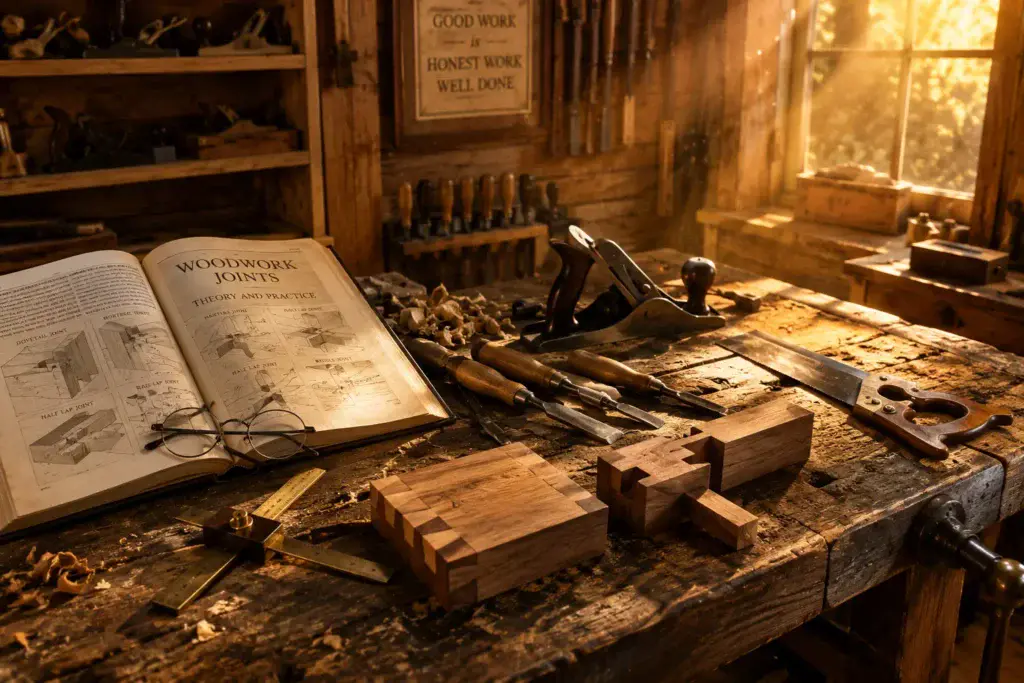
Centered on the famous Dominy workshop, With Hammer in Hand offers a fascinating look at how generations of craftsmen worked before electricity transformed the woodworking world. Original tools, surviving furniture, and detailed historical research reveal how traditional joinery was applied in everyday life.
Reading it feels less like studying and more like stepping into an active workshop from another era.
What You’ll Learn
- Traditional woodworking practices
- Historical furniture construction
- Hand-tool techniques
- Joinery used by early craftsmen
- Workshop organization
- Craftsmanship through history
Why It Belongs in Your Library
Understanding how master craftsmen solved problems with limited tools often inspires smarter, simpler solutions in today’s workshop.
Ideal for: Woodworkers who appreciate history, traditional craftsmanship, and period furniture.
20. The Workbench Book by Scott Landis
Every accurate joint begins long before the saw touches the wood.
It begins with a stable workbench.
Scott Landis explores workbench designs from around the world, explaining why different styles evolved and how each supports particular woodworking techniques.
As you read, you begin to realize that the workbench isn’t just another shop accessory.
It’s one of the most important tools you’ll ever own.
What You’ll Learn
- Traditional workbench designs
- Clamping strategies
- Work-holding systems
- Bench accessories
- Workshop ergonomics
Why It Belongs in Your Library
A better workbench doesn’t simply make woodworking more comfortable—it makes accurate joinery significantly easier.
Ideal for: Every woodworker planning a workshop upgrade.
21. The Workshop Book by Scott Landis
There’s an old saying that a tidy workshop leads to a tidy mind.
Whether or not that’s always true, an organized workshop certainly makes woodworking more enjoyable.
Scott Landis visits workshops of every size, showing how experienced woodworkers solve common problems involving space, storage, lighting, and workflow.
The ideas range from simple improvements to complete shop redesigns, making this book useful whether you’re working in a garage, basement, or dedicated workshop.
What You’ll Learn
- Efficient workshop layouts
- Tool storage systems
- Lighting solutions
- Workflow planning
- Space-saving ideas
- Shop organization
Why It Belongs in Your Library
Less time searching for tools means more time building furniture.
Small improvements in workshop layout often have a surprisingly large impact on productivity.
Ideal for: Woodworkers at every experience level.
22. Adventures in Wood Finishing by George Frank
Even flawless joinery deserves a finish that enhances rather than hides it.
George Frank’s classic has earned legendary status because it goes far beyond explaining stains and varnishes. It teaches readers how to bring out the natural beauty already hidden within the wood.
Throughout the book, finishing becomes an extension of craftsmanship rather than the final task on a checklist.
What You’ll Learn
- Surface preparation
- Coloring techniques
- Traditional finishes
- Repair methods
- Wood enhancement
- Professional finishing practices
Why It Belongs in Your Library
Beautiful joinery deserves an equally beautiful presentation, and few books explain finishing with as much clarity and enthusiasm.
Ideal for: Furniture makers seeking professional-looking results.
23. Furniture with Soul by David Savage
Some books improve your woodworking.
Others change the way you think about creating furniture.
David Savage explores craftsmanship from a deeply personal perspective, encouraging readers to move beyond measurements and machinery to create work that reflects thought, intention, and individuality.
His writing is honest, thoughtful, and often inspiring.
By the end, you’ll likely find yourself looking at your own projects with fresh eyes.
What You’ll Learn
- Furniture design
- Creative decision-making
- Joinery selection
- Professional craftsmanship
- Developing personal style
- Problem-solving techniques
Why It Belongs in Your Library
It reminds us that woodworking isn’t only about making objects.
It’s also about creating something meaningful.
Ideal for: Intermediate and advanced furniture makers.
24. By Hand & Eye by George R. Walker and Jim Tolpin
One challenge many woodworkers eventually face has nothing to do with cutting joints.
It’s designing furniture that simply looks right.
Why does one cabinet appear perfectly balanced while another feels awkward, even when both are built accurately?
By Hand & Eye answers that question by introducing traditional systems of proportion that craftsmen relied on long before rulers and calculators dominated workshop benches.
What You’ll Learn
- Classical proportions
- Visual balance
- Layout techniques
- Traditional geometry
- Furniture design principles
- Historical design methods
Why It Belongs in Your Library
Understanding proportion transforms good woodworking into beautiful woodworking.
It’s a lesson that stays with you long after you’ve finished reading.
Ideal for: Furniture builders interested in design as much as construction.
25. The Intelligent Hand by David Savage
The final recommendation on this list feels like an appropriate ending because it focuses on the lifelong journey of craftsmanship itself.
David Savage writes about patience, observation, continuous learning, and the habits that separate competent woodworkers from exceptional ones.
There’s very little obsession with shortcuts.
Instead, readers are encouraged to embrace deliberate practice, thoughtful decision-making, and genuine curiosity.
It’s the kind of book that grows more meaningful with every passing year.
What You’ll Learn
- Professional craftsmanship
- Creative thinking
- Workshop discipline
- Problem-solving
- Long-term skill development
- Mindset for continual improvement
Why It Belongs in Your Library
The greatest lesson isn’t a specific joint or technique.
It’s understanding that mastery is never finished.
There’s always another skill to refine and another lesson to discover.
Ideal for: Anyone committed to becoming a better craftsman over the long term.
The Best Joinery Books for Furniture Makers
Furniture making asks more of your joinery than almost any other area of woodworking.
A dining table has to remain flat despite changing humidity.
A chair must endure years of shifting weight without loosening.
A cabinet door should close smoothly today and just as smoothly many years from now.
That level of durability comes from understanding not only how to make strong joints but also why certain joints belong in certain pieces of furniture.
Several books in this guide stand out for furniture builders in particular.
Among the strongest choices are:
- The Complete Illustrated Guide to Joinery
- Tage Frid Teaches Woodworking – Book One: Joinery
- The Technique of Furniture Making
- The Essential Woodworker
- The Why & How of Woodworking
- Furniture with Soul
Together, they offer an exceptional blend of practical instruction, thoughtful design, and professional craftsmanship.
Essential Reading for Hand Tool Woodworkers
Working with hand tools changes the pace of woodworking.
Every cut demands attention.
Every shaving reveals something about the wood beneath it.
Many woodworkers discover that hand tools encourage patience in a way machines rarely can.
They slow the process just enough for technique and precision to improve naturally.
If traditional woodworking appeals to you, these books deserve special attention:
- The Essential Woodworker
- Japanese Joinery
- Japanese Woodworking Tools
- The Anarchist’s Tool Chest
- Making and Mastering Wood Planes
- Woodwork Joints
Each title develops skills that remain valuable regardless of how many power tools eventually fill your workshop.
Outstanding Joinery Books for Cabinetmakers
Cabinetmaking is often described as woodworking’s precision sport.
A mistake measuring just one millimeter can multiply across an entire run of cabinets.
Doors become uneven.
Drawers bind.
Face frames drift out of alignment.
That’s why cabinetmakers place such importance on reliable joinery and careful planning.
Books particularly suited to cabinet construction include:
- Cabinet Making and Millwork
- The Complete Illustrated Guide to Joinery
- The Complete Manual of Woodworking
- The Technique of Furniture Making
These books cover topics such as:
- Face-frame construction
- Frameless cabinetry
- Drawer joinery
- Casework assembly
- Panel construction
- Cabinet installation principles
Their lessons extend well beyond kitchen cabinets, improving accuracy in virtually every furniture project.
Choosing the Right Joinery Book for Your Experience Level
With twenty-five excellent books to choose from, deciding where to begin can seem like the hardest part.
The good news is that you don’t need them all immediately.
Building a woodworking library works much like building woodworking skills themselves.
One step at a time.
One carefully chosen addition after another.
If You’re Just Starting Out
Focus on books that explain the fundamentals clearly and encourage steady progress.
Excellent starting points include:
- The Complete Book of Woodworking
- The Joint Book
- The Complete Manual of Woodworking
These books establish a strong understanding of tools, materials, and the joints that appear in countless beginner projects.
If You’re Ready for More Challenging Projects
Once you’ve completed several pieces of furniture, you’ll benefit from books that explore deeper joinery concepts and more advanced construction techniques.
Strong choices include:
- The Complete Illustrated Guide to Joinery
- Joinery
- The Why & How of Woodworking
- Tage Frid Teaches Woodworking
These books help transform technical knowledge into sound woodworking judgment.
In the final part, we’ll explore how to build a woodworking library that continues to serve you for decades, answer the questions woodworkers ask most often when choosing joinery books, and finish with a practical Products / Tools / Resources section featuring valuable books, tools, and learning resources that naturally complement the techniques covered throughout this guide.
Building a Woodworking Library That Gets Better With Age
Ask experienced woodworkers how many books they own, and you’ll often hear the same answer.
“Not enough.”
That isn’t because they’re constantly chasing the latest release.
It’s because every stage of woodworking reveals new questions, and the right book often answers them better than a quick internet search ever could.
Your first woodworking book might teach you how to cut a clean mortise and tenon.
Years later, another book explains why that same joint failed after a humid summer.
Eventually, you begin studying furniture design, proportion, wood movement, and craftsmanship itself.
The learning never really stops.
That’s why building a woodworking library is so rewarding.
Unlike many hobbies where books become outdated, quality woodworking books remain useful for decades. A well-written explanation of grain direction or dovetail layout is just as valuable today as it was twenty or even fifty years ago.
Over time, your bookshelf begins to reflect your own journey.
The beginner’s guide with coffee stains across the cover.
The reference book filled with sticky notes.
The furniture design book you’ve read three times because each reading uncovered something you somehow missed before.
Those books become more than educational resources.
They become part of your workshop.
When you’re unsure about a technique, they’re there.
When you’re looking for inspiration, they’re waiting.
When you’re ready to tackle a more ambitious project, they quietly remind you that someone else has already solved many of the problems you’re about to face.
Frequently Asked Questions
I’m completely new to woodworking. Which joinery book should I buy first?
If you’re opening your very first woodworking book, it’s easy to feel overwhelmed by the number of choices.
A great starting point is The Joint Book by Terrie Noll. The illustrations are clear, the explanations are straightforward, and the layout makes it easy to understand how different joints compare.
If you’d like something that covers woodworking more broadly, The Complete Book of Woodworking by Tom Carpenter or The Complete Manual of Woodworking provide excellent foundations that extend beyond joinery alone.
The important thing isn’t choosing the “perfect” first book.
It’s choosing one you’ll actually spend time reading—and then taking those lessons into the workshop.
If I only buy one joinery book, which one gives me the most value?
For many woodworkers, The Complete Illustrated Guide to Joinery by Gary Rogowski earns that distinction.
It balances depth with clarity, covering an enormous range of woodworking joints while explaining where each one excels and how to produce reliable results.
It’s the kind of reference that grows alongside your skills.
You may first open it to learn a basic lap joint, then return years later for guidance on more advanced furniture construction.
Very few woodworking books remain that useful for so long.
Are older woodworking books still worth reading?
Without question.
Wood doesn’t behave differently because a book was written decades ago.
Mortise and tenon joints are still strong.
Dovetails still resist pulling apart.
Seasonal wood movement still matters.
Many classic woodworking books focus on craftsmanship instead of trends, which is precisely why they’ve remained respected for generations.
In fact, some of the oldest books on this list continue to be recommended by professional furniture makers because the underlying principles simply haven’t changed.
Is a printed woodworking book better than a digital version?
That depends on how you like to learn.
Printed books are wonderfully practical in the workshop. You can leave one open beside your bench, compare diagrams at a glance, and flip between pages without worrying about batteries or screens.
Digital editions offer different advantages.
They’re searchable, portable, and easy to carry when traveling or visiting the lumberyard.
Many woodworkers enjoy owning both.
A digital copy makes quick research simple, while the printed edition becomes the trusted companion that sits beside the workbench through countless projects.
How many woodworking books does someone really need?
Probably fewer than you think.
A carefully chosen collection of ten to twenty outstanding books will serve most woodworkers remarkably well for many years.
Rather than buying multiple books that repeat the same information, look for titles that complement one another.
One may specialize in traditional joinery.
Another explores furniture design.
A third explains wood science.
Together, they create a balanced library that supports continual learning without unnecessary duplication.
Which books do experienced furniture makers recommend most often?
Certain titles appear again and again whenever professional woodworkers discuss essential reading.
Among the most respected are:
- The Complete Illustrated Guide to Joinery
- The Essential Woodworker
- Tage Frid Teaches Woodworking – Book One: Joinery
- The Technique of Furniture Making
- Understanding Wood
- The Why & How of Woodworking
These books continue to earn praise because they teach lasting principles rather than temporary techniques.
Readers don’t simply learn how to build better furniture.
They learn how to think more carefully about every project they undertake.
Products / Tools / Resources
If you’re planning to build a woodworking library that will genuinely improve your skills over time, these resources are well worth considering.
Essential Books
- The Complete Illustrated Guide to Joinery by Gary Rogowski
- The Joint Book by Terrie Noll
- The Complete Manual of Woodworking
- The Essential Woodworker by Robert Wearing
- The Technique of Furniture Making by Ernest Joyce
- Understanding Wood by R. Bruce Hoadley
- The Why & How of Woodworking by Michael Pekovich
- Japanese Joinery by Kiyosi Seike
Hand Tools That Pair Perfectly With Joinery Practice
- Quality bevel-edge chisels
- Dovetail saw
- Tenon saw
- Marking gauge
- Mortise gauge
- Combination square
- Precision engineer’s square
- Wooden mallet
- Block plane
- Bench plane
- Card scraper
- Cabinet scraper
Measuring and Layout Tools
Accurate joinery begins long before the first cut.
Reliable layout tools make every stage of the process easier.
Consider adding:
- Steel rule
- Marking knife
- Digital calipers
- Wheel marking gauge
- Sliding bevel
- Precision ruler
- Story sticks for repeatable measurements
Sharpening Equipment
Even the finest joinery book can’t compensate for dull tools.
Keeping your edge tools razor sharp will improve both accuracy and enjoyment in the workshop.
Useful sharpening equipment includes:
- Diamond sharpening plates
- Water stones
- Honing guide
- Leather strop
- Flattening plate
- Sharpening compound
Power Tools for Efficient Joinery
If your workshop includes machinery, these tools can dramatically speed up joinery while maintaining excellent accuracy.
- Router with quality guide bushings
- Router table
- Table saw with dado capability
- Drill press
- Biscuit joiner
- Domino joiner (for loose-tenon construction)
- Band saw
- Thickness planer
- Jointer
Helpful Workshop Accessories
Small improvements often make a surprising difference when fitting joints and assembling projects.
Useful accessories include:
- Parallel clamps
- F-style clamps
- Corner clamps
- Bench dogs
- Holdfasts
- Assembly squares
- Glue brushes
- Silicone glue mat
- Bench hook
- Shooting board
Continuing Your Learning
The best woodworkers never stop learning.
As your confidence grows, revisit the books you’ve already read. You’ll notice techniques, observations, and subtle details that weren’t obvious the first time through.
Keep a notebook in your workshop.
Record successful joints.
Sketch ideas.
Write down mistakes and how you corrected them.
Over time, those notes become another valuable reference—one written from your own experience.
Combined with the books in this guide, they’ll help you build not only stronger joints, but also the knowledge, confidence, and craftsmanship that make woodworking such a rewarding lifelong pursuit.