
Featured Snippet
The fastest way to learn woodworking and carpentry is to master the fundamentals before investing in expensive tools. Start with safety, measuring, wood selection, and basic cutting techniques. Build simple projects that reinforce essential skills, gradually learn stronger joinery methods, and expand your tool collection only when your projects demand it. A structured learning plan helps beginners develop confidence, avoid costly mistakes, and build lasting craftsmanship.
Table of Contents
- Why Learning Woodworking Is Simpler Than You Think
- Woodworking vs. Carpentry: Understanding the Difference
- Learn the Fundamentals Before Buying Your First Tool
- Build a Beginner Tool Kit Without Wasting Money
- Master the Core Skills Every Builder Relies On
- Learn Joinery Through Projects That Build Confidence
- The Beginner Mistakes That Cost the Most Time and Money
- A Practical 90-Day Roadmap From Beginner to Builder
- Growing Beyond the Basics: Turning Skills Into Lifelong Craftsmanship
- Frequently Asked Questions
- Products / Tools / Resources
Part 1. Why Learning Woodworking Is Simpler Than You Think
Walk through any furniture showroom or admire a beautifully crafted dining table, and it’s easy to believe woodworking belongs to a different world—a place reserved for people with decades of experience, workshops packed with expensive machinery, and some mysterious talent you either have or you don’t.
That belief keeps countless people from ever making their first cut.
The truth is far less intimidating.
Every skilled carpenter, cabinetmaker, and furniture builder once stood exactly where you are now: staring at a piece of lumber, wondering where to begin and hoping they wouldn’t ruin it.
The difference wasn’t natural ability.
It was simply that they started.
Great Craftspeople Aren’t Born—They’re Built
One of the biggest misconceptions surrounding woodworking is that it’s a talent-driven craft.
In reality, it’s a skill-driven one.
The people who build beautiful furniture aren’t making perfect cuts because they’re gifted. They’re making them because they’ve repeated the same basic movements hundreds, sometimes thousands, of times.
They’ve measured enough boards to trust their eye.
They’ve made enough mistakes to recognize problems before they happen.
They’ve learned that confidence doesn’t appear overnight—it grows quietly with every completed project.
That’s encouraging news for beginners because it means progress isn’t reserved for a select few.
It’s available to anyone willing to practice consistently.
Why So Many Beginners Feel Overwhelmed
If you’ve spent any time watching woodworking videos or scrolling through social media, you’ve probably noticed something.
Everyone seems to have an incredible workshop.
Towering table saws.
Industrial dust collection systems.
Rows of perfectly organized hand tools.
Custom-built workbenches.
It’s impressive—but it’s also misleading.
What you rarely see is that most of those workshops were built gradually over years of learning.
The final destination is visible.
The early chapters usually aren’t.
This creates the illusion that woodworking requires a major financial investment before you can accomplish anything meaningful.
It doesn’t.
Some of the most valuable lessons in woodworking come from a handful of affordable tools, a small workspace, and the willingness to build something imperfect.
The Real Secret Is Following the Right Order
Most beginners assume the journey looks something like this:
Buy tools.
Watch videos.
Attempt a complicated project.
Get frustrated.
Buy more tools.
Repeat.
Experienced builders know the order should be almost the opposite.
Learn how wood behaves.
Practice measuring.
Understand safe tool use.
Complete small projects.
Develop reliable techniques.
Then invest in equipment as your skills expand.
This sequence saves money, shortens the learning curve, and creates confidence because every new challenge builds naturally on the one before it.
Woodworking rewards steady progress far more than rapid ambition.
Why Woodworking Is One of the Most Rewarding Skills You Can Learn
Few hobbies produce something you can actually use every day.
Woodworking does.
A shelf isn’t just practice.
It’s something that holds your books.
A workbench isn’t simply another project.
It becomes the foundation for every future build.
A dining table eventually becomes the place where birthdays are celebrated, homework gets finished, and conversations unfold late into the evening.
There’s a quiet satisfaction in creating something that exists because of your own hands.
It’s difficult to describe until you’ve experienced it.
The first project may have uneven joints or visible sanding marks.
You might notice every tiny flaw.
Everyone else will notice something different.
They’ll see something you made.
And that feeling has a way of pulling people back into the workshop again and again.
Woodworking Teaches More Than Technical Skills
At first glance, woodworking seems to be about wood.
Spend enough time doing it, though, and you realize it’s really about learning how to think.
Every project asks questions.
How should these pieces fit together?
Which joint will be strongest?
What’s the safest way to make this cut?
Can this design be improved?
Each answer develops a mindset built around observation, patience, and problem-solving.
Over time, those habits begin to extend beyond the workshop.
You become more methodical.
More resourceful.
More comfortable solving problems instead of avoiding them.
It’s one of the hidden benefits of the craft—one that rarely appears in beginner guides but becomes obvious after a few completed projects.
Progress Happens One Project at a Time
It’s tempting to look ahead and imagine building custom cabinets, handcrafted furniture, or elaborate home renovations.
Keep those goals.
But don’t let them distract you from the next small step.
Woodworking isn’t mastered through one ambitious project.
It’s mastered through dozens of manageable ones.
Each project introduces a new lesson.
One teaches accurate measuring.
Another improves your drilling technique.
A different one helps you understand wood movement or surface preparation.
Those lessons accumulate quietly until one day you realize you’re building things that once felt impossible.
Growth in woodworking is rarely dramatic.
It’s gradual.
And that’s exactly what makes it sustainable.
Forget Perfection—Aim for Improvement
Many beginners delay starting because they want their first project to look professional.
It won’t.
And that’s perfectly normal.
The goal of your first project isn’t perfection.
It’s experience.
Every cut teaches something.
Every mistake leaves behind useful knowledge.
Every completed project becomes evidence that you’re capable of learning something new.
Professional woodworkers don’t avoid mistakes because they’re experts.
They’re experts because they’ve learned from more mistakes than beginners have even encountered.
That’s an important distinction.
Instead of asking whether your project is flawless, ask a better question:
Did I learn something I’ll do better next time?
If the answer is yes, the project was a success.
Your Journey Starts With One Simple Decision
You don’t need a dedicated workshop.
You don’t need every tool on the market.
You don’t need years of experience.
What you need is the willingness to begin.
A tape measure.
A few basic tools.
A piece of lumber.
And enough curiosity to discover what you’re capable of building.
Everything else comes later.
Not all at once, but steadily—project by project, skill by skill, until the person who once wondered how to learn woodworking becomes someone confidently teaching others.
That’s how every craftsperson starts.
Not with mastery.
But with a single decision to make the first cut.
Part 2. Woodworking vs. Carpentry: Understanding the Difference
If you’re just beginning, one question almost always surfaces early:
Should I learn woodworking or carpentry first?
It’s a fair question—and one that causes more confusion than it should.
The answer isn’t choosing one over the other.
It’s understanding how they connect.
Think of them as two paths that start on the same trail. For the first stretch, you’re learning the same essential skills. Only later do those paths begin to branch in different directions, depending on the kind of work you enjoy most.
Once you understand that relationship, the learning process becomes much less intimidating.
Two Crafts, One Foundation
People often use the words woodworking and carpentry interchangeably, but they aren’t identical.
Woodworking is centered on creating objects from wood. It leans toward craftsmanship, detail, and design. Furniture, cabinets, shelves, cutting boards, decorative pieces, and fine joinery all fall under its umbrella.
Carpentry, on the other hand, is rooted in construction. Carpenters build the structures people live and work in. They frame walls, install doors and windows, fit trim, build staircases, construct decks, and renovate homes.
One discipline focuses on what goes inside a building.
The other often helps create the building itself.
Despite those differences, both demand the same fundamental abilities.
The Skills That Connect Both Worlds
Whether you’re crafting a walnut coffee table or building a backyard shed, the work begins in remarkably similar ways.
You’ll still need to:
- Measure accurately
- Read dimensions correctly
- Understand how wood behaves
- Make clean, controlled cuts
- Assemble parts precisely
- Use tools safely
- Solve unexpected problems
These aren’t woodworking skills.
They’re builder’s skills.
And they’re valuable no matter which direction you eventually choose.
That’s why beginners don’t need to worry about specializing immediately.
Master the basics first.
Specialization comes naturally later.
Wood Doesn’t Care What You’re Building
One of the biggest lessons every beginner learns is that wood follows its own rules.
A pine board doesn’t know whether it’s becoming a cabinet door or part of a roof frame.
It responds to moisture.
It follows the grain.
It expands.
It contracts.
It can split if handled carelessly and last for generations if treated well.
Learning to understand the material itself is far more important than deciding whether you identify as a woodworker or a carpenter.
Once you understand the material, building becomes much more predictable.
Precision Looks Different in Each Craft
Although the same core skills apply, the level of precision often changes depending on the project.
A cabinet door that sits slightly crooked will catch your eye every single day.
A wall hidden behind drywall has different priorities.
Furniture often demands millimeter-level precision because every joint remains visible.
Construction work usually prioritizes strength, durability, and efficiency while still maintaining strict building standards.
Neither approach is easier.
They’re simply solving different problems.
That’s an important distinction.
Woodworking asks:
“How can I make this beautiful?”
Carpentry often asks:
“How can I make this strong, safe, and reliable?”
The best builders eventually learn to do both.
Why Beginners Benefit From Learning Both
Many people assume they have to choose a lane immediately.
In reality, combining woodworking and carpentry creates a much stronger foundation.
A woodworker who understands construction builds furniture that’s structurally sound.
A carpenter with woodworking experience often produces cleaner trim, tighter joints, and more refined finishes.
Each discipline strengthens the other.
For example:
Learning framing teaches you how loads move through a structure.
Learning furniture making teaches you how tiny adjustments affect alignment and appearance.
Together, they develop a more complete understanding of craftsmanship.
Which Path Fits Your Personality?
As you spend more time building, you’ll naturally discover the type of work that excites you.
Some people love precision.
Others love scale.
Neither preference is better—they simply reflect different personalities.
You May Enjoy Woodworking If You Like:
- Designing custom furniture
- Building cabinets
- Working with hardwoods
- Fine joinery
- Decorative details
- Slow, deliberate craftsmanship
- Creating heirloom-quality pieces
Woodworking rewards patience and careful observation.
If you enjoy refining small details until everything feels just right, you’ll probably feel at home here.
You May Enjoy Carpentry If You Like:
- Home improvement projects
- Construction
- Renovation work
- Building decks and sheds
- Installing doors and trim
- Working outdoors
- Solving practical problems quickly
Carpentry often involves larger projects, faster workflows, and adapting to constantly changing job sites.
It’s ideal for people who enjoy seeing immediate, tangible progress.
Don’t Let Labels Limit Your Learning
One of the best things about woodworking and carpentry is that neither exists in isolation.
A carpenter may build custom shelving one day and frame a room the next.
A furniture maker might install built-in cabinets that require structural knowledge.
Modern builders frequently move between both worlds without thinking much about the distinction.
So don’t worry about giving yourself a title.
Focus on becoming someone who understands wood.
Everything else will follow.
Start With Projects That Teach Universal Skills
Rather than choosing projects based on whether they’re “woodworking” or “carpentry,” choose them based on what they’ll teach you.
Some excellent beginner builds include:
- A storage crate
- A simple shelf
- A plant stand
- A step stool
- A small workbench
- Wall-mounted organizers
These projects introduce essential techniques such as:
- Measuring and layout
- Straight cuts
- Drilling
- Clamping
- Sanding
- Assembly
- Basic joinery
They’re uncomplicated enough to build successfully while still challenging enough to develop real skills.
Every completed project becomes another layer in your foundation.
Your Goals May Change—and That’s a Good Thing
Many experienced craftspeople smile when asked how they got started.
Their answer is often surprisingly simple.
“I just wanted to build one thing.”
That one project became another.
Then another.
Some eventually built furniture for their homes.
Others renovated entire houses.
Some discovered a passion for cabinetry.
Others turned woodworking into a business.
Very few knew exactly where the journey would lead when they began.
You don’t need to know either.
Curiosity is enough.
The direction becomes clearer with every project you complete.
Focus Less on the Name, More on the Craft
At this stage, it doesn’t matter whether someone calls you a beginner woodworker or an aspiring carpenter.
What matters is learning the habits both professions rely on.
Measure carefully.
Cut deliberately.
Respect your tools.
Understand your materials.
Build patiently.
Those habits will carry you much further than any label ever could.
Long before you identify with a particular discipline, you’ll discover something much more valuable:
You’ll become someone who knows how to turn an ordinary piece of wood into something useful, beautiful, and built to last.
Part 3. Learn the Fundamentals Before Buying Your First Tool
It’s easy to believe that woodworking begins with a shopping list.
Open social media, watch a few workshop tours, or browse an online tool catalog, and you’ll see rows of gleaming machines, specialty jigs, and walls lined with equipment that seem essential to the craft.
For a beginner, it’s convincing.
It also happens to be one of the biggest myths in woodworking.
The truth is that the quality of your work has far less to do with what you own than with what you understand.
A skilled craftsperson can create remarkable work with a modest collection of tools because they’ve learned the principles behind every cut, every joint, and every decision.
That’s where your attention belongs first.
Not in filling a workshop.
In building a foundation.
Learn the Material Before You Learn the Machines
Wood has a personality of its own.
Unlike plastic or metal, it changes with its environment. It responds to humidity, temperature, and time. It expands in one season, contracts in another, and often reveals its character in ways that surprise beginners.
The moment you stop treating wood like a static material and start understanding how it behaves, your projects begin to improve.
You’ll notice grain patterns before making a cut.
You’ll think about seasonal movement before gluing panels together.
You’ll choose lumber more carefully because you understand that every board tells a different story.
This awareness separates thoughtful craftsmanship from simple assembly.
Hardwood and Softwood Aren’t What Most People Think
One of the first misconceptions beginners encounter is the idea that hardwoods are always hard and softwoods are always soft.
Nature isn’t quite that simple.
The names refer to the type of tree rather than the actual hardness of the wood.
Hardwoods generally come from deciduous trees that lose their leaves each year.
Popular examples include:
- Oak
- Maple
- Walnut
- Cherry
- Ash
These woods are often chosen for furniture because they’re durable, attractive, and finish beautifully.
Softwoods come from evergreen trees such as:
- Pine
- Cedar
- Spruce
- Fir
They’re widely used in framing, outdoor projects, shelving, and beginner builds because they’re easier to find and typically more affordable.
Neither category is automatically better.
The best choice always depends on what you’re building.
Grain Direction Is More Important Than You Realize
Every board has a natural grain.
Learning to recognize it is one of the quiet skills that transforms average work into clean, professional craftsmanship.
Cut with the grain, and your tools tend to move smoothly.
Work against it, and the wood may tear, splinter, or leave rough surfaces that require extra sanding.
The grain also influences:
- Strength
- Appearance
- Glue performance
- Finishing quality
- Wood movement over time
Experienced builders instinctively study a board before making the first cut.
It’s a habit worth developing from day one.
Moisture Changes Everything
Fresh lumber contains moisture.
Even dried lumber continues exchanging moisture with the surrounding air.
This constant movement explains why wood expands during humid summers and shrinks in dry winters.
Ignoring that reality often leads to problems such as:
- Cracked panels
- Warped tabletops
- Sticking drawers
- Split joints
- Twisted boards
Understanding moisture doesn’t require advanced knowledge.
It simply means recognizing that wood is always moving—and designing projects that allow it to do so naturally.
Measuring Is the Skill That Supports Every Other Skill
Ask experienced woodworkers what causes the most beginner mistakes, and you’ll hear one answer repeatedly.
Poor measuring.
Almost every problem in woodworking can be traced back to an inaccurate layout.
One incorrect mark creates one incorrect cut.
That cut affects the joint.
The joint affects the assembly.
Eventually, a tiny mistake becomes a project-wide problem.
Learning to measure carefully is one of the highest-return investments you can make.
Become Comfortable With a Tape Measure
Reading a tape measure quickly and accurately is a skill worth practicing on its own.
You should become comfortable identifying:
- Whole inches
- Half inches
- Quarter inches
- Eighths
- Sixteenths
The faster these measurements become second nature, the smoother every project will feel.
There’s no shortcut here.
Only repetition.
Mark Clearly Before You Cut
Professional builders rarely rush from measuring directly to cutting.
They pause.
They confirm.
They mark intentionally.
Useful layout tools include:
- Combination square
- Speed square
- Marking knife
- Carpenter’s pencil
- Straightedge
- Marking gauge
Each one improves consistency by helping you create clear, accurate reference lines.
Good cuts begin with good layout.
“Measure Twice, Cut Once” Is More Than a Saying
You’ve probably heard the phrase countless times.
There’s a reason it’s survived for generations.
Wood is forgiving in some ways.
Length isn’t one of them.
Before making any cut, ask yourself:
- Is this the correct measurement?
- Am I cutting on the waste side of the line?
- Have I accounted for the blade’s thickness?
- Is the board facing the right direction?
- Did I verify the measurement one final time?
Those few extra seconds often prevent costly mistakes.
Professional builders aren’t slow because they lack confidence.
They’re deliberate because experience has taught them how expensive rushing can become.
Safety Isn’t a Separate Lesson
Many beginners think about safety only when using large power tools.
In reality, safety begins with your first project.
It’s not something you remember occasionally.
It’s something you practice constantly.
Develop habits such as:
- Wearing eye protection whenever you’re cutting or drilling
- Using hearing protection around loud equipment
- Controlling dust with an appropriate mask or respirator
- Clamping workpieces securely before cutting
- Keeping blades sharp and clean
- Maintaining an organized workspace
- Disconnecting power before changing blades or bits
These routines become automatic over time.
And when they do, you’ll not only work more safely—you’ll work more accurately.
Learn Tool Control Before Tool Collection
It’s tempting to believe that bigger machines produce better work.
They don’t.
They simply amplify the skills you already have.
Learning with basic hand tools develops abilities that every advanced machine depends on.
You’ll naturally improve:
- Hand-eye coordination
- Pressure control
- Cutting accuracy
- Grain awareness
- Body positioning
When you eventually move to larger power tools, those habits transfer seamlessly.
The machine becomes an extension of your technique rather than a substitute for it.
Practice the Movements You’ll Use Forever
The best woodworking practice isn’t always building another project.
Sometimes it’s repeating one simple motion until it feels effortless.
Spend time practicing:
- Drawing straight layout lines
- Measuring identical dimensions
- Making square cuts
- Drilling centered holes
- Driving screws cleanly
- Sanding evenly
- Applying glue consistently
- Clamping without shifting parts
These exercises may seem ordinary.
They’re anything but.
They’re the same skills professional builders rely on every single day.
Mastering them early pays dividends for the rest of your woodworking journey.
Knowledge Saves More Money Than Any Tool Ever Will
One of the most expensive habits beginners develop is buying solutions instead of learning them.
When a cut isn’t straight, they assume they need another saw.
When joints don’t fit, they buy another jig.
When projects feel difficult, they purchase another tool.
Sometimes the solution really is new equipment.
More often, it’s a better understanding of the fundamentals.
Knowledge compounds.
Every concept you learn improves every future project.
Every skill you develop makes every existing tool more valuable.
That’s why experienced woodworkers often say the smartest investment isn’t a machine.
It’s experience.
Build Skills Before You Build a Workshop
A workshop grows naturally over time.
Every project teaches you something.
Every challenge reveals a new need.
Eventually, your collection of tools begins to reflect the kind of work you enjoy most.
That’s how the best workshops are built.
Not all at once.
Not through impulse purchases.
But gradually, with purpose.
When you focus on learning before buying, something unexpected happens.
You stop asking, “What tool should I buy next?”
Instead, you begin asking a much better question:
“What skill will make my next project better?”
That shift in thinking is where real craftsmanship begins.
Part 4. Build a Beginner Tool Kit Without Wasting Money
Walk into a hardware store for the first time, and it’s easy to feel like you’re already behind.
Shelves are packed with tools promising cleaner cuts, faster builds, smoother finishes, and professional results. Every aisle seems to suggest that one more purchase is the missing piece between where you are now and where you want to be.
It’s an expensive illusion.
The truth is, most experienced woodworkers didn’t build impressive workshops overnight. They built them slowly, one project at a time. Each new tool earned its place because it solved a real problem—not because it looked impressive on a shelf.
That’s the mindset worth adopting from the very beginning.
Your goal isn’t to own the biggest collection.
It’s to own the right collection.
Think Like a Builder, Not a Collector
Tools are incredibly satisfying to buy.
Using them well is another story.
Many beginners fall into the same cycle. They spend hundreds—or even thousands—of dollars assembling a workshop before they’ve completed a single project. Months later, half those tools are still sitting untouched.
A better approach is surprisingly simple.
Buy the tools you’ll actually use.
Then let your projects tell you what comes next.
If you build three shelves and realize cutting long, straight boards is slowing you down, that’s a sign you may benefit from upgrading your saw.
If you’re making furniture and constantly trimming edges, perhaps a router deserves a place in your shop.
The project reveals the need.
The purchase becomes intentional.
That approach saves money while ensuring every tool contributes to your growth.
Start With Measuring and Layout Tools
Before you cut a single board, you need to know exactly where that cut belongs.
That’s why measuring and layout tools deserve priority over almost everything else.
A reliable tape measure should feel comfortable in your hand and lock securely without bending too easily.
Pair that with a combination square, and you’ll be able to check right angles, mark accurate lines, and verify that parts fit together the way they’re should.
A speed square is equally valuable, especially when making quick crosscuts or checking ninety-degree corners.
Keep a sharp carpenter’s pencil nearby, but don’t overlook a marking knife. A knife creates crisp layout lines that are far more precise than thick pencil marks, especially when fine joinery becomes part of your projects.
These tools aren’t exciting purchases.
They’re foundational ones.
Every accurate project begins long before the saw touches the wood.
Hand Tools That Teach Real Craftsmanship
Power tools make work faster.
Hand tools make you better.
They slow the process just enough to help you understand what’s happening beneath your hands. You begin to feel the grain, notice subtle resistance, and develop a level of control that machines alone can’t teach.
A beginner doesn’t need an enormous hand tool collection.
A carefully chosen handful is more than enough.
A Good Hammer
A balanced claw hammer quickly becomes one of the most-used tools in your workshop.
It handles light assembly, tapping joints into place, driving nails, and countless small adjustments during a project.
Comfort matters more than appearance.
Choose one that feels natural rather than unnecessarily heavy.
A Reliable Handsaw
Even if you eventually rely on power saws, learning with a handsaw develops control that transfers to every cutting tool you’ll ever own.
It teaches patience.
It teaches accuracy.
Most importantly, it teaches you to follow a layout line instead of forcing a cut.
Those habits never stop being valuable.
Sharp Chisels
Few tools are as versatile as a quality set of chisels.
They’re used for trimming joints, cleaning corners, fitting hardware, removing glue squeeze-out, and making countless fine adjustments that machines simply can’t accomplish.
One thing matters above everything else:
Keep them sharp.
A sharp chisel slices cleanly and predictably.
A dull one demands extra force, increasing both frustration and the chance of injury.
A Block Plane
Small enough to fit in one hand, a block plane can transform rough edges into clean, finished surfaces within seconds.
It’s perfect for:
- Softening sharp corners
- Fine-tuning joints
- Removing tiny imperfections
- Trimming doors or drawers for a perfect fit
It’s one of those tools you may not think you need—until you own one.
Then you wonder how you managed without it.
Screwdrivers and a Utility Knife
A dependable set of screwdrivers and a sharp utility knife solve dozens of small workshop tasks every week.
From opening material packages to trimming veneer and marking cut lines, these simple tools quietly earn their keep on nearly every project.
Clamps: The Tool Everyone Wishes They Bought Sooner
Ask experienced woodworkers what beginners underestimate most, and clamps will almost certainly come up.
There’s an old saying in woodworking:
“You can never have too many clamps.”
Like most workshop sayings, it contains more truth than exaggeration.
Clamps act as an extra pair of hands.
They hold parts steady while you drill.
They keep joints aligned during glue-ups.
They prevent boards from shifting when precision matters most.
For beginners, a small collection of bar clamps and quick-release clamps covers the majority of projects.
As your builds become larger, your clamp collection will naturally grow with them.
The First Power Tools Worth Buying
Power tools save time, reduce physical effort, and open the door to more ambitious projects.
The key is buying them in the order that provides the greatest value.
Cordless Drill and Driver
If there were only one power tool every beginner should own, this would be it.
A cordless drill handles drilling, driving screws, assembling furniture, installing hardware, and countless household repairs.
Quality matters here because you’ll reach for this tool constantly.
A dependable drill quickly becomes the workhorse of the entire workshop.
Circular Saw
For beginners, a circular saw offers tremendous versatility.
With a straightedge guide, it can produce surprisingly accurate cuts while taking up far less space than larger stationary machines.
It’s capable of cutting plywood, trimming dimensional lumber, and preparing material for everything from shelves to workbenches.
For many home workshops, it’s one of the smartest early investments.
Random Orbital Sander
A beautiful finish begins long before stain or paint enters the picture.
Smooth preparation matters.
A random orbital sander removes milling marks, levels surfaces, and prepares wood for finishing far more efficiently than sanding by hand.
It also reduces fatigue, making larger projects much more enjoyable to complete.
Jigsaw
Not every project consists of straight lines.
A jigsaw allows you to create curves, cut openings, trim irregular shapes, and tackle creative designs that would otherwise be difficult with basic saws.
While it isn’t the most precise saw in every situation, its versatility makes it an excellent addition once your projects become more varied.
Router
Many beginners assume routers are advanced tools reserved for professionals.
In reality, they become incredibly useful surprisingly early.
A router allows you to:
- Round over sharp edges
- Cut dados and rabbets
- Create decorative profiles
- Flush-trim edges
- Improve joinery accuracy
As your confidence grows, the router often becomes one of the most frequently used tools in the workshop.
The Expensive Tools That Can Wait
One of the easiest ways to overspend is by buying machinery before you’ve reached the point where it genuinely improves your workflow.
There’s nothing wrong with owning advanced equipment.
There’s simply no rush.
Tools that most beginners can comfortably postpone include:
- Cabinet table saws
- Jointers
- Thickness planers
- Drill presses
- Large bandsaws
- CNC machines
- Wide drum sanders
These tools shine when you’re producing larger projects regularly or working with rough lumber on a consistent basis.
Until then, they’re often expensive solutions to problems you haven’t encountered yet.
Should You Buy New or Used?
For many beginners, buying used tools is one of the smartest financial decisions available.
Well-built tools are often designed to last for decades.
A carefully maintained used drill, planer, or bandsaw can deliver years of reliable service at a fraction of the cost of buying new.
That said, inspect used equipment carefully.
Check for excessive wear, damaged cords, missing safety features, rust that affects function, or signs of poor maintenance.
When in doubt, research the model before committing.
A little homework today can prevent expensive regrets tomorrow.
Don’t Forget the Tools That Protect You
Safety equipment rarely generates excitement.
It also happens to be some of the most important gear you’ll ever buy.
Protecting your eyesight, hearing, and lungs isn’t optional.
It’s part of responsible craftsmanship.
Your workshop should include:
- Safety glasses
- Hearing protection
- Dust mask or respirator
- Push sticks for table saw work
- First-aid kit
- Fire extinguisher
These items won’t make your projects look better.
They’ll help ensure you can keep building them for years to come.
Organize Your Workshop From Day One
Even a small workspace feels larger when it’s organized well.
Develop simple habits early.
Return tools to the same location after each use.
Sweep away sawdust regularly.
Store screws, nails, and hardware in labeled containers.
Keep measuring tools together.
Charge batteries before putting tools away.
An organized workshop reduces frustration, improves safety, and allows you to spend more time building instead of searching for what you need.
Good organization isn’t about perfection.
It’s about creating a workspace that helps you stay focused.
Build Your Workshop the Same Way You Build Your Skills
The best workshops aren’t assembled in a weekend.
They evolve.
Every project teaches you something new.
Every challenge exposes a gap.
Every solution shapes the next purchase.
Eventually, you’ll look around your workspace and realize every tool has a story behind it.
You didn’t buy it because someone else said you should.
You bought it because your own experience proved you were ready for it.
That’s a much smarter way to build a workshop—and a far more rewarding way to become a woodworker.
Part 5. Master the Core Skills Every Builder Relies On
Ask ten experienced woodworkers what separates a beginner from someone who builds with confidence, and you’ll hear ten different stories.
One might talk about years of experience.
Another might point to expensive machinery.
Someone else might credit a great mentor.
Look a little closer, though, and you’ll notice something they all have in common.
They’ve mastered the same small group of skills.
Not flashy techniques.
Not complicated joinery.
Just the fundamentals, repeated so often that they no longer have to think about them.
That’s the real turning point in woodworking.
The moment the basics become second nature, everything else starts to feel easier.
Projects move more smoothly. Mistakes become less frequent. Confidence grows—not because every build is perfect, but because you know how to recover when something doesn’t go exactly as planned.
Accurate Measuring Is the Habit That Holds Everything Together
Every successful project begins long before the first cut.
It begins with careful measuring.
A difference of just a millimeter may not seem important when you’re marking a board, but by the time you’ve assembled several pieces, that tiny error can multiply into gaps, uneven joints, or parts that simply don’t fit.
That’s why experienced builders never rush this stage.
They pause.
They verify.
Then they measure again.
Over time, you’ll discover that accurate measuring isn’t about working slowly.
It’s about working deliberately.
The few extra seconds spent checking a dimension often save hours of frustration later.
Learn to Make Clean, Controlled Cuts
Cutting wood seems straightforward until you actually begin.
The goal isn’t simply separating one piece from another.
The goal is making the cut exactly where you intended, while leaving an edge that’s clean enough to build from.
That takes practice.
Instead of forcing the tool through the wood, let the blade do the work.
Maintain a comfortable stance.
Watch your cut line rather than the blade itself.
Allow each movement to stay smooth and controlled.
At first, your cuts may wander slightly.
That’s normal.
Every accurate cut you make teaches your hands a little more about balance, pressure, and control.
Eventually, those movements become instinctive.
Drilling Is About Precision, Not Speed
A drill is one of the most frequently used tools in any workshop, yet beginners often underestimate how much technique it requires.
A poorly placed hole can throw off an entire assembly.
A screw driven too aggressively can split the wood.
A bit that enters at an angle may weaken the joint before the project is even finished.
Develop the habit of slowing down.
Mark hole locations carefully.
Use the correct drill bit.
Apply steady pressure instead of excessive force.
When driving screws, stop as soon as the head sits flush with the surface.
Small adjustments like these create cleaner, stronger, more professional-looking results.
Joinery Is About More Than Holding Wood Together
Every woodworking project depends on joinery.
Whether you’re using simple screws or traditional mortise-and-tenon joints, the goal remains the same.
Create a connection that’s strong, accurate, and built to last.
Beginners sometimes become fascinated with complex joints before mastering simple ones.
It’s easy to understand why.
Beautiful dovetails and intricate joinery capture attention.
Strong craftsmanship, however, begins elsewhere.
A perfectly executed butt joint is far more valuable than a poorly cut dovetail.
Focus first on alignment.
Then consistency.
Then strength.
The complexity can come later.
Clamping Is a Skill in Its Own Right
Many people think clamps simply hold pieces together while glue dries.
In reality, they do much more than that.
A well-placed clamp keeps boards aligned, prevents parts from shifting, and gives glue the pressure it needs to create a reliable bond.
Too little pressure can leave weak joints.
Too much pressure can force glue out completely or distort the workpiece.
Learning how much pressure is enough comes through experience.
As you build more projects, you’ll begin positioning clamps almost instinctively, balancing force without overdoing it.
It’s one of those quiet skills that dramatically improves the quality of your work.
Sanding Shapes the Final Impression
Few steps test a beginner’s patience quite like sanding.
It’s repetitive.
It’s dusty.
It rarely feels exciting.
Yet it’s also one of the biggest differences between a project that looks homemade and one that looks professionally crafted.
Good sanding isn’t about removing material as quickly as possible.
It’s about refining the surface.
Move through sandpaper grits gradually rather than skipping straight to finer papers.
Pay attention to the grain.
Let each grit remove the scratches left behind by the previous one.
The smoother your preparation, the better every stain, oil, or protective finish will look afterward.
Finishing doesn’t hide rough workmanship.
It highlights it.
Learn How Glue Really Works
Wood glue is remarkably strong when used correctly.
Stronger than many beginners realize.
A proper glue joint can become stronger than the surrounding wood itself.
The secret isn’t using more glue.
It’s using enough.
Spread an even, consistent layer across the mating surfaces.
Bring the pieces together without delay.
Clamp them securely and give the adhesive time to cure before stressing the joint.
Rushing this stage is one of the quickest ways to weaken an otherwise solid project.
Patience here almost always pays off.
Finishing Is the Moment Your Work Comes Alive
A project can be built beautifully and still disappoint if the finish is rushed.
Finishing protects the wood, but it also reveals its personality.
Grain patterns become richer.
Color deepens.
Subtle details emerge that were almost invisible before.
Whether you choose oil, wax, varnish, polyurethane, or paint, preparation matters more than the product itself.
Always test finishes on scrap pieces before applying them to your project.
Different wood species absorb finishes differently, and lighting can dramatically change the final appearance.
Taking time to experiment prevents unpleasant surprises when it matters most.
Learn to Read Your Mistakes
Every experienced builder develops an unusual habit.
Instead of becoming frustrated by mistakes, they study them.
A joint didn’t close properly.
Why?
A panel warped.
What caused it?
A finish dried unevenly.
What changed?
Every problem contains information.
Treat each mistake as feedback rather than failure.
Over time, you’ll begin recognizing patterns.
Perhaps your measurements drift when you rush.
Maybe your cuts wander because your stance changes.
Those observations are incredibly valuable because they transform future projects.
The best lessons in woodworking rarely come from flawless builds.
They come from figuring out why something didn’t work.
Efficiency Comes From Repetition
There’s a noticeable difference between someone completing their first project and someone who’s built twenty.
The experienced builder doesn’t necessarily move faster.
They simply waste fewer movements.
Their measuring tools are always within reach.
They know the order of operations.
They prepare before they cut.
They clean as they go.
Efficiency isn’t about hurrying.
It’s about removing unnecessary interruptions.
As your skills improve, your workflow becomes smoother almost without you noticing.
You’ll spend less time wondering what comes next and more time simply building.
Practice With Intention, Not Just Frequency
Building project after project is useful.
Building thoughtfully is even better.
Instead of asking yourself, “What should I build next?” ask a different question:
“What skill do I want to improve?”
Maybe it’s making straighter cuts.
Maybe it’s cleaner glue-ups.
Maybe it’s creating tighter joints or applying a more consistent finish.
When every project has a purpose beyond simply being completed, your progress accelerates.
That’s deliberate practice.
And it’s one of the fastest ways to become a better woodworker.
Confidence Is Built Through Repetition
There’s no single day when someone suddenly becomes a skilled craftsperson.
No ceremony.
No official milestone.
One day, you’ll simply notice that tasks which once felt intimidating now feel familiar.
You’ll mark measurements without hesitation.
You’ll cut with steady hands.
You’ll assemble projects with a clear plan already forming in your mind.
That confidence won’t come from buying another tool or watching another tutorial.
It will come from doing the work.
Again.
And again.
Every board you measure.
Every joint you fit.
Every mistake you correct.
Every project you finish.
Those small moments accumulate quietly until the skills that once demanded your full attention become second nature.
That’s when woodworking stops feeling like something you’re trying to learn and starts feeling like something you genuinely know how to do.
Part 6. Learn Joinery Through Projects That Build Confidence
If woodworking has a language, joinery is its vocabulary.
Every table, cabinet, bookshelf, or workbench tells a story through the way its pieces come together. Hidden beneath the surface, every joint has a purpose. Some are designed for strength. Others for appearance. Many quietly do both.
For beginners, though, joinery can feel intimidating.
Search online and you’ll quickly find intricate dovetails, flawless mortise-and-tenon joints, and handcrafted techniques that look more like fine art than something a newcomer could realistically attempt.
It’s inspiring—but it can also be discouraging.
The good news is that you don’t have to start there.
The strongest builders don’t begin with the most difficult joints.
They begin with the right ones.
Each new technique builds naturally on the last, turning what once felt complicated into something surprisingly familiar.
Every Strong Project Starts With a Strong Connection
Joinery isn’t about making wood look impressive.
It’s about creating reliable connections that allow a project to survive years of everyday use.
Think about the furniture around your home.
A chair supports weight every day.
A bookshelf carries dozens of heavy books.
A cabinet door opens and closes thousands of times over its lifetime.
The strength of those pieces depends less on the wood itself than on how the individual parts are connected.
That’s why learning joinery is one of the most valuable investments you can make as a beginner.
The better your joints become, the stronger—and more satisfying—your projects become.
Start With Simple Joints That Teach Essential Skills
Many beginners make the mistake of chasing complexity too early.
There’s a temptation to skip the basics and jump straight into advanced techniques because they look more impressive.
Resist that urge.
Simple joints teach lessons that advanced joints still rely on.
Accuracy.
Alignment.
Clean cuts.
Careful measuring.
Patience.
Without those foundations, even the most beautiful joint will struggle to perform.
Butt Joints: The Starting Point for Every Builder
The humble butt joint is often underestimated.
Two pieces of wood meet edge to edge or end to edge, secured with screws, nails, glue, or a combination of fasteners.
Simple?
Absolutely.
Worth mastering?
Without question.
Building reliable butt joints teaches you how to:
- Cut square ends.
- Align components accurately.
- Clamp without shifting the work.
- Drive screws cleanly.
- Assemble projects in the correct order.
Many beginner projects rely almost entirely on this joint.
Storage boxes, utility shelves, simple benches, and workshop organizers can all be built successfully while reinforcing these essential skills.
Pocket Hole Joinery: Fast, Strong, and Beginner-Friendly
Pocket hole joinery has become one of the most popular methods for new woodworkers—and for good reason.
It combines strength, speed, and simplicity without requiring years of experience.
Using a pocket hole jig, angled holes allow screws to pull two boards tightly together, creating surprisingly durable assemblies.
This technique works especially well for:
- Cabinets
- Face frames
- Tables
- Shelving
- Utility furniture
Beyond creating solid joints, pocket hole construction teaches something equally important: consistent assembly.
When every component fits together cleanly, your confidence begins to grow just as quickly as your skills.
Lap Joints: Learning Precision Through Simplicity
A lap joint removes part of the thickness from two boards so they overlap neatly.
At first glance, it seems straightforward.
In practice, it teaches several valuable lessons.
You’ll learn how to remove material evenly.
You’ll discover why flat surfaces matter.
You’ll begin appreciating how tiny inaccuracies affect the final fit.
Lap joints often appear in:
- Workbenches
- Frames
- Outdoor furniture
- Shop projects
They’re forgiving enough for beginners while introducing ideas that carry into more advanced joinery later.
Build Projects That Introduce New Joints Naturally
The best woodworking projects don’t just produce useful furniture.
They quietly teach new techniques along the way.
Rather than practicing joints on random scraps forever, apply them to something you’ll actually use.
For example:
A storage crate reinforces butt joints.
A floating shelf introduces pocket holes.
A simple workbench teaches lap joints.
A bookshelf begins introducing dados and rabbets.
Each completed project becomes more than another finished piece.
It becomes proof that you’ve added another skill to your toolkit.
Expand Into Intermediate Joinery
Once simple joints feel comfortable, it’s time to begin exploring techniques that offer greater strength, cleaner appearance, or improved functionality.
There’s no need to rush.
Progress matters far more than speed.
Dados and Rabbets: Precision That Pays Off
Dados and rabbets appear in countless furniture projects because they increase glue surface, improve alignment, and strengthen assemblies.
A dado is a groove cut across the grain.
A rabbet is a recessed edge cut along the outside of a board.
Both joints make shelves, cabinet backs, drawers, and casework noticeably stronger than relying on screws alone.
More importantly, they teach careful setup.
Unlike basic cuts, these joints demand consistency.
A groove that’s slightly too wide creates looseness.
Too narrow, and assembly becomes frustrating.
Learning to dial in precise dimensions is a milestone every woodworker benefits from reaching.
Dowel Joinery: Strength Hidden Inside
Dowels have connected furniture for generations.
When aligned correctly, they create clean, nearly invisible joints while adding impressive strength.
Success depends on one thing above all else.
Accuracy.
Every hole must line up perfectly.
Even tiny errors become obvious during assembly.
That challenge makes dowel joinery an excellent teacher.
It rewards careful measuring, thoughtful layout, and patient execution.
Those habits improve every other aspect of woodworking as well.
Advanced Joints Become Less Intimidating Over Time
When beginners first encounter traditional joinery, it often feels unattainable.
The truth is far more encouraging.
By the time you’ve mastered the earlier joints, advanced techniques won’t feel nearly as overwhelming.
Mortise-and-Tenon: A Timeless Standard
Few joints have earned more respect than the mortise-and-tenon.
Used for centuries in furniture, doors, and timber framing, it combines exceptional strength with elegant simplicity.
One piece contains a rectangular cavity.
The other forms a matching tongue that fits snugly inside.
The challenge isn’t understanding the concept.
It’s executing it accurately.
Fortunately, the measuring, cutting, and fitting skills you’ve already developed make that challenge far more manageable than it would have been months earlier.
Dovetails: The Icon of Fine Woodworking
Dovetails often symbolize craftsmanship.
Their interlocking shape creates extraordinary mechanical strength while adding unmistakable visual appeal.
They require patience.
Careful layout.
Sharp tools.
Consistent cuts.
But here’s something beginners rarely hear:
You don’t need dovetails to become a skilled woodworker.
Many outstanding furniture makers rely on a variety of joints depending on the project.
Dovetails are worth learning.
They’re simply not the place to begin.
Bridle Joints and Other Traditional Techniques
As your experience grows, you’ll encounter additional joints designed for specific situations.
Bridle joints.
Finger joints.
Sliding dovetails.
Box joints.
Loose tenons.
Spline joints.
Each one solves a particular problem.
The exciting part is that learning them becomes much easier because you’re no longer starting from zero.
You’re simply adding another tool to an already growing collection of skills.
Learn One Joint Well Before Chasing the Next
There’s a natural urge to collect techniques the same way people collect tools.
The result is often a little knowledge spread across many different joints without true confidence in any of them.
A better strategy is slower—and far more effective.
Choose one joint.
Build several projects using it.
Understand where it excels.
Discover its limitations.
Then move forward.
Depth creates confidence far faster than variety alone.
Most Joinery Problems Begin Long Before Assembly
When a joint fits poorly, beginners often blame the joint itself.
In reality, the problem usually started much earlier.
Perhaps the board wasn’t square.
Maybe measurements drifted.
The layout line wasn’t clear.
The blade wandered slightly.
Every successful joint begins with careful preparation.
Good joinery is rarely rescued during assembly.
It’s created through dozens of small decisions made before the pieces ever come together.
That’s why experienced builders spend so much time measuring, checking, and dry-fitting before reaching for glue.
Every Joint Teaches More Than One Lesson
Joinery is never just about connecting wood.
Every new joint quietly strengthens several other skills at the same time.
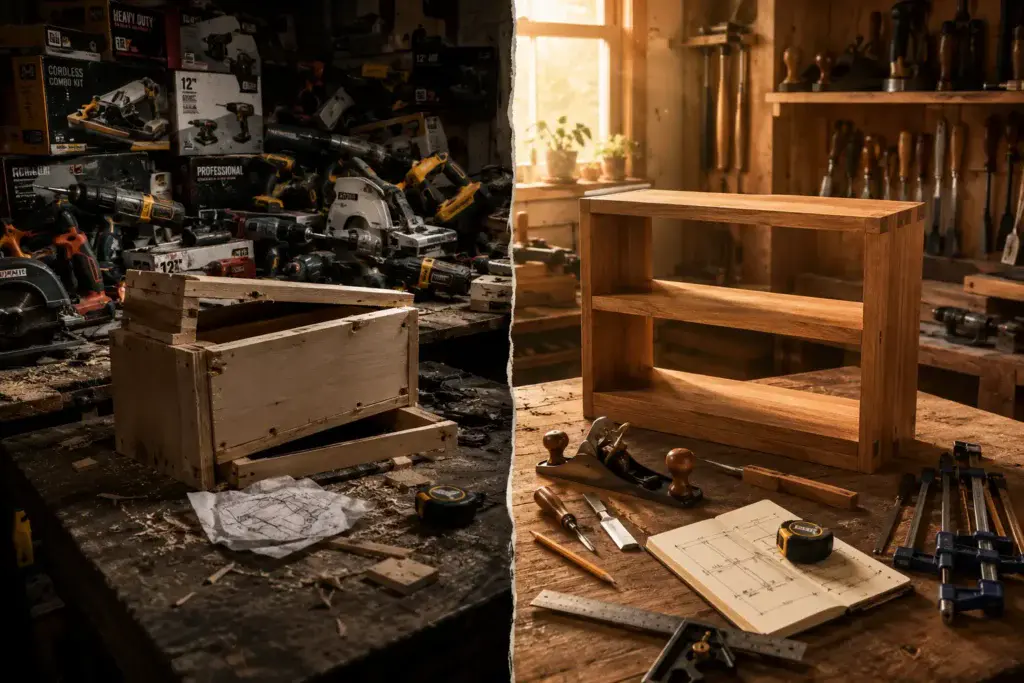
You become more accurate with measuring.
Cleaner with your cuts.
More patient during assembly.
Better at planning the order of operations.
More aware of how wood behaves under pressure.
That’s why progress often feels faster than expected.
You’re never learning just one thing.
Each project improves dozens of small abilities that work together behind the scenes.
And before long, you’ll notice something remarkable.
The joints that once looked impossibly complicated now feel like natural extensions of the fundamentals you practiced from the very beginning.
That’s how confidence grows in woodworking.
Not through shortcuts.
But through one well-built joint after another.
Part 7. The Beginner Mistakes That Cost the Most Time and Money
Every experienced woodworker has a collection of stories they’d rather not repeat.
The tabletop that came out too short because of one rushed measurement.
The expensive hardwood ruined by cutting on the wrong side of the line.
The project that looked perfect until the finish revealed every sanding scratch that had been overlooked.
Those moments are frustrating when they happen.
Looking back, though, most builders see them differently.
They weren’t failures.
They were tuition.
Woodworking has a way of teaching lessons that stay with you, especially when those lessons cost time, money, or a carefully selected piece of lumber.
The good news is that many of the most common beginner mistakes are entirely avoidable once you know where they tend to appear.
Buying Too Many Tools Too Soon
It’s easy to believe that better tools automatically lead to better projects.
Marketing encourages that idea.
So do beautifully equipped workshops online.
The reality is much simpler.
Tools amplify skill.
They don’t replace it.
A beginner with a room full of expensive equipment will often struggle more than someone with a handful of quality basics and a solid understanding of how to use them.
Before buying another tool, ask yourself one question:
Will this solve a problem I actually have, or one I imagine I might have someday?
That small pause can save hundreds of dollars over the course of your woodworking journey.
Skipping the Fundamentals
Everyone wants to build the impressive project.
Very few people get excited about practicing measurements or making repeated square cuts on scrap wood.
Yet those quiet exercises are where real progress begins.
When beginners skip the fundamentals, the same problems keep appearing.
Joints don’t line up.
Projects end up out of square.
Assembly becomes frustrating.
Instead of slowing down, they often blame the tools.
More often than not, the issue isn’t the equipment.
It’s the missing foundation underneath it.
The builders who improve the fastest are usually the ones willing to spend time mastering the skills that nobody applauds.
Ignoring How Wood Naturally Moves
Wood isn’t frozen in time.
It responds constantly to changes in humidity and temperature.
A board that fits perfectly today may expand slightly during a humid summer and shrink again in a dry winter.
Beginners often build as though the material will remain exactly the same forever.
That’s when problems begin.
Tabletops crack.
Panels split because they weren’t given room to move.
Learning to respect wood movement isn’t advanced woodworking.
It’s essential woodworking.
The sooner you understand it, the fewer unpleasant surprises you’ll encounter later.
Treating Measuring Like a Quick Step
There’s a reason experienced builders spend so much time checking dimensions.
They know that almost every major mistake starts with a small measuring error.
One inaccurate mark rarely stays isolated.
It travels through the project.
A board becomes too short.
A joint develops a gap.
Shelves no longer fit inside the cabinet.
Soon, you’re trying to fix a mistake that could have been prevented with a few extra seconds of attention.
Measuring carefully doesn’t slow the project down.
It keeps the project moving forward.
Working With Dull Blades
Few things make woodworking harder than using tools that no longer cut cleanly.
A dull saw blade tears fibers instead of slicing them.
A dull chisel crushes wood instead of shaving it.
A dull drill bit burns rather than cuts.
Many beginners assume rough cuts are caused by poor technique.
Sometimes they are.
Other times, the tool simply needs maintenance.
Sharp tools are easier to control, leave cleaner surfaces, and require less effort.
They also improve safety because they reduce the temptation to force a cut.
Maintaining your tools isn’t separate from woodworking.
It’s part of woodworking.
Letting the Workshop Become Chaotic
Creative work naturally creates clutter.
Sawdust piles up.
Offcuts collect in corners.
Hardware disappears beneath tools.
Then something unexpected happens.
Simple jobs start taking longer.
Not because the work became harder, but because you’re constantly searching for what you need.
A well-organized workshop isn’t about appearances.
It’s about momentum.
When every tool has a home and every project starts with a clean workspace, you spend more time building and less time dealing with unnecessary interruptions.
Even a small shop can feel efficient when it’s thoughtfully organized.
Skipping the Dry Fit
Glue has a way of revealing problems at exactly the wrong moment.
Once adhesive is applied, time suddenly matters.
Trying to discover whether everything fits after the glue is already spreading across the joints creates unnecessary stress.
That’s why experienced woodworkers almost always assemble projects once before reaching for the glue bottle.
A dry fit answers important questions.
Do all the parts align?
Do the joints close properly?
Are the clamps ready?
Is anything backwards?
Those few extra minutes often prevent hours of frustration.
Think of a dry fit as a rehearsal before opening night.
Rushing Through Sanding
After hours—or even days—of building, sanding often feels like the final obstacle standing between you and the finish.
Many beginners rush through it.
Then the stain goes on.
Suddenly, every scratch becomes visible.
Every uneven surface catches the light.
Every shortcut announces itself.
The finish doesn’t hide imperfections.
It magnifies them.
Take your time.
Progress through the grits methodically.
Remove the scratches from one grit before moving to the next.
The quality of your finish begins long before the finish itself.
Starting With Projects That Are Too Ambitious
There’s nothing wrong with dreaming about handcrafted dining tables or custom kitchen cabinets.
Ambition keeps people motivated.
Problems arise when those dreams become first projects.
Large, complex builds demand dozens of individual skills working together at once.
That’s a difficult environment for learning.
Smaller projects create faster feedback.
You finish them sooner.
You discover mistakes earlier.
You build confidence more consistently.
Each success becomes a stepping stone toward something larger.
Progress doesn’t come from attempting the biggest project possible.
It comes from completing the next project successfully.
Comparing Yourself to Professionals
The internet makes woodworking look effortless.
Finished projects appear flawless.
Cuts seem perfect.
Every workshop looks immaculate.
What you don’t see are the years behind those images.
The mistakes.
The failed glue-ups.
The rebuilt drawers.
The warped panels.
Every experienced craftsperson has produced work they wouldn’t show anyone today.
You’re seeing the highlight reel—not the learning process.
Compare your current project to your previous one instead.
That’s the comparison that actually matters.
If today’s work is better than last month’s, you’re moving in exactly the right direction.
Forgetting That Safety Is a Daily Habit
Accidents rarely happen because someone planned to be careless.
More often, they happen during familiar tasks.
A quick cut.
A rushed adjustment.
One moment of distraction.
That’s why experienced builders treat safety as a routine rather than an occasional reminder.
They wear eye protection without thinking about it.
They disconnect power before changing blades.
They avoid loose clothing around spinning tools.
They wait until a blade stops completely before reaching near it.
Good habits remove unnecessary risk.
And the best time to build those habits is while you’re still learning.
Chasing Perfection Instead of Progress
Perfection has stopped more woodworking projects than lack of ability ever has.
Some beginners become so afraid of making mistakes that they hesitate to start.
Others spend endless hours trying to eliminate tiny flaws that no one else will ever notice.
The irony is that improvement comes through completion.
Every finished project teaches lessons that unfinished projects never can.
Instead of asking whether your work is perfect, ask whether it’s better than the last thing you built.
That’s a goal you can reach repeatedly.
And over time, those small improvements add up to remarkable craftsmanship.
Mistakes Are Where Real Learning Happens
Every project leaves something behind.
Sometimes it’s a beautiful piece of furniture.
Sometimes it’s a lesson you won’t forget.
Both have value.
The woodworker who never makes mistakes probably isn’t building enough.
The one who studies mistakes carefully grows faster with every project.
Instead of becoming discouraged when something goes wrong, become curious.
Why did the joint fail?
Why did the finish behave differently this time?
Why did the board twist after assembly?
Those questions lead to knowledge that books alone can’t provide.
Experience has always been one of woodworking’s greatest teachers.
Build the Habit of Reflecting After Every Project
Before putting your tools away, take a few minutes to think about what happened.
Ask yourself:
- What worked exactly as planned?
- Which step caused the most difficulty?
- What would I do differently next time?
- Which skill improved the most?
- What should I practice before starting another project?
Many experienced woodworkers keep a simple notebook for this purpose.
Not because they expect every project to be perfect, but because they know every project has something valuable to teach.
That habit turns ordinary experience into steady improvement.
And over time, it becomes one of the most powerful tools in the workshop—even though it never cuts a single board.
Part 8. A Practical 90-Day Roadmap From Beginner to Builder
One of the biggest reasons people give up on woodworking isn’t a lack of talent.
It’s a lack of direction.
They watch random tutorials, buy a few tools, start a project that feels exciting, hit a problem they don’t know how to solve, and lose confidence before they ever experience the satisfaction of completing something.
It doesn’t have to happen that way.
Learning woodworking is much easier when every new skill has a purpose and every project prepares you for the next one.
Think of the next 90 days as a progression rather than a race.
You’re not trying to master every technique.
You’re building a foundation strong enough to support everything that comes afterward.
By the end of three months, you won’t know everything about woodworking—and that’s perfectly fine.
What you will have is something far more valuable: a dependable set of skills, completed projects, and the confidence to tackle increasingly ambitious builds.
Weeks 1–2: Build Strong Habits Before Building Furniture
The first two weeks should feel almost deceptively simple.
This is where you develop the habits that will shape every project you build from this point forward.
Focus your attention on learning how to work safely and accurately rather than trying to produce impressive results.
Practice reading a tape measure until common measurements become second nature.
Learn how to draw clean layout lines.
Study grain direction.
Practice making straight cuts on inexpensive lumber.
Drill holes with control instead of speed.
Sand scrap pieces until you can consistently create smooth, even surfaces.
These exercises may not produce furniture worth displaying, but they create something even more valuable.
They build confidence.
For your first real project, choose something uncomplicated.
A small storage box, shop organizer, or basic crate is ideal because it introduces measuring, cutting, assembly, and finishing without overwhelming you.
The goal isn’t perfection.
It’s completing your first project from start to finish.
Weeks 3–4: Learn to Build With Purpose
Once the fundamentals begin to feel familiar, it’s time to introduce stronger assembly methods and slightly more demanding projects.
This is the perfect stage to become comfortable with pocket hole joinery and simple glue-ups.
You’ll also begin developing a better understanding of clamping pressure and assembly order.
Instead of simply connecting pieces together, you’ll start thinking about how those connections affect strength, appearance, and long-term durability.
A floating shelf or compact side table makes an excellent project during this phase.
Neither requires advanced joinery, but both encourage greater accuracy and cleaner workmanship than your earliest builds.
You’ll likely notice something encouraging around this point.
Tasks that felt intimidating only a few weeks ago now feel surprisingly routine.
That’s how progress usually appears in woodworking.
Quietly.
Almost without you noticing.
Weeks 5–6: Expand Your Joinery Skills
With several completed projects behind you, you’re ready to move beyond the simplest joints.
Begin experimenting with dados, rabbets, lap joints, or dowels.
These techniques require more careful setup, but they also produce stronger, more refined projects.
Don’t feel pressured to learn every joint at once.
Choose one.
Practice it repeatedly.
Then introduce another.
This approach builds genuine confidence instead of scattered familiarity.
A small bookshelf, wall cabinet, or bedside organizer works particularly well during this stage because these projects naturally introduce stronger joinery while reinforcing everything you’ve already learned.
By now, measuring, cutting, sanding, and assembly should require much less conscious effort.
That mental space allows you to focus on craftsmanship rather than simply getting the project finished.
Weeks 7–8: Improve Workflow Instead of Chasing Complexity
Many beginners assume the next step is tackling more difficult furniture.
Often, the smarter move is improving how you work.
Professional builders aren’t just skilled.
They’re efficient.
They prepare materials before cutting.
They organize hardware before assembly.
They check measurements before reaching for the saw.
Develop those habits now.
Plan every project before making the first cut.
Lay out your tools in the order you’ll use them.
Keep your workspace clean throughout the build rather than waiting until the end.
A sturdy workbench is an excellent project for this stage.
You’ll use every fundamental skill you’ve learned so far while creating something that supports every future build.
It’s one of the few projects that continues paying dividends long after it’s finished.
Weeks 9–10: Take On Projects That Stretch Your Skills
Confidence grows when a project feels slightly beyond your current ability—but still achievable.
This is the stage where you begin introducing more refined craftsmanship.
Experiment with mortise-and-tenon joints if you’re ready.
Practice applying cleaner finishes.
Spend extra time fitting components precisely rather than relying on adjustments during assembly.
Consider building a coffee table, entryway bench, or small cabinet.
These projects combine multiple techniques while encouraging better planning, more accurate layout, and cleaner execution.
You may discover that you’re spending less time thinking about individual tasks and more time thinking about the project as a whole.
That’s a sign your foundational skills are becoming automatic.
Weeks 11–12: Build Something Without Following Every Instruction
The final phase of your first ninety days isn’t about learning another joinery technique.
It’s about learning to think independently.
Instead of following detailed plans step by step, try adapting an existing design or sketching one of your own.
It doesn’t need to be elaborate.
A nightstand.
A planter.
A shoe rack.
A small media shelf.
The specific project matters less than the decisions you’ll make while building it.
You’ll choose dimensions.
Adjust joinery.
Plan the assembly sequence.
Solve unexpected problems.
That’s exactly what experienced woodworkers do every day.
The confidence that comes from making those decisions yourself is difficult to replicate by simply following instructions.
Create a Weekly Practice Routine You Can Actually Maintain
Consistency beats intensity every time.
You don’t need to spend entire weekends in the workshop to improve.
Even a few focused sessions each week create remarkable progress over time.
A balanced routine might look something like this:
- Spend one session practicing a specific skill, such as measuring, cutting, or drilling.
- Dedicate another session to making progress on your current project.
- Use a third session to sand, finish, organize the workshop, sharpen tools, or review what you’ve learned.
That rhythm keeps you improving without turning woodworking into another obligation competing for your time.
Remember, steady practice almost always outperforms occasional bursts of enthusiasm.
Measure Progress by Skill, Not by Project Count
It’s easy to become focused on how many projects you’ve completed.
A better question is:
What can I do now that I couldn’t do a month ago?
Maybe your cuts are straighter.
Maybe your joints close without gaps.
Maybe your sanding leaves smoother surfaces.
Maybe you can now look at a project plan and immediately understand how the parts fit together.
Those improvements matter far more than the number of finished builds sitting in your garage.
Woodworking is a craft.
Craftsmanship develops through refinement, not speed.
Know When You’re Ready to Learn More
Many beginners wonder how they’ll know when it’s time to tackle more advanced techniques.
The answer usually arrives naturally.
You’ll notice you’re no longer struggling with the basics.
Measuring feels automatic.
Cuts are consistently accurate.
Assembly becomes predictable.
Instead of worrying about every step, you begin thinking about design, efficiency, and creative possibilities.
That’s your signal.
Not because you’ve mastered woodworking.
No one ever truly does.
But because you’ve mastered the foundation well enough to build confidently on top of it.
The Next 90 Days Are Only the Beginning
If you stay consistent, three months can change far more than your woodworking skills.
You’ll start noticing details you once overlooked.
You’ll understand why furniture is built the way it is.
You’ll walk through your home seeing projects instead of products.
Most importantly, you’ll stop thinking of yourself as someone who’s trying to learn woodworking.
You’ll simply be someone who builds.
And once that shift happens, every future project becomes more than another item for your home.
It becomes another chapter in a craft you can continue exploring for years, one thoughtful project at a time.
Part 9. Growing Beyond the Basics: Turning Skills Into Lifelong Craftsmanship
There comes a point in every woodworker’s journey when something quietly changes.
It isn’t marked by a perfect project or a new tool sitting on the workbench.
It happens the first time you look at a piece of furniture and instinctively notice the joinery. The first time you walk through a home improvement store and find yourself studying the grain of a board instead of its price tag. The first time you solve a problem without opening a tutorial or searching for an answer online.
That’s when you realize you’re no longer just learning woodworking.
You’re beginning to think like a builder.
And that’s where the most rewarding part of the journey truly begins.
The skills you’ve developed over the past weeks and months are not an end point. They’re a foundation—one that can support decades of learning, creating, and refining your craft.
Let Curiosity Lead the Way
One of the greatest things about woodworking is that there is no finish line.
No matter how experienced someone becomes, there’s always another technique to explore, another wood species to understand, or another project that pushes their abilities a little further.
That’s part of the appeal.
The craft continues to evolve because you do.
At first, simply cutting a straight line feels like an achievement.
Later, you’ll find yourself thinking about proportion, balance, texture, and design. You’ll become interested in why one table feels elegant while another feels bulky, or why certain pieces seem timeless no matter how trends change.
Those questions don’t signal that you’ve mastered woodworking.
They signal that your curiosity is growing.
And curiosity is one of the most valuable tools you’ll ever own.
Discover the Kind of Builder You Want to Become
As your confidence grows, you’ll naturally begin gravitating toward certain types of projects.
Some people fall in love with furniture making, enjoying the challenge of combining function with beautiful design.
Others are drawn to cabinetry, where precision and organization matter just as much as craftsmanship.
You may discover that home renovation projects excite you more than fine furniture, or perhaps you’ll become fascinated by traditional hand-tool woodworking and centuries-old joinery techniques.
There isn’t a right or wrong choice.
The beauty of woodworking lies in its flexibility.
Your interests will evolve with every project you complete, and it’s perfectly normal for your direction to change over time.
The important thing is to keep building.
Let Your Projects Decide Which Tools Come Next
One of the smartest habits you can carry forward is resisting the urge to buy tools simply because other people own them.
Instead, allow your work to guide your decisions.
If you’re building cabinets every weekend, a router table or track saw might dramatically improve your workflow.
If you’re milling rough lumber regularly, a thickness planer may save countless hours.
If curved furniture has captured your attention, a bandsaw could become one of the most valuable additions to your shop.
Notice the pattern.
Every purchase solves a real problem.
That’s how practical workshops grow.
Not through impulse buying, but through experience.
Years from now, you’ll look around your workspace and realize every tool has earned its place.
Learn to Appreciate the Material, Not Just the Project
Early on, a board is simply another piece of lumber.
With experience, that changes.
You’ll begin recognizing how different species behave before making the first cut.
You’ll notice subtle color variations hidden beneath rough surfaces.
You’ll learn which woods carve beautifully, which machine cleanly, and which demand extra patience.
Oak, maple, walnut, cherry, ash, cedar, pine—each offers a different experience.
Each teaches something unique.
Choosing wood becomes less about availability and more about intention.
That’s one of the quiet shifts that transforms woodworking from a hobby into a craft.
You stop asking, “What wood is cheapest?”
You begin asking, “What wood is right for this project?”
Good Design Is Just as Important as Good Construction
Building something that stays together is only part of the challenge.
Building something people genuinely enjoy looking at is another skill entirely.
Design isn’t reserved for professional furniture makers.
Every woodworker benefits from understanding the principles behind visually pleasing work.
Pay attention to proportion.
Notice how the thickness of a tabletop relates to its legs.
Observe how spacing affects the appearance of shelves or drawers.
Think about how people will actually use the piece you’re building.
The smallest design decisions often have the greatest impact.
The more carefully you observe well-made furniture, the more naturally those ideas begin influencing your own projects.
Every Challenge Makes You a Better Problem Solver
No project ever unfolds exactly as planned.
A board twists after milling.
A measurement needs adjusting.
A finish reacts differently than expected.
Hardware doesn’t fit quite the way the instructions suggested.
At first, these moments feel frustrating.
Eventually, they become part of the process.
Experienced woodworkers don’t avoid problems because they’re more talented.
They simply understand that every project includes a few unexpected turns.
Instead of panicking, they ask calm, practical questions.
What’s causing this?
Is there another way to approach it?
Can the design be adjusted without sacrificing quality?
Problem-solving is one of the hidden skills woodworking develops.
Long after you’ve left the workshop, you’ll find yourself approaching everyday challenges with the same thoughtful mindset.
Learn From People Who’ve Walked the Path Before You
Books and videos are incredible learning tools.
So is spending time around experienced builders.
Watching someone plane an edge, sharpen a chisel, or fit a joint often teaches details that are difficult to capture on a screen.
Whenever possible, visit woodworking clubs, makerspaces, community workshops, or local classes.
Ask questions.
Observe different techniques.
Notice that experienced craftspeople rarely do everything exactly the same way.
That’s an important lesson in itself.
Woodworking isn’t about memorizing one correct method.
It’s about understanding principles well enough to adapt them to the project in front of you.
Keep a Record of What You Build
Every finished project represents a milestone.
Take photographs.
Write down the wood species you used.
Record which finish worked well and which one didn’t.
Make notes about challenges you encountered and how you solved them.
At first, this may feel unnecessary.
A year later, it becomes incredibly valuable.
Looking back through older projects is one of the easiest ways to appreciate how far you’ve come.
It’s also a reminder that progress is rarely obvious day to day.
It reveals itself over months and years.
If You Decide to Sell Your Work, Build Trust Before Profit
Many hobbyists eventually wonder whether they could turn woodworking into extra income.
The answer is often yes—but craftsmanship alone isn’t enough.
People remember reliability just as much as beautiful furniture.
Deliver projects when you promise.
Communicate clearly.
Stand behind your work.
Listen carefully to what customers actually need.
A well-built reputation grows much like woodworking skills do.
Slowly.
Consistently.
One satisfied customer at a time.
Whether you sell a handful of cutting boards each year or build custom furniture full-time, trust will always be your most valuable asset.
Never Outgrow the Fundamentals
One of the most surprising discoveries you’ll make is that experienced woodworkers still rely on the same basics beginners practice.
They still measure carefully.
They still check for square.
They still sharpen their tools.
They still dry-fit assemblies before reaching for glue.
Those habits never become obsolete.
If anything, they become even more important as projects become larger and more complex.
Mastery isn’t about moving beyond the fundamentals.
It’s about performing them so consistently that they become second nature.
Craftsmanship Is Measured in Years, Not Weekends
Modern culture often celebrates speed.
Woodworking quietly rewards the opposite.
The projects you’ll treasure most probably won’t be the ones you finished fastest.
They’ll be the ones where you slowed down.
Where you paid attention.
Where you solved problems thoughtfully instead of rushing toward completion.
That’s one of the reasons handcrafted furniture carries such lasting value.
It contains something machines can’t manufacture.
Time.
Care.
Intention.
Every project becomes a snapshot of your skills at that moment in your journey.
Years later, you’ll see the progress hidden inside those pieces.
Not because they’re flawless, but because they reflect who you were when you built them.
Frequently Asked Questions
How long does it take to learn woodworking from scratch?
Most beginners can build simple, functional projects within a few weeks of consistent practice. Developing confidence with core skills often takes a few months, while mastering advanced techniques is a long-term process that continues throughout a woodworker’s career.
Can I learn woodworking without expensive tools?
Absolutely. Many essential skills can be learned with a small collection of basic hand tools, a drill, and a circular saw. Expensive machinery becomes valuable only when your projects consistently require it.
Should I learn hand tools before power tools?
Learning both together often produces the best results. Hand tools teach precision, control, and an understanding of wood grain, while power tools improve efficiency once those fundamentals are in place.
What’s the best first woodworking project?
Simple projects such as storage boxes, floating shelves, planter boxes, step stools, or small workbenches offer an excellent balance of challenge and success. They reinforce measuring, cutting, drilling, assembly, and finishing without becoming overwhelming.
How often should I practice woodworking?
Regular, consistent practice is far more effective than occasional marathon sessions. Even a few focused hours each week are enough to build steady progress if you’re practicing with intention.
Is woodworking difficult for beginners?
Woodworking has a learning curve, but it’s far more approachable than many people expect. By starting with the fundamentals, choosing manageable projects, and building skills gradually, beginners can make meaningful progress surprisingly quickly.
What’s the biggest mistake new woodworkers make?
The most common mistake is trying to skip the basics. Buying too many tools, choosing overly complex projects, or rushing through measuring and preparation often creates frustration that could have been avoided with a more structured learning approach.
Products / Tools / Resources
As your skills grow, a few carefully chosen resources can make learning smoother without encouraging unnecessary spending.
Essential Measuring and Layout Tools
- Quality tape measure
- Combination square
- Speed square
- Marking knife
- Carpenter’s pencil
- Marking gauge
Core Hand Tools
- Claw hammer
- Handsaw
- Sharp chisels
- Block plane
- Screwdriver set
- Utility knife
- Clamps in several sizes
Recommended Beginner Power Tools
- Cordless drill and driver
- Circular saw
- Random orbital sander
- Jigsaw
- Router with a basic bit set
Helpful Workshop Safety Equipment
- Safety glasses
- Hearing protection
- Dust mask or respirator
- Push sticks
- First-aid kit
- Fire extinguisher
Learning Resources Worth Exploring
- Beginner woodworking books that focus on foundational skills rather than advanced projects.
- Local woodworking clubs and community workshops where you can learn from experienced builders.
- Makerspaces that provide access to tools before you decide to purchase your own.
- Reputable woodworking magazines and educational video channels that emphasize safe techniques and project-based learning.
- A simple workshop notebook for recording measurements, project ideas, mistakes, and lessons learned as your skills continue to grow.
The most valuable resource, however, isn’t something you can buy.
It’s the willingness to keep building, keep learning, and keep making the next project just a little better than the last.