
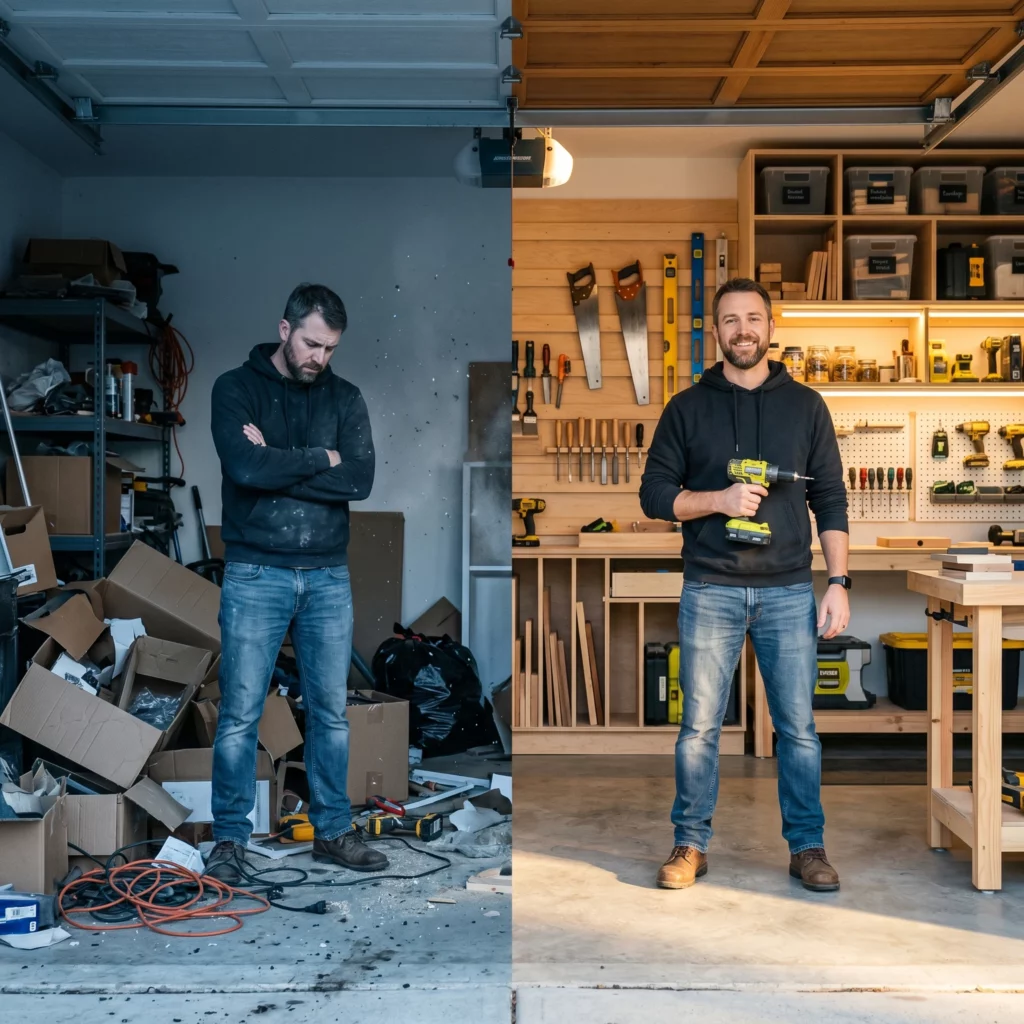
There’s a moment almost everyone has in their garage.
You open the door looking for one thing—a rake, a drill battery, maybe the extension cord you know you bought last summer—and suddenly you’re staring at a wall of unfinished decisions. Half-empty paint cans. Bent shelving. Sports gear buried under cardboard boxes that haven’t moved in years.
The garage becomes a strange kind of holding place. Not just for stuff, but for delayed intentions.
And the frustrating part? Most people don’t need a bigger garage.
They need a garage that finally works.
That’s why simple garage woodworking projects have become more than a DIY trend. For beginners especially, building your own garage organization system feels different than buying plastic bins off a store shelf. It feels permanent. Personal. Useful in the kind of everyday way that quietly changes how your home functions.
The projects below aren’t designed for master carpenters with elaborate workshops. They’re built for regular people with a drill, a free weekend, and a growing intolerance for chaos.
Some take two hours. Some take an afternoon. A few might turn into your favorite thing you build all year.
Either way, every single one helps reclaim space you probably thought was already gone.
Why Most Beginner Garage Projects Fall Apart Before They Start
It usually isn’t laziness.
And it definitely isn’t lack of motivation.
Most beginner woodworking projects fail because the internet has a habit of pretending beginners already know things they absolutely do not know yet.
A tutorial says something like “simply cut a dado joint,” as if that sentence means anything to someone holding a circular saw for the first time.
So people hesitate. They overthink. They postpone.
Eventually the garage stays exactly the same.
The Real Problems Beginners Run Into
Plans That Feel Written for Professionals
A lot of “easy” garage storage plans quietly assume you already own:
- a table saw
- advanced clamps
- specialty jigs
- years of muscle memory
Beginners don’t need complexity. They need momentum.
That’s a completely different thing.
Tool Anxiety Is Real
Walk into a hardware store long enough and woodworking starts to feel expensive fast.
But most beginner garage organization projects only require:
- a cordless drill
- a circular saw
- a tape measure
- a speed square
That’s enough to build shelves, storage racks, pegboards, workbenches, and even modular cabinets.
Not perfect versions. Real versions.
And honestly, that matters more.
The Fear Nobody Talks About
Most beginners aren’t afraid of woodworking.
They’re afraid of building something ugly.
Or crooked.
Or unstable.
There’s a quiet embarrassment people imagine before they even start—like the project might somehow expose them as incapable.
But woodworking has a strange effect on people once they begin.
The first successful shelf changes something.
Not because it’s beautiful.
Because it exists.
Because you built it.
The Best Beginner Tools for Garage Woodworking
A lot of garages become more organized the moment tools stop feeling mysterious.
You do not need a professional workshop. You need a handful of reliable basics that help you make clean cuts, solid connections, and repeatable measurements.
That’s it.
1. Circular Saw
If there’s one tool that unlocks beginner woodworking fast, it’s this one.
A circular saw handles:
- plywood cuts
- shelving material
- workbench tops
- storage cabinet panels
Paired with a straight edge, it becomes surprisingly accurate.
2. Cordless Drill
The workhorse of nearly every garage storage project.
You’ll use it for:
- pilot holes
- screws
- anchors
- mounting hardware
- cabinet assembly
A good drill instantly makes DIY feel less intimidating.
3. Speed Square
Simple. Cheap. Incredibly useful.
It helps beginners make:
- straighter cuts
- cleaner angles
- square frames
- aligned shelves
One of those tools you barely notice until you realize you use it constantly.
4. Stud Finder
Garage wall storage only works if it stays attached to the wall.
A stud finder helps safely mount:
- shelving systems
- French cleat walls
- tool organizers
- overhead storage racks
Especially important once projects start holding real weight.
5. Orbital Sander
This is the difference between “rough DIY project” and “something that actually looks finished.”
Even simple plywood shelves look dramatically better after sanding.
Choosing the Right Wood Without Overthinking It
One of the fastest ways beginners get overwhelmed is material selection.
There are dozens of wood types. Endless opinions. Entire internet arguments about plywood grades.
For garage organization projects, keep it simple.
| Material | Best Use | Beginner Friendly |
|---|---|---|
| Plywood | Shelves, cabinets, workbenches | Excellent |
| 2×4 Lumber | Frames and supports | Excellent |
| OSB | Utility shelving | Good |
| MDF | Painted storage builds | Moderate |
| Hardwood | Decorative projects | Advanced |
If you’re unsure where to start, 3/4-inch plywood is usually the safest choice for garage shelves and storage systems.
Strong. Affordable. Easy to work with.
That combination matters.
15 Easy Garage Organization Projects Beginners Can Actually Finish
Not “Pinterest easy.”
Actually easy.
Projects that create visible improvement fast enough to keep you motivated.
1. Scrap Wood Utility Shelf
This is often where it starts.
A single shelf.
No fancy joinery. No complicated cuts. Just practical storage built with leftover plywood and basic framing lumber.
And somehow, once that shelf goes up, the garage already feels different.
Best For
- paint cans
- cleaning supplies
- random hardware
- overflow storage
2. DIY Drill Charging Station
Cordless tools have a way of spreading themselves everywhere.
A charging station pulls everything back into one place:
- batteries
- chargers
- drills
- drivers
- cords
The visual calm this creates is immediate.
3. Wall-Mounted Garden Tool Rack
Long-handled tools are experts at wasting floor space.
Rakes lean. Shovels slide over. Brooms disappear behind ladders.
A simple vertical storage rack fixes all of it in one afternoon.
Ideal For
- shovels
- hedge trimmers
- leaf rakes
- extension tools
4. French Cleat Tool Wall
There’s a reason professional workshops use French cleat systems.
They evolve with you.
Instead of locking tools into permanent positions, French cleats allow constant adjustment as your setup changes.
And garage setups always change.
Why Beginners Love Them
- modular design
- expandable storage
- clean visual organization
- easy customization
Once you build one section, you’ll probably keep adding to it.
5. Folding Workbench
Small garages demand flexibility.
A folding workbench gives you:
- workspace when needed
- open floor space when finished
- better workflow
- cleaner movement paths
For shared garages, this project changes everything.
6. Mobile Storage Cart
Mobility makes garages feel bigger.
Instead of carrying tools back and forth across the room, the storage comes with you.
Perfect For
- automotive tools
- painting supplies
- gardening gear
- woodworking accessories
Add locking casters and it instantly feels professional.
7. Pegboard Tool Organizer
There’s something satisfying about seeing every tool clearly.
Pegboards create instant accessibility.
No digging through drawers. No wasted searching.
Just visibility.
And visibility reduces friction more than people realize.
8. Overhead Storage Rack
Most garages ignore the ceiling entirely.
Which is strange considering how much unused space lives above eye level.
An overhead rack is perfect for:
- holiday decorations
- camping bins
- seasonal storage
- backup supplies
Important Safety Note
Always anchor into ceiling joists—not drywall.
9. Lumber Storage Rack
Wood piles become chaos surprisingly fast.
One weekend project turns into ten leftover boards leaning against the wall forever.
A lumber rack:
- protects material
- prevents warping
- improves safety
- opens floor space
Simple project. Massive payoff.
10. Clamp Rack
Every woodworker eventually reaches the same realization:
Clamps multiply.
A dedicated clamp rack keeps them:
- organized
- visible
- accessible
- off the workbench
And somehow makes the whole garage feel more intentional.
11. DIY Sports Equipment Organizer
Family garages collect sports equipment like magnets collect dust.
Balls roll everywhere. Helmets disappear. Bats end up behind bicycles.
A custom sports station keeps everything contained while making cleanup dramatically easier.
Especially for kids.
12. Bucket Storage Shelf
Five-gallon buckets are useful for everything.
They’re also terrible at stacking neatly on their own.
A bucket shelf system creates:
- vertical organization
- cleaner access
- better visibility
- safer movement paths
13. Rolling Scrap Wood Cart
Scrap wood starts small.
Then suddenly there’s a dangerous leaning pile consuming an entire corner of the garage.
A rolling vertical cart solves the problem while making future projects easier to build.
Because now your material is visible.
Usable.
Reachable.
14. Wall-Mounted Bike Rack
Bikes take up an incredible amount of space.
Most people don’t notice until they remove them from the floor.
A vertical bike rack instantly creates:
- walking room
- parking clearance
- visual order
- safer storage
One project. Huge spatial difference.
15. Beginner Modular Garage Cabinet
This is where beginner woodworking starts feeling real.
Cabinets teach:
- structure
- spacing
- alignment
- layout planning
They also create the biggest visual transformation in the shortest amount of space.
Even one clean cabinet can make an entire garage feel upgraded.
The Beginner Mistakes That Cause the Most Frustration
Almost every frustrating DIY experience comes from rushing tiny steps.
Not big failures.
Tiny ones.
Skipping Pilot Holes
Wood splits. Screws wander. Joints weaken.
Pilot holes take seconds and save projects constantly.
Measuring Too Fast
Most wasted plywood comes from impatience, not lack of skill.
Measure slowly.
Then check again.
Future-you will appreciate it.
Overtightening Screws
Beginners often assume tighter equals stronger.
Usually it just strips the material.
Once the joint feels secure, stop.
Trying to Make Everything Perfect
Professional-looking woodworking comes later.
Right now, focus on:
- function
- stability
- clean assembly
- usable storage
Perfection is a terrible starting point.
Momentum is better.
Cheap Garage Organization Ideas That Feel Surprisingly High-End
Good garage design isn’t always about expensive materials.
It’s often about consistency.
Use Matching Storage Bins
Even inexpensive bins look polished when they match.
Visual repetition creates instant order.
Label Everything
Labels remove friction.
You stop searching. You stop guessing.
And maintenance becomes dramatically easier over time.
Paint Plywood Edges
One small detail.
Huge visual difference.
Painted edges instantly make DIY shelves feel cleaner and more intentional.
Build Storage Zones
Professional garages organize by activity, not object type.
Create separate zones for:
- tools
- gardening
- sports equipment
- automotive supplies
- seasonal storage
Once zones exist, clutter has fewer places to spread.
Why Organized Garages Feel So Emotionally Different
People think clutter is visual.
It isn’t.
Clutter is cognitive.
Every unfinished pile quietly asks the brain to process something:
- deal with this later
- organize this eventually
- remember this exists
That low-level mental noise adds up.
An organized garage changes more than appearance.
It changes friction.
You move easier. Find things faster. Start projects quicker.
The space begins working with you instead of against you.
And that feeling becomes addictive surprisingly fast.
A Simple Garage Layout Strategy That Actually Works
Before building anything new, pay attention to movement.
The best garages are designed around flow.
The 5-Zone Garage Method
Parking Zone
Keep vehicle movement clear and predictable.
Tool Zone
Store frequently used tools closest to your workspace.
Vertical Storage Zone
Walls are valuable real estate.
Use them aggressively.
Seasonal Storage Zone
Place infrequently used items overhead or deeper into storage.
Safety Zone
Separate:
- chemicals
- fuel
- blades
- hazardous materials
- power equipment
Especially important in family garages.
Questions Beginners Usually Ask Right Before They Start
“What’s the easiest woodworking project if I’ve never built anything before?”
A basic wall shelf or pegboard organizer is usually the best first project. Minimal cuts. Fast payoff. Immediate storage improvement.
“Do I need expensive tools to build garage storage?”
Not at all.
A drill, circular saw, measuring tape, and speed square can handle most beginner garage organization projects surprisingly well.
“What’s the best wood for garage shelves?”
For strength and simplicity, 3/4-inch plywood is hard to beat.
It handles weight well without becoming difficult to work with.
“Are DIY garage shelves actually cheaper?”
Usually by a wide margin.
Store-bought garage systems get expensive quickly, especially once customization enters the picture.
DIY lets you build around your exact space instead of forcing your space around prefabricated dimensions.
“How long do these projects realistically take?”
Most beginner garage projects can be finished in a few hours.
Larger builds—like cabinets or workbenches—usually fit comfortably into a weekend.
“What’s the best garage wall storage system overall?”
French cleat systems are one of the most flexible long-term options because they expand easily and adapt as your garage changes.
Products / Tools / Resources
Beginner Tool Essentials
- Cordless drill and driver kit
- Circular saw with guide rail
- Speed square
- Stud finder
- Orbital sander
- Clamps and sawhorses
Recommended Materials
- 3/4-inch plywood sheets
- 2×4 framing lumber
- Construction screws
- Heavy-duty wall anchors
- Wood glue
- Pegboard panels
Useful Garage Organization Add-Ons
- Locking caster wheels
- Clear storage bins
- Magnetic tool holders
- LED shop lighting
- Wall-mounted extension cord reels
- Label makers for storage zones
Helpful Project Upgrades
- French cleat hardware systems
- Fold-down workbench brackets
- Soft-close cabinet hinges
- Rubber shelf liners
- Dust collection attachments
- Battery charging docks
Smart Internal Reading Paths for DIYers
If you’re continuing your garage transformation, the next natural builds to explore are:
- DIY workbench plans
- French cleat wall systems
- beginner cabinet-making projects
- small workshop layout ideas
- overhead garage storage systems
- mobile tool cart builds