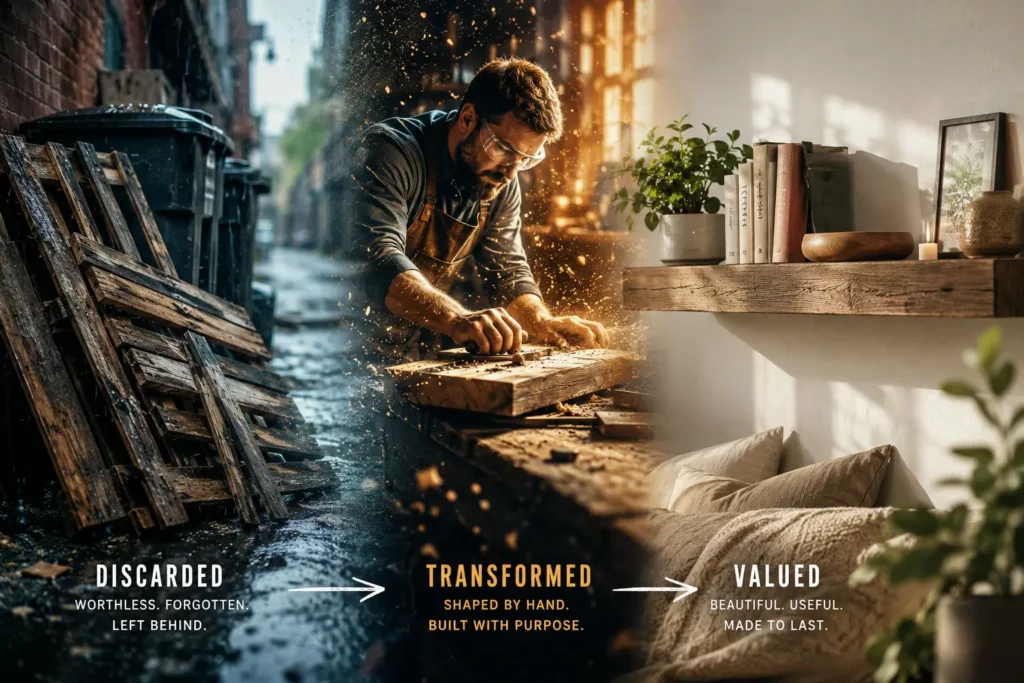
There’s a certain kind of pile most people ignore.
It sits in the corner of a garage workshop. Leaning against a wall. Half-cut boards. Warped pine scraps. Thin strips left over from old shelving projects. The kind of wood people promise themselves they’ll “use someday” before eventually hauling it to the curb.
But something strange has happened over the last few years.
That pile of scrap wood—the forgotten leftovers nobody thinks twice about—has quietly become raw material for an entirely new kind of business. One built not on massive inventory or expensive machinery, but on attention, craftsmanship, storytelling, and search visibility.
A few pieces of reclaimed oak become a floating shelf someone pins to a “dream home office” board on Pinterest.
A walnut offcut becomes a minimalist phone stand that sells twenty times a month on Etsy.
A rough cedar board turns into rustic wall decor photographed beside a linen blanket and a ceramic candle, then discovered through a long-tail Google search at 1:14 a.m. by someone redecorating their apartment after a breakup.
That’s the invisible woodworking business.
Not loud. Not flashy. No rented Lamborghinis or fake entrepreneurial theater.
Just ordinary people turning discarded wood into products the internet never seems to stop wanting.
And the deeper you look, the more you realize this isn’t really about woodworking at all.
It’s about emotion.
It’s about identity.
It’s about building physical objects that make digital audiences feel something.
Why Scrap Wood Suddenly Feels Valuable Again
Walk through any major furniture store and you’ll notice a pattern almost immediately.
Everything looks… finished.
Perfect edges. Factory symmetry. Smooth surfaces with no fingerprints, no history, no soul. The kind of products designed to offend nobody and impress nobody either.
That’s exactly why handmade woodworking has exploded online.
People are tired of buying objects that feel emotionally vacant.
They want texture now. Warmth. Grain variation. Imperfection. Something that looks touched by a human hand instead of assembled under fluorescent lights in a warehouse halfway across the world.
And search behavior reflects that shift.
Searches tied to:
- reclaimed wood decor
- rustic floating shelves
- DIY farmhouse furniture
- handmade wood gifts
- woodworking projects that sell
continue to grow because consumers aren’t only searching for products anymore.
They’re searching for atmosphere.
For meaning.
For homes that feel lived in instead of staged.
That emotional undercurrent is what makes small woodworking businesses surprisingly powerful in modern ecommerce.
The Internet Quietly Fell in Love With Handmade Wood Products
There’s a reason woodworking performs unusually well on platforms like Pinterest, TikTok, Instagram, and Shopify.
Woodworking is visual transformation.
And transformation is algorithm fuel.
A rough board becoming a polished shelf scratches something deep in the human brain. The process feels satisfying. Predictable. Comforting. Viewers linger longer. They watch sanding clips on repeat. They save before-and-after videos. They imagine themselves making something tangible in a world that increasingly feels intangible.
That behavior matters.
Modern algorithms pay attention to:
- watch time
- saves
- repeat views
- engagement depth
- dwell time
- click-through behavior
Woodworking naturally generates all of it.
Especially when the project feels attainable.
That’s why simple scrap wood builds often outperform elaborate furniture projects online. A beginner can imagine making a candle holder. A floating shelf feels achievable. A desk organizer feels useful immediately.
Accessibility creates momentum.
Momentum creates clicks.
Clicks create visibility.
What Actually Makes a Woodworking Project Profitable?
A beautiful woodworking project is not automatically a profitable one.
That distinction trips people up constantly.
Some projects are impressive but terrible businesses. They take too long. They’re difficult to ship. Margins collapse under labor hours. Buyers admire them but rarely purchase them.
The products that consistently generate evergreen online income usually share a different set of traits entirely.
They are:
- compact
- emotionally appealing
- easy to reproduce
- visually photogenic
- inexpensive to ship
- tied to everyday use
That combination matters more than advanced craftsmanship.
A simple reclaimed wood shelf can quietly outsell a handcrafted dining table because the shelf solves a smaller, faster emotional decision.
People hesitate over a $1,400 table.
They impulse-buy a $48 shelf at midnight while redesigning their apartment on Pinterest.
Understanding that psychological difference changes how you approach woodworking forever.
Floating Shelves: The Scrap Wood Project That Refuses to Stop Selling
There are few products more consistently profitable in the DIY woodworking world than floating shelves.
And honestly, it makes sense.
They sit at the intersection of nearly every high-performing home category online:
- organization
- minimalist decor
- farmhouse style
- apartment storage
- cozy interiors
- workspace aesthetics
A floating shelf isn’t just a shelf.
It becomes:
- a coffee station
- a plant display
- a reading nook accent
- a kitchen organizer
- a “clean girl aesthetic” backdrop
That flexibility creates massive search demand.
Long-tail searches like:
- rustic floating shelves
- reclaimed wood shelf ideas
- farmhouse floating shelf
- DIY wall shelf plans
carry strong buyer intent because people already know what they want. They’re simply deciding who to buy it from—or how to build it themselves.
And because shelves can be batch-produced from scrap wood, margins become surprisingly attractive.
Especially for beginners.
Why Small Wooden Phone Stands Outsell Bigger Projects
There’s something psychologically easy about buying a small handmade object.
A handcrafted phone stand feels personal but low-risk. Useful but aesthetic. Affordable but thoughtful.
That balance is incredibly powerful online.
Phone stands also perform unusually well in short-form content because the transformation is immediate. A plain wood offcut becomes a sleek minimalist accessory within seconds of video runtime.
Algorithms love that compression.
Fast visual payoff increases retention.
Retention increases distribution.
Distribution increases sales.
And suddenly a tiny scrap of walnut becomes:
- a digital product listing
- a Pinterest pin
- a TikTok video
- an Etsy bestseller
- a recurring source of passive income
all from material most people would have thrown away.
Rustic Candle Holders and the Psychology of Comfort
Some woodworking products sell because they solve problems.
Others sell because they create feelings.
Rustic candle holders belong firmly in the second category.
Candles already carry emotional associations:
- warmth
- calm
- intimacy
- comfort
- self-care
- ritual
Wood intensifies those emotions naturally.
Especially reclaimed wood.
The texture feels grounded. Organic. Human.
That’s why these products surge during:
- fall decorating season
- Christmas shopping periods
- weddings
- housewarming cycles
People are not just decorating rooms.
They’re designing moods.
And mood-driven products tend to generate evergreen demand year after year.
Desk Organizers Became a Bigger Market Than Anyone Expected
Remote work changed buying behavior permanently.
Millions of people suddenly became hyper-aware of their desks. Their backgrounds. Their environments. Their productivity spaces.
That shift created enormous demand for:
- minimalist desk organizers
- monitor risers
- headphone stands
- cable organizers
- wooden docking stations
A simple scrap wood organizer now taps into multiple emotional identities at once:
- productivity
- focus
- professionalism
- creative ambition
- aesthetic self-expression
And unlike trend-heavy products, workspace organization rarely disappears as a category.
It evolves.
Quietly.
Consistently.
Which is exactly what you want in an evergreen woodworking niche.
The Real Product Isn’t the Wood
This is where most people misunderstand handmade commerce.
Customers rarely buy woodworking products purely because they need wood.
They buy because the product represents something emotionally.
A reclaimed wood tray represents slower mornings.
A floating shelf represents an organized life.
A handmade desk organizer represents control in a chaotic world.
A rustic sign represents belonging.
The object itself becomes symbolic.
That symbolic value is what allows small woodworking businesses to compete against mass-produced retailers despite having higher prices and smaller operations.
People are willing to pay more for products that feel personal.
And handcrafted woodworking feels deeply personal.
How Free DIY Woodworking Plans Become Passive Income Assets
The phrase “passive income” gets abused constantly online.
But in woodworking, there actually is a version of passive income that’s very real.
Not because the work disappears.
Because the system compounds.
One woodworking project can become:
- a physical product
- a digital woodworking plan
- a YouTube tutorial
- a Pinterest traffic source
- a blog article
- an affiliate revenue stream
- an email list funnel
That changes the economics completely.
The creator who documents the process often earns more long-term than the creator who simply builds products silently in a garage.
Content becomes leverage.
And woodworking happens to generate exceptionally strong content.
Pinterest Might Be the Most Underrated Traffic Source in Woodworking
Most people think of Pinterest as social media.
It’s closer to a visual search engine.
Which is why woodworking thrives there.
Unlike Instagram posts that disappear after a day or two, Pinterest content can continue driving traffic for years. One well-designed pin tied to a strong keyword phrase can quietly generate clicks month after month with almost no maintenance.
And woodworking naturally fits Pinterest behavior because users already search for:
- DIY woodworking plans
- scrap wood project ideas
- farmhouse decor inspiration
- easy woodworking builds
- rustic shelf tutorials
The platform rewards aspiration.
Woodworking creates aspiration effortlessly.
SEO Is the Invisible Engine Behind Most Successful Woodworking Brands
A lot of woodworkers focus entirely on craftsmanship.
The highest-earning creators usually focus just as much on discoverability.
That means understanding:
- keyword intent
- search behavior
- topical authority
- entity relationships
- image optimization
- semantic relevance
Because the internet doesn’t reward the best product automatically.
It rewards the most discoverable product.
That’s why long-tail keywords matter so much in woodworking SEO.
Broad phrases like:
- woodworking
- wood crafts
- DIY furniture
are incredibly competitive.
But targeted searches like:
- easy woodworking projects to sell on Etsy
- beginner scrap wood ideas
- profitable DIY wood projects
- free woodworking plans for shelves
carry stronger conversion intent and lower competition simultaneously.
Those are the searches that quietly build businesses.
The Beginner Tool Setup That Actually Makes Sense
One of the biggest misconceptions in woodworking is that you need a dream workshop before you can sell anything.
You don’t.
A surprising number of profitable woodworking shops started with:
- a circular saw
- a drill
- clamps
- an orbital sander
- a pocket hole jig
That’s it.
The internet makes woodworking look more equipment-heavy than it really is because advanced setups perform well visually on YouTube.
But profitable simplicity beats expensive complexity almost every time in the beginning.
Especially when your goal is consistency rather than perfection.
The Mistakes That Quietly Kill Most Woodworking Side Hustles
The first mistake is usually underpricing.
Beginners calculate:
- wood cost
- labor time
and forget everything else.
But real pricing includes:
- sandpaper
- finishes
- packaging
- shipping supplies
- platform fees
- photography
- content creation
- customer service
Ignoring those costs slowly crushes margins.
The second mistake is building products that are too complicated.
Complex projects impress other woodworkers.
Simple projects usually sell better.
That truth takes many creators years to accept.
Why Handmade Woodworking Feels More Valuable in the AI Era
As AI-generated content floods the internet, something interesting is happening psychologically.
People are craving physical reality again.
Not simulated creativity.
Not digital abundance.
Real objects made by real people.
Woodworking sits directly inside that cultural shift.
A handmade shelf carries fingerprints. Grain variation. Tiny imperfections. Evidence of effort.
Those details create emotional scarcity.
And emotional scarcity creates value.
The more artificial the digital world becomes, the more meaningful handcrafted physical products feel.
Which is part of the reason woodworking continues growing even while countless online business trends fade almost as quickly as they appear.
Questions People Usually Ask Right Before They Start
“Can you actually make money with scrap wood?”
Yes—but probably not in the way most people imagine.
The money usually comes from repeatable, emotionally appealing products rather than giant custom furniture builds. Small items with low material costs tend to create healthier margins and easier scaling.
“What woodworking projects sell the fastest online?”
Floating shelves, wooden signs, desk organizers, candle holders, serving trays, and small home decor items consistently perform well because they combine usefulness with visual appeal.
They also ship easily, which matters more than most beginners realize.
“Where do people even find free woodworking plans?”
Everywhere now.
Blogs. YouTube tutorials. Pinterest. Maker communities. DIY forums.
The best plans usually include:
- cut lists
- dimensions
- printable templates
- beginner instructions
- material recommendations
Simple plans tend to outperform overly technical ones because they attract broader audiences.
“Do I need expensive tools before I can sell anything?”
Not remotely.
Skill matters.
Consistency matters.
Photography matters.
Search visibility matters.
Most buyers will never ask what saw you used.
They care about how the product makes them feel when they see it.
Products / Tools / Resources
Beginner Woodworking Tools Worth Buying Early
- Orbital sander
- Pocket hole jig
- Compact circular saw
- Parallel clamps
- Japanese pull saw
- Combination square
- Random orbit sanding discs
- Wood glue applicator bottles
Best Platforms for Selling Handmade Woodworking Products
- Etsy for beginner visibility
- Shopify for long-term brand control
- Facebook Marketplace for local furniture sales
- Pinterest for evergreen traffic generation
- TikTok for short-form woodworking videos
Useful Content Creation Tools for Woodworking Brands
- Canva for Pinterest graphics
- Lightroom for product photography
- CapCut for woodworking reels and TikTok edits
- Notion for inventory and build tracking
- Google Search Console for SEO monitoring
Free DIY Woodworking Plan Sources
- Ana White
- Instructables
- Kreg Tool project library
- Reddit woodworking communities
- YouTube woodworking creators
- Pinterest DIY build collections
Wood Types That Work Extremely Well for Scrap Projects
- Walnut
- White oak
- Maple
- Cedar
- Pine
- Reclaimed barn wood
- Pallet wood (when heat-treated and safe for indoor use)