Quick Answer: What Are the Most In-Demand Woodworking Projects Right Now?
Spend enough time around homeowners, contractors, renovation forums, and local home improvement groups, and a pattern starts to emerge.
People aren’t searching for woodworking projects because they love woodworking.
They’re searching because something in their home isn’t working.
A cramped entryway. A cluttered garage. An unused backyard. A spare bedroom that suddenly needs to function as an office. The search almost always begins with frustration and ends with a desire for transformation.
That’s exactly why the highest-demand woodworking projects continue to cluster around three powerful categories:
- Storage solutions such as mudroom systems, custom closets, garage organizers, and built-in shelving
- Outdoor living upgrades including pergolas, privacy screens, raised garden beds, and outdoor kitchens
- Space-optimization projects like custom desks, fold-down tables, multifunctional furniture, and home office built-ins
These projects aren’t trends in the traditional sense. They’re responses to real-life challenges homeowners face every day.
And that’s what makes them so valuable.
The strongest woodworking opportunities rarely come from creating something decorative alone. They come from solving a problem people are already thinking about when they wake up in the morning and again when they walk through their front door at night.
That distinction changes everything.
Why Certain Woodworking Projects Suddenly Explode in Demand
At first glance, demand can seem unpredictable.
One year everyone wants floating shelves. The next year it’s pergolas. Then suddenly home office built-ins begin appearing everywhere.
But beneath the surface, demand follows a surprisingly human pattern.
Every high-demand woodworking project is connected to a lifestyle shift.
When families spend more time at home, storage becomes valuable.
When remote work expands, custom workspaces become essential.
When outdoor entertaining grows in popularity, backyard structures move from luxury purchases to practical investments.
The woodworking industry doesn’t create demand.
Human behavior does.
Understanding that simple truth gives you an advantage most builders never develop.
Because homeowners don’t search for a mudroom bench.
They search because backpacks are scattered across the floor.
They don’t search for a custom closet system.
They search because every morning begins with frustration.
And they don’t search for a pergola because they’re interested in lumber dimensions.
They search because they’re imagining summer evenings spent outside with family and friends.
The project is never the destination.
The project is the bridge.
The destination is a better experience.
The Psychology Behind Today’s Home Improvement Searches
Look closely at modern search behavior and you’ll notice something fascinating.
Most homeowners aren’t asking, “What woodworking project should I build?”
Instead, they’re asking questions like:
- How can I organize my entryway?
- What’s the best way to add storage to a small house?
- How do I make my backyard more usable?
- What improvements increase home value?
- How can I create a home office in a limited space?
Woodworking enters the conversation as the answer.
This is where many professionals miss enormous opportunities.
They market craftsmanship.
Homeowners are searching for outcomes.
The difference may seem small, but it completely changes how demand is created.
When someone imagines a cleaner home, a more functional garage, or a backyard that finally feels complete, they’re already emotionally invested before they ever compare prices.
The purchase decision has quietly begun.
The woodworking project simply gives that desire a physical shape.
The Four Forces Driving High-Demand Woodworking Projects
Across virtually every housing market, today’s most sought-after woodworking projects are fueled by four powerful forces.
1. Space Optimization
Homes rarely feel large enough forever.
Families grow.
Needs change.
Possessions accumulate.
Projects that help homeowners reclaim usable space continue to generate strong demand because they solve a challenge that never truly disappears.
Built-ins, storage benches, garage systems, and custom shelving all thrive in this category.
2. Home Organization
Clutter creates stress.
Research consistently shows that organized spaces contribute to a greater sense of control and well-being.
That emotional benefit makes organization-focused woodworking projects particularly compelling.
People aren’t simply buying storage.
They’re buying relief.
3. Lifestyle Enhancement
Outdoor kitchens.
Pergolas.
Custom entertaining spaces.
These projects aren’t purchased out of necessity.
They’re purchased because they improve experiences.
The emotional return often exceeds the practical return.
4. Property Value Improvement
Many homeowners view woodworking projects through an investment lens.
Custom built-ins, closet systems, mudrooms, and premium outdoor features can significantly improve perceived home value.
The combination of immediate enjoyment and long-term value makes these projects especially attractive.
The Opportunity Hidden in Plain Sight
Most people assume the woodworking market is crowded.
In reality, demand is becoming increasingly specialized.
Homeowners are no longer looking for generic solutions.
They’re looking for solutions tailored to their exact lifestyle, floor plan, storage needs, and aesthetic preferences.
That shift is creating opportunities that didn’t exist a decade ago.
The projects generating the most attention today aren’t necessarily the most complicated.
They’re the ones that sit at the intersection of functionality, personalization, and everyday convenience.
And once you begin looking at the market through that lens, a different picture starts to emerge.
The biggest opportunities aren’t hiding in workshops.
They’re hiding inside garages overflowing with tools, entryways packed with shoes, spare bedrooms waiting to become offices, and backyards homeowners wish they used more often.
That’s where the real demand lives.
And that’s where the next section takes us.
Part 2: The Rise of Storage Projects — Why Homeowners Can’t Get Enough of Smart Organization
There was a time when storage was treated as an afterthought.
A closet was simply a closet. A garage was a place to park a car. Shelves existed to hold things and little more.
That world doesn’t exist anymore.
Today’s homeowners think differently.
Space has become one of the most valuable assets inside a home, and every square foot is expected to earn its keep. As property prices rise and families attempt to do more with the space they already have, storage has quietly transformed from a practical necessity into one of the most sought-after categories in home improvement.
This shift explains why storage-focused woodworking projects continue to dominate search results, local contractor inquiries, Pinterest boards, and renovation wish lists.
The demand isn’t slowing down.
If anything, it’s accelerating.
Because beneath every cluttered room is a homeowner imagining what life could feel like if everything finally had a place.
Why Storage Projects Create Such Powerful Demand
Most home improvement projects compete for attention.
Storage projects solve immediate pain.
That’s an important distinction.
A homeowner may dream about a luxury outdoor kitchen for months before taking action.
But when shoes spill across the entryway every morning or the garage becomes impossible to navigate, the frustration becomes impossible to ignore.
The search begins.
And that’s where opportunity appears.
Unlike trend-driven upgrades, storage solutions address recurring problems that return day after day.
The result is sustained demand.
Not seasonal demand.
Not impulse demand.
Persistent demand.
The kind of demand that keeps homeowners searching long after other trends have faded.
Mudroom Systems: Solving the Daily Chaos Homeowners Know Too Well
Few spaces create more frustration than an unorganized entryway.
It’s the first thing people see when they enter the house.
It’s also one of the first spaces to become overwhelmed.
Backpacks pile up.
Shoes scatter across the floor.
Jackets end up draped over chairs.
Keys disappear.
The cycle repeats every day.
A custom mudroom system interrupts that cycle.
Suddenly, the space has structure.
Shoes have designated storage.
Bags have cubbies.
Coats have hooks.
Daily clutter stops feeling random and starts feeling manageable.
That’s why mudroom woodworking projects consistently rank among the most requested home improvement upgrades.
What Homeowners Want in Modern Mudroom Designs
Today’s mudrooms are expected to do much more than provide storage.
They often function as command centers for busy households.
Popular features include:
- Built-in bench seating
- Individual storage cubbies
- Hidden shoe compartments
- Vertical storage systems
- Coat hooks
- Charging stations
- Overhead cabinetry
- Pet-friendly storage areas
The most successful designs combine organization with aesthetics.
Homeowners don’t just want less clutter.
They want a space that feels intentional.
A space that creates calm before the day begins.
Why Mudroom Projects Add So Much Perceived Value
One reason mudrooms perform exceptionally well is that they create visible transformation.
The before-and-after difference is dramatic.
Visitors notice it immediately.
Homeowners experience it every day.
That combination makes the project feel far more valuable than its physical components might suggest.
The lumber matters.
The craftsmanship matters.
But what people truly remember is how different the home feels afterward.
Garage Organization Solutions: The Untapped Goldmine in Home Improvement
If the entryway is the most visible clutter zone, the garage is often the most overwhelming.
Many garages begin with good intentions.
A workbench.
Some storage bins.
Then life happens.
Holiday decorations accumulate.
Sports equipment multiplies.
Tools spread across every available surface.
Before long, the garage becomes less of a functional space and more of a storage puzzle.
Homeowners know it.
And increasingly, they’re looking for solutions.
Why Garage Storage Searches Continue to Grow
The garage has evolved.
For many families, it’s no longer just a parking area.
It’s a workshop.
A fitness room.
A hobby space.
A storage center.
Sometimes all four at once.
That shift has created demand for custom woodworking projects specifically designed to maximize functionality.
Popular searches include:
- Garage organization ideas
- Custom garage storage systems
- Workshop storage solutions
- Wall-mounted tool storage
- Garage workbench plans
- Garage cabinet systems
Every one of those searches represents a homeowner trying to reclaim space they already own.
High-Demand Garage Woodworking Projects
The strongest opportunities often include:
Custom Workbenches
A well-designed workbench becomes the centerpiece of the garage.
Homeowners appreciate:
- Durable construction
- Integrated tool storage
- Expandable work surfaces
- Built-in organization
Wall Storage Systems
Vertical space remains one of the most underutilized assets in most garages.
Custom wall systems help homeowners store:
- Hand tools
- Garden equipment
- Sports gear
- Power tools
- Seasonal supplies
Modular Garage Cabinets
Cabinet systems appeal because they create visual order.
The garage instantly looks cleaner, more organized, and more functional.
That emotional impact often drives purchase decisions as much as practicality.
Closet Systems: Turning Everyday Frustration Into Everyday Convenience
Few routines are more repetitive than getting dressed.
And few frustrations are more common than searching for something that should be easy to find.
That’s why custom closet systems continue to experience remarkable demand.
The problem isn’t storage capacity alone.
It’s accessibility.
Most closets weren’t designed around the way people actually live.
Custom woodworking changes that.
What Makes Modern Closet Systems So Desirable?
Homeowners increasingly want personalized organization.
Not generic shelving.
Not standard wire racks.
Real solutions designed around their belongings and routines.
Common features include:
- Adjustable shelving
- Dedicated shoe storage
- Drawer systems
- Hanging sections
- Accessory organizers
- Built-in lighting accommodations
- Custom cabinetry
Every feature serves a purpose.
Every purpose reduces friction.
And reducing friction is one of the strongest drivers of home improvement spending.
The Emotional Side of Closet Organization
There’s a reason before-and-after closet videos attract millions of views online.
Organization creates emotional satisfaction.
People experience a sense of control when their environment feels ordered.
A custom closet system isn’t merely a storage upgrade.
For many homeowners, it feels like reclaiming a small piece of their day.
Less searching.
Less stress.
More efficiency.
Those benefits compound over time.
Which is exactly why demand remains so strong.
Built-In Storage: The Upgrade That Never Goes Out of Style
Some woodworking trends come and go.
Built-in storage rarely does.
Whether it’s a living room bookshelf, an entertainment center, a reading nook, or custom cabinetry, built-ins occupy a unique position within home improvement.
They’re practical.
They’re beautiful.
And they feel permanent.
That permanence matters.
Homeowners often associate built-ins with craftsmanship, quality, and long-term value.
Why Built-Ins Continue to Command Attention
Unlike freestanding furniture, built-ins maximize every available inch.
Awkward corners become useful.
Unused walls become storage opportunities.
Dead space becomes functional square footage.
Popular built-in woodworking projects include:
- Custom bookshelves
- Entertainment centers
- Window seat storage
- Reading nooks
- Hallway cabinetry
- Home office shelving
- Media walls
These projects blur the line between furniture and architecture.
And that’s part of their appeal.
They feel like they belong.
The Real Reason Storage Projects Continue to Win
On the surface, storage projects appear practical.
And they are.
But practicality isn’t the whole story.
People don’t spend thousands of dollars simply because they need another shelf.
They invest because they’re chasing something deeper.
They’re chasing simplicity.
They’re chasing control.
They’re chasing the feeling that their home is working with them instead of against them.
That’s why storage remains one of the most resilient categories in woodworking.
The projects solve visible problems.
The benefits are immediate.
And the emotional payoff lasts long after the installation is complete.
Which leads directly into the next major demand category—one that has transformed backyards across the country and created some of the most profitable woodworking opportunities available today.
Part 3: Outdoor Living Projects Homeowners Can’t Stop Searching For
Not long ago, the backyard was often treated as leftover space.
A patch of grass.
Maybe a grill sitting quietly in the corner.
Functional, certainly. But rarely intentional.
Today, that mindset has changed.
Walk through almost any neighborhood and you’ll see evidence of a larger shift taking place. Homeowners are investing in their outdoor spaces with the same level of attention once reserved exclusively for kitchens, living rooms, and master suites.
The backyard is no longer separate from the home.
It has become an extension of it.
And that transformation has created one of the most lucrative categories in high-demand woodworking projects.
Because people aren’t simply searching for structures.
They’re searching for experiences.
They’re searching for places where birthdays happen, where conversations stretch long into summer evenings, where coffee tastes better on quiet mornings, and where ordinary weekends feel just a little more memorable.
That’s the emotional engine driving today’s outdoor living boom.
Why Outdoor Woodworking Projects Are Experiencing Explosive Growth
Homeowners increasingly view outdoor space as usable living space.
That simple shift has changed everything.
Instead of asking:
“How do I maintain my backyard?”
People now ask:
“How do I improve it?”
“How do I spend more time there?”
“How do I make it feel like part of my home?”
Those questions naturally lead toward custom woodworking solutions.
Unlike many interior renovations, outdoor projects often create immediate visual impact while delivering both functional and emotional benefits.
The result is powerful demand.
Pergolas: The Backyard Upgrade That Changes Everything
Few woodworking projects have experienced the rise that pergolas have.
Search interest continues to grow year after year, and it isn’t difficult to understand why.
A pergola does something remarkable.
It creates definition.
Before installation, a backyard may feel open but undefined.
Afterward, the same space suddenly feels purposeful.
A destination appears where previously there was only open ground.
That psychological shift is incredibly powerful.
Why Homeowners Are Obsessed With Pergolas
Pergolas satisfy multiple needs simultaneously.
They provide:
- Partial shade
- Architectural interest
- Outdoor gathering areas
- Visual structure
- Property enhancement
- Lifestyle appeal
But the deeper reason homeowners love pergolas has little to do with construction.
A pergola changes how people imagine using their space.
Instead of seeing a backyard, they begin seeing possibilities.
Family dinners.
Weekend barbecues.
Quiet evenings under string lights.
A pergola creates a framework for experiences.
And experiences are what people ultimately buy.
Modern Pergola Design Trends
Today’s pergolas have evolved far beyond simple wooden structures.
Popular features include:
- Integrated lighting
- Privacy panels
- Decorative beams
- Climbing plant systems
- Outdoor dining areas
- Lounge zones
- Retractable shade options
Homeowners increasingly seek customized solutions that reflect their lifestyle rather than generic designs.
That customization creates tremendous opportunities for skilled woodworkers.
Raised Garden Beds: The Practical Project With Enduring Appeal
Some projects become popular because they’re beautiful.
Others become popular because they’re useful.
Raised garden beds manage to accomplish both.
Over the last decade, interest in gardening, sustainability, and homegrown food has grown steadily. What began as a hobby for many homeowners has evolved into a broader lifestyle movement.
People want greater connection to their outdoor environments.
Raised garden beds help make that possible.
Why Raised Garden Beds Continue to Generate Demand
Traditional gardens can present challenges.
Poor soil.
Drainage issues.
Maintenance difficulties.
Limited accessibility.
Raised beds solve many of those problems while creating a cleaner, more organized appearance.
Benefits include:
- Improved soil control
- Better drainage
- Easier maintenance
- Enhanced aesthetics
- Increased planting flexibility
For homeowners, the value is easy to understand.
For woodworkers, the demand is easy to serve.
The Emotional Appeal of Gardening Spaces
Gardening fulfills something many modern homeowners feel they’re missing.
Connection.
Connection to nature.
Connection to seasons.
Connection to the satisfaction that comes from nurturing something over time.
A well-built raised garden bed becomes more than a woodworking project.
It becomes the foundation for an experience homeowners return to throughout the year.
That emotional connection often drives stronger purchasing decisions than practical considerations alone.
Privacy Screens: One of the Most Overlooked Woodworking Opportunities
Privacy has become increasingly valuable.
As neighborhoods become denser and outdoor living grows in popularity, homeowners are searching for ways to create spaces that feel personal and protected.
This has fueled demand for custom privacy screens.
And yet many woodworkers still underestimate the opportunity.
Why Privacy Projects Are Growing So Quickly
People enjoy outdoor spaces more when they feel comfortable in them.
That comfort often depends on privacy.
Custom privacy screens provide:
- Visual separation
- Noise reduction
- Wind protection
- Decorative enhancement
- Defined outdoor zones
They help transform exposed spaces into intimate environments.
The difference may seem subtle.
In practice, it can completely change how frequently homeowners use their backyard.
Popular Privacy Screen Designs
Today’s homeowners often prefer solutions that balance function and aesthetics.
Popular styles include:
- Horizontal slat screens
- Decorative lattice systems
- Modern geometric panels
- Integrated planter walls
- Multi-purpose privacy dividers
These projects typically require fewer materials than larger structures while offering substantial perceived value.
That combination creates attractive profit potential.
Outdoor Dining Areas: Where Lifestyle Meets Woodworking
Perhaps no category better captures the modern outdoor living movement than outdoor dining spaces.
These projects tap into something deeply human.
Gathering.
Sharing meals.
Creating memories.
The structures themselves matter.
But what they represent matters even more.
The Growing Demand for Outdoor Entertainment Spaces
Homeowners increasingly want environments that encourage connection.
Popular outdoor woodworking projects include:
- Dining pergolas
- Built-in benches
- Outdoor bars
- Serving stations
- Deck enhancements
- Custom seating arrangements
These projects allow families to extend their living space beyond the walls of the home.
And once homeowners experience that additional functionality, it’s difficult to imagine going back.
Why Outdoor Entertainment Projects Feel So Valuable
Many home improvement projects improve a house.
Outdoor entertainment projects improve moments.
That’s an important distinction.
People remember birthdays celebrated beneath a pergola.
They remember summer dinners shared outdoors.
They remember conversations around a custom-built seating area.
The woodworking becomes woven into those memories.
And because of that, the value often feels far greater than the materials alone would suggest.
Firewood Storage, Planter Boxes, and Small Outdoor Projects That Add Up
Not every high-demand woodworking project requires a major investment.
Some of the most searched outdoor woodworking ideas are surprisingly simple.
Projects such as:
- Firewood storage racks
- Decorative planter boxes
- Garden benches
- Potting stations
- Trellis systems
- Outdoor shelving
continue to attract homeowners looking for affordable upgrades.
These smaller projects often serve as entry points.
A homeowner who begins with a planter box today may eventually invest in a pergola, privacy screen, or outdoor kitchen tomorrow.
Understanding that progression can be incredibly valuable when identifying future opportunities.
The Backyard Has Become the New Living Room
The most successful outdoor woodworking projects all share a common characteristic.
They increase usability.
They help homeowners spend more time outside.
They transform neglected areas into purposeful environments.
And perhaps most importantly, they allow people to experience their homes in new ways.
That’s why outdoor living remains one of the strongest growth areas in woodworking.
The demand isn’t driven by trends alone.
It’s driven by lifestyle.
By emotion.
By the universal desire to create spaces where life feels just a little richer.
And while backyards continue to evolve, another transformation has been happening inside the home itself—one that has created an entirely new category of high-demand woodworking projects.
A category born from remote work, changing lifestyles, and the need to make every square foot work harder.
Part 4: Home Office Woodworking Projects Driving a New Wave of Demand
Sometimes a shift happens so gradually that people don’t recognize its impact until years later.
The rise of the home office is one of those shifts.
What began as a temporary adjustment for many households has evolved into a permanent feature of modern living. Spare bedrooms have become workspaces. Dining room corners have transformed into productivity zones. Basements, lofts, and unused alcoves now serve purposes they were never originally designed to fulfill.
The result?
A massive surge in demand for woodworking projects that blend functionality, organization, comfort, and design.
And unlike many home improvement trends, this one isn’t fading.
Because even as workplaces evolve, homeowners continue searching for ways to create spaces that support focus, creativity, and efficiency.
That’s where custom woodworking enters the picture.
Why Home Office Projects Have Become a High-Demand Woodworking Category
For decades, offices were largely separated from home life.
Now they’re intertwined.
That change has created a new set of homeowner challenges.
People need places to:
- Work productively
- Attend virtual meetings
- Store equipment
- Organize documents
- Reduce distractions
- Maintain visual appeal
The average piece of mass-produced office furniture often falls short.
It’s either too large, too small, poorly designed, or unable to accommodate the unique dimensions of a particular room.
Custom woodworking solves that problem.
Not by offering more furniture.
But by offering better solutions.
The Hidden Frustration Driving Home Office Searches
If you study home office search behavior closely, a pattern emerges.
Most homeowners aren’t searching for desks.
They’re searching for relief.
Relief from tangled cables.
Relief from cramped workspaces.
Relief from cluttered countertops.
Relief from trying to balance productivity and comfort in a room that wasn’t designed for either.
That’s why some of the most successful woodworking projects focus less on appearance and more on eliminating friction.
Every inconvenience removed increases perceived value.
And perceived value drives demand.
Custom Desks: The Foundation of the Modern Workspace
Few woodworking projects offer the versatility of a custom desk.
Every homeowner works differently.
Some need expansive surfaces for multiple monitors.
Others require compact solutions that fit into small rooms.
Some prioritize storage.
Others prioritize aesthetics.
The beauty of custom woodworking lies in its ability to accommodate all of these needs.
Why Generic Desks Often Fail
Walk into any office furniture store and you’ll find hundreds of desk options.
Yet homeowners continue searching for custom alternatives.
Why?
Because homes are unique.
Rooms vary.
Work habits vary.
Technology setups vary.
A standard desk rarely accounts for those differences.
Custom desks can be designed around:
- Exact room dimensions
- Equipment requirements
- Storage preferences
- Ergonomic needs
- Interior design styles
That level of personalization creates a solution that feels intentional rather than temporary.
Features Homeowners Want Most
Modern custom desk projects often include:
- Integrated cable management
- Hidden charging stations
- Built-in drawers
- Adjustable shelving
- Monitor risers
- Keyboard trays
- Storage compartments
Each feature addresses a specific pain point.
Together, they create a workspace that supports productivity rather than competing with it.
Built-In Home Office Systems: Where Function Meets Architecture
For homeowners seeking a more permanent solution, built-in office systems have become one of the fastest-growing woodworking projects in the market.
These installations transform entire walls into highly functional workspaces.
The result feels less like furniture and more like part of the home itself.
And that’s precisely why demand continues to rise.
Why Built-Ins Create Such Strong Emotional Appeal
Freestanding furniture can always be moved.
Built-ins feel rooted.
Permanent.
Purposeful.
They create the impression that a room was specifically designed to support the homeowner’s lifestyle.
That perception carries significant value.
A built-in office instantly communicates organization, professionalism, and intentional design.
It suggests that the homeowner isn’t simply working from home.
They’re thriving there.
Popular Built-In Office Features
Today’s homeowners frequently request:
- Floor-to-ceiling shelving
- Integrated cabinetry
- Hidden storage
- Display shelves
- Filing systems
- Floating desks
- Decorative lighting integration
The combination of beauty and practicality makes these projects especially desirable.
Wall-Mounted Workstations: The Small-Space Revolution
Not every homeowner has an entire room available for a dedicated office.
In fact, many don’t.
This limitation has created enormous demand for compact woodworking solutions.
And among them, wall-mounted workstations stand out.
Why Small-Space Projects Continue to Grow
Housing trends have pushed many homeowners toward maximizing existing square footage rather than expanding it.
Every corner matters.
Every wall matters.
Every inch matters.
As a result, woodworking projects that create functionality without consuming excessive space continue attracting attention.
Popular searches include:
- Small home office ideas
- Wall-mounted desks
- Fold-down workstations
- Compact office storage
- Floating desk designs
These aren’t niche searches anymore.
They’re mainstream homeowner concerns.
What Makes Wall-Mounted Workstations So Effective?
They solve multiple problems simultaneously.
A well-designed workstation can:
- Save floor space
- Improve organization
- Create dedicated work zones
- Maintain room flexibility
- Reduce visual clutter
When not in use, some designs virtually disappear.
That flexibility is incredibly appealing in multipurpose homes.
Cable Management: The Small Detail Homeowners Notice Immediately
One of the most overlooked woodworking opportunities involves something surprisingly simple.
Cables.
Modern workspaces contain:
- Computers
- Monitors
- Printers
- Chargers
- Speakers
- Networking equipment
Without planning, cords quickly become overwhelming.
This is where thoughtful woodworking creates disproportionate value.
Why Cable Management Matters
People often underestimate how much visual clutter affects a space.
Visible cables create a sense of disorder.
Hidden cables create a sense of control.
The difference may seem minor.
But homeowners notice it immediately.
Popular woodworking solutions include:
- Hidden channels
- Concealed compartments
- Wire management trays
- Integrated charging stations
- Cable access panels
These details rarely dominate marketing materials.
Yet they’re often among the most appreciated features after installation.
The Rise of Hybrid Spaces
Perhaps the most important trend shaping home office woodworking isn’t the office itself.
It’s the blending of multiple functions into a single space.
Today’s homeowners increasingly need rooms that serve several purposes.
A guest room may also function as an office.
A living room corner may become a workstation.
A basement may serve as both entertainment area and productivity hub.
This evolution is creating demand for woodworking projects that adapt.
Not rigid solutions.
Flexible ones.
High-Demand Hybrid Workspace Projects
Some of the fastest-growing categories include:
- Convertible desks
- Fold-away workstations
- Hidden office cabinetry
- Multi-use shelving systems
- Murphy-style desk installations
- Modular storage solutions
These projects reflect a larger trend in home improvement.
Homeowners want spaces that work harder.
Woodworking provides a way to make that happen.
The New Definition of Productivity
The demand for home office woodworking projects isn’t really about desks.
Or shelving.
Or cabinetry.
At least not entirely.
At its core, this category is about creating environments that support better work and better living.
People want spaces that help them focus.
Spaces that reduce stress.
Spaces that feel organized, comfortable, and uniquely their own.
And because those desires aren’t likely to disappear anytime soon, the demand remains strong.
In fact, it continues to evolve.
Because while many homeowners are trying to optimize workspaces, another group is focused on a different challenge altogether.
They’re looking at small homes, apartments, and compact rooms and asking a simple question:
How can this space do more?
That question has created one of the most overlooked opportunities in modern woodworking.
Part 5: The Small-Space Woodworking Opportunity Most Builders Still Overlook
Walk through a beautifully designed small home and you’ll notice something almost immediately.
It doesn’t feel small.
Not because it has more square footage.
Not because the ceilings are higher.
But because every inch serves a purpose.
That’s the secret.
The future of home improvement isn’t always about adding more space. Increasingly, it’s about using existing space more intelligently.
As housing costs continue to rise and homeowners become more intentional about how they live, a powerful shift is taking place. People are no longer asking how large a room is.
They’re asking how much that room can do.
That single question has created one of the fastest-growing segments in woodworking.
And surprisingly, many builders still underestimate it.
Why Small-Space Living Is Reshaping Woodworking Demand
For decades, bigger was considered better.
Larger homes.
Larger kitchens.
Larger garages.
Larger everything.
Today, priorities are changing.
Many homeowners are choosing efficiency over excess.
Young professionals are buying smaller homes.
Families are maximizing existing floor plans instead of moving.
Retirees are downsizing.
Urban homeowners are working within tighter square footage constraints.
The result is a growing demand for woodworking projects designed around flexibility, organization, and multifunctionality.
In short, people want their homes to work smarter.
The Psychology Behind Small-Space Design
Small-space woodworking isn’t really about furniture.
It’s about freedom.
Every time a homeowner struggles to find storage, navigate clutter, or use a room effectively, they experience a small amount of friction.
Enough friction, repeated often enough, creates frustration.
The best woodworking projects remove that friction.
And when they do, the emotional response is surprisingly powerful.
People don’t simply gain storage.
They gain breathing room.
They gain convenience.
They gain a sense that their environment finally supports their lifestyle.
That’s why demand continues to grow.
Fold-Down Tables: The Space-Saving Project Homeowners Love
Some woodworking projects make a statement.
Others quietly solve problems.
Fold-down tables belong firmly in the second category.
And that’s exactly why they’re so popular.
Why Fold-Down Furniture Is Experiencing a Resurgence
In smaller homes, flexibility is everything.
A room may need to function as:
- A home office during the day
- A dining space in the evening
- A guest room on weekends
Permanent furniture often gets in the way.
Fold-down solutions create adaptability.
When needed, they provide valuable surface area.
When not needed, they disappear.
That simple capability transforms how homeowners use a room.
High-Demand Fold-Down Projects
Popular woodworking projects include:
- Fold-down desks
- Wall-mounted dining tables
- Convertible workstations
- Crafting tables
- Laundry room work surfaces
These projects appeal because they create functionality without sacrificing openness.
And in smaller homes, openness feels valuable.
Multipurpose Furniture: One Piece, Multiple Functions
Perhaps no category better represents modern living than multifunctional furniture.
Homeowners increasingly want products that perform more than one role.
The reasoning is simple.
Every square foot matters.
Furniture that occupies space without adding flexibility is becoming harder to justify.
Why Multipurpose Furniture Continues to Gain Popularity
People naturally gravitate toward solutions that simplify their lives.
Multipurpose furniture does exactly that.
Instead of buying separate pieces, homeowners can invest in a single woodworking project that accomplishes several objectives.
This approach saves:
- Space
- Money
- Visual clutter
- Organizational effort
The result is a cleaner and more efficient environment.
High-Demand Multifunctional Woodworking Projects
Current homeowner favorites include:
Storage Benches
A storage bench creates seating and organization simultaneously.
These projects perform especially well in:
- Entryways
- Mudrooms
- Bedrooms
- Outdoor spaces
Lift-Top Coffee Tables
These designs provide:
- Hidden storage
- Workspace functionality
- Dining flexibility
The combination makes them highly attractive for smaller living rooms.
Murphy Bed Systems
Murphy beds continue to generate strong demand because they instantly convert a room’s purpose.
A guest room can become a home office.
An office can become a bedroom.
One room serves multiple needs.
Convertible Desks
These projects are increasingly popular among remote workers seeking flexibility.
When work ends, the desk folds away and the room reclaims its original purpose.
Vertical Storage: The Opportunity Hidden Above Eye Level
One of the most overlooked resources in a home isn’t a room.
It’s a wall.
Many homeowners focus on floor space while ignoring vertical opportunities.
That’s a mistake.
And it’s one that woodworking can solve beautifully.
Why Vertical Storage Creates So Much Value
Floor space is finite.
Wall space often isn’t.
By utilizing vertical storage systems, homeowners can dramatically increase functionality without sacrificing mobility.
Popular woodworking solutions include:
- Floating shelves
- Wall-mounted cabinets
- Vertical bookcases
- Ladder shelving systems
- Custom storage walls
These projects appeal because they create organization while preserving openness.
The room feels larger rather than smaller.
That’s an important psychological distinction.
Floating Shelves: The Simple Project That Refuses to Fade
Some woodworking trends disappear quickly.
Floating shelves continue thriving.
The reason is straightforward.
They satisfy multiple homeowner goals simultaneously.
They provide:
- Storage
- Display space
- Design appeal
- Flexibility
And because they work in nearly every room, their popularity remains remarkably consistent.
Underutilized Spaces: Where Hidden Demand Lives
Every home contains forgotten areas.
Corners.
Alcoves.
Spaces beneath stairs.
Narrow wall sections.
Small gaps between architectural features.
Most homeowners see these areas as unusable.
Woodworkers see potential.
Under-Stair Storage Solutions
As homeowners seek more efficient use of space, under-stair storage projects continue gaining attention.
Popular options include:
- Pull-out drawers
- Hidden cabinets
- Open shelving
- Reading nooks
- Pet spaces
- Wine storage systems
These projects transform dead space into valuable real estate.
And because the transformation is often dramatic, homeowners perceive tremendous value.
Corner Shelving and Niche Storage
Custom corner solutions continue attracting homeowners who want every part of a room working efficiently.
Popular projects include:
- Corner bookcases
- Display shelving
- Built-in cabinetry
- Decorative storage systems
The beauty of these projects lies in their ability to create function where none previously existed.
Why Small-Space Projects Often Deliver Higher Perceived Value
One fascinating aspect of small-space woodworking is the disproportionate emotional impact.
A large addition may add significant square footage.
But a clever storage solution can completely change how a homeowner experiences an existing room.
That transformation feels meaningful.
The homeowner isn’t simply gaining furniture.
They’re gaining possibilities.
A cramped room becomes usable.
A cluttered space becomes calm.
A frustrating layout becomes intuitive.
The emotional return often exceeds the physical scope of the project.
The Future Belongs to Flexible Living
The strongest small-space woodworking projects share a common theme.
Adaptability.
Modern homeowners increasingly want homes that evolve alongside their lives.
Work schedules change.
Families grow.
Children move out.
Hobbies emerge.
Needs shift.
Furniture and storage systems that can adapt to those changes create lasting value.
And that’s why demand continues to rise.
Because homeowners aren’t just searching for products.
They’re searching for flexibility.
They’re searching for efficiency.
They’re searching for ways to make the homes they already own feel larger, smarter, and more capable.
Which brings us to an equally important question.
If these projects are in such high demand, where are the biggest opportunities hiding?
Not every category offers the same profit potential.
Not every woodworking niche faces the same level of competition.
And understanding that difference can reveal opportunities many builders never see.
Part 6: High Demand vs. Low Competition — Where the Real Woodworking Opportunities Exist
Most people look at the woodworking market and see competition.
The smartest builders look at the same market and see gaps.
That difference in perspective changes everything.
Because success in woodworking isn’t simply about finding projects homeowners want. If it were, everyone would be building the same things, competing on price, and fighting for the same customers.
The real opportunity lives elsewhere.
It lives where homeowner demand is strong, but quality solutions remain surprisingly difficult to find.
That’s where projects become more than woodworking jobs.
They become market advantages.
And once you learn how to spot those opportunities, you start seeing them everywhere.
Why Demand Alone Doesn’t Create Opportunity
At first glance, high demand sounds ideal.
And often it is.
But demand tells only half the story.
The other half is competition.
A project category can attract enormous interest while generating limited profit if dozens of contractors, builders, and woodworking shops are already targeting the same audience.
Meanwhile, a less glamorous niche with moderate competition can quietly become a consistent source of revenue.
The goal isn’t simply to find what homeowners want.
It’s to identify where their needs remain underserved.
That is where hidden opportunities emerge.
The Demand-Competition Matrix
When evaluating woodworking opportunities, it helps to think in terms of four categories:
High Demand + High Competition
These projects attract significant attention but often require stronger branding, superior craftsmanship, or specialized expertise.
Examples include:
- Pergolas
- Outdoor kitchens
- Floating shelves
- Standard deck projects
There is plenty of work available, but competition can be intense.
High Demand + Moderate Competition
This is often the sweet spot.
Demand remains strong, but fewer providers specialize in the category.
Examples include:
- Mudroom systems
- Custom closet installations
- Built-in home offices
- Garage organization systems
These projects frequently generate some of the strongest opportunities in today’s market.
Moderate Demand + Low Competition
These niches may not attract massive search volume, but they often provide excellent profitability.
Examples include:
- Under-stair storage
- Hidden storage furniture
- Wall-mounted workstations
- Custom pet furniture
- Multipurpose room solutions
These categories frequently benefit from highly motivated buyers.
Low Demand + High Competition
This is the zone most businesses should avoid.
Demand is limited and providers are abundant.
Profit margins tend to shrink quickly.
The Most Undervalued Woodworking Niches Right Now
While many builders focus on large, highly visible projects, some of the strongest opportunities are hiding in categories receiving far less attention.
These niches align closely with emerging homeowner priorities.
And those priorities are creating demand faster than many professionals realize.
Mudroom Systems: The Quiet Powerhouse
Mudrooms rarely generate the excitement of an outdoor kitchen or custom pergola.
Yet they solve a problem millions of families experience every day.
That makes them incredibly valuable.
Homeowners searching for mudroom solutions are often motivated by ongoing frustration.
They’re not casually browsing.
They’re actively seeking relief.
This creates strong purchase intent.
And strong purchase intent often converts into action.
Why Mudrooms Outperform Expectations
Mudroom projects offer several advantages:
- Clear functional benefits
- Strong visual transformation
- High customization potential
- Moderate material requirements
- Broad homeowner appeal
They also generate powerful before-and-after imagery, which makes them highly effective for marketing and referrals.
Garage Organization Systems: Demand Continues to Outpace Supply
Garages remain one of the most underdeveloped spaces in residential design.
Yet homeowners increasingly want them to perform multiple functions.
Storage.
Workshops.
Fitness spaces.
Hobby areas.
Vehicle protection.
Few generic solutions address all of those needs effectively.
That’s why custom garage woodworking projects continue gaining traction.
Why Garage Projects Offer Strong Long-Term Potential
Garage projects often produce immediate results.
A homeowner can walk into the space and instantly feel the difference.
That emotional reaction matters.
Visible transformation creates satisfaction.
Satisfaction creates referrals.
Referrals create momentum.
Many successful woodworking businesses have built entire service offerings around garage organization systems for this reason.
Built-In Home Offices: A Category Still Growing
While remote work helped spark demand for home office projects, the category has evolved beyond temporary solutions.
Today, homeowners increasingly view dedicated workspaces as permanent home features.
That shift has elevated the value of custom office woodworking.
Why Built-In Offices Command Premium Pricing
Unlike standard furniture, built-in office systems often require:
- Custom measurements
- Architectural integration
- Design consultation
- Storage planning
- Finish coordination
These additional layers create greater perceived value.
And greater perceived value often supports stronger profit margins.
The Hidden Advantage
Many homeowners struggle to find providers specializing in custom office installations.
This creates a supply gap.
And supply gaps create opportunity.
Privacy Screens: One of the Most Overlooked Niches in Outdoor Woodworking
Pergolas receive most of the attention.
Privacy screens often solve the more urgent problem.
Homeowners want outdoor spaces they can actually enjoy.
That frequently requires privacy.
Custom screens offer:
- Functionality
- Design appeal
- Relatively efficient installation
- Strong customization opportunities
Despite growing demand, many markets remain underserved.
Why Privacy Projects Are Gaining Momentum
Several trends are contributing to increased demand:
- Higher housing density
- Smaller lot sizes
- Expanded outdoor living
- Greater emphasis on backyard usability
As these trends continue, privacy solutions become increasingly valuable.
Multipurpose Furniture: A Niche Positioned for Future Growth
If there’s one category that reflects modern living particularly well, it’s multipurpose furniture.
Today’s homeowners expect more from every square foot.
Furniture that performs only one task is gradually losing appeal.
Projects that combine functionality, storage, and flexibility continue attracting attention.
High-Potential Multipurpose Projects
Growing demand exists for:
- Storage benches
- Lift-top tables
- Convertible desks
- Murphy bed systems
- Modular storage furniture
- Fold-away workstations
These projects align directly with broader housing and lifestyle trends.
That makes them especially attractive from a long-term perspective.
The Role of Local Market Opportunities
Not all demand is national.
Some of the best opportunities exist at the local level.
Climate.
Architecture.
Lifestyle preferences.
Population density.
All influence homeowner behavior.
Understanding local demand often reveals opportunities that broader market reports overlook.
Examples of Regional Demand Patterns
Certain projects tend to perform especially well in specific environments:
Warmer Climates
- Pergolas
- Outdoor kitchens
- Privacy screens
- Garden structures
Urban Areas
- Space-saving furniture
- Wall-mounted workstations
- Vertical storage systems
- Compact organization projects
Suburban Markets
- Mudroom systems
- Garage organization
- Built-in storage
- Family-focused solutions
Rural Areas
- Workshop cabinetry
- Farmhouse storage systems
- Outdoor structures
- Utility-focused woodworking
The more closely a project aligns with local homeowner needs, the stronger its potential demand.
Following Emerging Trends Before They Peak
The biggest opportunities often appear before they become obvious.
By the time every builder starts offering the same service, competition increases.
Margins tighten.
Differentiation becomes harder.
That’s why forward-thinking woodworkers pay close attention to behavioral shifts.
Not just design trends.
Behavioral shifts.
Because behavior creates demand.
And demand shapes markets.
Signals Worth Watching
Several emerging trends continue influencing woodworking opportunities:
- Smaller home footprints
- Flexible living arrangements
- Remote and hybrid work
- Outdoor lifestyle investments
- Sustainability preferences
- Custom organization solutions
- Wellness-focused home design
Each trend points toward future demand categories.
And those categories often become tomorrow’s most profitable projects.
Opportunity Is Rarely Where Everyone Is Looking
One of the most common mistakes in woodworking is assuming the largest market is automatically the best market.
Often, the opposite is true.
Some of the strongest opportunities exist in niches that solve highly specific homeowner problems.
Problems that may not seem glamorous.
But problems people are willing to pay to eliminate.
That’s why mudroom systems, garage organization projects, custom office installations, privacy screens, and multifunctional furniture continue attracting attention.
They solve real frustrations.
And solving real frustrations will almost always outperform chasing trends.
Because when a project removes stress, creates convenience, and improves daily life, homeowners don’t view it as an expense.
They view it as a solution.
And solutions are what people actively search for.
Which raises another important question.
If demand is growing and opportunities exist, where is the market heading next?
The answer lies in the emerging trends already beginning to reshape how homeowners think about their homes, their lifestyles, and the woodworking projects they invest in.
Part 7: Emerging Trends Creating Tomorrow’s Woodworking Goldmine
The woodworking projects generating demand today tell an important story.
The projects generating demand tomorrow tell an even more important one.
Because markets rarely change overnight.
They evolve gradually.
A small shift in homeowner behavior becomes a trend. That trend becomes a preference. Eventually, that preference reshapes entire categories of home improvement.
The builders who recognize those shifts early often find themselves in a very different position a few years later.
Less competition.
Stronger demand.
Better margins.
Greater authority.
That’s why understanding emerging woodworking trends isn’t about predicting the future.
It’s about paying attention to what’s already happening.
And right now, several powerful forces are quietly reshaping what homeowners want from their homes.
The Future of Woodworking Is Being Driven by Lifestyle, Not Design
For years, design trends dominated conversations around home improvement.
Farmhouse.
Industrial.
Mid-century modern.
Minimalist.
While aesthetics still matter, they’re no longer the primary driver of demand.
Lifestyle is.
Homeowners increasingly choose projects based on how a space functions rather than how closely it follows a design trend.
The question has shifted.
People are asking less:
“Does this look good?”
And more:
“Will this make my life easier?”
That shift is creating entirely new opportunities for woodworking professionals.
Why Function Has Become the New Luxury
Luxury once meant excess.
Today, luxury often means simplicity.
A perfectly organized mudroom.
A hidden charging station.
A clutter-free workspace.
A backyard designed for meaningful gatherings.
These experiences create a sense of ease that homeowners increasingly value.
And because woodworking sits at the intersection of beauty and functionality, it plays a central role in delivering those experiences.
The future belongs to projects that remove friction.
Not add complexity.
Sustainable Materials Are Becoming a Major Buying Factor
A decade ago, sustainability was often treated as a bonus feature.
Today, it’s becoming part of the purchasing decision itself.
More homeowners are paying attention to:
- Material sourcing
- Environmental impact
- Product longevity
- Waste reduction
- Responsible manufacturing
This shift is influencing woodworking demand in subtle but important ways.
Why Reclaimed Wood Continues to Attract Attention
Reclaimed wood offers something many modern materials struggle to replicate.
Character.
Every board tells a story.
Weathered grain patterns.
Natural imperfections.
Unique textures.
Homeowners are increasingly drawn to these qualities because they create authenticity.
In an era of mass production, authenticity feels valuable.
Sustainable Woodworking Projects Gaining Momentum
Demand continues growing for:
- Reclaimed wood shelving
- Recycled timber furniture
- Sustainable outdoor structures
- Eco-conscious storage systems
- Long-lasting built-in cabinetry
These projects appeal to homeowners who want solutions that align with both their practical needs and personal values.
Smart Storage Is Becoming the Next Evolution of Organization
Storage isn’t disappearing.
It’s evolving.
The next generation of storage projects isn’t simply about creating more space.
It’s about creating smarter space.
Homeowners increasingly expect their environments to support modern lifestyles.
That means organization systems must adapt to technology as well.
The Rise of Integrated Technology
Modern households contain more devices than ever before.
Phones.
Tablets.
Laptops.
Smart home systems.
Wearables.
Charging stations.
Managing all of that technology creates new organizational challenges.
Woodworking is increasingly becoming part of the solution.
High-Demand Smart Storage Features
Homeowners are showing growing interest in:
- Hidden charging drawers
- Built-in cable management
- Device storage compartments
- Integrated workstation systems
- Concealed technology hubs
These additions may seem small.
But they address frustrations homeowners encounter every single day.
And daily frustrations create consistent demand.
Wellness Spaces Are Creating New Woodworking Opportunities
One of the most interesting shifts happening in home improvement has little to do with storage or productivity.
It’s about well-being.
More homeowners are designing spaces that support relaxation, reflection, and mental clarity.
This trend accelerated in recent years, but it shows no signs of slowing down.
People increasingly view their homes as places of restoration, not just shelter.
Why Wellness Is Influencing Home Design
Modern life is noisy.
Busy.
Constantly connected.
Many homeowners are searching for ways to create moments of calm inside their homes.
That search is generating demand for woodworking projects designed around comfort and intentional living.
Wellness-Oriented Woodworking Projects
Growing categories include:
- Reading nooks
- Window seats
- Meditation corners
- Garden retreats
- Outdoor relaxation structures
- Custom library shelving
- Cozy built-in seating
These projects often succeed because they address emotional needs rather than purely practical ones.
And emotional needs can be incredibly powerful purchasing drivers.
Outdoor Living Is Entering Its Next Phase
Outdoor living remains one of the strongest sectors in home improvement.
But homeowner expectations are changing.
A simple patio is no longer enough.
People increasingly want outdoor environments that feel like complete living spaces.
What Homeowners Want Next
The future of outdoor woodworking is moving toward:
- Fully integrated entertainment areas
- Outdoor dining environments
- Multi-season structures
- Privacy-focused designs
- Custom gathering spaces
The emphasis is shifting from isolated features to complete experiences.
Homeowners want backyards that function like extensions of their homes.
That demand is creating opportunities for larger, more comprehensive woodworking projects.
Flexible Living Continues to Shape Demand
One of the most influential trends affecting woodworking isn’t tied to any specific project.
It’s tied to adaptability.
Modern lifestyles change quickly.
Homes must keep up.
A guest room becomes an office.
An office becomes a nursery.
A basement becomes a fitness space.
Needs evolve.
Woodworking projects that support those transitions continue gaining value.
Why Adaptability Matters More Than Ever
The traditional idea of assigning a single purpose to every room is gradually fading.
Homeowners increasingly prefer spaces that can evolve.
That preference fuels demand for:
- Convertible furniture
- Fold-away desks
- Hidden storage
- Modular shelving
- Multi-use cabinetry
The more flexible a project is, the longer its value tends to last.
Aging-in-Place Design Is Becoming a Significant Market
Another trend quietly gaining momentum involves long-term livability.
Many homeowners want homes that remain functional throughout different life stages.
This has created growing interest in woodworking projects that improve accessibility without sacrificing design.
Examples of Aging-in-Place Woodworking Solutions
Popular requests include:
- Built-in seating
- Wider storage access
- Easy-reach shelving
- Functional entryway systems
- Accessible organization solutions
These projects often combine practicality with thoughtful design.
As populations age, demand is expected to continue rising.
Customization Is Replacing Standardization
Perhaps the most important trend of all is personalization.
Homeowners increasingly expect solutions tailored to their unique circumstances.
Mass-produced products still have a place.
But custom woodworking offers something they cannot.
Specificity.
A custom solution fits the homeowner’s space.
Their habits.
Their preferences.
Their challenges.
That level of personalization creates value that generic alternatives struggle to match.
The Next Goldmine Is Already Taking Shape
The most profitable woodworking opportunities of the future aren’t emerging from design magazines.
They’re emerging from changing homeowner behaviors.
People want:
- More flexibility
- Better organization
- Greater comfort
- Sustainable choices
- Technology integration
- Wellness-focused environments
Every one of those desires creates opportunities for woodworking projects that solve meaningful problems.
And the woodworkers who pay attention to those underlying motivations—not just the visible trends—will often discover opportunities long before the broader market catches up.
Because trends come and go.
Human needs endure.
And the strongest woodworking projects are always built around needs that aren’t going anywhere.
The next question becomes obvious.
How do you turn those trends and opportunities into actual revenue?
How do successful woodworkers position themselves so that homeowners find them, trust them, and ultimately choose them?
That’s where strategy becomes just as important as craftsmanship.
Part 8: How to Turn Woodworking Demand Into Consistent Revenue
A surprising number of talented woodworkers struggle to grow their business.
Not because their craftsmanship lacks quality.
Not because homeowners don’t need their services.
And certainly not because demand has disappeared.
In many cases, the opposite is true.
Demand is everywhere.
The challenge is visibility.
Because in today’s market, building exceptional woodworking projects and building a successful woodworking business are two entirely different skills.
One creates beautiful results.
The other creates consistent opportunities.
The most successful professionals understand both.
Why Great Craftsmanship Alone No Longer Guarantees Growth
There was a time when word-of-mouth could carry a woodworking business almost indefinitely.
A satisfied customer told a neighbor.
That neighbor told a friend.
A reputation slowly expanded.
Word-of-mouth still matters.
In fact, it remains one of the most powerful forms of marketing available.
But homeowner behavior has changed.
Today, the buying journey often begins long before a recommendation is made.
It begins with a search.
A homeowner sits down with a problem and opens a browser.
The search might look something like:
- Best mudroom storage ideas
- Custom garage organization systems
- Pergola builders near me
- Built-in home office shelving
- Small-space woodworking solutions
By the time they contact a professional, they’ve often spent hours researching options.
Which means visibility matters.
If homeowners can’t find you, they can’t hire you.
No matter how skilled you are.
Sell Outcomes, Not Woodworking Projects
This is one of the most important shifts any woodworker can make.
Most businesses talk about what they build.
Homeowners care about what those projects do.
The distinction is subtle.
But powerful.
What Homeowners Are Really Buying
A homeowner doesn’t purchase a mudroom system.
They purchase a calmer morning routine.
They don’t purchase garage cabinetry.
They purchase easier access to their tools and equipment.
They don’t purchase a pergola.
They purchase a better backyard experience.
The physical project matters.
But the emotional outcome drives the decision.
When marketing focuses on transformation rather than construction, engagement tends to increase dramatically.
Outcome-Focused Messaging Examples
Instead of saying:
“Custom Garage Storage Systems”
Say:
“Turn a cluttered garage into a space you actually enjoy using.”
Instead of saying:
“Built-In Home Office Solutions”
Say:
“Create a workspace that helps you focus, organize, and perform at your best.”
The difference is psychological.
One describes a product.
The other describes a benefit.
People respond more strongly to benefits.
Build Authority Before Homeowners Need You
Many woodworking businesses only market when they need leads.
The most successful businesses do the opposite.
They build visibility long before homeowners are ready to buy.
This creates familiarity.
And familiarity creates trust.
Why Educational Content Works So Well
Homeowners often spend weeks—or even months—researching home improvement projects before making a decision.
During that period, they’re consuming information.
Reading articles.
Watching videos.
Comparing options.
Learning terminology.
The businesses that educate homeowners during this phase gain a significant advantage.
They become trusted sources.
And trust influences purchasing decisions.
Content Topics That Attract High-Intent Homeowners
Consider creating resources around:
- Mudroom design ideas
- Garage organization systems
- Pergola planning guides
- Home office woodworking projects
- Built-in storage inspiration
- Outdoor living upgrades
- Closet organization solutions
Each topic aligns with real homeowner searches.
Each topic creates opportunities to demonstrate expertise.
And each topic attracts visitors who may eventually become customers.
Why Before-and-After Transformations Are Marketing Gold
Few forms of content are more persuasive than transformation.
Humans naturally respond to contrast.
We want to see change.
Improvement.
Progress.
That’s why before-and-after photos remain incredibly effective.
The Psychology Behind Transformation Content
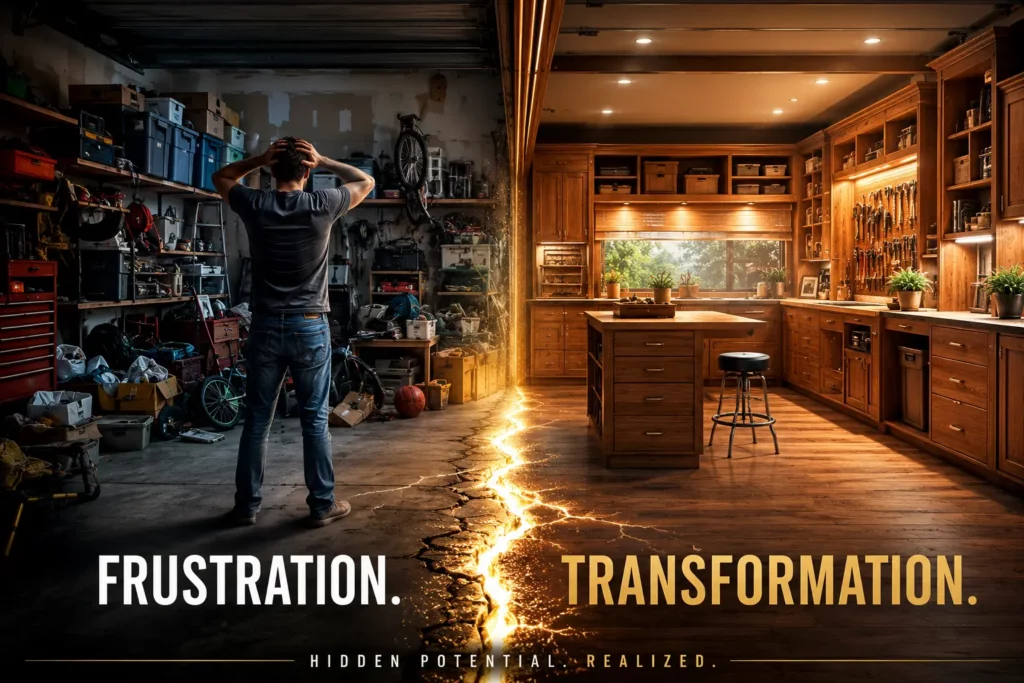
When homeowners see a cluttered garage transformed into an organized workspace, they don’t simply admire the project.
They imagine their own garage.
Their own frustration.
Their own potential result.
That emotional projection is powerful.
It’s one of the reasons transformation-focused content consistently outperforms purely technical explanations.
Projects That Generate Exceptional Before-and-After Results
Some woodworking projects are especially effective visually:
- Mudroom systems
- Garage organization installations
- Closet systems
- Built-in shelving
- Outdoor entertainment areas
- Pergolas
- Reading nooks
- Home office transformations
The greater the visible change, the stronger the engagement.
Local Authority Often Beats National Visibility
Many woodworking businesses chase large audiences.
In reality, local visibility frequently delivers better results.
A homeowner searching for inspiration may browse national content.
A homeowner ready to hire usually searches locally.
Why Local SEO Matters
Searches with local intent often signal stronger purchase readiness.
Examples include:
- Custom woodworking near me
- Pergola builders near me
- Garage storage installation
- Built-in shelving contractor
- Closet system installer
These searches typically come from homeowners actively seeking solutions.
Not simply gathering ideas.
Ways to Strengthen Local Authority
Create content around:
- Regional design styles
- Climate-specific woodworking projects
- Local home improvement trends
- Neighborhood project showcases
- Area-specific storage solutions
The more relevant your content feels to local homeowners, the stronger your connection becomes.
Position Yourself Around a Specialty
One mistake many businesses make is trying to serve everyone.
The market increasingly rewards specialization.
Homeowners often perceive specialists as experts.
And experts command trust.
High-Demand Specialization Opportunities
Rather than offering generic woodworking services, consider focusing on:
- Mudroom systems
- Garage organization
- Outdoor living structures
- Built-in home offices
- Closet systems
- Small-space solutions
- Multipurpose furniture
Specialization creates clarity.
And clarity often leads to stronger referrals, better branding, and higher perceived value.
Reviews and Social Proof Matter More Than Ever
Homeowners naturally seek reassurance before investing in custom projects.
They want evidence.
Proof.
Validation.
This is where reviews become essential.
Why Social Proof Influences Decisions
People often trust other homeowners more than marketing messages.
A positive review answers questions that advertising cannot.
Questions like:
- Was the contractor reliable?
- Was the project completed on time?
- Did the finished product meet expectations?
- Was the experience enjoyable?
The more uncertainty you remove, the easier it becomes for homeowners to move forward.
Create a Portfolio That Tells Stories
Many woodworking portfolios focus entirely on finished projects.
The strongest portfolios go deeper.
They tell stories.
What Homeowners Actually Want to See
A compelling project showcase includes:
- The original challenge
- The homeowner’s goals
- Design considerations
- Construction highlights
- Finished results
- Real-world benefits
Storytelling helps homeowners understand not just what was built, but why it mattered.
And why it might matter for them as well.
The Businesses That Win Understand Human Behavior
At first glance, woodworking appears to be a craft-driven industry.
And it is.
But growth often depends on understanding something else entirely.
People.
The homeowners searching for solutions are motivated by:
- Convenience
- Comfort
- Organization
- Pride of ownership
- Functionality
- Lifestyle improvement
The businesses that recognize those motivations tend to outperform those that focus exclusively on technical details.
Because homeowners rarely buy projects.
They buy better experiences.
And when your business consistently communicates that value, demand becomes much easier to capture.
Which leads naturally to the final stage of understanding this market.
The questions homeowners ask right before they decide.
The concerns they carry.
The uncertainties they want resolved.
And the answers that often determine whether they move forward or continue searching.
Part 9: Frequently Asked Questions Homeowners Secretly Ask Before Investing in Woodworking Projects
Every woodworking project begins long before the first board is cut.
It begins with questions.
Some are practical.
Others are emotional.
Many homeowners spend weeks researching before they ever reach out to a contractor, builder, or custom woodworker. They compare ideas. Browse inspiration galleries. Read reviews. Save photos. Watch videos. Measure rooms.
And throughout that process, a quiet conversation unfolds in their mind.
A conversation filled with uncertainty, possibility, and hesitation.
The questions below aren’t simply common search queries.
They’re the questions homeowners ask themselves when they’re trying to decide whether a project is truly worth pursuing.
Understanding them reveals something important about demand itself.
Because demand isn’t just created by desire.
It’s created by the need for clarity.
“Which Woodworking Projects Are Actually Trending Right Now?”
This is usually the first question homeowners ask.
Not because they want to follow trends blindly.
Because they want reassurance.
Nobody wants to invest time and money into something that already feels outdated.
Fortunately, today’s most popular woodworking projects aren’t driven by short-lived design fads.
They’re driven by functionality.
Projects currently attracting significant homeowner interest include:
- Mudroom systems
- Custom closet storage
- Garage organization solutions
- Pergolas
- Privacy screens
- Built-in home offices
- Floating shelves
- Multipurpose furniture
- Raised garden beds
- Custom storage cabinetry
Notice the pattern.
Nearly every project solves a practical problem while simultaneously improving aesthetics.
That’s why these categories continue performing well.
Their value extends beyond appearance.
“What Woodworking Projects Add the Most Value to a Home?”
This question reflects a deeper concern.
Homeowners want to know whether an improvement feels like an expense or an investment.
The answer depends partly on location, market conditions, and property type.
But certain categories consistently stand out.
Projects Often Associated With Strong Value Perception
Built-In Storage
Custom shelving and cabinetry create functionality while enhancing architectural appeal.
Mudroom Systems
Families often view mudrooms as lifestyle upgrades rather than simple storage solutions.
Custom Closet Systems
Well-designed closets improve organization and create a premium feel.
Outdoor Living Spaces
Pergolas, outdoor dining areas, and entertainment zones frequently improve perceived property appeal.
Home Office Built-Ins
As remote and hybrid work remain common, dedicated workspaces continue attracting attention.
One important point often gets overlooked.
Homeowners don’t always evaluate value solely through resale potential.
Sometimes value comes from daily enjoyment.
And daily enjoyment can be remarkably persuasive.
“Will I Actually Use This After It’s Finished?”
This may be the most important question of all.
Because homeowners have seen projects that looked impressive but delivered little real-world benefit.
The strongest woodworking projects avoid that trap.
They become integrated into daily routines.
Signs a Project Will Deliver Long-Term Value
Projects tend to perform best when they solve recurring problems.
Examples include:
- Entryway clutter
- Lack of storage
- Limited workspace
- Outdoor usability challenges
- Organization frustrations
When a project improves something homeowners encounter every day, usage tends to remain high.
The project becomes part of life rather than an occasional feature.
That’s one reason storage projects remain so resilient.
Their utility rarely fades.
“Is Custom Woodworking Worth It Compared to Store-Bought Alternatives?”
At first glance, mass-produced products often appear more affordable.
And sometimes they are.
But homeowners frequently discover that standard solutions come with limitations.
They rarely fit perfectly.
They often waste space.
And they may not align with specific needs.
Custom woodworking exists because homes—and homeowners—are unique.
What Custom Solutions Offer That Generic Products Cannot
Custom projects can be tailored around:
- Room dimensions
- Storage requirements
- Design preferences
- Lifestyle habits
- Future flexibility
That personalization often creates better long-term satisfaction.
The project feels intentional because it was designed for a specific purpose rather than a general audience.
“What If My Home Doesn’t Have Much Space?”
This concern has become increasingly common.
And it’s one reason small-space woodworking projects continue gaining popularity.
The assumption that larger homes have more opportunities isn’t always accurate.
In many cases, smaller homes benefit most from custom solutions.
High-Impact Projects for Limited Spaces
Popular options include:
- Fold-down desks
- Wall-mounted workstations
- Under-stair storage
- Vertical shelving systems
- Storage benches
- Multipurpose furniture
- Floating cabinetry
The goal isn’t simply to add storage.
It’s to improve efficiency.
Small spaces become far more valuable when every square foot serves a purpose.
“Which Projects Tend to Have the Strongest Demand?”
Homeowners often ask this question when considering future resale appeal or long-term relevance.
Projects with broad demand typically address universal challenges.
Those challenges rarely change.
Consistently Strong Categories
Across many markets, demand remains especially strong for:
- Garage organization systems
- Mudroom storage
- Built-in shelving
- Outdoor living projects
- Closet systems
- Home office solutions
- Custom storage cabinetry
These categories continue thriving because they improve functionality in meaningful ways.
They’re not dependent on temporary trends.
They’re tied to ongoing homeowner needs.
“How Do I Know Which Project Is Right for My Home?”
This question often reveals a deeper uncertainty.
Many homeowners have ideas.
What they lack is confidence.
They know they want improvement.
They’re simply unsure where to begin.
A Better Way to Evaluate Potential Projects
Rather than asking:
“What should I build?”
Ask:
“What frustration do I experience most often?”
That question frequently produces clearer answers.
If clutter creates stress, storage may provide the greatest value.
If outdoor space feels underused, a pergola or entertainment area may offer the strongest return.
If work-from-home challenges persist, a custom office solution may deliver the greatest impact.
The best woodworking projects solve meaningful problems.
Start with the problem.
The project often reveals itself.
“Are Outdoor Living Projects Still Worth Investing In?”
Many homeowners wonder whether outdoor living remains a worthwhile investment or whether the trend has peaked.
Current demand suggests continued momentum.
But the reasons have evolved.
Why Outdoor Spaces Continue to Matter
Homeowners increasingly view outdoor areas as extensions of interior living space.
Projects such as:
- Pergolas
- Privacy screens
- Outdoor dining structures
- Garden installations
- Built-in seating
allow people to use their properties more fully.
The appeal isn’t merely visual.
It’s experiential.
People value spaces that encourage connection, relaxation, and enjoyment.
Those motivations remain powerful.
“What Woodworking Trend Looks Most Promising for the Future?”
This question usually comes from homeowners, investors, and woodworking professionals alike.
And while predicting the future perfectly is impossible, several themes continue gaining momentum.
Trends Showing Long-Term Potential
The strongest indicators point toward:
- Smart storage systems
- Flexible furniture
- Custom organization solutions
- Sustainable woodworking projects
- Wellness-focused spaces
- Technology-integrated cabinetry
- Adaptable home office systems
The common thread is functionality.
Future demand appears increasingly tied to projects that improve everyday living rather than simply enhance appearance.
The Questions Behind the Questions
Something interesting happens when you examine homeowner concerns closely.
Most questions aren’t really about woodworking.
They’re about confidence.
People want reassurance that they’re making a smart decision.
That the project will improve their home.
That it will simplify life rather than complicate it.
That it will continue delivering value long after installation is complete.
The wood itself is only part of the equation.
What homeowners are really evaluating is the future experience the project will create.
And the projects that consistently succeed are the ones that make that future feel clear.
Which brings us to the final piece of the puzzle.
The tools, resources, and products that help transform ideas into finished spaces—and why certain categories continue shaping the future of high-demand woodworking.
Part 10: Products, Tools & Resources for High-Demand Woodworking Projects
Behind every great woodworking project is a simple reality.
Ideas are important.
Design matters.
Craftsmanship matters even more.
But eventually every successful project reaches the same point.
The planning ends.
The measuring begins.
And the right tools, materials, and resources become the difference between frustration and momentum.
Whether you’re a homeowner exploring custom storage solutions, a DIY enthusiast researching your next build, or a woodworking professional looking to capitalize on growing demand, the resources below represent some of the most valuable categories shaping today’s market.
Not because they’re trendy.
Because they consistently support the types of woodworking projects homeowners are actively searching for right now.
Essential Materials for High-Demand Woodworking Projects
The quality of a finished project often begins long before construction starts.
Material selection affects durability, appearance, maintenance requirements, and long-term value.
For projects such as mudroom systems, garage organization, built-in shelving, custom closets, and home office cabinetry, homeowners increasingly prioritize materials that balance strength with visual appeal.
Popular Wood Choices
White Oak
Known for:
- Durability
- Timeless appearance
- Strong grain character
- Excellent stain acceptance
Common applications include:
- Built-ins
- Custom cabinetry
- Floating shelves
- Home office systems
Maple
A favorite for:
- Closet systems
- Storage cabinetry
- Garage organization projects
- Modern interiors
Homeowners appreciate its clean appearance and versatility.
Walnut
Often chosen for premium projects because of its rich color and sophisticated character.
Popular uses include:
- Executive desks
- High-end shelving
- Custom furniture
- Luxury built-ins
Cedar
Frequently used in outdoor woodworking projects due to its natural resistance to moisture and insects.
Ideal for:
- Pergolas
- Privacy screens
- Garden structures
- Outdoor seating
Reclaimed Wood
Increasingly popular among homeowners interested in sustainability and unique visual character.
Works especially well for:
- Accent walls
- Floating shelves
- Statement furniture
- Decorative storage projects
Must-Have Power Tools for Modern Woodworking
Technology continues to improve woodworking efficiency without replacing craftsmanship.
These tools remain foundational across many high-demand woodworking categories.
Table Saw
Few tools influence productivity as significantly as a quality table saw.
Common uses include:
- Breaking down sheet goods
- Precision ripping
- Cabinet construction
- Built-in storage projects
For many woodworkers, it serves as the center of the workshop.
Miter Saw
Particularly useful for:
- Trim work
- Shelving projects
- Pergola construction
- Framing components
Its speed and accuracy make it indispensable for repetitive cuts.
Router
One of the most versatile woodworking tools available.
Applications include:
- Decorative edges
- Joinery
- Sign making
- Cabinet detailing
- Custom trim profiles
A router often helps transform simple projects into premium-looking installations.
Orbital Sander
Finishing quality frequently determines how homeowners perceive craftsmanship.
An orbital sander helps create smooth surfaces and professional finishes across a wide range of projects.
Cordless Drill and Driver Set
Used constantly throughout nearly every woodworking build.
Essential for:
- Assembly
- Installation
- Hardware mounting
- Structural fastening
A quality cordless system saves significant time during project execution.
Hardware That Elevates Functionality
Woodworking creates structure.
Hardware creates usability.
Many of today’s most sought-after projects rely heavily on well-chosen hardware systems.
Soft-Close Drawer Slides
Increasingly expected in:
- Closet systems
- Mudroom storage
- Built-in cabinetry
- Home office installations
Homeowners often associate soft-close functionality with premium quality.
Heavy-Duty Shelf Supports
Critical for:
- Garage storage systems
- Built-in shelving
- Floating shelf projects
Strength and stability directly influence long-term performance.
Concealed Hinges
Popular because they create:
- Clean aesthetics
- Smooth operation
- Professional appearance
Frequently used in modern cabinetry and custom storage projects.
Adjustable Shelving Systems
One reason homeowners invest in custom woodworking is flexibility.
Adjustable systems help future-proof storage projects by allowing layouts to evolve over time.
Design Software and Planning Resources
The most successful projects often begin with visualization.
Homeowners increasingly expect to see concepts before construction begins.
Fortunately, modern planning tools make that easier than ever.
Digital Design Platforms
Useful for:
- Space planning
- Layout visualization
- Material estimation
- Client presentations
Even simple visual mockups can dramatically improve communication and decision-making.
Project Planning Templates
Helpful for:
- Measuring rooms
- Tracking materials
- Managing budgets
- Organizing timelines
A structured planning process often prevents costly mistakes later.
Resources for Storage and Organization Projects
Because storage remains one of the strongest woodworking categories, homeowners frequently benefit from researching organization principles before beginning a build.
Topics worth exploring include:
- Closet organization systems
- Garage workflow design
- Mudroom layout planning
- Vertical storage strategies
- Space optimization techniques
Understanding how people actually use a space often leads to better project outcomes than focusing solely on aesthetics.
Resources for Outdoor Living Projects
Outdoor woodworking continues to attract enormous interest.
Homeowners considering pergolas, privacy screens, outdoor kitchens, or garden structures may benefit from researching:
- Climate considerations
- Material durability
- Maintenance requirements
- Shade planning
- Landscape integration
The best outdoor projects feel connected to the broader property rather than existing as isolated additions.
Resources for Home Office Woodworking Projects
As remote and hybrid work remain common, home office demand continues evolving.
Useful areas of research include:
- Ergonomic workspace design
- Cable management systems
- Storage optimization
- Lighting considerations
- Productivity-focused layouts
The most effective office projects blend comfort, organization, and flexibility.
Resources for Small-Space Woodworking Solutions
Small-space projects often deliver some of the highest perceived value.
Before beginning a project, homeowners may benefit from exploring:
- Multipurpose furniture concepts
- Fold-away workstation designs
- Under-stair storage ideas
- Vertical organization systems
- Modular storage approaches
In compact homes, thoughtful planning often creates more impact than additional square footage.
Recommended Categories for Future Research
For homeowners exploring future woodworking opportunities, these topics consistently align with growing demand:
Storage & Organization
- Mudroom systems
- Garage organization
- Custom closets
- Built-in shelving
Outdoor Living
- Pergolas
- Privacy screens
- Raised garden beds
- Outdoor entertainment areas
Home Office Solutions
- Built-in workstations
- Floating desks
- Hybrid workspace design
- Cable management systems
Flexible Living
- Multipurpose furniture
- Fold-down desks
- Modular cabinetry
- Space-saving storage
Emerging Trends
- Sustainable woodworking
- Smart storage integration
- Wellness-focused spaces
- Custom organization systems
Internal Linking Opportunities
To deepen expertise and continue exploring high-demand woodworking projects, consider related resources on:
- Best Wood Types for Outdoor Projects
- How Much Do Custom Built-Ins Cost?
- Beginner-Friendly Woodworking Projects That Sell
- Pergola Design Ideas for Modern Backyards
- Garage Organization Systems That Increase Home Value
- DIY vs Professional Woodworking Installations
- Woodworking Business Pricing Guide
- Home Office Design Trends for Small Spaces
- Smart Storage Ideas for Modern Homes
- Sustainable Woodworking Materials and Finishes