
Quick Answer: What Are the Best Modern Woodworking Projects for Small Apartments?
The best modern woodworking ideas for small apartments are the ones that do more than simply occupy space—they earn it. Projects like floating shelves, wall-mounted desks, storage platform beds, fold-down dining tables, modular shelving systems, and hidden-storage furniture help transform tight living quarters into highly functional, visually open environments.
Instead of adding more furniture, these solutions rethink how space is used. Walls become storage. Corners become opportunities. Furniture adapts to your routine rather than forcing your routine to adapt to it.
If you’re looking to make a small apartment feel larger without knocking down walls or spending a fortune on renovations, woodworking offers one of the most effective paths forward.
Why Small Apartments Feel Cramped—Even When They Aren’t
Most people blame square footage.
That’s understandable. When you’re stepping around shoes in the entryway, balancing dinner plates on a coffee table, or searching for somewhere—anywhere—to put seasonal items, it feels like the apartment itself is the problem.
But size is only part of the story.
Walk into a thoughtfully designed 500-square-foot apartment and it can feel surprisingly spacious. Walk into a cluttered 900-square-foot apartment and it may feel restrictive within minutes.
The difference lies in perception.
Our brains constantly evaluate space through visual cues. Every exposed object competes for attention. Every awkward furniture placement interrupts movement. Every underused corner quietly contributes to the feeling that there’s never enough room.
This is where modern woodworking changes everything.
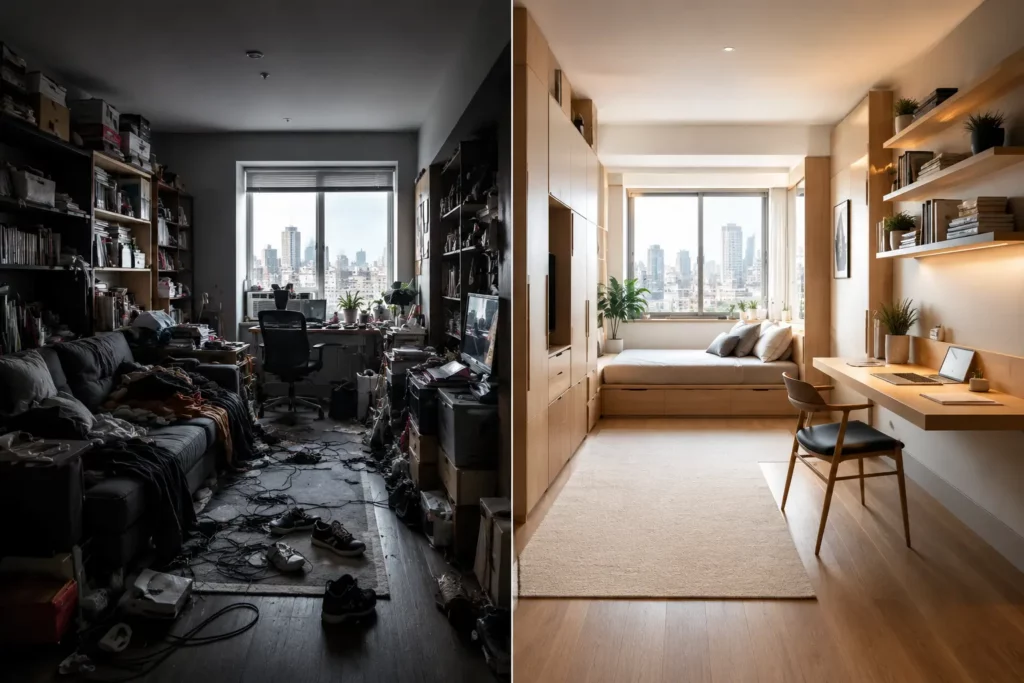
Instead of relying on mass-produced furniture designed for average homes, custom woodworking allows every inch of an apartment to serve a purpose. Storage becomes integrated. Furniture becomes multifunctional. Dead space becomes productive space.
And slowly, something unexpected happens.
The apartment begins to feel larger without gaining a single square foot.
The New Philosophy of Small-Space Living
For decades, furniture was designed around the assumption that space was abundant.
Today’s urban living reality is different.
Apartments are becoming smaller. Remote work has created new demands. Living rooms double as offices. Bedrooms function as storage zones. Dining areas often disappear entirely.
The most successful modern interiors respond to these challenges with intention rather than excess.
That philosophy draws inspiration from several design movements:
- Scandinavian minimalism
- Japanese spatial efficiency
- Tiny-home architecture
- Modular furniture design
- Sustainable living practices
Although each approach looks different on the surface, they share a common belief:
Space should work harder than it looks.
A bench can hide storage.
A wall can become an office.
A bed can replace an entire dresser.
When woodworking is approached this way, furniture stops being furniture. It becomes infrastructure.
27 Modern Woodworking Ideas That Transform Small Apartments
1. Floating Wall Shelves
Few woodworking projects deliver a bigger return for such a small investment.
Floating shelves solve one of the most common apartment challenges: limited storage combined with limited floor space.
Instead of adding another bulky cabinet, floating shelves move storage upward, making use of vertical real estate that often goes ignored.
They’re ideal for:
- Books
- Plants
- Decorative accents
- Kitchen essentials
- Everyday storage baskets
What makes floating shelves particularly effective is the visual breathing room they create. Because the floor remains visible beneath them, the room feels less crowded and more open.
It’s a subtle psychological effect, but an incredibly powerful one.
2. Fold-Down Wall Desk
The rise of remote work has forced many apartment dwellers into an impossible compromise.
Work needs a dedicated space.
Apartments often don’t have one.
A fold-down wall desk solves that tension elegantly.
During working hours, it functions as a productive workstation. At the end of the day, it folds neatly against the wall, restoring valuable living space.
Modern versions often include:
- Integrated shelving
- Hidden storage compartments
- Cable management systems
- Charging stations
For studio apartments and one-bedroom layouts, this may be one of the smartest woodworking investments available.
3. Murphy Bed Storage Wall
There are projects that improve a room.
Then there are projects that completely redefine it.
A Murphy bed belongs in the second category.
When folded away, the sleeping area virtually disappears, opening up valuable floor space for work, exercise, entertaining, or simply moving around more comfortably.
The best custom Murphy bed systems incorporate:
- Built-in shelving
- Closed cabinetry
- Integrated lighting
- Display storage
- Hidden organizational compartments
In smaller apartments, reclaiming even 30 square feet can dramatically alter how a room feels and functions.
4. Storage Platform Bed
Look underneath the average bed and you’ll find one of the most underutilized areas in the home.
It’s a surprising amount of space.
A custom storage platform bed transforms that forgotten footprint into highly organized storage.
Depending on the design, it can accommodate:
- Seasonal clothing
- Extra bedding
- Luggage
- Sports equipment
- Household essentials
Many apartment residents discover that after installing a storage platform bed, they no longer need a bulky dresser at all.
That’s not just additional storage.
That’s reclaimed floor space.
5. Corner Floating Shelves
Corners are often treated like architectural leftovers.
Yet some of the most effective apartment storage solutions begin there.
Custom corner shelving transforms neglected angles into practical display and storage zones without interrupting traffic flow.
They work beautifully for:
- Indoor plants
- Books
- Artwork
- Small electronics
- Decorative collections
Because these shelves occupy otherwise unused space, they deliver functionality without demanding sacrifice elsewhere.
6. Lift-Top Coffee Table
In small apartments, furniture that serves a single purpose rarely earns its place.
A lift-top coffee table challenges that limitation.
At first glance, it looks like a standard living room centerpiece.
But beneath the surface lies a surprisingly versatile system.
It can function as:
- A coffee table
- A dining surface
- A laptop workstation
- A hidden storage compartment
For apartments where every square foot matters, multifunctionality isn’t a luxury.
It’s survival.
7. Entryway Storage Bench
The entryway often becomes the first casualty of limited space.
Shoes pile up.
Bags accumulate.
Keys disappear.
Mail develops its own ecosystem.
A custom storage bench creates an immediate sense of order the moment you walk through the door.
Features often include:
- Shoe storage compartments
- Hidden drawers
- Seating space
- Open cubbies
- Coat organization systems
What’s remarkable isn’t simply the storage it provides.
It’s the reduction in visual noise.
And visual noise, more than many people realize, is what makes a small apartment feel overwhelming.
8. Wall-Mounted Media Console
Traditional entertainment centers were designed for larger homes and older technology.
Today’s apartments require a lighter touch.
A floating media console keeps electronics organized while exposing more visible floor area, helping rooms feel larger and less cluttered.
Additional benefits include:
- Concealed cables
- Easier cleaning
- Modern minimalist aesthetics
- Flexible customization
The result is a living room that feels intentional rather than crowded.
9. Vertical Pantry Cabinet
When apartment kitchens run out of storage, most people think horizontally.
The better solution is usually vertical.
A tall, narrow pantry cabinet can dramatically increase storage capacity without consuming significant floor space.
Items commonly stored include:
- Dry goods
- Small appliances
- Cookware
- Cleaning supplies
- Bulk pantry items
This shift—from thinking in square feet to thinking in cubic feet—is one of the most valuable lessons in small-space woodworking.
10. Floating Nightstands
Traditional nightstands occupy floor space while offering relatively little storage.
Floating nightstands provide the same convenience with a lighter visual footprint.
The difference seems small at first.
Then you notice how much easier the room feels to move through.
How much cleaner the floor appears.
How much more spacious the bedroom suddenly feels.
Sometimes the biggest transformations come from the smallest adjustments.
11. Modular Bookshelf Systems
The challenge with most storage furniture is that life eventually outgrows it.
A bookshelf that works perfectly today may feel restrictive a year from now. New books arrive. Interests evolve. Storage needs shift.
That’s why modular bookshelf systems have become a favorite among apartment dwellers and modern woodworkers alike.
Instead of committing to one rigid structure, modular shelving allows pieces to expand, contract, or rearrange as your needs change.
A well-designed system can function as:
- A traditional bookshelf
- A display wall
- A room divider
- Home office storage
- Media organization
The beauty lies in flexibility.
Your apartment evolves. Your furniture evolves with it.
12. Fold-Out Dining Table
Dining tables occupy an unusual place in apartment living.
They’re essential when needed and strangely wasteful when they’re not.
For most households, a dining table sits unused for the majority of the day, quietly consuming valuable floor space.
A fold-out dining table solves that imbalance.
When folded away, it occupies minimal space. When guests arrive or dinner is served, it expands into a fully functional gathering area.
Some custom woodworking designs even incorporate:
- Hidden storage
- Wall-mounted installation
- Convertible desk functions
- Seating integration
The result is a dining solution that adapts to life instead of dictating it.
13. Window Bench with Hidden Storage
Every apartment has at least one overlooked opportunity.
Often, it’s the window.
Most windows serve a single purpose: bringing in light.
A custom-built window bench transforms that area into something far more valuable.
Suddenly, the space becomes:
- A reading retreat
- Extra seating
- Storage space
- A design focal point
Built-in compartments beneath the bench can store everything from blankets and books to seasonal décor and household essentials.
And because natural light naturally draws attention, window benches tend to make rooms feel larger and more inviting than their actual dimensions suggest.
14. Sliding Door Storage Cabinets
Traditional cabinet doors require clearance.
It’s a detail most people never think about until they live in a compact apartment.
Doors swing open. Pathways become blocked. Movement becomes restricted.
Sliding door cabinets eliminate that problem entirely.
By moving laterally instead of outward, they create storage solutions ideal for:
- Narrow hallways
- Compact kitchens
- Tight bedrooms
- Studio apartments
The effect is subtle but meaningful.
Every movement through the apartment feels easier.
And in small spaces, ease translates directly into comfort.
15. Under-Stair Storage Drawers
For loft apartments, duplex units, and multi-level small homes, staircases often hide a remarkable amount of untapped storage.
Most people see steps.
Woodworkers see opportunity.
Custom under-stair drawers can accommodate:
- Shoes
- Cleaning supplies
- Seasonal decorations
- Sports equipment
- Household storage bins
What was once empty space becomes one of the most efficient storage zones in the home.
It’s a reminder that some of the best square footage isn’t visible at first glance.
16. Wall-Mounted Bike Rack
Urban apartment living and cycling often go hand in hand.
Storage, unfortunately, does not.
A bicycle leaning against a wall can dominate an entire room. A bicycle mounted thoughtfully becomes part of the room’s design.
Custom woodworking bike racks offer:
- Space efficiency
- Protection from damage
- Easier access
- Decorative appeal
In many modern apartments, bicycles become functional artwork—displayed rather than hidden.
17. Floating Entry Organizer
Few frustrations feel as persistent as constantly searching for keys, chargers, wallets, or incoming mail.
The solution isn’t more space.
It’s better organization.
A floating entry organizer creates a designated home for everyday essentials.
Popular features include:
- Key hooks
- Mail slots
- Charging shelves
- Sunglasses storage
- Small-item compartments
The project itself is relatively simple.
The daily impact is anything but.
18. Compact Home Office Nook
The modern apartment has inherited a new responsibility.
It must now function as a workplace.
That challenge becomes easier when underutilized spaces are viewed differently.
Closets.
Alcoves.
Hallway recesses.
Unused corners.
Each can become a compact home office nook with custom woodworking.
A thoughtfully designed workstation might include:
- Floating desktop surfaces
- Vertical shelving
- Integrated lighting
- Hidden cable routing
- Fold-away functionality
What was once forgotten space becomes one of the apartment’s most productive assets.
19. Ceiling-Height Storage Cabinets
Look around most apartments and you’ll notice something curious.
Cabinets stop.
The ceiling continues.
That empty gap represents storage potential that’s often ignored.
Custom ceiling-height cabinets maximize vertical storage while creating a cleaner, more architectural appearance.
They’re particularly effective in:
- Kitchens
- Closets
- Entryways
- Utility rooms
By extending cabinetry upward, visual fragmentation decreases and storage capacity increases simultaneously.
It’s one of the rare upgrades that improves both function and aesthetics.
20. Hidden Laundry Cabinet
Laundry areas have a tendency to create visual clutter.
Detergent bottles.
Cleaning supplies.
Hampers.
Drying equipment.
A hidden laundry cabinet conceals these necessities behind clean, cohesive woodworking.
The apartment feels calmer.
Cleaner.
More intentional.
And because the eye no longer registers dozens of competing objects, the surrounding space often feels noticeably larger.
21. Room Divider Storage Unit
Studio apartments face a unique challenge.
Without separation, every activity happens in the same visual field.
Work blends into leisure.
Sleep blends into productivity.
Storage blends into everything.
A custom room divider storage unit creates distinction without sacrificing openness.
Depending on the design, it can function as:
- Shelving
- Closed storage
- Display space
- Workspace divider
Rather than building walls, it creates zones.
And zones make even the smallest apartments feel more organized and purposeful.
22. Under-Sofa Storage Platform
Most sofas hide an opportunity beneath them.
A custom platform with integrated drawers turns that overlooked area into practical storage.
Perfect for:
- Extra blankets
- Board games
- Seasonal clothing
- Household supplies
The advantage isn’t merely additional storage.
It’s invisible storage.
The best organizational systems are often the ones you barely notice.
23. Wall-Mounted Plant Display
Plants bring life to a room.
Unfortunately, they also consume valuable surfaces.
A vertical plant display solves both problems.
By moving greenery onto the walls, you preserve floor space while introducing:
- Texture
- Depth
- Color
- Natural elements
The result is a room that feels richer, brighter, and more expansive.
Nature has a remarkable ability to soften the edges of small-space living.
24. Fold-Away Craft Station
Creative hobbies require space.
Apartment living rarely offers it.
A fold-away craft station bridges that gap.
When open, it provides a dedicated workspace for:
- Painting
- Sewing
- Model building
- DIY projects
- Creative work
When closed, it disappears neatly into the surrounding design.
Creativity remains accessible without permanently claiming square footage.
25. Modular Closet Organizer
Closets often appear full long before they’re actually optimized.
The issue isn’t always volume.
It’s structure.
Custom modular organizers dramatically increase closet efficiency through:
- Adjustable shelving
- Vertical compartments
- Pull-out drawers
- Dedicated storage zones
The difference can be transformative.
Many apartment residents discover they already had enough storage space.
They simply weren’t using it effectively.
26. Hidden Storage Ottoman
Some furniture pieces quietly outperform everything around them.
The storage ottoman is one of them.
Compact yet versatile, it can serve as:
- Seating
- Footrest
- Coffee table
- Storage compartment
It’s a simple concept.
But simplicity is often where great design lives.
27. Integrated Smart Furniture Wall
The future of modern woodworking isn’t just about craftsmanship.
It’s about integration.
Custom furniture walls now combine traditional woodworking with smart technology to create seamless living environments.
Features may include:
- Wireless charging stations
- Concealed power outlets
- Integrated LED lighting
- Cable management systems
- Modular storage solutions
The result feels less like furniture and more like an ecosystem designed around daily life.
The Best Wood Types for Modern Apartment Furniture
Choosing the right wood influences far more than appearance.
Durability, weight, maintenance requirements, and overall atmosphere all begin with material selection.
A beautiful design built from the wrong material rarely performs as intended.
A thoughtful material choice elevates everything.
Birch Plywood
Birch plywood has become a favorite among modern furniture designers for good reason.
It’s strong, affordable, and exceptionally versatile.
Best for:
- Shelving systems
- Built-ins
- Desks
- Storage projects
Its clean grain and minimalist appearance fit naturally within contemporary apartment interiors.
White Oak
White oak occupies a unique position between luxury and practicality.
It’s durable enough for daily use yet refined enough for statement furniture.
Ideal applications include:
- Dining tables
- Floating shelves
- Built-in cabinetry
- Premium storage furniture
The grain pattern brings warmth without overwhelming a room.
Walnut
Few materials communicate craftsmanship quite like walnut.
Rich color variation and striking grain make it a favorite for feature pieces.
Best used for:
- Coffee tables
- Statement shelving
- Luxury furniture
- Custom cabinetry
A little walnut goes a long way.
In smaller apartments, selective use often creates the strongest visual impact.
Bamboo
Sustainability continues to influence modern furniture design.
Bamboo offers an environmentally conscious alternative without sacrificing durability.
Benefits include:
- Renewable sourcing
- Lightweight construction
- Modern appearance
- Strong performance
For eco-conscious apartment dwellers, it’s an increasingly attractive option.
The Essential Woodworking Tools for Small Apartment Projects
One of the biggest misconceptions about woodworking is that it requires a sprawling garage, industrial machinery, and thousands of dollars in equipment.
It doesn’t.
In fact, some of the most effective small-apartment woodworking projects are built with a surprisingly compact tool collection.
The goal isn’t to own every tool.
The goal is to own the right tools.
For apartment-friendly woodworking, versatility matters more than volume.
Circular Saw
If there is one tool that consistently earns its place in a small workshop, it’s a circular saw.
Capable of making clean, accurate cuts in plywood, hardwood, and sheet goods, it offers remarkable flexibility without requiring dedicated floor space.
Why it matters:
- Portable
- Affordable
- Easy to store
- Suitable for most furniture projects
For many apartment woodworkers, this becomes the foundation of the entire toolkit.
Drill and Driver
Every woodworking project eventually comes down to assembly.
A quality drill and driver set handles:
- Fastening
- Pilot holes
- Hardware installation
- Furniture assembly
Look for compact cordless models that balance power with storage convenience.
Random Orbital Sander
Raw wood rarely looks finished straight off the saw.
A random orbital sander smooths surfaces, softens edges, and prepares projects for stain or paint.
The difference between a project that feels homemade and one that feels professional often comes down to sanding.
It’s the step people notice most when it’s skipped.
Pocket-Hole Jig
Modern furniture construction often relies on hidden joinery.
Pocket-hole systems create strong, clean connections while keeping visible surfaces free of exposed fasteners.
For beginners, few tools offer a bigger confidence boost.
Projects come together faster, cleaner, and with less frustration.
Clamps
Woodworkers often joke that you can never own enough clamps.
There’s some truth to that.
Clamps hold pieces securely during:
- Assembly
- Gluing
- Finishing
- Precision adjustments
Even a modest collection can dramatically improve project quality.
Measuring and Layout Tools
Accurate woodworking starts long before cutting begins.
Basic essentials include:
- Tape measure
- Combination square
- Marking gauge
- Carpenter’s pencil
- Level
A small measuring error at the beginning of a project often becomes a large problem at the end.
Precision saves time.
Why Smart Woodworking Makes Small Apartments Feel Bigger
At first glance, space-saving furniture appears to solve a storage problem.
But the real impact runs deeper.
Much deeper.
Human beings don’t experience a room through square footage alone.
We experience it through perception.
Visual flow.
Movement.
Mental effort.
The number of decisions our brains must make every time we enter a space.
Every visible object demands attention.
Every cluttered surface creates cognitive friction.
Every poorly organized area quietly consumes mental bandwidth.
This is why thoughtfully designed woodworking often feels transformative.
Not because the apartment physically expands.
Because mental resistance shrinks.
A floating shelf reduces visual interruption.
A storage bed eliminates scattered belongings.
A wall-mounted desk removes unnecessary bulk.
The room becomes easier to process.
And when a room becomes easier to process, it feels larger.
Interior designers sometimes refer to this as visual breathing room.
Woodworkers create it through function.
The Hidden Psychology Behind Great Small-Space Design
The most successful apartments share a common characteristic.
They don’t merely store possessions.
They remove decisions.
Think about the difference between:
- Searching for your keys every morning
- Knowing exactly where they are
Between:
- Looking at a pile of cables
- Seeing a clean media console
Between:
- Stacking items wherever they fit
- Having designated storage for everything
The square footage hasn’t changed.
The experience has.
Modern woodworking succeeds because it addresses both physical and psychological clutter simultaneously.
That’s why custom-built solutions often feel dramatically more effective than mass-produced alternatives.
They are designed around real habits.
Real routines.
Real living.
Common Woodworking Mistakes That Make Small Apartments Feel Smaller
Not every storage solution creates more space.
Some actually create the opposite effect.
Understanding these pitfalls can save considerable time, money, and frustration.
Choosing Oversized Furniture
This mistake appears everywhere.
A large sectional sofa.
An oversized entertainment center.
A bulky desk.
Each piece may work individually.
Together, they overwhelm the room.
Scale matters.
Furniture should fit the apartment rather than dominate it.
Ignoring Vertical Space
Most apartments contain far more usable wall space than residents realize.
When storage remains concentrated at floor level, valuable opportunities are lost.
Vertical solutions often provide the greatest storage gains with the smallest footprint.
Think upward.
Not outward.
Installing Too Many Open Shelves
Open shelving photographs beautifully.
Living with it is another story.
Without disciplined organization, open shelves quickly accumulate visual clutter.
The result can make a room feel busier rather than larger.
A healthy balance between open and concealed storage tends to work best.
Mixing Too Many Wood Finishes
Wood introduces warmth and character.
Too many competing finishes introduce chaos.
Consistency creates cohesion.
Cohesion creates calm.
Whether you prefer white oak, walnut, birch plywood, or bamboo, maintaining a unified palette helps apartments feel more intentional and expansive.
Buying Single-Purpose Furniture
In larger homes, single-purpose furniture can be practical.
In smaller apartments, every item should justify its footprint.
The most effective pieces typically serve at least two functions.
Sometimes three.
Sometimes more.
A bench becomes storage.
A coffee table becomes a workstation.
A bookshelf becomes a room divider.
Efficiency becomes design.
Frequently Asked Questions
Which woodworking project creates the biggest storage gain in a small apartment?
For most apartments, a custom storage platform bed delivers the largest increase in usable storage.
The area beneath a bed represents one of the biggest untapped storage zones in the home. Converting it into organized drawers or compartments often eliminates the need for additional furniture elsewhere.
What’s the easiest woodworking project to start with?
Floating shelves remain one of the best beginner projects.
They require relatively few materials, minimal tools, and teach foundational woodworking skills while delivering an immediate visual and functional upgrade.
Can woodworking really make a room feel larger?
Yes.
While woodworking doesn’t increase actual square footage, it can dramatically improve perceived space by reducing clutter, improving organization, enhancing visual flow, and maximizing vertical storage.
The result is often a room that feels significantly larger than before.
Is custom furniture worth the investment for apartment living?
In many cases, absolutely.
Apartments present unique spatial challenges that standard furniture isn’t always designed to solve.
Custom woodworking allows furniture to fit the space precisely, maximizing both functionality and storage efficiency.
What type of wood works best for modern apartment furniture?
The answer depends on goals and budget.
- Birch plywood offers affordability and versatility.
- White oak balances durability with timeless style.
- Walnut provides premium aesthetics.
- Bamboo supports sustainable living priorities.
Each material can work beautifully when matched to the right project.
Products / Tools / Resources
If you’re planning to build modern woodworking projects for a small apartment, these are the resources most woodworkers consistently find useful.
Recommended Materials
Birch Plywood
Excellent for shelving, cabinets, desks, and modular furniture systems.
White Oak Boards
Ideal for premium furniture projects where durability and appearance matter equally.
Walnut Lumber
Perfect for statement pieces, floating shelves, coffee tables, and luxury accents.
Bamboo Panels
A sustainable alternative that works well for contemporary interiors.
Recommended Hardware
Soft-Close Drawer Slides
Improves storage functionality and creates a more premium feel.
Concealed Cabinet Hinges
Essential for modern built-ins and hidden storage projects.
Floating Shelf Brackets
Creates the clean, minimalist appearance that defines contemporary apartment design.
Folding Table Hardware
Useful for wall-mounted desks and fold-out dining tables.
Recommended Apartment-Friendly Power Tools
Compact Circular Saw
A versatile solution for cutting plywood and hardwood without requiring large workshop space.
Cordless Drill Driver
The most frequently used tool in furniture building and installation.
Random Orbital Sander
Helps achieve professional-quality finishes on shelving, cabinets, and furniture.
Multi-Tool
Ideal for detailed adjustments, trimming, and tight-space work.
Design Inspiration Resources
When planning future projects, study:
- Scandinavian interior design principles
- Japanese small-space architecture
- Tiny-home furniture systems
- Modular storage concepts
- Built-in cabinetry designs
The most successful apartment woodworking projects rarely begin with wood.
They begin with observation.
Pay attention to the places where your apartment creates friction. Notice where clutter gathers. Look for the corners that sit unused and the furniture that consumes more space than it returns.
Those observations often reveal the next great project long before the first board is cut.