If you’ve ever finished a woodworking project, stepped back to admire it, and wondered, “Would someone actually pay for this?”—you’re asking the same question that has launched thousands of successful Etsy shops.
For many woodworkers, the dream starts in a garage, a basement workshop, or a small corner of a shed. A few hand tools become a table saw. Weekend projects turn into custom orders. Before long, what began as a creative escape starts looking like a real business.
But there’s one detail that separates thriving Etsy sellers from talented hobbyists.
They don’t simply build beautiful things.
They build products people are already searching for.
That’s an important distinction. Etsy isn’t an online craft fair where customers wander past your booth and discover your work by chance. It’s a search-driven marketplace. Buyers arrive with a purpose—they’re looking for a personalized wedding gift, a handcrafted cutting board, a floating shelf for a new apartment, or a thoughtful Father’s Day present. The shops that consistently generate sales understand how to meet that intent while creating products that are practical to make, profitable to ship, and memorable enough to earn glowing reviews.
This guide is designed to help you do exactly that.
Whether you’ve never sold a single item online or you’re ready to turn weekend woodworking into full-time income, you’ll discover which woodworking projects make the most sense for your current skill level, how to avoid common mistakes that drain profits, and what separates products that collect dust from those that generate sales month after month.
More importantly, you’ll learn how to think like a successful Etsy seller—not just a skilled woodworker.
Quick Answer: What Are the Best Woodworking Projects to Sell on Etsy?
If you’re looking for the short version before diving deeper, here’s the landscape at a glance.
| Skill Level | Best Woodworking Projects | Average Selling Price | Scalability |
|---|---|---|---|
| Beginner | Phone stands, wooden coasters, key holders, plant markers, magnets | $15–45 | ★★★★★ |
| Intermediate | Cutting boards, serving trays, floating shelves, desk organizers, personalized signs | $40–150 | ★★★★★ |
| Advanced | Live-edge furniture, custom desks, record cabinets, premium storage furniture | $300–2,500+ | ★★★★☆ |
If one category consistently outperforms the rest on Etsy, it’s personalized woodworking products priced between $40 and $120.
That price range tends to hit a sweet spot. Customers are comfortable spending enough to appreciate genuine craftsmanship, while sellers can still produce and ship these items efficiently without the logistical headaches that often come with large furniture pieces.
Products like engraved cutting boards, personalized family signs, custom serving trays, and handcrafted desk accessories strike an ideal balance between emotional value and practical production. They’re giftable, highly searchable, and often become repeat purchases for birthdays, weddings, anniversaries, and holidays throughout the year.
In other words, they’re built for both people and the Etsy algorithm.
Why Your Skill Level Matters More Than the Size of Your Projects
There’s a belief that quietly circulates through woodworking communities.
The more complicated the build, the more money you’ll make.
On paper, it sounds logical.
A handcrafted walnut dining table selling for $2,000 must be more profitable than a $60 engraved cutting board…right?
Not necessarily.
Once you look beyond the price tag, the economics tell a very different story.
That custom dining table demands premium hardwood, dozens of hours of labor, precision joinery, extensive sanding and finishing, specialized packaging, freight shipping, insurance, and often multiple conversations with the customer before production even begins. One damaged shipment or unexpected design revision can erase a significant portion of your profit.
Now compare that with a personalized walnut phone stand.
It uses a fraction of the material. You can produce several in a single afternoon. Shipping is inexpensive. Packaging is simple. Custom engraving adds perceived value with very little additional labor. Better yet, once your process is refined, you can recreate the same product over and over with remarkable consistency.
One sale generates income.
One hundred nearly identical sales create a business.
That’s the shift many new Etsy sellers overlook.
The most successful woodworking shops aren’t necessarily run by the craftsmen producing the most intricate work. They’re often built by makers who understand systems, efficiency, and customer demand.
Instead of asking:
“What’s the most impressive thing I can build?”
Successful sellers ask:
“What’s the best product I can build repeatedly without sacrificing quality?”
That subtle change in perspective transforms the entire business.
The Real Formula Behind Best-Selling Etsy Woodworking Projects
If you browse hundreds of successful woodworking shops on Etsy, you’ll notice something surprising.
Their best-selling products don’t always look revolutionary.
Some are elegantly simple.
A floating shelf.
A personalized cutting board.
A wooden phone dock.
A family name sign.
An entryway key holder.
None of these ideas are new. Yet thousands of them sell every single month.
Why?
Because successful products solve problems while creating emotional value.
A floating shelf helps organize a small apartment.
A cutting board becomes a cherished wedding gift.
A personalized sign celebrates a family’s new home.
A handcrafted desk organizer transforms a cluttered workspace into something calm and intentional.
People rarely buy wood.
They buy what that piece of wood represents.
Organization.
Comfort.
Connection.
Celebration.
Identity.
Understanding that emotional layer changes the way you approach every product you design.
Before cutting your first board, ask yourself:
- What problem does this solve?
- Why would someone choose handmade instead of mass-produced?
- Can this become a meaningful gift?
- Is there an opportunity for personalization?
- Could I build this efficiently if demand doubled?
Those questions matter far more than whether a project requires advanced joinery.
Choosing Projects That Match Your Workshop—and Your Life
One of the easiest ways to become discouraged is by comparing your workshop to someone else’s.
You don’t need a commercial CNC router, an industrial spray booth, or thousands of dollars’ worth of machinery to build a successful Etsy shop.
Many thriving businesses began with a modest collection of tools and a commitment to making one product exceptionally well.
If you’re working evenings after your regular job, your ideal product will probably be different from someone running a full-time cabinet shop.
Limited time favors projects that are:
- Quick to batch produce
- Easy to personalize
- Simple to package
- Affordable to ship
- Consistent in quality
As your workshop grows, your product catalog can grow with it.
That’s why this guide is organized by skill level, not just profitability.
The goal isn’t to rush toward complex furniture because it looks impressive on social media.
The goal is to build confidence, refine your workflow, and create a business that grows at a pace your time, tools, and experience can realistically support.
Every successful Etsy woodworker started somewhere.
Most didn’t begin with heirloom dining tables or luxury office furniture.
They began with one product.
Then another.
Then another.
Each order taught them something about pricing, photography, customer expectations, search visibility, and production efficiency. Over time, those lessons became systems. Those systems became consistency. And consistency became a reliable source of income.
That’s the journey this guide is designed to help you navigate—one project, one customer, and one smart decision at a time.
Beginner Woodworking Projects That Actually Sell on Etsy
Every experienced woodworker has a story about the project that taught them the biggest lesson.
Ironically, it usually isn’t the most complicated build.
It’s often something simple.
A cutting board that sold out unexpectedly.
A phone stand that quietly became a bestseller.
A set of coasters that kept generating repeat orders long after the maker had moved on to more ambitious projects.
That’s one of the fascinating realities of selling on Etsy. The products that consistently earn the most aren’t always the ones that demand the highest level of craftsmanship. More often, they’re the pieces that fit naturally into someone’s everyday life, solve a small problem, or become an easy, meaningful gift.
If you’re new to selling online, resist the temptation to prove how skilled you are.
Instead, focus on proving that you can create something people genuinely want to buy.
Your first collection should prioritize repeatability, efficiency, and customer appeal over technical complexity. Every successful order teaches you something valuable about photography, pricing, shipping, customer service, and Etsy SEO—lessons that become much harder to learn when you’re juggling large custom furniture projects.
These beginner-friendly woodworking ideas are ideal for building that foundation.
Wooden Phone Stands: Small Product, Big Opportunity
At first glance, a wooden phone stand seems almost too simple.
That’s exactly why it works.
Nearly everyone owns a smartphone. Whether they’re working from home, following recipes in the kitchen, making video calls, or watching content at their desk, a thoughtfully designed phone stand solves a problem that millions of people encounter every day.
Simple products often create the strongest demand because they become part of daily routines.
From a seller’s perspective, phone stands offer several advantages:
- Low material costs
- Fast production time
- Minimal waste
- Lightweight shipping
- Easy personalization
- Strong gift appeal
Even small details can dramatically increase perceived value.
Offering different hardwoods—such as walnut, maple, or cherry—allows buyers to choose a finish that matches their home or office. Adding engraved initials, names, company logos, or meaningful dates transforms an everyday accessory into something personal.
That’s where handmade products begin to stand apart from mass-produced alternatives.
People aren’t simply buying a phone holder.
They’re buying something that feels uniquely theirs.
Ideas That Add Value
Instead of offering a single design, consider expanding your collection with variations like:
- MagSafe-compatible stands
- Charging cable management slots
- Business card holders
- Personalized corporate gifts
- Dual-device docking stations
- Matching desk accessory sets
Creating a family of related products also strengthens your Etsy shop by encouraging multiple purchases from the same customer.
Wooden Coasters: The Perfect Blend of Creativity and Profitability
Few woodworking projects offer as much creative freedom as a simple set of coasters.
They require relatively little lumber, produce very little waste, and provide an ideal canvas for experimenting with new techniques.
But what makes them especially attractive on Etsy is their versatility.
Customers purchase wooden coasters for countless reasons:
- Housewarming gifts
- Wedding presents
- Christmas gifts
- Office décor
- Coffee lovers
- Home bar accessories
That broad appeal creates year-round demand instead of limiting sales to a single season.
From a production standpoint, coasters also introduce valuable skills you’ll use in larger projects later on:
- Precision cutting
- Consistent sanding
- Clean edge finishing
- Wood finishing techniques
- Laser engraving
- Batch production
As your confidence grows, your designs can evolve alongside your skills.
A simple square coaster can become a geometric collection.
Rustic reclaimed wood can appeal to farmhouse enthusiasts.
Rich walnut paired with brass inlays can attract buyers looking for luxury home décor.
The project stays familiar while your market expands.
Bundle Instead of Selling Singles
One common mistake new Etsy sellers make is listing individual coasters.
Most buyers think in sets.
Offering collections of four, six, or eight immediately increases average order value while making your listing feel more complete. Premium packaging, a wooden display holder, or personalized engraving can further elevate the buying experience without adding significant production time.
Sometimes the most profitable improvement isn’t changing the product.
It’s changing how the product is presented.
Entryway Key Holders That People Use Every Day
Walk into almost any home and you’ll find one thing people constantly misplace.
Their keys.
That simple frustration has created one of Etsy’s strongest evergreen woodworking categories.
An entryway key holder combines functionality with home décor, making it especially attractive to buyers who want practical organization without sacrificing style.
The beauty of this project lies in its flexibility.
Depending on your design, a key holder can complement:
- Modern interiors
- Farmhouse décor
- Scandinavian minimalism
- Rustic cabins
- Industrial lofts
Each style speaks to a different audience while relying on the same basic construction methods.
Features Buyers Appreciate
Small upgrades often justify noticeably higher prices.
Consider incorporating:
- Mail shelves
- Floating ledges
- Hidden key storage
- Sunglasses trays
- Dog leash hooks
- Personalized family names
- Established dates
- House numbers
These additions increase functionality while giving customers more reasons to choose your product over dozens of similar listings.
Remember, buyers rarely compare handcrafted products solely by price.
They compare them by perceived usefulness and emotional connection.
Wooden Plant Markers: A Small Product with Remarkably Consistent Demand
The rise of indoor gardening has quietly created an opportunity that many woodworkers overlook.
Plant lovers enjoy adding thoughtful details to their collections, and personalized wooden plant markers offer exactly that.
They’re inexpensive to produce, require minimal materials, and can often be made from offcuts left over from larger woodworking projects.
That means higher material efficiency and less waste—two advantages every small business appreciates.
Popular variations include:
- Herb garden labels
- Vegetable markers
- Indoor houseplant signs
- Botanical illustrations
- Personalized greenhouse collections
Laser engraving makes customization fast and consistent, allowing you to produce entire sets in a single production run.
They’re also excellent companion products.
Someone purchasing a handcrafted planter stand may happily add matching plant markers to their order, increasing your average transaction value without requiring a separate customer acquisition effort.
Wooden Magnets: Small Purchases That Build Customer Trust
Magnets rarely become the centerpiece of an Etsy shop.
What they often become is an entry point.
Because they’re affordable, buyers feel comfortable making an impulse purchase. That first order introduces them to your craftsmanship, your packaging, and your customer service.
If the experience exceeds expectations, they’re far more likely to return later for larger, higher-value products.
Viewed through that lens, magnets become more than inexpensive accessories.
They become relationship builders.
Creative ideas include:
- National park collections
- Mountain silhouettes
- State outlines
- Inspirational quotes
- Personalized family initials
- Seasonal holiday designs
- Pet illustrations
- Local landmarks
Their compact size also keeps shipping costs exceptionally low, making them ideal for international customers.
Why Simple Projects Often Become Best Sellers
There’s a tendency among creative people to equate complexity with value.
In reality, buyers think differently.
Most customers aren’t evaluating dovetail joints or advanced joinery techniques.
They’re asking themselves much simpler questions.
“Will this make my home feel warmer?”
“Would my friend love receiving this as a gift?”
“Does this solve a problem I deal with every day?”
That’s why beginner woodworking projects continue to outperform many elaborate builds on Etsy.
They’re approachable.
They’re useful.
They’re affordable.
And because they fit naturally into everyday life, they reach a much larger audience than niche or highly specialized products.
As your woodworking skills improve, you’ll absolutely have opportunities to build larger and more sophisticated pieces.
But learning to produce simple products exceptionally well is what creates the systems, confidence, and customer base that make those future projects possible.
In the next section, we’ll move beyond beginner builds and explore the intermediate woodworking projects where craftsmanship, personalization, and profitability begin to intersect—often producing some of the highest-margin products on Etsy.
Intermediate Woodworking Projects That Increase Profits Without Multiplying Complexity
There comes a point when your Etsy shop begins to change.
Instead of wondering whether your next product will sell, you start asking a different question:
“How can I earn more from every order?”
That’s an exciting milestone because it signals a shift from experimentation to strategy.
By now, you’ve likely learned what customers respond to. You understand the importance of clean product photography, compelling Etsy listings, responsive customer service, and the impact of five-star reviews. You’re no longer building projects just because they look interesting—you’re creating products with purpose.
This is where intermediate woodworking projects shine.
They allow you to charge higher prices without dramatically increasing production time. More importantly, they open the door to personalization, premium materials, and product collections that naturally encourage customers to spend more during a single visit to your shop.
The projects in this section have one thing in common: they offer exceptional perceived value while remaining realistic for small workshops to produce consistently.
Cutting Boards: The Evergreen Bestseller That Rarely Goes Out of Style
Ask experienced Etsy woodworkers which product has delivered the most consistent sales over the years, and one answer appears again and again:
Cutting boards.
Their popularity isn’t driven by trends.
It’s driven by life.
People move into new homes. Couples get married. Friends celebrate anniversaries. Families gather during the holidays. Every one of those moments creates demand for thoughtful, personalized gifts—and few products feel as timeless as a handcrafted hardwood cutting board.
Unlike decorative items that depend on changing design trends, a quality cutting board blends beauty with everyday function.
That’s a combination buyers rarely regret purchasing.
Why Cutting Boards Sell So Well
Several factors make cutting boards ideal for Etsy sellers:
- They appeal to gift buyers and home cooks alike.
- Personalization significantly increases perceived value.
- They ship more easily than large furniture.
- Production can be standardized.
- Premium hardwoods justify premium pricing.
Many successful shops build entire brands around this single category.
Instead of offering one design, they create collections tailored to different audiences:
- Wedding gift boards
- Anniversary collections
- Family recipe boards
- Monogrammed serving boards
- Charcuterie boards
- Housewarming gifts
- Corporate appreciation gifts
Every variation expands your visibility in Etsy search while strengthening your authority within one niche.
Choosing the Right Wood Species
The wood you choose influences more than appearance—it shapes how customers perceive quality.
Popular options include:
Walnut
Rich, dark tones that immediately communicate luxury. Walnut consistently attracts buyers looking for premium gifts.
Maple
Bright, durable, and food-safe, maple remains one of the most trusted hardwoods for kitchen products.
Cherry
Known for its warm color that deepens beautifully with age, cherry appeals to buyers who appreciate heirloom-quality craftsmanship.
White Oak
Modern, durable, and increasingly popular in contemporary interior design.
Offering multiple hardwood options allows customers to choose a style that matches their kitchen while increasing your average order value through premium upgrades.
Serving Trays: Where Function Meets Lifestyle
Some products don’t simply organize a home.
They become part of the experience people want to create inside it.
Serving trays fall squarely into that category.
A handcrafted tray isn’t just for carrying coffee.
It’s used during slow Sunday mornings, dinner parties, breakfast in bed, holiday gatherings, and cozy evenings with friends. Buyers often imagine those moments long before they click the purchase button.
That’s why lifestyle photography is especially powerful for this product category.
Instead of displaying an empty tray against a white background, show it in use.
A linen napkin.
Fresh pastries.
A ceramic coffee mug.
Soft morning light.
Those details help buyers picture the product in their own lives.
And once they can imagine owning it, purchasing becomes much easier.
Design Styles That Perform Well
Serving trays adapt beautifully to different home décor trends.
Popular styles include:
- Modern minimalist
- Scandinavian
- Farmhouse
- Rustic reclaimed wood
- Mid-century modern
- Luxury walnut with brass hardware
Offering matching products—such as coasters, cutting boards, and serving utensils—creates opportunities for bundled purchases while reinforcing your brand identity.
Floating Shelves: A Product That Solves Real Problems
Not every best-selling Etsy product is purchased because it’s beautiful.
Some succeed because they’re practical.
Floating shelves are a perfect example.
People buy them to organize small apartments, decorate empty walls, display family photographs, store kitchen essentials, or create functional office space. In every case, the shelf solves a problem while improving the appearance of a room.
That combination gives it remarkably broad appeal.
Unlike highly seasonal products, floating shelves remain relevant throughout the year because people are always moving, renovating, or redesigning their homes.
Why They Continue to Sell
Floating shelves offer several business advantages:
- Strong year-round demand
- Relatively simple construction
- Excellent opportunities for size variations
- Multiple finish options
- High perceived value
Instead of creating one listing, consider offering several lengths and finishes.
For example:
- 16-inch shelf
- 24-inch shelf
- 36-inch shelf
- Natural oak
- Walnut
- Black stain
- Whitewashed finish
Each variation captures additional search traffic while requiring only minor adjustments to your production process.
Desk Organizers: A Growing Market Fueled by Remote Work
Over the past few years, the home office has evolved from an occasional convenience into a permanent workspace for millions of people.
As desks became everyday environments rather than temporary setups, demand for handcrafted office accessories grew alongside them.
Wooden desk organizers occupy an interesting space within the Etsy marketplace.
They’re practical enough to justify purchasing.
Elegant enough to display proudly.
And highly customizable.
That combination makes them ideal for gifting as well as personal use.
Products That Pair Well Together
Instead of treating each item as a standalone listing, think in collections.
A cohesive workspace collection might include:
- Phone stand
- Pen holder
- Headphone stand
- Monitor riser
- Watch dock
- Charging station
- Business card holder
Customers appreciate coordinated products because they create visual harmony across an entire workspace.
For sellers, collections naturally increase average order value while strengthening brand recognition.
Personalized Wooden Signs: Turning Wood Into Meaning
Among all woodworking products sold on Etsy, personalized signs occupy a unique place.
People rarely buy them for themselves alone.
They buy them to celebrate milestones.
A wedding.
A first home.
A new baby.
A family reunion.
An anniversary.
Those moments carry emotional significance, and personalization transforms a simple wooden sign into something that can’t be found on a store shelf.
That’s one of the greatest competitive advantages handmade businesses possess.
Mass-produced products compete on price.
Personalized products compete on meaning.
Popular Personalization Ideas
Some of the strongest-performing categories include:
- Family name signs
- Nursery name signs
- Wedding welcome signs
- Anniversary gifts
- Established date plaques
- Business logo signs
- Vacation home décor
- Lake house signs
- Farmhouse wall décor
Because each order is created specifically for one customer, direct price comparisons become much less relevant.
The buyer isn’t searching for the cheapest sign.
They’re searching for their sign.
That emotional ownership often leads to higher conversion rates and healthier profit margins.
The Hidden Advantage of Product Collections
One of the biggest differences between new Etsy shops and established ones isn’t craftsmanship.
It’s structure.
Beginners often list unrelated products:
A birdhouse.
A cutting board.
A toy truck.
A shelf.
A candle holder.
Individually, each product may be beautifully made.
Collectively, they create confusion.
Successful shops tend to build ecosystems instead.
Imagine a customer searching for a handcrafted kitchen gift.
They discover one of your cutting boards.
Then they notice matching serving trays.
Next, engraved recipe holders.
Coordinating spice racks.
Knife blocks.
Wooden utensil holders.
Without realizing it, they’ve moved from purchasing one product to furnishing an entire collection.
That’s the power of thematic product design.
It doesn’t just improve your Etsy shop’s appearance—it encourages larger purchases, stronger brand loyalty, and repeat customers who already trust your craftsmanship.
As your catalog becomes more cohesive, every new listing strengthens the visibility of the ones around it.
And that’s where your business begins to grow exponentially rather than one product at a time.
Advanced Woodworking Projects That Position Your Shop as a Premium Brand
There’s a quiet shift that happens when your woodworking business matures.
You’re no longer competing to make the next sale.
You’re competing to become someone’s first choice.
By the time you reach this stage, you’ve likely developed efficient workflows, earned a healthy collection of positive reviews, and built confidence in your craftsmanship. Customers recognize your style. Returning buyers trust your quality. Instead of asking whether people will pay for handmade work, you’re refining what kind of experience your brand represents.
Advanced woodworking projects aren’t simply larger or more complex. They occupy a different space in the market.
They attract buyers looking for craftsmanship that can’t be replicated by mass-produced furniture or big-box retailers. These customers aren’t shopping solely on price—they’re searching for quality, originality, durability, and the story behind the piece.
That’s an important distinction because premium customers expect more than beautiful joinery.
They expect thoughtful design, exceptional communication, reliable delivery, and products that feel worthy of becoming part of their homes for years to come.
Live-Edge Furniture: Selling a Story, Not Just a Table
Few woodworking styles capture attention as quickly as live-edge furniture.
The appeal isn’t difficult to understand.
Every slab carries its own history. The flowing grain, natural curves, knots, and imperfections ensure that no two pieces are ever identical. For many buyers, that uniqueness is exactly what they’re paying for.
A live-edge coffee table isn’t simply furniture.
It’s a conversation piece.
It becomes the focal point of a living room, a reminder of natural craftsmanship in a world filled with identical flat-pack furniture.
That emotional connection allows skilled makers to command premium prices.
Popular Live-Edge Products
Rather than focusing only on dining tables, many successful Etsy shops expand into complementary pieces that are easier to produce and ship.
Popular options include:
- Coffee tables
- Console tables
- Entryway benches
- Floating shelves
- Fireplace mantels
- End tables
- Desk tops
- Bathroom vanities
Smaller live-edge products often deliver stronger profit margins because they retain the premium aesthetic while avoiding the logistical challenges of oversized freight shipments.
Choosing the Right Slabs
Your material selection becomes part of your brand story.
Species like:
- Black walnut
- White oak
- Maple
- Cherry
- Elm
- Ash
each create a different visual identity.
Equally important is transparency.
Many buyers appreciate learning where the wood came from, how it was sourced, and why one slab differs from another. Sharing that narrative in your Etsy listing transforms raw material into something far more meaningful.
Custom Office Desks: Meeting the Demand for Better Workspaces
The way people work has changed dramatically over the past few years.
Home offices have evolved from temporary solutions into permanent spaces where people spend eight or more hours every day. As a result, buyers have become increasingly selective about the furniture they invest in.
A handcrafted desk isn’t viewed as a luxury purchase alone.
It’s an investment in comfort, productivity, and daily life.
That mindset creates opportunities for woodworkers who can balance craftsmanship with functionality.
Features Buyers Value Most
Today’s customers are looking beyond aesthetics.
They appreciate practical design details like:
- Cable management systems
- Adjustable monitor risers
- Keyboard trays
- Hidden storage
- Charging stations
- Solid hardwood construction
- Custom dimensions
- Durable finishes
Offering flexible sizing can significantly expand your customer base. Someone furnishing a compact apartment office has very different needs than someone designing a spacious executive workspace.
Customization allows you to serve both without abandoning your core product line.
Record Cabinets: Serving a Passionate Niche
Some markets don’t rely on enormous audiences.
They thrive because the audience they do have cares deeply.
Vinyl collectors are a perfect example.
For many enthusiasts, a record collection represents years of discovery and personal memories. They’re often willing to invest in furniture that protects those records while displaying them beautifully.
Mass-produced storage solutions frequently overlook those priorities.
Handcrafted cabinetry offers something different.
It combines functionality with personality.
What Buyers Look For
The strongest-performing record cabinets typically emphasize:
- Solid hardwood construction
- Smooth-opening drawers
- Album display shelves
- Expandable storage
- Mid-century modern styling
- Premium finishes
Many sellers also offer matching media consoles or turntable stands, encouraging customers to purchase complete entertainment collections instead of individual pieces.
Luxury Storage Furniture: Creating Heirloom Pieces
At the highest end of the Etsy woodworking market, furniture begins to move beyond utility.
It becomes legacy.
Luxury storage pieces—such as sideboards, media cabinets, entryway consoles, and handcrafted buffets—appeal to buyers searching for furniture they’ll keep for decades rather than replace every few years.
These projects require significantly more planning, precision, and finishing expertise, but they also position your brand in a market with less direct competition.
Instead of producing dozens of items each month, many makers focus on fewer commissions with substantially higher average order values.
The business model changes.
Volume becomes less important than reputation.
Premium Pricing Starts Long Before the Price Tag
Many woodworkers assume premium pricing begins when they choose an expensive hardwood.
In reality, it starts much earlier.
It begins with presentation.
Imagine two nearly identical walnut coffee tables.
One listing contains a few workshop photos, a short description, and basic dimensions.
The other tells the story of the tree’s origin, explains the finishing process, showcases the piece in a thoughtfully designed living room, includes close-up images of the grain, and answers every common customer question before it’s asked.
The furniture hasn’t changed.
The perceived value has.
Customers rarely judge quality by material alone.
They evaluate the complete buying experience.
That includes:
- Photography
- Product descriptions
- Packaging
- Communication
- Brand consistency
- Reviews
- Delivery expectations
Premium brands understand that trust is built long before checkout.
Scaling Without Losing the Handmade Feel
One concern almost every successful Etsy seller eventually faces is this:
“If I become more efficient, will my products stop feeling handmade?”
It’s a reasonable question.
Many buyers choose Etsy specifically because they’re searching for authenticity.
The good news is that efficiency and craftsmanship aren’t opposites.
They’re partners.
The goal isn’t to replace handmade work with automation.
The goal is to eliminate repetitive tasks so you can spend more time on the parts customers truly value.
Build Smarter, Not Harder
As demand grows, simple systems make an enormous difference.
Examples include:
- Cutting templates
- Router jigs
- Finishing racks
- Assembly stations
- Packaging checklists
- Labeling systems
- Material inventory tracking
These improvements reduce mistakes, shorten production time, and help maintain consistent quality across every order.
Your customer never notices the jig you used.
They notice that every product arrives beautifully finished and exactly as expected.
When CNC Machines Become a Business Tool
Few topics spark more debate among woodworkers than CNC routers.
Some see them as shortcuts.
Others see them as essential production equipment.
For an Etsy business, the truth usually falls somewhere in the middle.
A CNC machine doesn’t replace craftsmanship.
It replaces repetition.
Tasks like cutting identical shapes, engraving precise lettering, or creating repeatable joinery become dramatically faster and more consistent.
That consistency allows you to focus your energy on areas that still require human judgment:
- Wood selection
- Hand sanding
- Assembly
- Finishing
- Quality control
- Custom modifications
Buyers aren’t purchasing your products because every cut was made by hand.
They’re purchasing them because the final piece feels intentional, beautiful, and exceptionally well made.
If automation helps you deliver that experience more consistently, it becomes an asset rather than a compromise.
Knowing When to Expand Your Product Line
Growth can be exciting.
It can also become distracting.
Many Etsy sellers reach a point where every new idea feels like an opportunity.
Soon they’re making pet furniture, kitchen accessories, nursery décor, coffee tables, wall art, and holiday ornaments—all at once.
Instead of expanding strategically, they dilute their identity.
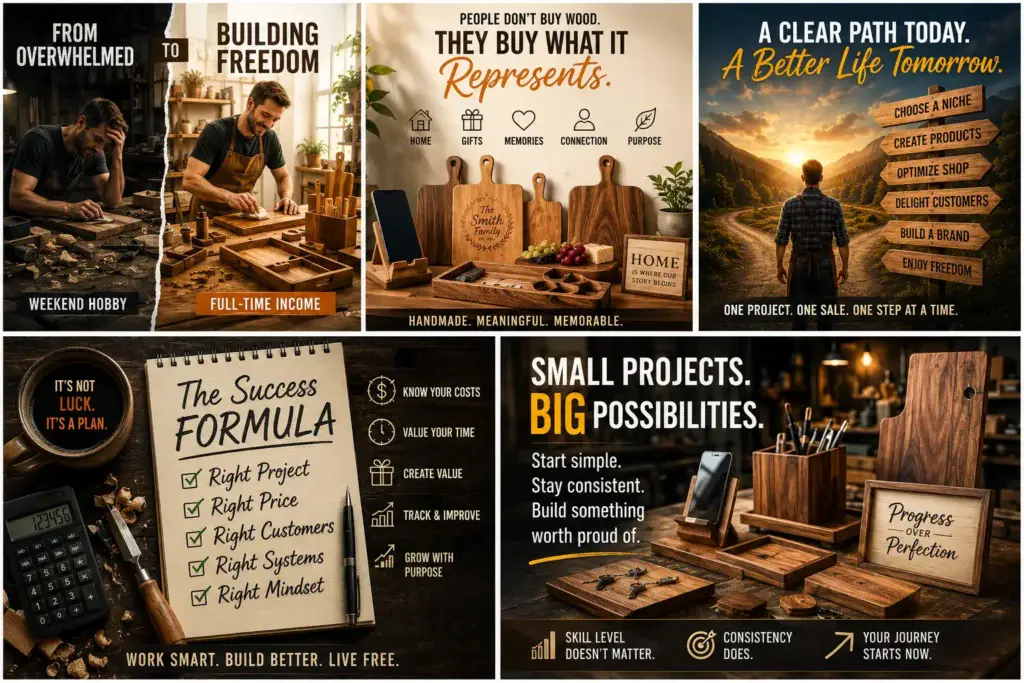
A stronger approach is to grow outward from your best-selling category.
Imagine your top seller is a personalized cutting board.
Rather than introducing unrelated products, expand naturally:
Kitchen Collection
↓
Personalized Cutting Boards
↓
Serving Trays
↓
Recipe Holders
↓
Knife Blocks
↓
Spice Racks
↓
Utensil Holders
↓
Paper Towel Holders
↓
Coffee Station Accessories
Every new product reinforces the others.
Customers immediately understand what your shop specializes in, and your catalog begins to feel curated instead of scattered.
That’s how premium brands are built—not through endless variety, but through thoughtful depth.
When your products share a common design language, material palette, and purpose, each listing strengthens the authority of every other listing in your shop.
The result isn’t just a larger catalog.
It’s a brand customers remember.
Build the Right Workshop Before You Build More Products
One of the easiest traps to fall into as a woodworker is believing that the next tool will solve every problem.
Spend a few minutes on YouTube or woodworking forums and it’s easy to convince yourself that a larger table saw, a premium planer, or a CNC router is the missing piece standing between you and a successful Etsy business.
In reality, most thriving Etsy shops didn’t begin with professional-grade equipment.
They began with a clear understanding of what customers wanted.
Only then did the workshop grow to support increasing demand.
The smartest investments are rarely the flashiest ones. They’re the tools that remove bottlenecks, improve consistency, and save hours of repetitive work.
Think of your workshop as something that evolves alongside your business—not something you have to perfect before making your first sale.
Stage One: A Beginner Workshop That Pays for Itself
If you’re just starting out, simplicity is your biggest advantage.
A small, organized workspace with dependable tools can produce hundreds of products before expensive machinery ever becomes necessary.
At this stage, focus on equipment that allows you to build a wide range of projects without stretching your budget.
Essential Starter Tools
A practical beginner workshop typically includes:
- Circular saw
- Drill and driver set
- Random orbital sander
- Trim router
- Jigsaw
- Clamps in multiple sizes
- Combination square
- Tape measure
- Quality chisels
- Safety equipment
With this setup, you can comfortably produce products like:
- Wooden phone stands
- Coasters
- Key holders
- Plant markers
- Picture ledges
- Simple shelves
- Decorative signs
More importantly, you’ll learn the habits that matter far more than expensive equipment—accuracy, consistency, and efficient workflow.
Stage Two: Upgrading for Growth
Eventually, something interesting happens.
Your tools stop limiting your creativity.
They start limiting your production speed.
Orders become more frequent.
Customers request custom variations.
Projects take longer than they should.
That’s usually the right time to invest.
Not because a new machine is exciting, but because your business has earned it.
High-Impact Workshop Upgrades
Many successful Etsy sellers expand with tools such as:
- Table saw
- Thickness planer
- Compound miter saw
- Router table
- Band saw
- Dust collection system
- Air compressor
- Quality workbench
- Mobile tool storage
These additions don’t necessarily allow you to build different products.
They allow you to build the same products faster, more accurately, and with less physical effort.
That distinction is incredibly important.
Efficiency creates profit.
Stage Three: Building a Workshop Designed for Scale
Once woodworking becomes more than a weekend hobby, your priorities begin to change.
You stop asking:
“What tool should I buy next?”
Instead, you ask:
“What process should I improve next?”
That’s the mindset of a business owner.
Professional workshops aren’t impressive because they contain expensive equipment.
They’re impressive because every step follows a logical sequence.
Material enters one end of the shop.
Finished products leave the other.
Very little time is wasted moving lumber, searching for tools, or repeating unnecessary tasks.
Equipment That Supports Larger Production Runs
As your business grows, you may consider adding:
- CNC router
- Laser engraver
- Drum sander
- Wide jointer
- Spray finishing system
- Dedicated finishing racks
- Packaging station
- Label printer
- Inventory shelving
Each addition should solve a specific production problem.
If it doesn’t save measurable time or improve quality, it’s probably an expense rather than an investment.
Understanding Profit Before You Build Anything
One of the biggest differences between hobbyists and successful Etsy sellers isn’t woodworking skill.
It’s financial discipline.
Experienced sellers rarely begin production without understanding exactly how a product will make money.
That calculation starts long before the first cut.
A beautiful project that produces little profit isn’t a successful product.
It’s an expensive lesson.
The Four Numbers Every Etsy Seller Should Know
Pricing isn’t guesswork.
It’s a system.
Before listing a product, calculate these four variables.
1. Material Costs
This includes every physical component required to complete the project.
Examples include:
- Hardwood
- Plywood
- Hardware
- Screws
- Glue
- Sandpaper
- Finish
- Packaging materials
- Shipping supplies
Don’t overlook small consumables.
Individually they seem insignificant.
Over hundreds of orders, they become meaningful expenses.
2. Labor Costs
Many new sellers accidentally pay themselves less than minimum wage because they underestimate how long projects actually take.
Track everything.
Not just assembly.
Include:
- Milling lumber
- Cutting
- Sanding
- Routing
- Finishing
- Drying time
- Packaging
- Listing preparation
Knowing your true production time allows you to identify where better tools, templates, or improved workflows can make the biggest difference.
3. Marketplace Fees
Every Etsy order includes costs beyond production.
Account for:
- Etsy transaction fees
- Payment processing fees
- Listing fees
- Advertising costs
- Shipping label costs
Ignoring these expenses creates the illusion of profitability.
Tracking them creates real profitability.
4. Target Profit Margin
Finally, determine what remains after every expense has been paid.
Healthy businesses don’t simply cover costs.
They generate enough profit to fund:
- New equipment
- Additional inventory
- Marketing
- Business insurance
- Taxes
- Future growth
If a product doesn’t support those goals, it deserves another look before it reaches your Etsy shop.
From First Sale to Full-Time Income
Every successful woodworking business follows its own path.
Yet most of them pass through remarkably similar stages.
Understanding those stages makes growth feel intentional instead of overwhelming.
Stage One: Validate the Market
Your first objective isn’t earning thousands of dollars.
It’s discovering what people genuinely want.
Launch a focused collection of products rather than dozens of unrelated listings.
Pay attention to:
- Search traffic
- Favorites
- Conversion rates
- Customer questions
- Reviews
Every interaction becomes valuable market research.
Sometimes the product you expected to become your bestseller barely attracts attention.
Another design quietly gains momentum.
Let the data guide your decisions.
Stage Two: Improve the Winners
Once certain products consistently generate sales, resist the urge to replace them with new ideas.
Improve them instead.
Ask yourself:
Can production be faster?
Can packaging feel more premium?
Can photography better communicate quality?
Can personalization options increase perceived value?
Small improvements often outperform entirely new products because you’re building on proven demand rather than starting over.
Stage Three: Create Repeatable Systems
At this point, your business shifts from craftsmanship alone to operational excellence.
Document every process.
Build templates.
Standardize measurements.
Create finishing schedules.
Organize packaging supplies.
Maintain inventory before you run out—not after.
Systems remove stress.
They also make growth possible.
Whether you eventually hire help or continue working alone, documented processes ensure that quality remains consistent.
Stage Four: Build a Brand, Not Just a Catalog
Customers remember brands.
They rarely remember random products.
Think about the shops you admire.
Chances are, they have a recognizable style.
Their photography feels consistent.
Their products complement one another.
Their descriptions reflect the same voice.
Their packaging creates a memorable experience.
That’s intentional.
Instead of asking:
“What should I build next?”
Begin asking:
“What fits naturally within my brand?”
That question transforms product development.
A shop known for handcrafted kitchen accessories doesn’t suddenly introduce birdhouses and children’s toys.
It expands thoughtfully.
One collection leads to another.
One satisfied customer becomes a repeat customer.
Over time, your shop evolves into something much more valuable than a collection of listings.
It becomes a trusted destination.
And in a marketplace filled with thousands of talented makers, trust is one of the few advantages competitors can’t easily copy.
Questions Every New Etsy Woodworker Eventually Asks
No matter where you are in your woodworking journey, there comes a moment when practical questions begin to replace creative ones.
You stop wondering what to build.
Instead, you start wondering whether you’re making the right decisions.
Should you invest in better tools?
Are your prices too low?
Is Etsy already too competitive?
These are the same questions almost every successful seller has wrestled with. The difference isn’t that they had all the answers from the beginning—it’s that they kept refining their approach one decision at a time.
Below are some of the questions that surface again and again, along with the kind of advice experienced Etsy sellers wish they’d heard earlier.
“What’s the Fastest-Selling Woodworking Product on Etsy?”
There’s no single product that guarantees success.
What sells consistently are products that combine three characteristics:
- They’re genuinely useful.
- They make thoughtful gifts.
- They can be personalized.
That combination explains why items like cutting boards, desk organizers, floating shelves, serving trays, wooden signs, and phone stands continue to perform year after year.
They’re woven into everyday life.
Someone buying a personalized cutting board isn’t just purchasing kitchen equipment.
They’re celebrating a wedding.
Commemorating a first home.
Giving parents an anniversary gift they’ll actually use.
Products attached to meaningful life moments almost always outperform products purchased on impulse alone.
“Do I Need a CNC Machine Before I Can Compete?”
Not even close.
It’s easy to believe that every successful Etsy shop is filled with expensive equipment, but that’s rarely how those businesses started.
Many of today’s top sellers began with a modest workshop and a handful of reliable tools.
A CNC router becomes valuable when demand justifies the investment—not before.
Think of it this way:
A CNC machine improves efficiency.
It doesn’t create demand.
If customers already love your products, automation helps you fulfill orders more quickly and consistently.
If customers aren’t buying your products yet, a new machine won’t solve that problem.
Learn the market first.
Upgrade the workshop second.
“Which Type of Wood Do Buyers Prefer?”
Material selection influences far more than durability.
It shapes first impressions.
Certain hardwoods immediately communicate quality because buyers associate them with premium furniture and handcrafted craftsmanship.
Among the most popular choices are:
Walnut
A favorite for luxury gifts, desk accessories, serving trays, and cutting boards thanks to its deep, rich color.
Maple
Bright, durable, and timeless. Maple works especially well for kitchen products because customers recognize it as a trusted food-safe hardwood.
White Oak
Clean grain patterns and contemporary appeal have made white oak increasingly popular in modern home décor.
Cherry
Known for developing a richer tone over time, cherry appeals to buyers searching for heirloom-quality pieces.
Reclaimed Wood
Beyond appearance, reclaimed lumber tells a story. Buyers interested in sustainability or rustic design often appreciate the character and history that reclaimed materials bring to a finished piece.
Rather than offering every species available, many successful sellers focus on a carefully selected palette that complements their brand identity.
“Should I Start by Selling Furniture?”
For most beginners, the answer is no.
Large furniture certainly commands impressive prices, but it also introduces challenges that can overwhelm a new business.
Heavy products require:
- More expensive materials
- Longer production times
- Complex packaging
- Higher shipping costs
- Greater risk of damage
- More customer communication
Smaller woodworking projects provide something equally valuable:
Momentum.
They allow you to build reviews, refine your workflow, improve your Etsy SEO, and generate consistent sales while keeping risk relatively low.
Many full-time furniture makers started with products that fit inside a small shipping box.
There’s nothing small about the experience those products provide.
“How Many Listings Should a New Etsy Shop Have?”
You don’t need hundreds of listings to attract buyers.
You need enough high-quality listings to demonstrate expertise within a specific niche.
For most woodworking shops, launching with 15 to 30 carefully optimized products creates a strong foundation.
More important than the number of listings is how well they relate to one another.
Imagine landing on a shop that sells:
- A personalized cutting board
- Matching serving trays
- Recipe holders
- Knife blocks
- Wooden utensil organizers
- Spice racks
Everything feels intentional.
Now imagine another shop selling:
- Birdhouses
- Picture frames
- Toy cars
- Shelves
- Holiday ornaments
- Dog bowls
Every item might be beautifully made, but the overall experience feels scattered.
Customers trust specialists.
Search engines understand specialists.
Building around one product ecosystem benefits both.
“How Do I Stand Out When There Are Thousands of Similar Products?”
This question often hides a deeper concern.
“If someone else is already selling cutting boards, why would anyone buy mine?”
The answer isn’t always found in the product itself.
It’s found in the experience surrounding it.
Buyers compare far more than dimensions and price.
They notice:
- Product photography
- Lifestyle images
- Packaging
- Personalization options
- Response time
- Reviews
- Shop branding
- Storytelling
- Material quality
- Attention to detail
Two nearly identical products can perform very differently depending on how they’re presented.
People don’t simply buy handcrafted products.
They buy confidence.
Every detail of your shop either strengthens that confidence—or weakens it.
“When Should I Raise My Prices?”
Most Etsy sellers wait too long.
A steady flow of orders is often the clearest signal that your pricing deserves another look.
If your production schedule stays full, customers leave positive reviews, and demand continues to grow, increasing prices may actually improve your business.
Higher prices don’t automatically reduce sales.
In many handmade categories, they reinforce perceptions of quality.
The goal isn’t to become the cheapest option.
It’s to create enough value that buyers feel your craftsmanship is worth every dollar they spend.
Premium customers rarely begin their search by sorting listings from lowest to highest price.
They look for trust, quality, and authenticity.
Continue Building Your Etsy Business
Launching a successful woodworking shop is only one piece of the puzzle.
As your business grows, new challenges—and opportunities—will naturally appear.
Expanding your knowledge in related areas will help you strengthen both your products and your brand.
If you’re planning future content for your website, these topics create natural next steps for readers while reinforcing your topical authority.
Recommended Internal Links
How to Price Handmade Woodworking Projects for Maximum Profit
Learn practical pricing formulas that account for labor, materials, Etsy fees, overhead, and healthy profit margins without underpricing your craftsmanship.
Etsy SEO for Woodworkers: A Complete Guide to Keywords That Convert
Discover how to research keywords, write optimized product titles, improve tags, and structure listings that attract more qualified buyers.
The Best Wood Finishes for Products You Sell Online
Compare food-safe finishes, durable topcoats, natural oils, and protective sealers to choose the right finish for cutting boards, furniture, home décor, and personalized gifts.
Product Photography Tips That Increase Etsy Conversion Rates
Explore lighting techniques, lifestyle staging, image composition, and editing strategies that help handcrafted woodworking products stand out in competitive search results.
How to Batch Produce Woodworking Projects Without Losing Handmade Quality
Build efficient production systems using templates, jigs, workflow planning, and quality-control processes while maintaining the craftsmanship buyers expect from handmade products.
CNC vs. Traditional Woodworking: Finding the Right Balance
Understand where automation improves consistency, when hand craftsmanship adds value, and how to combine both approaches without sacrificing authenticity.
Seasonal Etsy Trends Every Woodworker Should Plan For
Prepare your product calendar around major shopping events, including weddings, Father’s Day, Mother’s Day, Christmas, housewarming season, graduation gifts, and holiday décor, so you’re creating products before demand peaks rather than after it arrives.
Products, Tools & Resources for Etsy Woodworkers
Building a successful Etsy woodworking business isn’t about owning every tool on the market or chasing every trend. It’s about choosing the right resources at the right stage of your journey. The recommendations below are organized around the needs of growing makers—from launching your first listing to scaling a thriving handmade brand.
Essential Workshop Tools
These are the tools that deliver the greatest return on investment for most Etsy woodworkers.
Measuring & Layout
Accurate work starts long before the first cut.
Recommended essentials:
- Tape measure
- Combination square
- Digital angle gauge
- Marking knife
- Precision ruler
- Carpenter’s pencils
Consistent measurements reduce waste, improve repeatability, and make batch production significantly easier.
Cutting Tools
Reliable cutting tools form the backbone of almost every woodworking shop.
A practical setup includes:
- Table saw
- Circular saw
- Compound miter saw
- Jigsaw
- Japanese pull saw for fine detail work
Upgrade only when your current workflow becomes a bottleneck.
Sanding & Surface Preparation
Smooth finishes often separate premium products from average ones.
Helpful tools include:
- Random orbital sander
- Detail sander
- Sanding blocks
- Dust extractor
- Quality sanding discs in multiple grits
Customers may never notice perfect sanding directly—but they’ll immediately notice when it isn’t there.
Routing & Joinery
For cleaner edges and repeatable profiles, consider adding:
- Trim router
- Router table
- Flush-trim bits
- Round-over bits
- Chamfer bits
- Edge guides
These tools dramatically expand the variety of products you can create without significantly increasing complexity.
Wood Species Worth Keeping in Your Shop
Choosing the right lumber affects appearance, durability, machining characteristics, and perceived value.
Walnut
Ideal for:
- Cutting boards
- Desk organizers
- Serving trays
- Luxury gifts
- Phone stands
Premium appearance with strong customer appeal.
Maple
Excellent for:
- Kitchen accessories
- Children’s products
- Food-safe items
- Minimalist décor
Bright, durable, and consistently popular.
White Oak
Best suited for:
- Floating shelves
- Modern furniture
- Entryway pieces
- Home décor
Offers a timeless look that complements contemporary interiors.
Cherry
Perfect for:
- Keepsake boxes
- Personalized gifts
- Furniture
- Decorative accessories
Develops a richer color over time, making it especially attractive for heirloom-quality projects.
Finishing Products That Enhance Handmade Quality
A well-executed finish protects your work while elevating the natural beauty of the wood.
Depending on the product, consider:
- Food-safe mineral oil
- Beeswax conditioners
- Hardwax oils
- Water-based polyurethane
- Furniture wax
- Danish oil
- Matte protective finishes
Choose finishes that align with both the intended use of the product and the expectations of your customers.
Packaging Materials That Create a Better First Impression
The customer experience doesn’t end when your project leaves the workshop.
Thoughtful packaging reinforces the value of handmade craftsmanship.
Useful supplies include:
- Kraft boxes
- Corrugated shipping cartons
- Recyclable packing paper
- Honeycomb paper wrap
- Tissue paper
- Branded thank-you cards
- Care instruction cards
- Product tags
- Custom logo stickers
Small presentation details often become memorable parts of the buying experience—and can encourage repeat purchases and positive reviews.
Digital Resources for Running an Etsy Shop
Growing a woodworking business requires more than building products.
You’ll also benefit from systems that help you manage your time, marketing, and operations.
Consider creating workflows around:
- Inventory tracking
- Expense management
- Production scheduling
- Customer communication templates
- Product photography editing
- Keyword research
- Shipping management
- Order fulfillment checklists
The more repeatable your business processes become, the more time you can spend designing and building.
Business Metrics Worth Tracking Every Month
Successful Etsy sellers don’t rely on instinct alone.
They pay attention to the numbers that reveal what’s working.
Review these metrics regularly:
- Total revenue
- Net profit
- Average order value
- Conversion rate
- Repeat customer rate
- Best-selling products
- Seasonal sales trends
- Production time per item
- Material costs
- Advertising return on investment
Even simple monthly tracking can reveal opportunities to improve pricing, streamline production, or expand your most profitable product categories.
Your Etsy Shop Growth Checklist
As your business evolves, revisit this checklist to keep moving forward with intention.
Foundation
✔ Choose a focused product niche
✔ Launch a cohesive collection of listings
✔ Write clear, keyword-rich product descriptions
✔ Invest in high-quality product photography
Growth
✔ Offer personalization options
✔ Build product collections instead of isolated listings
✔ Refine your pricing based on real production costs
✔ Standardize your workflow
✔ Improve packaging and customer experience
Scale
✔ Introduce templates and jigs
✔ Expand your best-selling category
✔ Automate repetitive production tasks where appropriate
✔ Monitor profitability, not just sales volume
✔ Continue strengthening your brand identity
Growth isn’t measured only by the number of orders you receive.
It’s reflected in how efficiently you can deliver exceptional products, create memorable customer experiences, and build a business that’s enjoyable to run for years to come.