
Quick Answer
If you’re looking for DIY outdoor sofa woodworking plans that are affordable, beginner-friendly, and sturdy enough to handle years of outdoor use, you’re in the right place. With roughly $250–$300 in materials, a handful of basic woodworking tools, and a free weekend, you can build a beautiful patio couch that rivals furniture selling for well over $1,500.
Most builders complete this project in 8–12 hours. The result is a custom outdoor sofa designed specifically for your space, your style, and the way you actually live outdoors.
Project Overview
| Feature | Details |
|---|---|
| Estimated Cost | $250–$300 |
| Retail Equivalent | $1,200–$1,500+ |
| Build Time | 8–12 Hours |
| Skill Level | Beginner to Intermediate |
| Seating Capacity | 3–4 Adults |
| Lifespan | 7–15 Years |
The Real Reason DIY Outdoor Sofas Have Exploded in Popularity
Something interesting happens when people start investing in their outdoor spaces.
At first, they think they’re shopping for furniture.
A few hours later, they’re imagining summer evenings under string lights. Family cookouts that stretch long after sunset. Quiet mornings with coffee and a blanket while the neighborhood is still asleep.
The furniture becomes secondary.
The experience becomes everything.
That’s exactly why DIY outdoor sofa projects have become one of the most searched woodworking builds online.
The modern backyard isn’t simply a backyard anymore. It has become an outdoor living room, a gathering space, a place where conversations happen naturally because nobody is staring at a television screen.
And yet when homeowners start pricing outdoor furniture, the excitement often fades.
A simple patio couch can cost $1,500.
A full outdoor seating set can easily push beyond $3,000.
The shock usually arrives somewhere between the second showroom and the third online furniture store.
That’s the moment many people discover something important:
Most outdoor sofas are built using surprisingly straightforward construction methods.
The hidden structure underneath the cushions is often far less complicated than the price tag suggests.
Once you realize that, the equation changes.
Instead of paying for branding, freight shipping, retail markup, and warehouse storage, you can invest those same dollars directly into quality lumber, stronger hardware, and a custom design built specifically for your patio.
The difference isn’t just financial.
It’s personal.
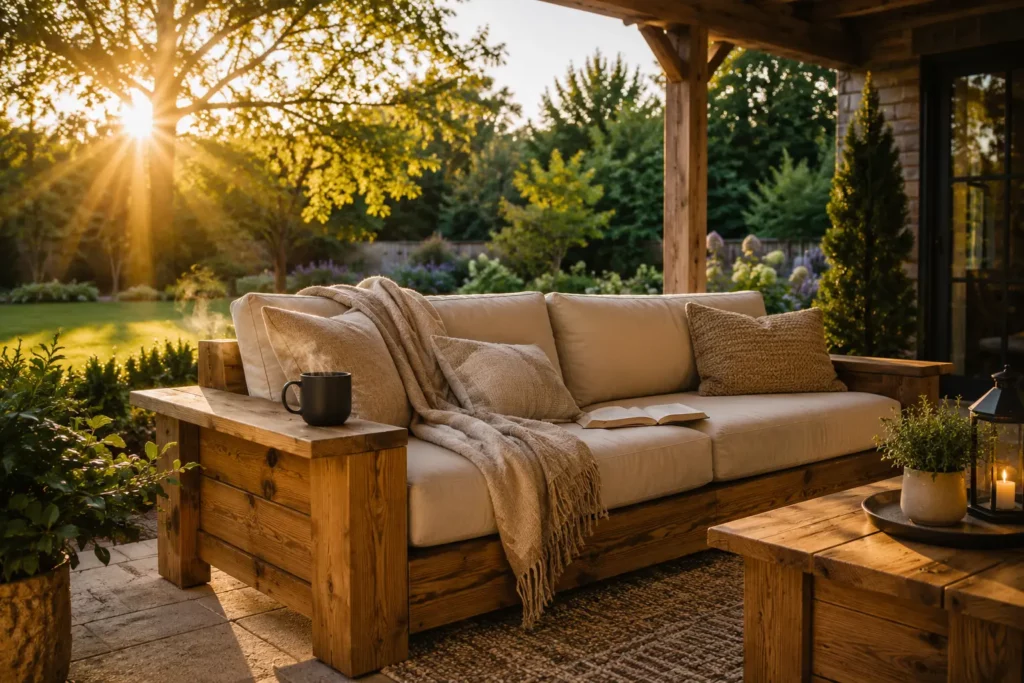
A sofa you build yourself feels different every time you sit down.
Why Building Your Own Outdoor Sofa Often Makes More Sense Than Buying One
The financial savings grab attention first.
But they’re rarely the reason people end up loving the project.
The Numbers Are Hard to Ignore
Walk into almost any outdoor furniture retailer today and you’ll see prices like these:
Store-Bought Patio Sofas
- Entry-level outdoor sofas: $800–$1,200
- Mid-range patio couches: $1,200–$2,000
- Premium hardwood furniture: $2,000–$4,000+
Now compare that to a DIY outdoor sofa.
Typical DIY Build Costs
- Lumber: $120–$180
- Exterior-grade hardware: $20–$40
- Outdoor stain or sealer: $25–$50
- Cushions: $80–$150
Total investment: approximately $250–$300.
That’s not a minor discount.
It’s often a four-figure difference.
Yet the bigger surprise comes after the build is finished.
Many DIY outdoor sofas feel sturdier than their retail counterparts because you’re not building to maximize shipping efficiency or profit margins.
You’re building for durability.
You Control the Quality
Mass-produced furniture has limitations.
Manufacturers need products that are inexpensive to build, simple to transport, and easy to stock in warehouses.
Homeowners have different priorities.
You care about how something feels after five summers. You care whether it wobbles after a season of use. You care about whether the armrest can comfortably hold a cup of coffee on a quiet Sunday morning.
Building your own outdoor sofa allows you to choose:
- Thicker framing materials
- Stronger joinery
- Exterior-rated fasteners
- Better wood species
- Additional reinforcement
The result is often stronger than furniture costing several times more.
Your Space Isn’t Standard—Your Furniture Shouldn’t Be Either
Outdoor furniture stores assume everyone has the same patio.
Anyone who’s ever measured a real backyard knows that’s not true.
Maybe your deck is narrow.
Maybe your porch wraps around a corner.
Maybe you’re trying to maximize seating around a fire pit.
Maybe you need extra depth because you actually want to lounge instead of sitting upright like you’re waiting in an airport terminal.
Custom dimensions solve those problems.
When you build from DIY outdoor sofa woodworking plans, you decide:
- Overall length
- Seat depth
- Backrest angle
- Armrest width
- Seating height
- Cushion dimensions
Every measurement serves your space instead of forcing your space to serve the furniture.
Choosing the Best Wood for Outdoor Furniture
Wood selection affects nearly everything.
Appearance.
Longevity.
Maintenance requirements.
Comfort.
Even the overall personality of the finished piece.
Choosing the right material now prevents disappointment years later.
Cedar: The Sweet Spot Most DIY Builders Love
If there’s one material that consistently earns recommendations from experienced outdoor furniture builders, it’s cedar.
For good reason.
Cedar naturally contains oils that help resist moisture, insects, and decay. It performs exceptionally well outdoors without demanding excessive maintenance.
Why Cedar Works So Well
- Naturally rot resistant
- Lightweight and easy to move
- Attractive grain patterns
- Pleasant aroma during construction
- Easy to cut and sand
- Excellent durability-to-cost ratio
For most homeowners, cedar represents the ideal balance between performance and affordability.
Pressure-Treated Lumber: Budget-Friendly and Tough
Pressure-treated wood remains one of the most popular options for outdoor construction projects.
It’s readily available, affordable, and designed specifically to withstand moisture exposure.
Benefits of Pressure-Treated Lumber
- Lower upfront cost
- Excellent weather resistance
- Widely available
- Strong structural performance
One important note: freshly treated lumber often contains excess moisture and should be allowed to dry before applying stain or paint.
Patience here pays off later.
Redwood: Beauty That Ages Gracefully
There are few materials that develop character quite like redwood.
Its rich color and natural resistance to decay make it a favorite among builders who prioritize aesthetics.
Redwood Advantages
- Exceptional visual appeal
- Strong natural weather resistance
- Long lifespan
- Minimal warping
The primary drawback is cost.
Still, for homeowners creating a premium outdoor living space, redwood often justifies the investment.
Teak: The Gold Standard of Outdoor Furniture
Mention luxury outdoor furniture and teak usually enters the conversation.
There’s a reason.
Teak has earned a reputation for surviving decades of exposure while maintaining remarkable structural integrity.
Why Teak Is Revered
- Extraordinary durability
- Natural oils protect against moisture
- Outstanding lifespan
- Minimal maintenance
The challenge, of course, is price.
For a project centered on building a $1,500 patio couch for under $300, teak generally falls outside the target budget.
But it’s worth understanding where it sits within the outdoor furniture hierarchy.
Before You Buy a Single Board
Here’s something many woodworking guides overlook.
Don’t start with lumber.
Start with cushions.
That sounds backward until you’ve watched someone build an entire outdoor sofa only to discover that every cushion they like is either too large, too small, or completely incompatible with the finished dimensions.
The smartest builders reverse the process.
Choose the cushions first.
Measure them carefully.
Then build the sofa around those measurements.
It’s a small decision that prevents a surprisingly large number of frustrations later.
And it’s one of the easiest ways to make your finished project look professionally designed rather than improvised.
Tools, Materials, and the Foundation of a Great Build
Before the first cut is made, before sawdust begins collecting on the garage floor, there’s a brief moment that often determines how smoothly the entire project unfolds.
Preparation.
It’s not the exciting part. Nobody takes photos of measuring tapes or neatly stacked lumber. Yet experienced woodworkers know something beginners learn quickly:
Most building mistakes don’t happen during construction.
They happen before construction starts.
A little planning now saves hours of frustration later.
Essential Tools for Building a DIY Outdoor Sofa
One of the reasons this project continues to attract new woodworkers is its accessibility.
You don’t need a professional workshop.
You don’t need industrial equipment.
And you certainly don’t need thousands of dollars in specialty tools.
Most homeowners already own enough equipment to complete the project successfully.
Core Tools You’ll Need
Circular Saw
A circular saw handles the majority of cuts required for outdoor sofa construction.
For many builders, it’s the single most versatile tool in the workshop.
Use it for:
- Framing lumber
- Crosscuts
- Trimming boards to length
- Creating clean edges
A sharp blade matters more than an expensive saw.
Drill and Driver
Every screw, support, brace, and connection depends on reliable drilling and fastening.
Look for:
- Variable speed settings
- Good battery life
- Comfortable grip
- Sufficient torque
A quality drill quickly becomes your most-used tool throughout the build.
Tape Measure
Few tools seem simpler.
Few tools create more problems when used carelessly.
Measure carefully.
Then measure again.
Every fraction of an inch compounds throughout a furniture project.
A perfectly square frame begins with accurate measurements.
Speed Square
This inexpensive tool prevents expensive mistakes.
A speed square helps verify:
- 90-degree corners
- Straight cuts
- Consistent layout lines
The difference between furniture that feels professional and furniture that feels homemade often comes down to precision.
Clamps
Clamps function as an extra set of hands.
And unlike most helpers, they don’t get distracted.
Use clamps to:
- Hold boards during assembly
- Keep joints aligned
- Maintain square corners
- Improve fastening accuracy
Many builders wish they had purchased more clamps sooner.
Very few wish they had purchased fewer.
Orbital Sander
Construction creates furniture.
Sanding creates comfort.
An orbital sander dramatically improves:
- Surface smoothness
- Finish quality
- Stain absorption
- Overall appearance
The armrest you’re about to touch hundreds of times deserves extra attention.
Safety Equipment
Never skip this section.
You’ll need:
- Safety glasses
- Hearing protection
- Dust mask or respirator
- Work gloves
Woodworking should create memories—not injuries.
Helpful Upgrades That Make the Build Easier
These aren’t required, but they can improve both speed and accuracy.
Miter Saw
A miter saw simplifies repetitive cuts and helps maintain consistency.
Benefits include:
- Faster production
- Cleaner cuts
- Improved precision
- Reduced measuring errors
If you’re planning future woodworking projects, this is often one of the best investments you can make.
Pocket Hole Jig
Pocket-hole joinery has transformed modern DIY furniture building.
It offers:
- Strong hidden joints
- Cleaner appearance
- Faster assembly
- Beginner-friendly construction
Many outdoor furniture plans rely heavily on this technique.
Impact Driver
While a drill can drive screws, an impact driver does it with noticeably less effort.
Long exterior screws become easier to install, particularly when working with dense lumber.
Your wrists will thank you.
DIY Outdoor Sofa Materials List
Let’s talk about the materials that actually determine how the finished piece feels.
Because once the cushions are in place and guests are sitting down, nobody notices how quickly the project was completed.
They notice stability.
Comfort.
Quality.
Those things start here.
Lumber Shopping List
For a standard three-seat outdoor sofa approximately 72 inches wide, you’ll typically need:
Frame Components
- 2×4 boards for structural framing
- Additional 2x4s for reinforcement
- Support braces
These pieces form the skeleton of the furniture.
Everything depends on their strength.
Armrests
Many builders prefer:
- 2×6 lumber
- 2×8 lumber
Wider armrests create a premium appearance and provide practical space for everyday use.
Think about how people actually interact with outdoor furniture.
A drink.
A book.
A phone.
A small plate during a barbecue.
Wide armrests quietly improve all of those experiences.
Seat and Back Slats
Common choices include:
- 1×4 cedar boards
- 1×4 redwood boards
- Exterior-rated pine boards
These create the visible surfaces supporting cushions while allowing airflow and drainage.
Hardware That Lasts Outdoors
Outdoor furniture faces conditions that indoor furniture never encounters.
Rain.
Humidity.
Sun exposure.
Temperature swings.
Cheap fasteners rarely survive these conditions gracefully.
Choose hardware designed for exterior environments.
Recommended Fasteners
- Exterior-grade deck screws
- Stainless steel screws
- Galvanized fasteners
- Exterior-rated pocket-hole screws
The difference in cost is minimal.
The difference in longevity is significant.
Choosing the Right Outdoor Finish
Furniture built for the outdoors needs protection.
Not eventually.
Immediately.
Wood begins responding to environmental conditions from the moment it’s exposed.
Popular Finishing Options
Exterior Stain
Highlights natural wood grain while providing protection.
Ideal for:
- Cedar
- Redwood
- Premium lumber
Outdoor Paint
Provides the greatest color flexibility.
Useful for:
- Modern designs
- Farmhouse aesthetics
- Coordinated patio decor
Clear Sealers
Allow natural wood character to remain visible while adding weather resistance.
Many builders prefer this option because it preserves the organic beauty of the material.
The Build Begins: Step-by-Step Outdoor Sofa Construction
This is where the project starts feeling real.
The pile of lumber slowly becomes recognizable.
Individual boards become structure.
Structure becomes furniture.
And somewhere during the process, most builders experience a moment of surprise.
The realization that a patio sofa is far less complicated than they imagined.
Step 1: Build the Base Frame
Everything starts here.
Every future measurement relies on this foundation being accurate.
Construct a rectangular frame using your 2×4 lumber.
Take your time.
Rushing this stage creates problems that follow you throughout the entire build.
Key Priorities
- Ensure corners are square
- Verify equal diagonal measurements
- Check for level surfaces
- Fasten securely
A square frame today prevents wobbling tomorrow.
Why Squareness Matters More Than Most People Realize
A frame can be off by only a quarter inch and still create noticeable issues later.
You may not see the problem immediately.
But once cushions are installed and guests begin using the sofa, uneven pressure starts revealing structural weaknesses.
Professional-looking furniture starts with disciplined measurements.
Step 2: Install Vertical Supports
Once the base frame is complete, the project begins rising off the ground.
Attach vertical support posts at designated locations.
These supports determine:
- Backrest height
- Armrest position
- Overall proportions
- Seating ergonomics
This stage introduces the visual identity of the sofa.
For the first time, you can begin imagining the finished piece.
A Small Detail That Changes Comfort Dramatically
Many beginner builders focus exclusively on appearance.
Experienced builders focus on posture.
A beautiful sofa that feels uncomfortable quickly becomes unused furniture.
Before fastening supports permanently, consider:
- Cushion thickness
- Seat height
- Natural sitting position
Tiny adjustments here produce major comfort improvements later.
Step 3: Build the Backrest Structure
The backrest is where functionality meets comfort.
Too upright and the sofa feels rigid.
Too reclined and guests struggle to sit comfortably.
Most outdoor furniture designers target a range between 100 and 110 degrees.
That angle creates the sweet spot.
Supportive enough for conversation.
Relaxed enough for lounging.
The best outdoor furniture rarely feels accidental.
Comfort is usually engineered.
And the backrest is where much of that engineering happens.
Building Strength Into the Structure
At this stage, the project starts crossing an important threshold.
The frame is standing.
The proportions are visible.
You can step back and finally recognize it as something more than lumber.
Yet this is also the point where many builders become impatient.
They can see the finish line, so they begin rushing toward it.
Ironically, the sections ahead are where long-term durability is won or lost.
Nobody notices the hidden supports when the sofa is finished.
But they’ll definitely notice if those supports aren’t there five years from now.
Step 4: Install Seat Supports
Think of seat supports as the unseen workhorses of the entire structure.
Every conversation, every gathering, every afternoon nap eventually transfers weight into these components.
Their job is simple:
Distribute pressure evenly and prevent sagging over time.
Install horizontal support members across the seating area, spacing them consistently throughout the frame.
What Proper Support Accomplishes
- Increases weight capacity
- Reduces long-term stress
- Prevents seat deflection
- Extends furniture lifespan
- Creates a more solid seating experience
When someone sits down, they shouldn’t feel movement beneath them.
They should feel confidence.
That’s what good support framing creates.
How Much Weight Should an Outdoor Sofa Handle?
A properly built DIY outdoor sofa should comfortably support multiple adults without flexing.
Many commercial outdoor couches are engineered to meet minimum standards.
Your build doesn’t have to settle for minimums.
Adding an extra support brace costs very little.
Replacing a failed frame later costs much more.
When in doubt, overbuild.
Experienced woodworkers rarely regret additional reinforcement.
Step 5: Attach Seat Slats
Now the project begins developing its finished appearance.
Seat slats create the platform that ultimately supports the cushions and define much of the furniture’s visual character.
Install slats evenly across the seating surface.
Consistency matters here.
Small variations become surprisingly visible once everything is assembled.
Ideal Slat Spacing
Leave small gaps between boards.
These gaps serve an important purpose.
They allow:
- Rainwater drainage
- Air circulation
- Faster drying
- Reduced moisture retention
Outdoor furniture survives because water escapes.
Furniture fails when water lingers.
Why Drainage Matters More Than Waterproofing
Many homeowners focus entirely on protecting wood from water.
The smarter approach is helping water leave.
No finish lasts forever.
No sealer remains perfect indefinitely.
Good furniture design assumes moisture will occasionally arrive and creates pathways for it to disappear quickly.
That’s why drainage gaps, elevated feet, and airflow remain essential elements of durable outdoor furniture construction.
Step 6: Build and Install the Armrests
This is where function begins meeting personality.
Armrests seem simple until you start paying attention to how people actually use outdoor furniture.
Spend a few minutes observing guests during a gathering.
You’ll notice something interesting.
People place things everywhere.
Coffee mugs.
Phones.
Books.
Sunglasses.
Snack plates.
A well-designed armrest quietly solves dozens of small daily inconveniences.
Choosing the Right Armrest Width
Narrow armrests save material.
Wide armrests create luxury.
Most premium outdoor furniture collections intentionally feature oversized armrests because they make furniture feel substantial and inviting.
For many builders, armrests between 5 and 8 inches wide create an ideal balance.
Benefits include:
- Improved comfort
- Better visual proportions
- Additional usable surface area
- More premium appearance
It’s one of the highest-impact upgrades you can make without significantly increasing project cost.
Creating a Custom Look
This stage also allows room for creativity.
Popular armrest styles include:
Modern Minimalist
- Straight edges
- Sharp lines
- Clean geometry
Farmhouse Style
- Thick lumber
- Visible grain patterns
- Rustic finishes
Contemporary Lounge Design
- Wider tops
- Softer edges
- Relaxed proportions
Small design choices here dramatically influence the overall aesthetic.
Step 7: Sand Everything—Then Sand It Again
This is the stage many builders underestimate.
The structure is complete.
The furniture looks finished.
The temptation to skip ahead becomes powerful.
Resist it.
The difference between furniture that looks homemade and furniture that looks professionally crafted often comes down to sanding.
Not construction.
Sanding.
Why Sanding Changes Everything
Your hands notice details your eyes miss.
Rough edges.
Sharp corners.
Raised grain.
Tiny imperfections.
Every one of those details influences how the furniture feels.
And feeling matters.
People instinctively associate smooth surfaces with quality craftsmanship.
Recommended Sanding Progression
Start aggressively.
Finish gently.
First Pass: 80 Grit
Removes:
- Mill marks
- Surface irregularities
- Sharp transitions
Second Pass: 120 Grit
Refines the surface.
Creates a smoother texture while maintaining efficiency.
Final Pass: 220 Grit
Produces a polished feel and prepares the wood for finishing.
Focus especially on:
- Armrests
- Front seat edges
- Backrest contact points
- Frequently touched surfaces
These are the places people experience most directly.
The Edge Softening Technique
Professional furniture builders rarely leave hard edges untouched.
Instead, they slightly soften corners.
Not enough to alter the design.
Just enough to create comfort.
Run your hand along every exposed edge.
If it feels sharp, round it slightly.
The change is subtle.
The improvement is immediate.
Step 8: Apply a Protective Outdoor Finish
At this point, the sofa is structurally complete.
But unfinished wood outdoors is like a new vehicle without paint.
It might function perfectly.
It simply won’t remain in peak condition for very long.
Outdoor furniture exists in a harsh environment.
Every day introduces challenges.
Sunlight.
Moisture.
Temperature fluctuations.
Humidity.
Windborne debris.
The right finish acts as a shield between the wood and those forces.
Understanding Outdoor Furniture Finishes
Not all protection methods accomplish the same goal.
Choosing the right finish depends on both aesthetics and maintenance preferences.
Exterior Stain
For many DIY outdoor sofa projects, stain represents the sweet spot.
It enhances natural wood character while providing protection against environmental exposure.
Advantages include:
- Visible grain patterns
- Natural appearance
- UV resistance
- Easier maintenance
Cedar and redwood often look particularly impressive when stained.
Exterior Paint
Paint offers maximum design flexibility.
It’s popular among homeowners creating coordinated outdoor spaces.
Benefits include:
- Unlimited color options
- Strong UV protection
- Contemporary design possibilities
- Excellent visual impact
The tradeoff is maintenance.
Eventually, painted surfaces require touch-ups.
Clear Outdoor Sealers
Some woods deserve to be seen.
Clear sealers protect the material while preserving its original appearance.
This option works especially well when the wood itself is a major design feature.
Applying the Finish Correctly
The quality of application matters just as much as the product itself.
For best results:
- Clean surfaces thoroughly.
- Remove all sanding dust.
- Apply thin, even coats.
- Follow manufacturer drying times.
- Add additional coats as recommended.
Patience here produces dramatically better results.
The furniture you’ll use for years deserves a few extra hours today.
The Moment It Starts Looking Real
There’s a point during every build when something shifts.
The finish deepens the grain.
The texture changes.
The lumber stops looking like construction material and starts looking like furniture.
It’s a satisfying transformation.
Not because the project is nearly finished.
Because for the first time, you can clearly see the destination you’ve been working toward.
And suddenly the measurements, cuts, sanding sessions, and sawdust-covered afternoons make perfect sense.
Turning a Simple Outdoor Sofa Into the Centerpiece of Your Backyard
Most people begin this project with a practical goal.
They want somewhere comfortable to sit.
A place for guests.
A better use of patio space.
But somewhere along the way, the project often becomes something larger.
Because furniture has a curious effect on outdoor spaces.
One well-designed piece can completely change how an area feels.
An empty patio becomes a destination.
A neglected deck becomes a gathering place.
A backyard corner nobody used suddenly becomes everyone’s favorite spot.
That’s why design choices matter.
Not because trends matter.
Because atmosphere matters.
And atmosphere is what people remember.
Outdoor Sofa Design Variations
One of the greatest advantages of DIY outdoor sofa woodworking plans is flexibility.
You’re not locked into a showroom model.
You’re creating something that reflects your space, your lifestyle, and the way people naturally gather around your home.
The Modern Minimalist Outdoor Sofa
Minimalist outdoor furniture has become increasingly popular for one simple reason:
It allows the space itself to shine.
Instead of competing with landscaping, architecture, or outdoor decor, it creates visual balance.
Key Characteristics
- Straight lines
- Clean geometry
- Hidden fasteners
- Neutral finishes
- Wide seating surfaces
The result feels intentional without feeling busy.
Modern outdoor spaces often rely on restraint rather than decoration.
The Farmhouse Patio Couch
Farmhouse design remains popular because it feels approachable.
Warm.
Inviting.
Uncomplicated.
A farmhouse outdoor sofa often looks like it belongs exactly where it sits.
Typical Features
- Chunkier lumber
- Visible wood grain
- Rustic stain finishes
- Substantial proportions
- Traditional joinery
These designs pair beautifully with:
- Pergolas
- Covered porches
- Cottage gardens
- Backyard fire pits
There’s a timeless quality to farmhouse furniture that tends to age gracefully.
Deep Seating Lounge Sofas
Comfort has become the defining trend in outdoor living.
Homeowners no longer want patio furniture that merely survives outside.
They want furniture that invites them to stay.
Deep seating designs accomplish exactly that.
Benefits of Deep Seating
- Relaxed posture
- Greater lounging comfort
- Resort-inspired feel
- Enhanced entertaining experience
This style works especially well when paired with oversized cushions and outdoor sectionals.
The effect feels less like patio furniture and more like an outdoor living room.
Modular Outdoor Sectionals
Large families and frequent entertainers often gravitate toward modular furniture.
And for good reason.
Life changes.
Gatherings change.
Furniture that adapts usually remains useful longer.
Advantages
- Expandable layouts
- Flexible configurations
- Easier future upgrades
- Improved seating capacity
A modular approach allows your outdoor space to evolve over time without requiring a complete redesign.
Designing Around How People Actually Use Outdoor Spaces
A surprising number of furniture decisions fail because they focus exclusively on appearance.
Real success comes from understanding behavior.
Ask yourself:
What actually happens in your backyard?
Do people gather around a fire pit?
Do children climb on furniture?
Do guests linger for hours?
Do you enjoy reading outdoors?
Do family dinners occasionally migrate outside?
The answers should influence the design.
Beautiful furniture attracts attention.
Functional furniture earns daily use.
The best outdoor sofa accomplishes both.
Weatherproofing: The Difference Between Lasting Years and Lasting Decades
Outdoor furniture faces challenges indoor furniture never encounters.
Sunlight attacks finishes.
Rain tests joints.
Humidity expands wood fibers.
Winter freezes moisture trapped in tiny cracks.
Durability isn’t achieved through a single product.
It’s achieved through a system.
Every layer contributes.
Every decision matters.
Moisture Is the Real Enemy
Many homeowners assume sunlight causes the greatest damage.
In reality, water is usually responsible for most long-term failures.
Moisture creates conditions for:
- Rot
- Mold
- Mildew
- Joint failure
- Surface deterioration
Protecting furniture starts with managing water.
Build for Drainage First
The smartest outdoor furniture designs don’t fight water.
They direct it away.
This philosophy appears repeatedly throughout professional outdoor furniture construction.
Critical Drainage Features
- Slat spacing
- Elevated feet
- Airflow gaps
- Open-frame construction
These small design choices dramatically increase longevity.
Water that drains quickly causes far fewer problems than water trapped against wood.
UV Protection Matters More Than Most People Realize
Sunlight is relentless.
Every day, ultraviolet radiation slowly breaks down wood fibers and protective finishes.
Eventually, fading begins.
Then drying.
Then cracking.
The process is gradual enough that many homeowners don’t notice it until significant damage has occurred.
Fortunately, prevention is straightforward.
UV Protection Options
- Exterior stain
- UV-resistant sealers
- Outdoor paint
- Annual maintenance coats
A few hours of maintenance each year often adds years of life to outdoor furniture.
Seasonal Maintenance Schedule
Outdoor furniture rewards consistency.
Not perfection.
Consistency.
Small maintenance habits prevent major repairs later.
Spring Maintenance
Winter often leaves behind dirt, moisture, and small issues that are easy to overlook.
At the beginning of the season:
Spring Checklist
- Wash all surfaces
- Inspect hardware
- Tighten fasteners
- Examine finish condition
- Check for water damage
Think of it as a yearly reset.
Summer Care
Summer is usually when outdoor furniture receives its heaviest use.
Pay attention to:
- Cushion condition
- Finish wear
- High-contact surfaces
Addressing small problems early prevents larger issues later.
Fall Preparation
As temperatures begin to drop, focus shifts toward protection.
Recommended Tasks
- Clean thoroughly
- Touch up exposed wood
- Reapply protective coatings where needed
- Remove trapped debris
Leaves and moisture often create hidden trouble spots.
Winter Storage Strategies
Not every outdoor sofa requires indoor storage.
However, protection still matters.
Whenever possible:
- Store cushions indoors
- Use breathable furniture covers
- Elevate furniture off standing water
- Avoid fully sealing moisture beneath covers
The goal is protection without trapping humidity.
Advanced Customization Ideas
Once builders complete their first outdoor sofa, many immediately begin imagining upgrades.
That’s the beauty of woodworking.
One project tends to inspire the next.
Integrated Side Tables
Wide armrests already provide useful surfaces.
Integrated side tables expand functionality even further.
Perfect for:
- Drinks
- Outdoor speakers
- Decorative lanterns
- Serving trays
Small additions often create the biggest improvements in daily usability.
Built-In Storage
Outdoor living spaces accumulate accessories quickly.
Cushions.
Blankets.
Garden tools.
Decorative items.
Hidden storage transforms furniture into a multifunctional solution.
Popular options include:
- Lift-up seats
- Storage benches
- Side compartment designs
Matching Outdoor Furniture Collections
A standalone sofa looks great.
A coordinated outdoor seating area feels intentional.
Many builders eventually create matching pieces such as:
- Outdoor coffee tables
- Patio side tables
- Adirondack chairs
- Outdoor sectionals
- Dining benches
These projects naturally expand your woodworking skills while creating a cohesive design language throughout the backyard.
Creating a Backyard That Pulls People Outside
Furniture rarely changes a space by itself.
What it changes is behavior.
People stay longer.
Conversations stretch further.
Family members spend more time together.
Guests gather naturally.
A well-designed outdoor sofa quietly encourages all of those things.
That’s why the most successful outdoor spaces aren’t necessarily the most expensive.
They’re the most inviting.
And invitation often starts with somewhere comfortable to sit.
Questions Most People Are Really Asking Before They Build
When someone searches for DIY outdoor sofa woodworking plans, they’re usually looking for more than measurements and material lists.
They’re trying to answer a different question.
“Can I actually pull this off?”
It’s a fair concern.
Every woodworking project looks intimidating until you’ve completed the first few cuts.
The good news is that outdoor furniture is often one of the most forgiving categories of woodworking. The tolerances are practical rather than microscopic, the materials are readily available, and the skills you develop carry into dozens of future projects.
Still, a few questions come up again and again.
Frequently Asked Questions
Is This Actually a Beginner-Friendly Woodworking Project?
In most cases, yes.
If you can measure accurately, operate a drill safely, and make straight cuts with a circular saw, you already possess the core skills needed to build a basic outdoor sofa.
The project sits in a sweet spot.
It’s challenging enough to feel rewarding but approachable enough that a motivated beginner can complete it successfully.
Many woodworkers point to outdoor furniture as the project category that helped them gain confidence because the learning curve feels manageable while the finished result feels substantial.
How Much Money Can I Realistically Save?
The answer depends on materials, cushion choices, and design complexity.
For a typical three-seat outdoor sofa:
DIY Build
- Lumber: $120–$180
- Hardware: $20–$40
- Finish: $25–$50
- Cushions: $80–$150
Total
Approximately $250–$300
Comparable Retail Furniture
Typically ranges between:
- $1,200
- $1,500
- $2,000+
The savings often exceed $1,000 while allowing greater customization.
What’s the Best Wood for Outdoor Furniture?
The answer depends on priorities.
Choose Cedar If You Want
- Excellent value
- Natural weather resistance
- Attractive appearance
- Easy workability
Choose Pressure-Treated Lumber If You Want
- Lowest overall cost
- Strong durability
- Easy availability
Choose Redwood If You Want
- Premium aesthetics
- Long-term outdoor performance
- Rich natural character
Choose Teak If You Want
- Maximum lifespan
- Luxury appearance
- Minimal maintenance
For most homeowners, cedar remains the practical winner.
It balances beauty, durability, and affordability exceptionally well.
How Long Will a DIY Outdoor Sofa Last?
A properly constructed outdoor sofa isn’t a short-term project.
With quality materials and routine maintenance:
- Cedar sofas commonly last 10–15 years
- Redwood often lasts even longer
- Teak furniture may survive for decades
Longevity depends less on construction difficulty and more on maintenance consistency.
Small annual maintenance tasks create massive long-term benefits.
What If My Patio Has Limited Space?
One of the biggest advantages of DIY outdoor furniture is customization.
Unlike retail furniture, you’re not restricted to standard dimensions.
You can adjust:
- Overall width
- Seat depth
- Armrest size
- Backrest height
Custom sizing allows homeowners to maximize awkward spaces that store-bought furniture often fails to accommodate effectively.
Should I Buy Cushions Before Building?
Absolutely.
In fact, this is one of the smartest decisions you can make.
Experienced builders almost always select cushions first.
Then they design furniture around those dimensions.
This approach prevents:
- Improper fit
- Wasted materials
- Last-minute redesigns
- Limited cushion choices
Think of cushions as a design constraint rather than an accessory.
Common DIY Outdoor Sofa Mistakes (And How to Avoid Them)
Every woodworking project contains a handful of predictable mistakes.
Fortunately, most are easy to prevent.
Mistake #1: Using Interior Screws Outdoors
This happens more often than people realize.
Standard interior fasteners eventually rust when exposed to outdoor conditions.
The corrosion spreads slowly.
Then one day a structurally sound piece of furniture develops unexpected weakness.
Better Option
Use:
- Stainless steel screws
- Exterior deck screws
- Galvanized fasteners
The additional cost is small.
The durability difference is enormous.
Mistake #2: Ignoring Drainage
Many builders focus entirely on waterproofing.
Fewer focus on drainage.
Yet drainage often matters more.
Furniture lasts longer when water leaves quickly.
Always include:
- Slat spacing
- Airflow gaps
- Elevated feet
These details quietly extend the life of the project.
Mistake #3: Building Before Choosing Cushions
This issue deserves repetition because it’s incredibly common.
Builders create a beautiful frame.
Then they start shopping for cushions.
Suddenly nothing fits.
The dimensions are slightly off.
The proportions feel awkward.
The redesign begins.
Avoid the problem entirely.
Choose cushions first.
Build second.
Mistake #4: Skipping Surface Preparation
Excitement can create shortcuts.
Sanding often becomes the first victim.
Unfortunately, it’s also one of the most visible quality indicators.
Furniture is experienced through touch as much as sight.
Invest the extra time.
Your future self will notice the difference every single day.
Mistake #5: Underbuilding Structural Supports
Many beginners assume furniture should use the minimum amount of lumber possible.
Experienced builders tend to think differently.
Outdoor furniture endures:
- Dynamic weight loads
- Weather cycles
- Seasonal movement
- Years of repeated use
Extra reinforcement rarely causes regret.
Structural failure often does.
Internal Project Expansion Ideas
Once you’ve completed this outdoor sofa, several related projects naturally become easier.
These builds share similar skills, tools, and materials:
Outdoor Living Space Projects
- DIY outdoor coffee table
- Patio side table
- Outdoor sectional furniture
- Fire pit seating
- Garden bench
- Outdoor dining bench
- Pergola seating
- Built-in deck furniture
Together, these projects create a complete outdoor living environment while steadily advancing your woodworking abilities.
Products / Tools / Resources
The following products and resources consistently provide value when building outdoor furniture projects. While specific brands will vary based on budget and availability, these categories are worth prioritizing.
Recommended Lumber Choices
Cedar
Best overall balance of:
- Weather resistance
- Appearance
- Affordability
- Ease of use
Ideal for most DIY outdoor sofa projects.
Redwood
Excellent for premium outdoor builds where aesthetics are a priority.
Pressure-Treated Pine
Strong budget-friendly option for builders focused on durability and cost control.
Recommended Fasteners
Look for:
- Stainless steel deck screws
- Exterior-rated structural screws
- Galvanized hardware
- Outdoor pocket-hole screws
Avoid interior fasteners for any furniture exposed to weather.
Recommended Finishes
Exterior Wood Stain
Best for showcasing natural grain patterns while protecting against UV damage and moisture.
Marine-Grade Sealer
Provides additional protection in climates with heavy rain or humidity.
Exterior Furniture Paint
Ideal for modern, farmhouse, or color-coordinated outdoor designs.
Recommended Cushion Types
When shopping for outdoor cushions, prioritize:
- Quick-dry foam
- UV-resistant fabric
- Mold-resistant materials
- Removable washable covers
The comfort of the finished sofa depends heavily on cushion quality.
Most Useful Tools for Future Projects
If you plan to continue woodworking after this build, these tools provide the highest long-term value:
Essential Upgrades
- Miter saw
- Pocket-hole jig
- Impact driver
- Random orbital sander
- Bar clamps
Each tool improves accuracy, efficiency, and overall build quality.
Helpful Learning Resources
Expand your skills by studying:
- Outdoor furniture joinery
- Wood movement fundamentals
- Furniture design principles
- Exterior finishing techniques
- Advanced woodworking layouts
The more you understand these topics, the easier future builds become.
And once you’ve completed an outdoor sofa, you’ll likely discover something many woodworkers eventually learn:
The project itself was only the beginning.