
There’s a moment that happens somewhere between the first rough cut and the final coat of finish.
You stop looking at the wood as material.
And start seeing possibility.
A stack of white oak leaning against the garage wall becomes a floating media console. A warped sheet of birch plywood turns into a desk where real work gets done. Four boards, a handful of clamps, a free woodworking plan with a cut list — suddenly your home begins carrying pieces of you inside it.
That’s why modern woodworking has exploded over the last few years. Not because people desperately need another coffee table. Most don’t.
They want something harder to buy.
Capability.
Ownership.
Control.
A sense that they can still make things with their own hands in a world increasingly built from screens and subscriptions.
And modern woodworking — especially minimalist furniture design — happens to be one of the fastest, most satisfying ways to get there.
This guide is built for exactly that transition.
Inside, you’ll find free modern woodworking plans with cut lists, beginner-friendly furniture projects, workshop strategies, material breakdowns, tool recommendations, and progression-based builds designed to move you from simple weekend projects to clean, architectural furniture that looks custom-made.
No fluff. No fantasy-shop perfectionism. Just a practical system for building stunning furniture faster — and actually enjoying the process while you do it.
Why Modern Woodworking Feels Different Right Now
Walk through almost any modern apartment, renovated home, or design-forward office and the patterns start repeating themselves.
Clean lines.
Light wood tones.
Minimalist shelving.
Floating furniture.
Soft matte finishes.
The influence is everywhere — Scandinavian interiors, Japandi design, mid-century modern furniture, minimalist architecture. What used to belong to boutique studios and expensive design catalogs has become the dominant visual language of modern living.
But there’s another reason people are searching for free woodworking plans with cut lists in record numbers.
Furniture got expensive.
And somehow… worse.
A $1,400 media console arrives in a cardboard box held together with cam locks and particleboard. “Solid wood” becomes marketing language instead of material reality. Veneer chips. Legs wobble. Drawers sag after six months.
People notice.
So the search behavior changes.
Instead of:
“best modern coffee table”
they search:
- DIY modern furniture
- beginner woodworking projects
- free woodworking plans PDF
- modern woodworking plans with cut lists
- easy minimalist furniture builds
- how to build furniture yourself
What they’re really looking for isn’t furniture.
It’s escape from disposable living.
The Real Secret Behind Learning Woodworking Fast
Most beginners don’t quit woodworking because they lack talent.
They quit because they start too big.
An elaborate dining table.
Custom cabinetry.
Advanced joinery they saw on YouTube at 1:00 AM and convinced themselves they could figure out in a weekend.
Then reality hits.
Bad cuts.
Crooked assemblies.
Measurements drifting out of square.
Wood movement they didn’t account for.
Tools they don’t understand yet.
Confidence disappears fast when every mistake feels permanent.
That’s why the smartest path into woodworking isn’t ambition.
It’s momentum.
Small wins matter more than complicated builds.
A floating shelf that sits perfectly level teaches more than a failed dining table ever will. A clean side table builds confidence that compounds into bigger projects later. Momentum creates repetition. Repetition creates instinct.
And instinct is what eventually makes woodworking feel natural.
What Separates a Great Woodworking Plan From a Bad One
A lot of free woodworking plans look impressive at first glance.
Then you start building.
Suddenly dimensions are vague. Hardware isn’t specified. The assembly order makes no sense. The cut list is incomplete. Material estimates are wildly inaccurate.
That’s where frustration begins.
A genuinely useful woodworking plan should remove uncertainty, not create more of it.
Accurate Cut Lists Change Everything
If you’ve never used one before, a cut list is essentially the blueprint behind the blueprint.
Every board.
Every panel.
Every measurement.
Every quantity.
Laid out before the first cut ever happens.
Good cut lists eliminate wasted lumber, reduce mistakes, and dramatically speed up the building process. More importantly, they reduce mental friction — and beginners desperately need that.
Because woodworking becomes overwhelming the second you’re forced to solve ten problems at once.
The best woodworking plans simplify decisions before you ever touch a saw.
Step-by-Step Builds Keep You Moving
There’s a huge psychological difference between:
“Build this cabinet”
and:
“Attach side panels before installing the stretcher supports.”
Specificity creates momentum.
The best modern woodworking plans guide you through the build in clean stages:
- cut preparation
- dry fitting
- assembly order
- sanding phases
- finishing sequences
- hardware installation
That structure matters more than most people realize.
When people stop building halfway through a project, it’s rarely because the project became impossible.
It became mentally noisy.
Beginner Woodworking Projects That Actually Build Skill
Some projects look beginner-friendly but quietly require advanced precision.
Others teach foundational skills without overwhelming you.
That second category is where real progress happens.
Floating Shelves: The Project That Changes Everything
Floating shelves are deceptively simple.
A few cuts. A wall mount. Basic assembly.
But they teach core woodworking fundamentals incredibly fast:
- measuring accurately
- finding studs
- sanding edges properly
- mounting level surfaces
- understanding clean visual lines
And unlike practice scraps hidden in a garage corner, floating shelves immediately become part of your space.
That matters psychologically.
You walk past them every day thinking:
I made that.
That feeling is addictive.
The Minimalist Side Table Every Beginner Should Build
There’s a reason side tables show up constantly in beginner woodworking plans.
They compress essential furniture-building skills into a manageable project:
- squareness
- structural stability
- repeatable cuts
- clamping pressure
- edge alignment
And because modern minimalist furniture relies on clean geometry instead of ornate detailing, even simple builds can look genuinely high-end when executed well.
Especially in white oak, walnut, or maple.
Plant Stands and the Confidence Loop
Plant stands might be one of the most underrated beginner woodworking projects ever.
They build quickly.
They photograph beautifully.
They feel modern almost instantly.
But more importantly, they create fast emotional payoff.
You spend a few hours building something tangible, place it in a room, add greenery, and suddenly the entire space feels more intentional.
That emotional reward matters more than people think.
Woodworking sticks when projects improve your environment fast enough to keep you emotionally invested.
Intermediate Woodworking Projects: Where Things Start Feeling Real
There’s a noticeable shift that happens after your first few successful builds.
You stop asking:
“Can I do this?”
And start asking:
“What else can I build?”
That’s the turning point.
Building a Modern Coffee Table With Storage
Coffee tables introduce a new level of precision.
Suddenly you’re balancing proportions, alignment, storage integration, and surface finishing all at once. Minor inconsistencies become more visible because larger furniture exposes mistakes differently.
This is where cut lists become critical.
A clean modern coffee table depends heavily on symmetry. One uneven reveal or misaligned panel can throw off the entire visual rhythm of the piece.
But when it works?
A well-built coffee table completely changes a living room.
Especially in walnut or white oak with a matte hardwax finish.
Floating Nightstands and Architectural Furniture
Floating nightstands sit somewhere between furniture and interior design.
They force you to think differently:
- hidden supports
- visual weight
- wall anchoring systems
- negative space
- proportion relative to the room
Modern woodworking starts becoming architectural at this stage.
You’re no longer just building objects.
You’re shaping environments.
The Desk Project That Quietly Changes Your Relationship With Work
There’s something strange about building your own desk.
Once it’s finished, work feels different sitting at something you built yourself.
You notice the grain.
The corners.
The joinery.
The finish reflecting morning light.
The object stops being invisible.
Mass-produced furniture disappears into the background. Handmade furniture pulls your attention back toward physical reality.
That shift is subtle, but powerful.
Advanced Modern Woodworking Projects
By the time you reach advanced builds, woodworking stops feeling like assembly and starts feeling like systems thinking.
Precision matters more.
Workflow matters more.
Planning matters more.
And ironically, the projects often become visually simpler.
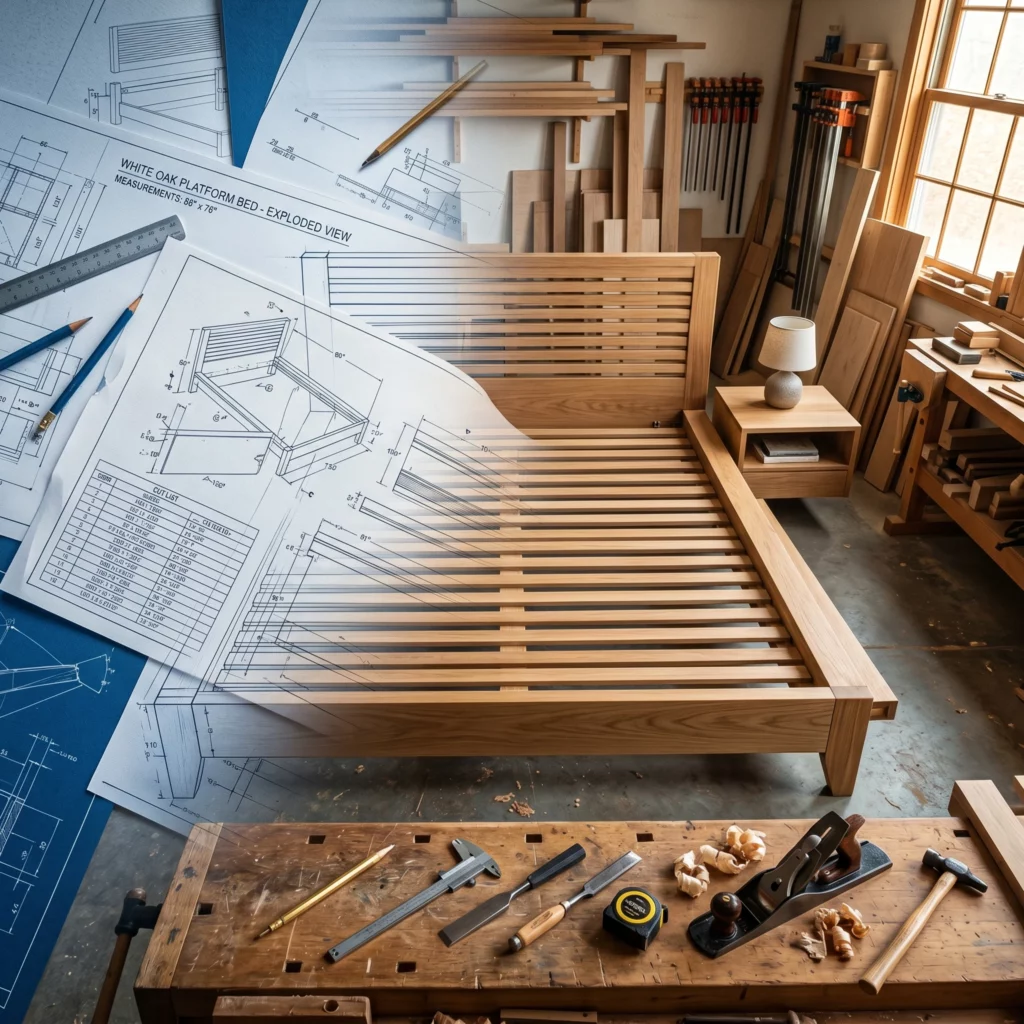
Platform Beds and Structural Simplicity
Modern platform beds look minimal because the complexity is hidden internally.
You’re balancing:
- structural load
- frame stability
- slat spacing
- hardware concealment
- movement resistance
This is where woodworking becomes deeply satisfying for analytical thinkers.
Every hidden support matters.
Every measurement compounds.
Every detail influences longevity.
And unlike smaller projects, a bed frame becomes part of daily life in a very personal way.
Built-In Shelving Systems That Transform Entire Rooms
Built-ins change how people perceive a space.
A room with freestanding furniture feels temporary.
Built-ins feel intentional.
Permanent.
Architectural.
They also require an entirely different level of planning:
- wall irregularities
- floor leveling
- modular spacing
- trim integration
- load distribution
This is where many woodworkers realize they’re no longer “trying a hobby.”
They’re developing craftsmanship.
Why Accurate Cut Lists Matter More Than Most Beginners Realize
Tiny errors multiply faster than people expect.
A single bad measurement can ripple across an entire project:
- uneven reveals
- crooked doors
- twisted assemblies
- visible asymmetry
- unstable furniture
And the frustrating part is that the original mistake often looks insignificant when it happens.
That’s why experienced woodworkers obsess over systems instead of rushing.
Good woodworking isn’t fast because professionals hurry.
It’s fast because they eliminate avoidable problems before cutting material.
Understanding Wood Movement Before It Ruins a Project
Wood moves.
Even after it’s cut, sanded, finished, and assembled.
Humidity changes cause expansion and contraction across the grain, which means furniture needs room to breathe structurally.
Ignoring wood movement is one of the fastest ways to destroy an otherwise beautiful build.
Tabletops crack.
Panels warp.
Joints separate.
The best modern woodworking plans account for movement from the beginning through:
- floating panels
- elongated screw holes
- tabletop fasteners
- strategic grain orientation
This is one of the biggest differences between furniture that lasts five years and furniture that lasts generations.
The Best Woods for Modern Furniture
Material choice changes everything — visually, structurally, emotionally.
Some woods feel warm.
Others feel architectural.
Some absorb finish beautifully.
Others fight you every step of the way.
White Oak: The Language of Modern Design
White oak dominates modern furniture for good reason.
The grain is clean without feeling sterile. It works beautifully with Scandinavian interiors, Japandi aesthetics, minimalist architecture, and contemporary homes.
It also finishes exceptionally well.
A matte hardwax oil on white oak creates a soft, natural texture that feels expensive without trying too hard.
Walnut and the Instantly Premium Effect
Walnut has depth.
Even unfinished, it carries visual weight that immediately feels luxurious. Pair walnut with black steel, matte lighting, or brass hardware and the furniture starts feeling architectural almost instantly.
It’s one of the few materials that can make simple joinery look elevated.
Birch Plywood: The Smart Builder’s Secret Weapon
Birch plywood quietly powers a massive percentage of modern woodworking builds.
It’s stable.
Affordable.
Strong.
Widely available.
And exposed plywood edges have become part of modern design language themselves.
Especially in minimalist shelving, desks, cabinetry, and modular furniture systems.
The Truth About Tools Nobody Tells Beginners
You do not need a professional woodworking shop to build beautiful furniture.
You really don’t.
Social media has distorted expectations so badly that beginners assume they need:
- cabinet saws
- industrial dust collection
- giant workshops
- premium routers
- thousands of dollars in equipment
Most modern woodworking projects can be built with surprisingly few tools.
A Beginner Tool Setup That Actually Makes Sense
Start simple:
- circular saw
- drill/driver
- orbital sander
- clamps
- speed square
- tape measure
That alone can build an enormous range of modern furniture.
Then expand naturally as projects demand new capabilities.
Not before.
Why Finishing Determines Whether Furniture Looks Homemade
A mediocre build with an excellent finish often looks professional.
A great build with a bad finish looks unfinished forever.
Finishing changes perception.
Sanding Is Where Patience Shows Up
Most beginners rush sanding because they’re emotionally finished before the project actually is.
That’s a mistake.
Good sanding creates:
- consistent stain absorption
- softer edges
- smoother touch
- cleaner reflected light
The difference between 120 grit and 220 grit doesn’t sound dramatic until finish hits the surface.
Then everything changes.
Modern Furniture Finishes That Actually Look Good
Heavy glossy polyurethane tends to fight modern aesthetics.
Most contemporary furniture builders prefer finishes that preserve natural texture and grain clarity:
- Rubio Monocoat
- hardwax oils
- matte polyurethane
- natural oil blends
The goal is usually subtlety.
Modern furniture looks best when the material itself remains the focus.
Small Workshop Setups Can Produce Incredible Furniture
Some of the best furniture builders work in spaces smaller than most people imagine.
One-car garages.
Basements.
Garden sheds.
A compact workshop forces efficiency.
And efficiency creates cleaner workflow habits:
- mobile tools
- modular workstations
- better organization
- intentional layouts
Space matters far less than consistency.
Why Woodworking Becomes So Hard to Walk Away From
At first, people think they’re building furniture.
Then something deeper starts happening.
You become more patient.
More observant.
More deliberate.
You start noticing proportions in restaurants. Grain patterns in hotel lobbies. Joinery details in coffee shops. The world begins revealing how things are made.
And that changes how you move through it.
Modern woodworking isn’t addictive because people desperately need more shelves or side tables.
It’s addictive because creating physical things restores a kind of focus most people haven’t felt in years.
Frequently Asked Questions
“What’s the easiest woodworking project that still looks impressive?”
Floating shelves. Easily.
They’re approachable for beginners, require relatively few tools, and instantly improve a room visually. Done well, they look custom-built — especially in white oak or walnut.
“Do free woodworking plans actually work, or are they mostly junk?”
Some are excellent. Some are chaos disguised as instruction.
The best free woodworking plans include:
- detailed cut lists
- assembly diagrams
- material breakdowns
- hardware recommendations
- realistic measurements
- clear sequencing
If the plan feels vague before you start, it usually gets worse mid-build.
“What tools should I buy first without wasting money?”
Start with versatility, not prestige.
A circular saw, drill/driver, orbital sander, clamps, and reliable measuring tools can build a surprising amount of modern furniture.
Buy tools around projects.
Not around fantasies.
“What wood makes DIY furniture look expensive?”
White oak and walnut dominate modern furniture design for a reason.
White oak feels clean, architectural, and timeless. Walnut adds warmth and visual richness almost instantly. Birch plywood is the best budget-friendly option for modern builds.
“Can someone realistically teach themselves woodworking?”
Absolutely.
Most modern woodworkers learn through:
- online tutorials
- downloadable woodworking plans
- YouTube build videos
- forums and woodworking communities
- repetition through progressively harder projects
The key isn’t talent.
It’s staying in the process long enough for confidence to catch up.
Related Guides Worth Exploring
If you’re building topical authority around woodworking content or planning future projects, these topics naturally connect to modern woodworking plans with cut lists:
- Beginner woodworking tools guide
- DIY floating shelf tutorial
- How to read woodworking cut lists
- Best wood for modern furniture
- Pocket hole joinery explained
- Small garage workshop layouts
- Scandinavian furniture design principles
- Plywood edge finishing techniques
- Modern coffee table woodworking plans
- Furniture finishing and staining methods
Products / Tools / Resources
Recommended Beginner Tools
- Circular Saw
- Cordless Drill/Driver Combo
- Random Orbital Sander
- Speed Square
- Parallel Clamps
- Pocket Hole Jig
- Flush Trim Router Bit
- Track Saw Guide System
Best Woods for Modern Furniture Projects
- White Oak
- Walnut
- Maple
- Birch Plywood
- Ash
- Baltic Birch Panels
Helpful Woodworking Software & Planning Tools
- SketchUp for Furniture Modeling
- CutList Optimizer
- Fusion 360
- ShaperHub Design Files
- Printable PDF Plan Libraries
Favorite Finishes for Clean Modern Furniture
- Rubio Monocoat
- Osmo Polyx-Oil
- Water-Based Matte Polyurethane
- Danish Oil
- Hardwax Oil Finishes
Recommended Beginner Projects
- Floating Shelves
- Minimalist Side Table
- Modern Plant Stand
- Floating Nightstand
- Coffee Table With Storage
- Plywood Desk Build
- Platform Bed Frame
- Modular Bookshelf System