
The Best Small Patio Woodworking Projects for Tiny Backyards at a Glance
When space is limited, every inch matters.
The most effective small patio woodworking plans aren’t necessarily the biggest, most elaborate, or most expensive. They’re the projects that quietly solve multiple problems at once. A bench that hides storage. A planter that doubles as a privacy wall. A folding table that appears when you need it and disappears when you don’t.
That’s where the magic happens.
For homeowners working with compact backyards, the goal isn’t to cram more into the space. It’s to make the space work harder while feeling lighter, cleaner, and more open.
The projects featured in this guide were chosen because they do exactly that:
- Storage benches
- Corner seating systems
- Fold-down patio tables
- Vertical herb gardens
- Compact pergolas
- Privacy screen trellises
- Storage coffee tables
- Modular seating
- Planter bench combinations
- Outdoor console tables
- Wall-mounted bars
- Swing benches
- Patio divider walls
- Rolling serving carts
- Firewood storage benches
- Raised planter boxes
- Multi-level garden displays
Each project serves a purpose. Most serve several.
And together, they can completely change the way a small backyard feels.
Why Some Small Patios Feel Cramped—and Others Feel Surprisingly Spacious
Walk into two patios with identical dimensions and you’ll often experience something strange.
One feels crowded.
The other feels inviting.
Bigger, somehow.
Even though the measurements are exactly the same.
The difference rarely comes down to square footage. More often, it’s a matter of visual flow, storage, furniture scale, and how intelligently the space has been designed.
Professional landscape designers have understood this for decades.
People don’t experience outdoor spaces mathematically.
They experience them emotionally.
A cluttered patio filled with oversized furniture feels restrictive. A thoughtfully designed patio with integrated storage, layered height, and clearly defined zones feels calm. Intentional. Comfortable.
That’s why woodworking projects can have such a dramatic impact.
Done correctly, they’re not just additions to the space.
They’re solutions.
A custom-built bench eliminates clutter. A vertical garden draws the eye upward. A pergola creates dimension. A privacy screen establishes boundaries without making the area feel closed in.
Small changes. Massive perception shifts.
And perception is what makes a backyard feel large.
The Three Design Principles Behind Every Successful Small Patio
Before cutting a single board, it helps to understand the principles that make compact outdoor spaces work.
Skip this step and you risk building furniture that consumes valuable square footage without improving the overall experience.
Follow these principles and every project becomes exponentially more effective.
Build Up Before You Build Out
The biggest mistake homeowners make is thinking horizontally.
More chairs.
More tables.
More decorations.
More stuff.
Meanwhile, fences, walls, and vertical surfaces remain completely untouched.
That’s a missed opportunity.
Vertical woodworking projects instantly increase functionality without stealing floor space.
Think about how much room you gain when herbs grow on a wall instead of occupying containers across the patio floor.
Or when a privacy screen supports climbing vines rather than requiring multiple large planters.
Vertical space is often the most underutilized real estate in a backyard.
The homeowners who learn to use it effectively unlock possibilities that others never see.
Smart Vertical Projects
- Vertical herb gardens
- Trellis privacy screens
- Wall-mounted folding tables
- Outdoor shelving systems
- Tiered planter displays
- Decorative lattice walls
Every project shifts activity upward and creates breathing room below.
Choose Furniture That Does More Than One Job
Large outdoor spaces can afford luxury.
Small patios require efficiency.
Every object should earn its footprint.
The best woodworking projects combine multiple functions into a single structure.
A storage bench isn’t simply a place to sit.
It’s seating, organization, and visual decluttering wrapped into one project.
The same principle applies throughout a compact backyard.
Multi-Function Woodworking Ideas
- Bench + Storage
- Planter + Privacy Screen
- Coffee Table + Storage Chest
- Seating + Garden Bed
- Bar Station + Serving Shelf
- Divider Wall + Vertical Garden
When one piece serves three purposes instead of one, the entire patio feels more spacious.
Not because you’ve added less.
Because you’ve added smarter.
Create Distinct Outdoor Zones
One of the most powerful tricks used in landscape architecture involves dividing a small area into multiple experiences.
It sounds counterintuitive.
Wouldn’t separating a small space make it feel smaller?
In practice, the opposite happens.
The brain interprets defined areas as distinct destinations.
Instead of seeing one tiny patio, visitors begin to experience:
- A dining area
- A lounge area
- A gardening area
- A social area
Even subtle changes can create this effect.
A planter bench might separate a seating corner from a grilling station.
A pergola might define an outdoor dining space.
A trellis wall might create privacy around a relaxation zone.
The result feels organized rather than crowded.
And organization almost always feels larger than chaos.
17 Space-Smart Patio Woodworking Plans That Maximize Every Square Foot
Now comes the fun part.
These projects were selected not simply because they look good, but because they actively improve how a compact backyard functions.
Some create storage.
Some create comfort.
Others create the illusion of more space.
The strongest projects accomplish all three.
1. The Storage Bench That Eliminates Clutter Before It Starts
If there were a single woodworking project capable of transforming almost any small patio, this would be it.
Outdoor cushions.
Garden tools.
Children’s toys.
Extension cords.
Plant supplies.
Small backyards accumulate clutter surprisingly fast.
A storage bench quietly removes that problem while adding valuable seating.
What makes it especially powerful is the visual simplicity it creates. Once items disappear behind a hinged lid, the entire patio immediately feels calmer.
Cleaner.
Larger.
And because storage benches can be custom-sized to fit awkward corners or narrow spaces, they often outperform store-bought furniture in both function and appearance.
Why It Works
- Hidden storage
- Extra seating
- Cleaner sightlines
- Custom sizing options
Space Efficiency Rating: ★★★★★
2. Corner Bench Seating That Unlocks Dead Space
Corners are frequently ignored.
Yet they’re often the most efficient seating locations available.
A custom-built corner bench transforms an otherwise wasted area into a comfortable gathering spot while preserving open floor space in the center of the patio.
The effect is subtle but significant.
Traffic flow improves.
The layout feels intentional.
The entire patio suddenly seems larger because furniture has been pushed to the perimeter instead of scattered throughout the space.
Why It Works
- Uses underutilized corners
- Maximizes seating capacity
- Preserves central walking areas
- Creates a built-in designer look
Space Efficiency Rating: ★★★★★
3. The Fold-Down Patio Table You’ll Wonder How You Lived Without
Few projects deliver more utility per square foot.
Mounted directly to a wall or fence, a fold-down patio table remains virtually invisible until needed.
Morning coffee.
Outdoor lunches.
Laptop work sessions.
Evening drinks.
When the moment passes, the tabletop folds flat and gives the space back.
That flexibility is incredibly valuable in compact backyards where permanent furniture often becomes an obstacle.
Some homeowners use these tables every day.
Others only when entertaining.
Either way, having the option changes how the patio functions.
Why It Works
- Zero wasted footprint
- Easy DIY project
- Ideal for small patios
- Creates flexible outdoor living space
Space Efficiency Rating: ★★★★★
4. The Vertical Herb Garden That Turns Empty Walls Into Living Space
Most small patios have at least one surface that’s doing absolutely nothing.
A fence panel.
A blank wall.
The side of a shed.
At first glance, these areas seem irrelevant. But they’re often the key to unlocking valuable square footage.
A vertical herb garden transforms forgotten vertical space into something productive and beautiful.
There’s also something uniquely satisfying about stepping outside and clipping fresh basil for pasta or rosemary for grilled vegetables. It turns a patio into a place of participation rather than observation.
More importantly, it moves gardening upward instead of outward.
That’s a critical distinction when floor space is limited.
Best Herbs for Vertical Gardens
- Basil
- Mint
- Rosemary
- Thyme
- Oregano
- Parsley
- Chives
- Sage
Why It Works
- Frees patio floor space
- Adds greenery without clutter
- Creates visual height
- Encourages daily use of the patio
Space Efficiency Rating: ★★★★★
5. A Compact Pergola That Creates Instant Architectural Presence
Some projects add function.
Others change how a space feels.
A compact pergola does both.
One of the reasons small backyards often feel confined is because everything exists on a single visual plane. Your eye travels across the ground and stops.
A pergola changes that journey.
It introduces height, structure, and rhythm. Suddenly the space feels layered instead of flat.
Even a modest pergola can become the visual anchor of an entire patio.
Add climbing vines, string lights, or hanging planters and the effect becomes even stronger.
What homeowners often discover is that the pergola doesn’t physically enlarge the yard.
It simply convinces the brain that the space extends beyond its actual dimensions.
That’s powerful design.
Why It Works
- Draws the eye upward
- Defines outdoor rooms
- Creates shade opportunities
- Increases perceived depth
Space Efficiency Rating: ★★★★☆
6. The Privacy Screen Trellis That Solves Multiple Problems at Once
Privacy is one of those things you don’t think about until it’s missing.
A neighboring window.
A nearby sidewalk.
A fence that feels a little too exposed.
The instinctive solution is often to install something solid and tall.
But solid barriers can make small patios feel boxed in.
That’s where a privacy screen trellis shines.
It creates separation without creating heaviness.
The open framework allows air, light, and visibility to move through the space while still offering a sense of enclosure.
Add climbing plants and the structure evolves over time, becoming softer and more natural with each season.
Ideal Plants for Trellis Systems
- Clematis
- Jasmine
- Honeysuckle
- Climbing Roses
- Star Jasmine
- Ivy
Why It Works
- Provides privacy
- Supports vertical gardening
- Adds texture and dimension
- Maintains visual openness
Space Efficiency Rating: ★★★★☆
7. The Storage Coffee Table That Quietly Multiplies Functionality
Coffee tables tend to be underestimated.
They’re usually viewed as decorative pieces.
In a compact backyard, that mindset wastes valuable potential.
A storage coffee table becomes far more than a surface for drinks.
It becomes a place to store:
- Outdoor blankets
- Pillows
- Garden gloves
- Citronella candles
- Small entertaining supplies
By hiding frequently used items, it reduces visual clutter throughout the patio.
And visual clutter matters more than many homeowners realize.
A clean space feels larger.
A crowded space feels smaller.
The dimensions may never change, but the experience does.
Why It Works
- Hidden storage
- Central gathering point
- Reduces visible clutter
- Supports entertaining
Space Efficiency Rating: ★★★★☆
8. Modular Patio Seating Designed for Real Life
Outdoor living isn’t static.
Some weekends involve quiet mornings with a book.
Others involve friends, family, and spontaneous gatherings.
Traditional furniture rarely adapts well to changing needs.
Modular seating does.
Each section can be rearranged, expanded, separated, or combined depending on the occasion.
That flexibility becomes incredibly valuable in compact backyards where every square foot must remain adaptable.
What makes modular woodworking projects especially appealing is their scalability.
Start with two sections.
Add more later.
Expand as your needs evolve.
The patio grows with you.
Why It Works
- Adaptable layouts
- Easy future expansion
- Better use of limited space
- Supports multiple activities
Space Efficiency Rating: ★★★★☆
9. The Planter Bench Combination That Blends Nature and Function
This is one of those projects that consistently looks more expensive than it actually is.
By integrating seating directly into raised planter boxes, you eliminate the need for separate furniture pieces while creating a built-in custom appearance.
The greenery softens hard edges.
The seating encourages gathering.
And the combined footprint remains surprisingly efficient.
There’s another benefit that’s easy to overlook.
Plants naturally create boundaries.
Without walls.
Without fences.
Without making a space feel restricted.
That’s exactly what small patios need.
Popular Plant Choices
- Lavender
- Ornamental grasses
- Boxwood
- Hydrangeas
- Salvia
- Evergreen shrubs
Why It Works
- Combines seating and landscaping
- Defines outdoor zones
- Creates custom visual appeal
- Saves floor space
Space Efficiency Rating: ★★★★★
10. The Narrow Console Table That Makes Awkward Spaces Useful
Every patio seems to have one.
That narrow strip along a wall.
The slim gap behind seating.
The area that’s too small for furniture yet too visible to ignore.
Most homeowners leave it empty.
A narrow console table changes that.
Built just deep enough to remain functional without obstructing movement, it becomes a versatile surface for entertaining, decorating, or gardening.
Think of it as the outdoor equivalent of a hallway table.
Useful.
Elegant.
Quietly indispensable.
Uses for a Patio Console Table
- Serving station
- Beverage setup
- Plant display
- Lantern arrangement
- Outdoor workspace
Why It Works
- Fits narrow spaces
- Maintains traffic flow
- Adds storage and display opportunities
- Creates visual polish
Space Efficiency Rating: ★★★★☆
11. The Wall-Mounted Outdoor Bar That Becomes an Instant Gathering Spot
Every memorable outdoor space has a focal point.
A place where people naturally gravitate.
In larger backyards, that role might belong to an outdoor kitchen or fire pit.
In compact patios, a wall-mounted outdoor bar often accomplishes the same goal with a fraction of the footprint.
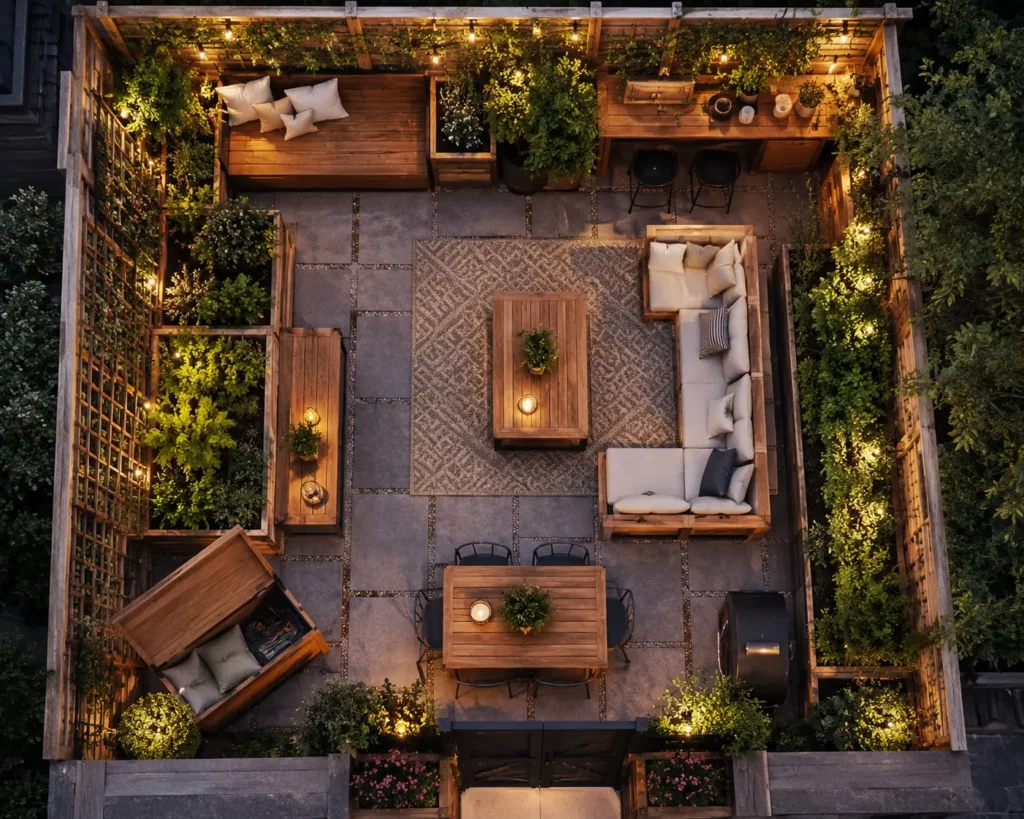
Installed directly against a fence or wall, it creates a dedicated entertaining area without consuming precious floor space.
It can function as:
- A drink station
- A serving counter
- A grilling prep surface
- A casual dining area
And because it occupies vertical real estate instead of horizontal space, the patio remains open and easy to navigate.
The best designs include folding shelves, hidden storage, and integrated lighting, allowing the bar to remain useful day and night.
Why It Works
- Creates an entertainment hub
- Uses wall space efficiently
- Adds functionality without crowding
- Encourages social interaction
Space Efficiency Rating: ★★★★★
A Pattern Begins to Emerge
By this point, a pattern becomes impossible to ignore.
The projects creating the biggest transformations aren’t necessarily the largest.
They’re the smartest.
Again and again, the most successful patio woodworking plans accomplish one of three things:
They move activity upward.
They combine multiple functions.
Or they reduce visual clutter.
Often, they do all three simultaneously.
And that’s exactly why small backyards that embrace these principles feel so dramatically different from those that don’t.
The next group of projects takes those same ideas even further, introducing movement, zoning, storage integration, and visual depth in ways that can completely redefine how a compact outdoor space is experienced.
12. The Pergola Swing Bench That Makes a Small Patio Feel Like a Destination
There are practical projects.
And then there are projects that change the emotional character of a space.
A pergola swing bench belongs firmly in the second category.
The moment a swing enters a backyard, the atmosphere shifts. People slow down. Conversations linger. Morning coffee stretches a little longer than planned.
What makes this project especially effective for compact patios is that it combines seating with vertical structure. The pergola provides architectural presence while the swing creates an experience that standard furniture simply can’t replicate.
It’s not just somewhere to sit.
It’s somewhere to stay.
Why It Works
- Combines seating and structure
- Creates a focal point
- Adds movement and visual interest
- Encourages longer outdoor use
Space Efficiency Rating: ★★★★☆
13. The Patio Divider Wall That Creates the Illusion of Multiple Outdoor Rooms
One of the oldest tricks in architecture is surprisingly simple:
Break a space into smaller experiences.
Counterintuitive as it sounds, dividing a compact patio often makes it feel larger.
Why?
Because the brain begins to perceive separate destinations instead of one confined area.
A divider wall can separate:
- Dining and lounging areas
- Gardening and entertaining zones
- Private and social spaces
The key is maintaining openness.
Wood slats, decorative screens, lattice panels, and partially open designs work particularly well because they define boundaries without stopping visual flow.
When done correctly, a divider wall doesn’t make a backyard feel smaller.
It creates layers.
And layers create depth.
Why It Works
- Defines activity zones
- Creates visual depth
- Improves organization
- Enhances privacy without enclosure
Space Efficiency Rating: ★★★★★
14. The Rolling Serving Cart That Moves With the Moment
Flexibility is often overlooked in patio design.
Yet flexibility is one of the greatest luxuries a small space can offer.
A rolling serving cart allows the patio to adapt throughout the day.
In the morning, it may hold coffee supplies.
At lunch, it becomes a prep station.
By evening, it’s a drink cart.
When not in use, it disappears neatly against a wall.
That ability to move function where it’s needed prevents the patio from becoming locked into a single layout.
For compact backyards, mobility is often more valuable than permanence.
Why It Works
- Easy to reposition
- Supports entertaining
- Adds temporary workspace
- Stores compactly
Space Efficiency Rating: ★★★★☆
15. The Firewood Storage Bench That Turns Necessity Into Design
Anyone who enjoys a fire pit knows the problem.
Firewood tends to accumulate in messy stacks.
Even neatly arranged piles can create visual clutter if they’re not integrated into the overall design.
A firewood storage bench solves that challenge elegantly.
Wood is stored where it’s needed.
Additional seating is created.
The patio remains organized.
Even homeowners who only use their fire pits seasonally often appreciate how this project creates a more intentional look throughout the year.
Practical elements become architectural features.
And that’s one of the defining characteristics of well-designed outdoor spaces.
Why It Works
- Combines storage and seating
- Reduces visual clutter
- Keeps firewood accessible
- Creates a custom built-in appearance
Space Efficiency Rating: ★★★★☆
16. Raised Planter Boxes That Bring Order to the Landscape
Gardens have a tendency to expand.
One container becomes three.
Three become ten.
Before long, a small patio begins to feel crowded by scattered pots and mismatched planters.
Raised planter boxes introduce structure.
Instead of random growth, they create intentional planting zones.
They’re also easier to maintain.
Plants sit at a comfortable working height. Soil conditions remain more consistent. Irrigation becomes simpler.
Most importantly, they help organize the visual landscape.
And organized spaces almost always feel larger.
Best Uses for Raised Planters
- Herbs
- Vegetables
- Pollinator gardens
- Seasonal flowers
- Decorative shrubs
Why It Works
- Creates visual organization
- Defines garden areas
- Improves accessibility
- Reduces clutter from containers
Space Efficiency Rating: ★★★★☆
17. The Multi-Level Garden Display That Creates Instant Depth
Depth is one of the most powerful visual tools available in landscape design.
The more layers the eye can explore, the larger a space tends to feel.
A multi-level garden display introduces those layers naturally.
Plants occupy varying heights.
Textures overlap.
Shadows shift throughout the day.
The result is movement, dimension, and visual richness without requiring additional square footage.
For homeowners who love gardening but have limited outdoor space, few projects deliver more impact per square foot.
Why It Works
- Creates visual depth
- Maximizes growing space
- Adds architectural interest
- Encourages layered planting
Space Efficiency Rating: ★★★★★
Choosing the Right Wood for Outdoor Patio Projects
A great design can only perform as well as the materials behind it.
Outdoor woodworking projects face constant exposure to moisture, sunlight, temperature swings, and seasonal weather conditions. Choosing the right lumber at the beginning saves time, maintenance, and frustration later.
Cedar: The Small Patio Favorite
Cedar continues to be one of the most popular choices for outdoor woodworking—and for good reason.
Its natural resistance to insects and decay makes it exceptionally well-suited for benches, pergolas, planters, and patio furniture.
The warm grain pattern also develops character over time, aging into a soft silver-gray if left untreated.
Best For:
- Storage benches
- Pergolas
- Raised planters
- Privacy screens
Redwood: Premium Beauty and Durability
Redwood offers many of the same advantages as cedar but with a richer appearance and enhanced durability.
It’s often chosen for projects intended to become permanent design features.
Best For:
- Statement furniture
- Architectural patio features
- Luxury outdoor spaces
Pressure-Treated Pine: Budget-Friendly Performance
For homeowners balancing cost and durability, pressure-treated pine remains one of the most accessible options available.
It performs particularly well for structural projects and larger builds where material costs can add up quickly.
Best For:
- Frameworks
- Benches
- Utility projects
- Pergola structures
Composite Materials: Minimal Maintenance, Modern Appeal
Some homeowners prefer spending time enjoying their patio rather than maintaining it.
Composite materials offer excellent longevity and require significantly less upkeep than natural wood.
Best For:
- Contemporary designs
- High-exposure locations
- Low-maintenance lifestyles
The Mistakes That Make Small Patios Feel Smaller Than They Are
Sometimes expanding a space has less to do with what you add and more to do with what you avoid.
The following mistakes consistently undermine otherwise beautiful patios.
Oversized Furniture
Furniture selected for a large deck rarely translates well to a compact backyard.
Bulky pieces dominate sightlines and reduce circulation.
Scale matters.
In many cases, slightly smaller furniture creates a noticeably larger-feeling patio.
Ignoring Vertical Space
A blank fence is wasted real estate.
A blank wall is untapped potential.
Every vertical surface represents an opportunity for storage, gardening, lighting, or decoration.
Failing to use that space places unnecessary pressure on the patio floor.
Too Many Individual Pieces
Small spaces often suffer from furniture accumulation.
A chair here.
A table there.
Another planter.
Another shelf.
Eventually the patio begins to feel fragmented.
Integrated, multi-purpose projects almost always outperform collections of separate items.
Visible Clutter Everywhere
Nothing shrinks a space faster than clutter.
Garden tools.
Cushions.
Extension cords.
Outdoor toys.
Supplies that lack dedicated storage create constant visual noise.
The solution is rarely more space.
It’s better storage.
Questions Homeowners Often Ask Before Starting
“What’s the easiest patio woodworking project if I’ve never built anything before?”
A raised planter box is usually the best starting point.
The cuts are straightforward, mistakes are forgiving, and the finished project delivers immediate visual impact.
Storage benches are another excellent beginner-friendly option once you’re comfortable with basic assembly.
“What’s the best wood for outdoor furniture that will stay outside year-round?”
For most homeowners, cedar offers the strongest balance of durability, appearance, workability, and cost.
It resists moisture naturally and performs exceptionally well in outdoor environments.
If budget is less of a concern, redwood is another outstanding choice.
“How much should I expect to spend on a small patio woodworking project?”
Costs vary depending on lumber selection, hardware, and finishes, but many projects fall within these ranges:
- Raised planters: $50–$150
- Storage benches: $100–$300
- Privacy screens: $100–$400
- Pergolas: $300–$1,500+
Starting with smaller projects often allows homeowners to build skills while improving the space incrementally.
“Do I need permits for backyard woodworking projects?”
Most furniture, planters, benches, and decorative structures don’t require permits.
Larger permanent structures such as pergolas, covered patios, or substantial divider walls may be subject to local regulations.
Checking requirements before construction begins can prevent costly surprises later.
“How do I make my backyard look professionally designed without spending a fortune?”
The secret isn’t expensive materials.
It’s cohesion.
Consistent wood tones.
Integrated seating.
Purposeful storage.
Layered planting.
Defined zones.
When those elements work together, even modest projects create a custom-built appearance that feels far more expensive than it actually is.
Products / Tools / Resources
If you’re planning to tackle any of the projects in this guide, a few well-chosen tools and materials will make the experience dramatically smoother.
Essential Woodworking Tools
- Circular saw
- Miter saw
- Cordless drill and driver
- Pocket hole jig
- Orbital sander
- Speed square
- Tape measure
- Clamps
- Level
- Safety glasses and hearing protection
Recommended Materials
- Cedar boards for benches and planters
- Pressure-treated lumber for structural frames
- Exterior-grade screws
- Galvanized hardware
- Waterproof wood glue
- Outdoor wood stain
- UV-resistant sealant
Helpful Accessories
- Hidden storage hinges
- Heavy-duty caster wheels for rolling carts
- Adjustable furniture feet
- Solar patio lighting
- Trellis panels
- Outdoor cushion storage liners
Project Planning Resources
- Printable woodworking plans
- Patio layout design software
- Cut-list calculators
- Lumber quantity estimators
- Outdoor lighting planners
- Landscape design sketch templates
Best Starter Projects for Beginners
If you’re building your first outdoor project, start here:
- Raised planter box
- Vertical herb garden
- Storage bench
- Fold-down patio table
- Privacy screen trellis
These projects offer the fastest combination of skill development, visual transformation, and day-to-day usefulness—while helping a compact backyard feel larger, cleaner, and significantly more enjoyable to spend time in.