
The Real Reason Small Patios Feel So Frustrating
Most people blame square footage.
They stand on a compact patio, glance at the walls, the fence, the edges of the deck, and immediately conclude there’s simply not enough room.
But space isn’t usually the problem.
Furniture is.
A bulky chair shoved into a corner. A dining table designed for a backyard twice the size. Storage bins scattered wherever they’ll fit. Piece by piece, the available space gets swallowed until the patio begins to feel less like a retreat and more like an obstacle course.
What’s fascinating is how quickly that feeling can change.
You don’t need a larger deck. You don’t need a costly renovation. You don’t even need to remove functionality. In many cases, you can actually gain functionality while making the entire space feel dramatically bigger.
That’s where space-saving outdoor furniture woodworking plans become so powerful.
The best designs aren’t simply smaller versions of traditional furniture. They’re smarter. They fold, stack, nest, convert, store, and adapt. Every inch earns its place. Every component serves more than one purpose.
And when that happens, something interesting occurs.
The patio begins to breathe again.
Movement becomes effortless. Clutter disappears. The space feels intentional rather than crowded.
This guide explores 17 space-saving outdoor furniture woodworking plans specifically designed for small patios, balconies, compact decks, and tight backyard spaces. Whether you’re building your first DIY outdoor project or designing a complete outdoor living area from scratch, these ideas can help you reclaim square footage you didn’t realize you had.
Quick Answer: What Is Space-Saving Outdoor Furniture?
Space-saving outdoor furniture is furniture designed to maximize usability while minimizing physical footprint.
Instead of dedicating one piece to one function, these designs often combine multiple purposes into a single build.
Common examples include:
- Folding outdoor chairs
- Wall-mounted drop-leaf tables
- Storage benches
- Nesting tables
- Modular seating systems
- Convertible bench-to-table designs
- Balcony rail tables
- Fold-down workstations
For homeowners working with limited outdoor square footage, these solutions can significantly increase usable space while improving organization, comfort, and visual openness.
In practical terms, the right furniture layout can make a 100-square-foot patio feel more functional than a poorly designed space twice its size.
Why Some Small Outdoor Spaces Feel Claustrophobic While Others Feel Spacious
Have you ever visited two patios with nearly identical dimensions, only to find one feels inviting while the other feels cramped?
The difference rarely comes down to size alone.
It comes down to how space is being used.
Designers often refer to this as circulation—the ability to move comfortably through a space without feeling restricted.
When furniture interrupts movement, the brain perceives the environment as smaller than it actually is.
That’s why oversized outdoor furniture often creates problems.
Even beautiful furniture can become a liability if it dominates the available footprint.
Several factors tend to create this effect:
Oversized Furniture
Retail furniture is typically built for average-sized outdoor spaces.
Small patios rarely benefit from average-sized solutions.
Poor Traffic Flow
When every route requires stepping around chairs, tables, or planters, the entire area feels congested.
Wasted Corner Space
Corners are often neglected, despite being some of the most valuable real estate in compact layouts.
Visual Clutter
Storage bins, garden tools, cushions, and miscellaneous outdoor accessories create a constant sense of disorder.
Single-Purpose Furniture
Every additional item consumes floor space.
Furniture that serves only one purpose becomes increasingly inefficient as square footage shrinks.
The encouraging part?
Each of these problems can be solved through thoughtful woodworking.
Unlike store-bought furniture, custom-built outdoor pieces can be designed around the exact dimensions of your space.
Every measurement can be intentional.
Every inch can work harder.
The Four Design Principles Behind Every Great Space-Saving Furniture Build
The most successful outdoor furniture projects tend to follow a surprisingly consistent set of principles.
Once you understand them, you’ll start recognizing why certain layouts feel so much larger than others.
1. Multifunctionality: One Piece, Multiple Jobs
The smartest furniture rarely does just one thing.
Think about an outdoor storage bench.
At first glance, it’s a place to sit.
Lift the lid, however, and it becomes storage for cushions, gardening supplies, outdoor games, or grilling accessories.
Now one piece performs the work of two.
The same concept applies to:
- Planter benches
- Storage ottomans
- Convertible dining furniture
- Bench-table combinations
When each item serves multiple functions, you naturally need fewer pieces overall.
Less furniture often creates more freedom.
2. Foldability: Space When You Need It, Absence When You Don’t
Few design features have a greater impact on small patios than foldability.
A folding chair doesn’t merely shrink.
It disappears from daily life when not needed.
The psychological effect is surprisingly powerful.
The patio feels open.
Flexible.
Ready for whatever the day requires.
Popular examples include:
- Folding Adirondack chairs
- Fold-down wall tables
- Collapsible garden workstations
- Folding dining sets
For homeowners who entertain occasionally rather than constantly, foldable furniture delivers exceptional value.
3. Vertical Thinking Changes Everything
Most homeowners focus almost exclusively on floor space.
The walls remain largely untouched.
That’s a missed opportunity.
Vertical design allows functionality to expand upward rather than outward.
Wall-mounted furniture, shelving systems, hanging storage, and fold-away surfaces can dramatically increase utility without occupying valuable patio real estate.
This approach is particularly effective on balconies and urban outdoor spaces where every square foot matters.
4. Modularity Creates Freedom
Traditional furniture assumes your needs remain static.
Real life doesn’t work that way.
Sometimes you’re drinking coffee alone.
Sometimes you’re hosting six guests.
Modular furniture adapts to both situations.
Individual sections can function independently or combine into larger arrangements when needed.
For small patios, this flexibility often becomes one of the biggest advantages of custom woodworking.
17 Space-Saving Outdoor Furniture Woodworking Plans
1. Folding Adirondack Chair
The Adirondack chair is one of the most recognizable pieces of outdoor furniture ever created.
It’s comfortable. Timeless. Instantly associated with relaxation.
It’s also notoriously large.
Traditional versions occupy significant floor space even when nobody is sitting in them.
A folding Adirondack chair solves that problem elegantly.
When in use, you enjoy the same deep seating angle and classic appearance. When not needed, the chair folds flat enough to lean against a wall, store in a shed, or tuck away beside a storage bench.
Why It Works
The footprint essentially vanishes between uses.
For small patios, that’s a remarkable advantage.
Ideal For
- Compact decks
- Small backyard patios
- Seasonal outdoor seating
- Vacation properties
2. Wall-Mounted Drop-Leaf Patio Table
Few projects deliver more space-saving value than a well-built drop-leaf table.
Mounted directly to a wall, fence, or sturdy exterior surface, this table remains almost invisible when folded.
Then, within seconds, it transforms into a dining table, coffee station, laptop workspace, or serving area.
What makes this design especially compelling is how little material it requires compared to a traditional table.
No bulky base.
No oversized legs.
No permanent footprint.
Just useful surface area exactly when you need it.
Best Locations
- Balcony walls
- Privacy fences
- Deck rail systems
- Small courtyard patios
3. Outdoor Storage Bench
If there were a single project deserving the title of “highest return on effort,” it would probably be the outdoor storage bench.
Small patios often suffer from one persistent problem: nowhere to put things.
Cushions need storage.
Garden tools need storage.
Outdoor blankets, games, and accessories need storage.
Without designated space, clutter slowly spreads across the patio.
A storage bench solves all of it at once.
You gain seating.
You gain organization.
You gain cleaner sightlines.
And because visual clutter is one of the fastest ways to make a space feel cramped, the impact often extends far beyond the square footage itself.
4. Convertible Bench-to-Picnic Table
At first glance, it looks like an ordinary outdoor bench.
That’s part of the appeal.
Nothing about it announces its hidden capability. It sits quietly against a fence line or patio edge, occupying a relatively modest footprint. Then guests arrive, lunch turns into an impromptu gathering, and with a few simple movements, the bench unfolds into a complete picnic table.
This is the kind of furniture that makes small spaces feel intelligent.
Instead of forcing you to choose between seating and dining, it provides both. The transformation creates a subtle sense of abundance—a feeling that the space can do more than its dimensions suggest.
Why Homeowners Love This Build
- Functions as two pieces of furniture
- Reduces clutter
- Ideal for entertaining
- Maximizes flexibility
For families, it’s particularly valuable because outdoor needs change constantly. Morning coffee for one becomes dinner for four. The furniture adapts without requiring additional square footage.
5. Stackable Patio Chairs
Most patios aren’t crowded all the time.
They’re crowded occasionally.
The problem is that traditional seating occupies space every day, even when it’s only truly needed a handful of times each month.
Stackable patio chairs solve this elegantly.
When guests arrive, seating expands instantly. When the gathering ends, the chairs return to a compact vertical stack that occupies a fraction of the original footprint.
There’s something psychologically satisfying about reclaiming space so quickly.
One moment the patio is configured for entertaining. The next, it’s open again.
Design Considerations
Well-designed stackable chairs should balance three priorities:
- Structural strength
- Comfort
- Compact stacking geometry
A chair that stacks beautifully but feels uncomfortable won’t get used. Likewise, a comfortable chair that stacks inefficiently defeats the purpose.
The sweet spot lies somewhere in between.
6. Nested Side Tables
Small outdoor spaces often struggle with surfaces.
You need a place for a coffee cup.
A book.
A drink.
Maybe a small tray during dinner.
Yet adding multiple tables can quickly overwhelm the patio.
Nested tables offer a smarter solution.
The smaller tables slide beneath the larger one, remaining hidden until needed. Pull one out when guests arrive. Return it when they leave.
Simple.
Elegant.
Efficient.
Where Nested Tables Shine
- Balcony seating areas
- Outdoor lounges
- Small conversation zones
- Compact decks
The beauty of nesting furniture lies in its invisibility. Additional functionality exists without constantly demanding attention.
7. Corner Storage Bench
Corners are among the most overlooked areas in outdoor design.
Walk through most patios and you’ll notice the pattern immediately. Valuable corner space sits underutilized while furniture crowds the center.
A corner storage bench reverses that equation.
By wrapping seating along the perimeter, the center of the patio remains open. The visual effect is dramatic.
The space suddenly feels larger.
Movement becomes easier.
And beneath the seating, hidden storage keeps clutter out of sight.
What Makes This Design So Effective
Corners naturally define gathering areas.
Instead of fighting the geometry of the patio, this project works with it.
The result is more seating, more storage, and more usable space—all from an area that often goes ignored.
8. Fold-Down Outdoor Bar Table
Some furniture earns its place every day.
Other furniture earns its place only occasionally.
The challenge is making room for both.
An outdoor bar table falls into the second category. It’s wonderful for entertaining but often unnecessary during daily use.
A fold-down version solves the dilemma.
Mounted to a wall or fence, the table remains flat when not in use. During gatherings, it creates an instant serving station, beverage center, or outdoor dining surface.
Perfect Uses
- Weekend entertaining
- Outdoor cocktail stations
- Grilling zones
- Small patio dining
The best designs incorporate shelves or integrated storage, adding even more functionality without increasing footprint.
9. Modular Patio Seating
Traditional furniture tells you how the space should function.
Modular furniture asks what you need today.
That distinction matters.
A fixed outdoor sofa occupies the same footprint whether one person is using it or six. Modular seating can be rearranged, expanded, separated, or reconfigured based on the moment.
This adaptability is one of the most powerful advantages of custom-built outdoor furniture.
Common Configurations
- Conversation circle
- L-shaped sectional
- Individual chairs
- Daybed arrangement
- Entertaining layout
For small patios, flexibility often matters more than size.
The ability to change the environment keeps the space feeling fresh, functional, and responsive.
10. Outdoor Ottoman Storage Cube
Some of the most valuable outdoor furniture projects are also the smallest.
The storage ottoman is a perfect example.
At first glance, it’s deceptively simple.
Yet within a compact cube, you can combine several essential functions:
- Extra seating
- Footrest
- Side table
- Hidden storage
Few projects offer so much utility in so little space.
Why This Build Deserves Attention
Small patios rarely suffer from a lack of large furniture.
They suffer from a lack of flexible furniture.
Storage ottomans fill gaps in functionality without adding visual bulk, making them one of the smartest additions to compact outdoor environments.
11. Balcony Rail Table
Urban living presents unique challenges.
When your outdoor space measures only a few feet deep, every design decision carries weight.
That’s why balcony rail tables have become increasingly popular.
Rather than occupying floor space, the table attaches directly to the railing itself.
The result feels almost magical.
You gain a functional surface without sacrificing precious walking room.
Ideal For
- Apartment balconies
- Condominium terraces
- Rooftop patios
- Narrow outdoor spaces
Whether used for morning coffee, laptop work, or evening drinks, the table creates usability where none existed before.
12. Rolling Outdoor Cart
Mobility is an underrated space-saving strategy.
Most people think of furniture as fixed.
Stationary.
Permanent.
But when furniture moves effortlessly, the entire patio becomes more flexible.
A rolling outdoor cart can function as:
- A grill station
- Beverage center
- Gardening workstation
- Outdoor prep table
- Storage unit
Then, when finished, it rolls neatly into a corner.
Why Mobility Matters
Permanent furniture claims territory.
Mobile furniture borrows it.
That distinction changes how a space feels.
Instead of dedicating valuable square footage to a single purpose, you create adaptable zones that shift throughout the day.
Morning gardening.
Afternoon relaxation.
Evening entertaining.
The same piece supports each activity.
A Pattern Begins to Emerge
If you’ve noticed a recurring theme among these woodworking plans, you’re seeing the underlying principle that separates average patios from exceptional ones.
The best outdoor spaces aren’t filled with more furniture.
They’re filled with better furniture.
Furniture that folds instead of lingering.
Furniture that stores instead of cluttering.
Furniture that adapts instead of demanding permanence.
And perhaps most importantly, furniture that respects the limited space it’s been given.
As we move into the next group of projects, the focus shifts even further toward advanced space optimization—designs that blur the line between furniture, architecture, storage, and outdoor living itself.
The next builds don’t simply save space.
They fundamentally change how a small patio functions.
13. Murphy-Style Garden Table
Some space-saving ideas feel clever.
Others feel transformative.
A Murphy-style garden table belongs firmly in the second category.
Borrowing inspiration from the classic Murphy bed, this design folds completely against a wall when not in use. Closed, it occupies only a few inches of depth. Open, it becomes a surprisingly capable workspace for gardening, dining, crafting, or outdoor entertaining.
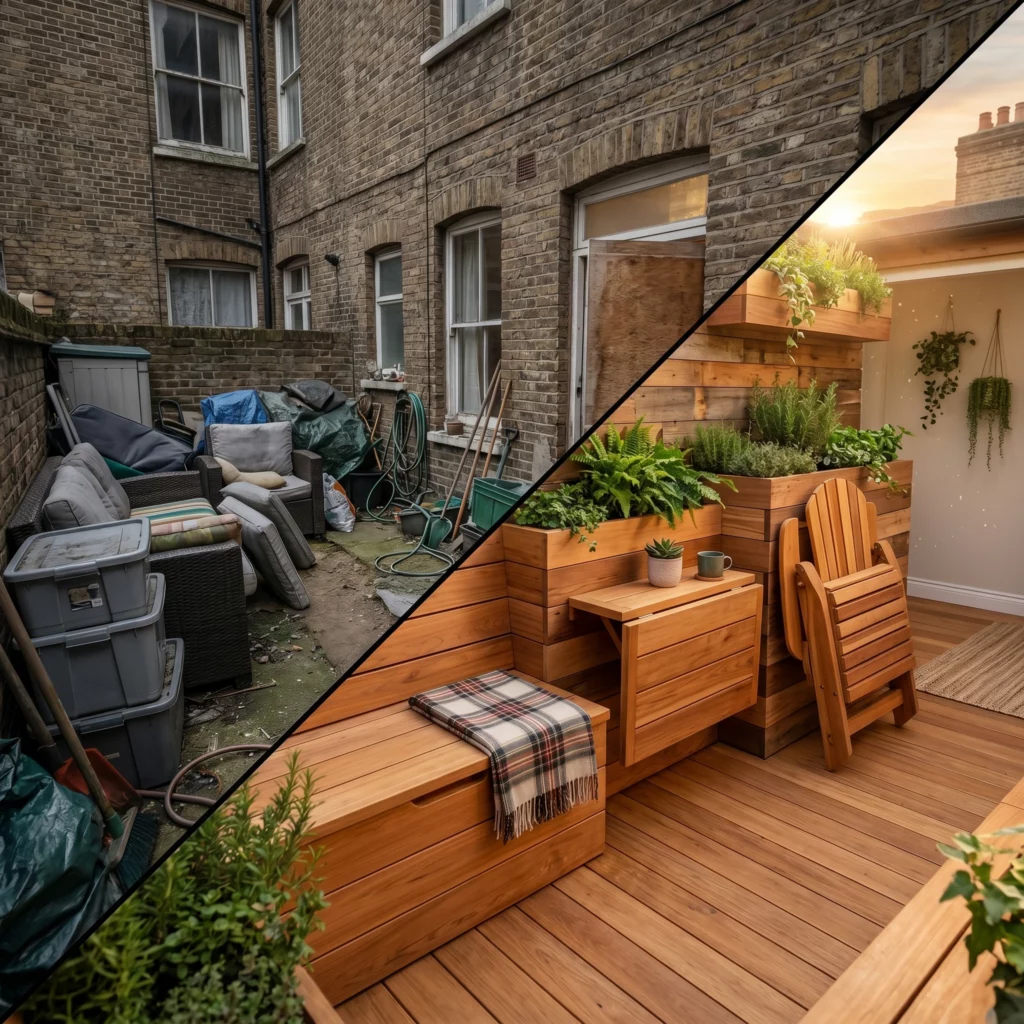
What makes this project so compelling is the contrast.
One moment, there’s virtually nothing there.
The next, there’s a fully functional surface ready for use.
For homeowners working with exceptionally tight patios, balconies, or courtyard spaces, that kind of flexibility can feel like gaining square footage without adding a single inch.
Best Applications
- Potting stations
- Outdoor workspaces
- Compact dining areas
- Balcony meal prep surfaces
The visual cleanliness alone makes this build worth considering. When folded away, the patio instantly feels calmer and more spacious.
14. Planter Bench Combination
Outdoor furniture doesn’t always have to compete with landscaping.
Sometimes the two can become the same thing.
A planter bench merges seating and greenery into a single structure, creating an outdoor feature that feels both functional and alive.
This design works especially well in smaller spaces because it eliminates the need for separate planters.
Instead of finding room for benches and finding room for plants, you’re creating one integrated solution.
Why It Changes the Atmosphere
Plants soften hard edges.
They add texture, movement, color, and seasonal variation.
When incorporated directly into seating, they create a more immersive outdoor experience without consuming additional floor space.
Many homeowners also use planter benches to establish subtle privacy screens, particularly on decks and balconies where neighboring properties are visible.
The result feels intentional rather than crowded.
15. Compact Outdoor Loveseat
Walk through a furniture showroom and you’ll notice something immediately.
Most outdoor loveseats are oversized.
Wide arms. Deep cushions. Bulky proportions.
They look impressive in large display settings but often overwhelm compact patios.
Building your own loveseat changes that equation entirely.
Instead of designing around generic dimensions, you design around your actual space.
Every measurement becomes purposeful.
Every inch serves a reason.
Smart Space-Saving Features
- Narrow arm profiles
- Built-in storage compartments
- Raised legs for visual openness
- Lightweight framing techniques
One of the most overlooked principles of small-space design is visual weight.
Furniture doesn’t just occupy physical space—it occupies visual space.
Well-proportioned furniture creates breathing room, making patios feel larger than their measurements suggest.
16. Foldable Garden Workstation
Gardeners understand a unique challenge.
The tools required for gardening often consume more space than the gardening itself.
Pots, soil, hand tools, fertilizers, watering equipment—they all need a home.
A foldable garden workstation solves this elegantly.
When open, it provides a dedicated workspace complete with storage and organization.
When closed, it retreats neatly against a wall, preserving valuable patio real estate.
Features Worth Including
- Fold-down work surface
- Tool storage compartments
- Hanging hooks
- Integrated shelving
- Pot storage racks
For homeowners who enjoy gardening but lack a dedicated shed or workspace, this project can dramatically improve organization and workflow.
17. Modular Sectional Seating With Storage
If there were a single project that captures the philosophy behind space-saving outdoor furniture, this might be it.
Modular sectional seating with integrated storage represents the convergence of flexibility, organization, comfort, and efficiency.
Each module performs multiple functions simultaneously.
It provides seating.
It provides storage.
It contributes to a larger furniture arrangement.
And because each section can move independently, the layout evolves alongside your needs.
Why This Project Stands Out
One afternoon, it may function as a quiet reading nook.
The next evening, it may transform into a conversation area for guests.
The following weekend, it may become an outdoor lounge for family gatherings.
Few furniture projects offer this level of adaptability.
For small patios, adaptability often matters more than size itself.
Choosing the Best Wood for Outdoor Furniture
A great design can only perform as well as the material it’s built from.
Outdoor furniture faces constant exposure to moisture, sunlight, temperature fluctuations, and seasonal wear. Selecting the right lumber isn’t simply about appearance—it’s about longevity.
Cedar
Cedar remains one of the most popular choices for outdoor woodworking, and for good reason.
It naturally resists rot, insects, and moisture while remaining lightweight and easy to work with.
Best For
The pleasant aroma and warm color are added bonuses.
Redwood
Redwood combines durability with exceptional visual appeal.
Its natural resistance to decay makes it a premium option for outdoor furniture intended to last for years.
Best For
- High-end seating
- Decorative furniture
- Premium patio projects
Many homeowners choose redwood when aesthetics matter as much as performance.
Teak
Teak has earned its reputation as the benchmark for luxury outdoor furniture.
Its dense grain structure and natural oils provide extraordinary resistance to weather.
Best For
- Long-term investments
- Luxury outdoor furniture
- Coastal environments
While the upfront cost is higher, few materials offer comparable longevity.
White Oak
White oak occupies an interesting middle ground.
Strong, durable, and highly moisture resistant, it performs exceptionally well in outdoor applications while delivering a timeless appearance.
Best For
- Structural furniture
- Benches
- Tables
- Heavy-use pieces
Its strength makes it particularly attractive for load-bearing projects.
Pressure-Treated Pine
For budget-conscious builders, pressure-treated pine offers accessibility and durability when properly sealed.
Best For
- Entry-level projects
- Large furniture builds
- Cost-sensitive designs
Proper finishing is essential, but the value is difficult to ignore.
Finishing Outdoor Furniture So It Lasts
Building furniture is only half the process.
Protection determines whether a project lasts three years or twenty.
Outdoor conditions are relentless. Sunlight degrades surfaces. Moisture penetrates exposed grain. Temperature swings stress joints and finishes.
A quality finishing system helps prevent those problems before they start.
Exterior Oils
Exterior oils enhance the natural appearance of wood while allowing the material to breathe.
They’re particularly popular for cedar and teak furniture.
Advantages
- Natural appearance
- Easy maintenance
- Simple reapplication
Spar Urethane
Spar urethane was originally developed for marine environments, making it highly effective for outdoor furniture.
Advantages
- UV resistance
- Moisture protection
- Flexible coating system
Ideal for projects exposed to significant weather.
Exterior Paint Systems
Paint provides one of the strongest barriers against environmental damage.
Advantages
- Maximum protection
- Color flexibility
- Long-term durability
Particularly useful when design aesthetics call for specific color palettes.
Penetrating Sealers
For homeowners who prefer a raw, natural look, penetrating sealers offer protection without dramatically altering appearance.
Advantages
- Preserves wood character
- Easy maintenance
- Reduced surface buildup
A strong option for modern outdoor furniture designs.
Common Mistakes That Make Small Patios Feel Smaller
Sometimes creating more space isn’t about adding something.
It’s about avoiding mistakes.
These are the design decisions that repeatedly undermine otherwise beautiful outdoor spaces.
Choosing Furniture Before Measuring
This happens more often than most people realize.
Furniture should respond to space—not the other way around.
Measure first.
Build second.
Ignoring Hidden Storage
Every outdoor area accumulates items over time.
Without dedicated storage, clutter becomes inevitable.
And clutter shrinks a space faster than almost anything else.
Overbuilding Furniture
Large armrests.
Excessively thick frames.
Unnecessary bulk.
These details consume valuable square footage without improving functionality.
Blocking Natural Movement
People need intuitive pathways.
When furniture interrupts circulation, patios feel crowded regardless of actual size.
Always leave comfortable walking routes between major activity zones.
Forgetting Vertical Opportunities
Walls, fences, and railings represent untapped real estate.
Ignoring them often forces unnecessary pressure onto the floor plan.
Questions People Usually Ask Before Building
“What’s the easiest outdoor furniture project if I’ve never built anything before?”
A storage bench is often the best starting point.
The construction is straightforward, the functionality is enormous, and the project introduces many core woodworking skills without becoming overwhelming.
“Which wood actually lasts the longest outdoors?”
Teak generally sits at the top of the list thanks to its natural oils and remarkable weather resistance.
White oak, cedar, and redwood are also excellent long-term choices.
“Do folding furniture designs really make a noticeable difference?”
Absolutely.
Many folding designs reduce their footprint by more than half when stored.
On a compact patio, that difference can completely change how the space feels.
“Is building outdoor furniture actually cheaper than buying it?”
In many cases, yes.
DIY outdoor furniture often costs substantially less than comparable retail options while offering custom dimensions and higher-quality materials.
The biggest advantage, however, is control.
You build exactly what your space requires.
“Which project gives the most value in the least amount of space?”
Storage benches, modular seating systems, storage ottomans, and convertible bench-to-table designs consistently rank among the most efficient outdoor furniture projects available.
Each one solves multiple problems simultaneously.
Products / Tools / Resources
If you’re planning to build any of the space-saving outdoor furniture woodworking plans featured in this guide, these are the resources most builders find themselves reaching for repeatedly.
Essential Woodworking Tools
- Circular saw
- Miter saw
- Cordless drill and driver set
- Pocket-hole jig
- Random orbital sander
- Speed square
- Bar clamps
- Tape measure
- Combination square
- Wood chisels
Recommended Outdoor Hardware
- Stainless steel screws
- Exterior-grade pocket screws
- Galvanized lag bolts
- Marine-grade hinges
- Folding table brackets
- Heavy-duty caster wheels
- Weather-resistant drawer slides
Lumber Options Worth Considering
- Cedar boards
- Redwood lumber
- Teak hardwood
- White oak
- Pressure-treated pine
Outdoor Finishing Products
- Exterior wood oil
- Spar urethane
- Marine varnish
- Penetrating wood sealer
- Exterior paint and primer systems
Helpful Accessories for Small Patios
- Outdoor storage cushions
- Waterproof deck boxes
- Wall-mounted tool organizers
- Hanging planter systems
- Vertical garden panels
- Outdoor LED lighting
- Compact fire pit tables
- Space-saving furniture covers
Additional Project Ideas to Explore
- DIY outdoor kitchen carts
- Vertical herb gardens
- Wall-mounted folding bars
- Compact pergola seating
- Hidden storage coffee tables
- Outdoor murphy bars
- Modular deck furniture systems
- Balcony gardening stations
The most successful small patios are rarely the ones with the most space. They’re the ones where every piece has a purpose, every inch is intentional, and every woodworking project contributes to a more functional outdoor experience.