
There’s a moment that happens to almost everyone who gets curious about woodworking.
You walk through the lumber aisle at a hardware store, run your hand across a stack of 2x4s, and think:
Could I actually build something with this?
Not someday.
Not after watching 400 hours of tutorials.
Now.
That’s the thing most beginner woodworking guides miss. People aren’t searching for “2×4 woodworking plans for beginners” because they want to become master carpenters overnight. They’re searching because they want proof—something real, tangible, and useful they can build with their own hands before doubt talks them out of starting.
And 2×4 lumber is where that transformation quietly begins.
It’s cheap. Strong. Easy to find. Forgiving when mistakes happen. A little rough around the edges, sure—but that’s part of the charm. You don’t need a professional workshop or years of experience to make something beautiful out of it.
You just need one good weekend and a project simple enough to finish before fear gets loud.
Why 2×4 Woodworking Hooks Beginners So Fast
There’s a reason so many first-time builders start with 2×4 projects.
Actually, there are a few reasons.
It’s Affordable Enough to Experiment
One of the biggest invisible barriers in woodworking is the fear of wasting money. Hardwood feels expensive. Fancy tools feel intimidating. Mistakes feel costly before you even make them.
2×4 lumber removes that pressure.
A beginner can build an entire bench, shelf, or planter box for less than the cost of dinner out. That changes the emotional equation immediately. Suddenly, experimenting feels safe.
And when people feel safe, they keep building.
2x4s Are Strong Enough for Real Furniture
A lot of beginners assume “cheap lumber” means flimsy results.
Not true.
With the right cuts, screws, sanding, and finish, standard 2×4 lumber can become:
- Farmhouse tables
- Outdoor sofas
- Bed frames
- Garage shelving
- Patio furniture
- Workbenches
Some of the most searched DIY furniture online is built almost entirely from construction lumber.
They Teach Core Woodworking Skills Without Overwhelming You
Every simple build teaches something:
- Measuring accurately
- Making cleaner cuts
- Drilling straight
- Leveling surfaces
- Reinforcing structure
- Sanding smooth edges
- Understanding how wood behaves
You don’t realize it at first, but each project stacks confidence on top of competence.
That’s how woodworking becomes addictive.
The Beginner Tool Setup You Actually Need
The internet loves making woodworking look expensive.
It doesn’t have to be.
You can build most beginner 2×4 woodworking plans using a surprisingly small tool setup.
Essential Beginner Woodworking Tools
Start here:
- Circular saw
- Drill/driver
- Tape measure
- Speed square
- Orbital sander
- Clamps
- Wood screws
- Safety glasses
That’s enough to build almost everything in this guide.
Not perfectly.
But perfectly isn’t the goal in the beginning.
Momentum is.
Tools Worth Upgrading Later
Once woodworking starts pulling you in—and it probably will—these upgrades make projects cleaner and faster:
- Pocket-hole jig
- Miter saw
- Brad nailer
- Random orbital sander
- Bar clamps
The important part is understanding this:
Nobody starts with a dream workshop.
Most people start with one project that turns into another.
The Secret to Better Projects Starts at the Lumber Rack
This sounds small until you experience it firsthand.
Crooked boards create frustrating projects.
A warped 2×4 can make even a simple table wobble like it’s haunted.
How to Pick Straight 2×4 Lumber
At the store:
- Lift one end of the board
- Hold it near eye level
- Look down the entire length
If the board twists, bows, or curves dramatically, put it back.
Straight lumber saves beginners from problems they don’t yet know how to solve.
Dry Lumber Matters More Than Most Beginners Realize
Fresh construction lumber often contains moisture.
As it dries, it can:
- Shrink
- Crack
- Twist
- Pull joints apart
Whenever possible, choose kiln-dried boards. Your future self will thank you.
27 Easy 2×4 Woodworking Plans Beginners Can Finish in One Weekend
Some of these projects take two hours.
Some take a full Saturday.
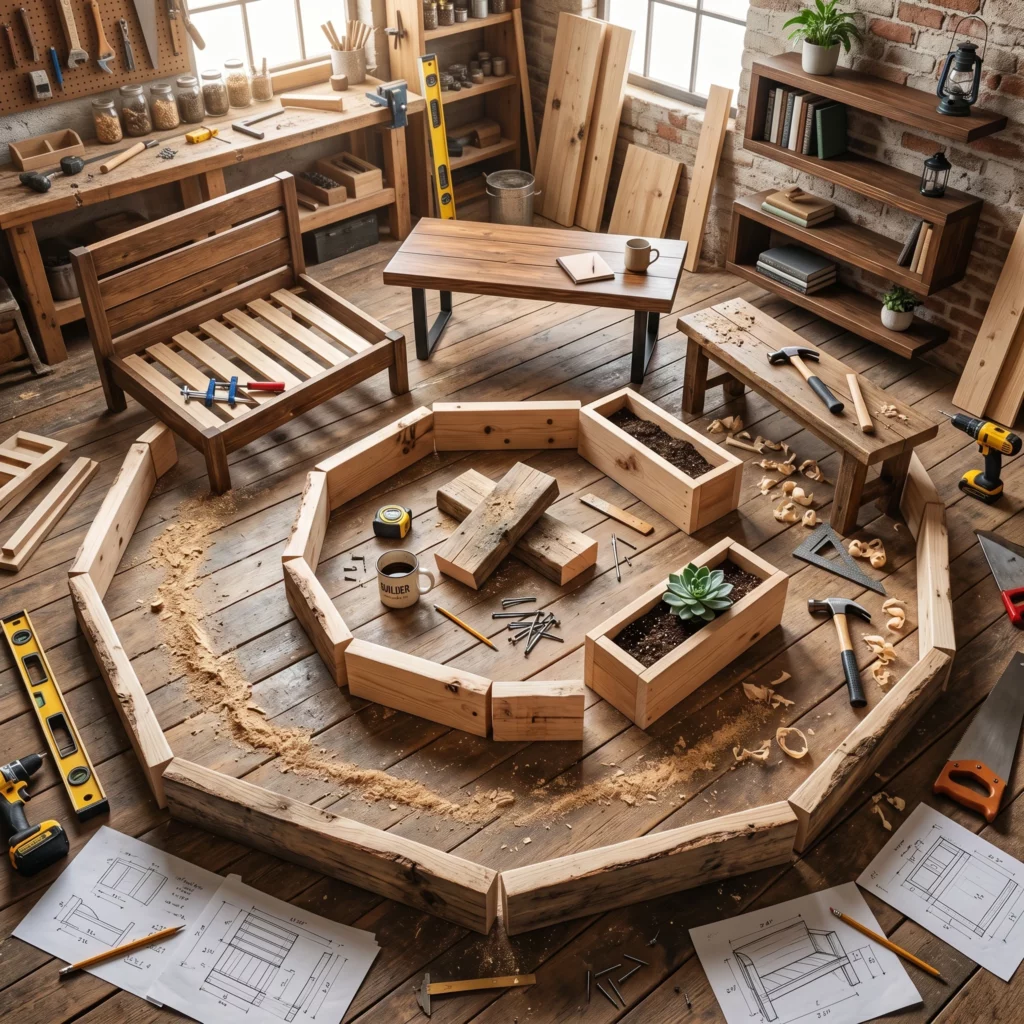
All of them are beginner-friendly.
And every single one teaches a skill you’ll carry into the next build.
1. Simple Outdoor Bench
This is where a lot of people fall in love with woodworking.
A bench is simple enough to finish quickly, but substantial enough to feel real when it’s done.
You sit on it afterward and think:
I made this.
That feeling hits hard.
What You’ll Learn
- Structural balance
- Basic assembly
- Screw placement
- Measuring parallel pieces
Estimated Build Time
2–3 hours
2. Rustic Planter Box
If confidence could be built in an afternoon, it would probably look like this project.
Planter boxes are forgiving. Tiny imperfections disappear into the rustic style naturally.
Perfect For
- Herb gardens
- Front porches
- Patios
- Backyard décor
Beginner Win
Even rough cuts still look intentional.
3. Garage Storage Shelves
This project changes your space immediately.
And that immediate payoff matters psychologically.
You stop seeing woodworking as decoration and start seeing it as capability.
Skills You’ll Practice
- Leveling
- Weight distribution
- Wall anchoring
- Stud placement
4. Sawhorses
Nobody gets excited about building sawhorses… until they own them.
Then suddenly every future project becomes easier.
Why They Matter
They teach:
- Stability geometry
- Angled cuts
- Fast assembly
And they quietly become the foundation of your workshop.
5. Basic Coffee Table
This is usually the first project that feels like “real furniture.”
Not utility furniture.
Living-room furniture.
Beginner Skills Introduced
- Tabletop alignment
- Surface sanding
- Symmetrical construction
Best Finish for Beginners
Dark walnut stain hides imperfections beautifully.
6. Entryway Shoe Rack
A small project with surprisingly high emotional payoff.
Because clutter disappears instantly.
Why Beginners Love This Build
Minimal cuts.
Simple structure.
Useful every day.
That combination keeps people motivated.
7. Farmhouse Bench
There’s something timeless about farmhouse furniture.
Warm wood. Thick lines. Simple construction.
It feels approachable in a way modern furniture sometimes doesn’t.
Skills You’ll Learn
- Cross bracing
- Reinforcement
- Surface finishing
8. Raised Garden Bed
This project taps into two things people deeply crave right now:
- Self-sufficiency
- Outdoor living
And it’s incredibly beginner-friendly.
Best Use Cases
- Vegetables
- Herbs
- Flowers
- Compact backyard gardens
9. Wooden Blanket Ladder
One of the easiest projects in this entire guide.
And somehow still one of the most visually satisfying.
Why It Works So Well
The minimalist design hides beginner mistakes naturally.
Straight lines. Clean spacing. Soft wood grain.
Simple sells.
10. DIY Workbench
This project changes the psychology of woodworking completely.
Before a workbench, projects feel temporary.
Afterward, woodworking starts feeling like part of your life.
Core Skills
- Structural framing
- Reinforced support
- Workspace planning
11. Outdoor Side Table
Fast. Cheap. Useful.
Three things beginners desperately need from early projects.
Estimated Cost
Usually under $25
Best Beginner Feature
Almost no complicated joinery required.
12. Wall-Mounted Tool Rack
Organization doesn’t sound exciting.
Until your tools stop disappearing.
Skills Introduced
- Wall anchoring
- Measuring consistency
- Functional layout design
13. Simple TV Stand
This is where projects begin looking expensive.
What You’ll Learn
- Shelf spacing
- Weight-bearing structure
- Furniture proportions
Style Upgrade
Black pipe accents instantly create an industrial-modern look.
14. DIY Bar Cart
There’s something psychologically satisfying about building something stylish.
Not just useful. Stylish.
Why This Project Builds Confidence Fast
It looks far more difficult than it actually is.
15. Modern Console Table
Minimalist furniture is secretly beginner-friendly.
Straight cuts. Clean lines. Less visual clutter.
Why It Works
Simple design makes imperfections less noticeable.
16. Folding Work Table
Perfect for garages, apartments, or compact workshops.
Skills You’ll Learn
- Hinges
- Folding mechanisms
- Space-saving construction
17. Adirondack Chair (Simplified)
This project introduces curves without overwhelming complexity.
Skills Developed
- Comfort angles
- Outdoor finishing
- Ergonomic shaping
18. DIY Headboard
A dramatic visual upgrade with surprisingly simple construction.
Why People Love This Build
Bedrooms feel deeply personal.
Building furniture for that space creates emotional attachment fast.
19. Rustic Bookshelf
Bookshelves remain one of the most searched beginner woodworking projects online for a reason.
They combine:
- Utility
- Style
- Simplicity
And they instantly make a room feel warmer.
20. Outdoor Sofa Frame
This one looks intimidating.
It isn’t.
What You’ll Learn
- Cushion sizing
- Modular framing
- Outdoor durability techniques
Emotional Payoff
Massive.
Patios stop feeling empty after this build.
21. Picnic Table
A classic woodworking milestone.
Skills Introduced
- Long-span support
- Outdoor reinforcement
- Multi-person structural stability
22. DIY Bed Frame
This project hits differently.
Sleeping on something you built yourself changes the relationship between craftsmanship and daily life.
Core Skills
- Large-frame assembly
- Weight distribution
- Precision alignment
23. Entryway Coat Rack
Quick build. Constant use.
Why It’s Great for Beginners
Minimal cuts.
Minimal stress.
Maximum usefulness.
24. Kids’ Toy Storage Bin
Parents tend to connect with this project emotionally almost immediately.
Because it’s not just furniture anymore.
It’s care.
Skills Learned
- Hinged lids
- Box construction
- Sanding safety for children’s furniture
25. Mobile Lumber Cart
This is when your workshop starts feeling organized instead of chaotic.
Skills Introduced
- Wheel installation
- Vertical storage
- Weight management
26. Patio Chair
A surprisingly rewarding project.
You begin thinking beyond utility and into comfort, posture, and human use.
That shift matters.
27. Beginner Platform Bed
This is the project that flips a switch for a lot of people.
Because once you build a bed frame, you stop feeling like a beginner.
Advanced Beginner Skills
- Large-scale assembly
- Structural support systems
- Precision alignment
And when it’s finished, the emotional payoff is enormous.
How to Make Cheap 2×4 Furniture Look Surprisingly Expensive
This is where projects stop looking homemade and start looking intentional.
Sanding Is Half the Battle
Most beginner builds fail visually because the surface prep gets rushed.
Slow down here.
Sanding Progression That Actually Works
- 80 grit
- 120 grit
- 220 grit
Smooth wood changes everything.
Use Wood Conditioner Before Staining Pine
Pine absorbs stain unevenly.
Without conditioner, blotches appear fast.
Why This Matters
A cheap board with a beautiful finish looks premium.
An expensive board with a bad finish still looks unfinished.
Hide Screws Whenever Possible
Cleaner surfaces instantly elevate furniture quality.
Beginner-Friendly Methods
- Pocket holes
- Countersinking
- Wood plugs
Small details create expensive-looking results.
The Beginner Mistakes Almost Everyone Makes
And honestly? Most people need to make them once before the lesson sticks.
Skipping Pre-Drilling
Wood splits. Joints weaken. Frustration rises.
Take the extra minute.
Buying Warped Lumber
Crooked boards turn easy projects into confusing ones.
Most beginners blame themselves when the wood was the problem all along.
Rushing Through the Finish
Finishing is where average projects become beautiful projects.
This part deserves patience.
Measuring Too Casually
Every experienced woodworker eventually develops the same habit:
checking measurements twice before cutting once.
Usually after learning the hard way.
Questions Beginners Quietly Ask Before Starting
“What’s the easiest 2×4 project if I’ve never built anything before?”
Planter boxes, simple benches, and garage shelves are usually the best starting point. They require minimal cuts, basic tools, and forgiving assembly.
“Can regular construction lumber actually look good indoors?”
Absolutely.
With sanding, stain, and clean assembly, 2×4 lumber can become beautiful furniture with rustic, farmhouse, industrial, or modern aesthetics.
“Do I need expensive woodworking tools to get started?”
No.
A circular saw, drill, measuring tape, and sander are enough for most beginner woodworking projects.
People often overestimate the equipment and underestimate consistency.
“How long do these projects realistically take?”
Many can be finished in a single afternoon.
Others take a full weekend if you include sanding and finishing.
The important thing isn’t speed—it’s completion.
Finished projects build momentum.
“Is woodworking actually difficult to learn?”
It feels intimidating before you start.
Then something strange happens.
You build one small thing successfully, and your brain begins rewriting what you believe you’re capable of.
That’s usually the real beginning.
Products / Tools / Resources
If you’re just getting started, these are the tools and resources that genuinely make beginner woodworking easier—not more complicated.
Recommended Beginner Tools
- Circular saw
- Cordless drill/driver
- Random orbital sander
- Speed square
- Bar clamps
- Pocket-hole jig
- Safety glasses
- Hearing protection
Best Materials for Beginner 2×4 Projects
- Kiln-dried pine 2x4s
- Exterior wood screws
- Wood glue
- Walnut stain
- Matte polyurethane
- Sandpaper packs (80/120/220 grit)
Helpful Project Add-Ons
- Locking caster wheels
- Soft-close hinges
- Felt furniture pads
- Outdoor weather sealant
- Heavy-duty shelf brackets
Smart Beginner Resources
- Printable cut-list templates
- Stud finder guides
- Wood stain comparison charts
- Furniture dimension calculators
- Beginner woodworking YouTube channels
- DIY garage workshop layouts
Projects Worth Building After These
Once these 27 beginner 2×4 woodworking plans start feeling comfortable, most people naturally move toward:
- Farmhouse dining tables
- Outdoor sectional sofas
- Built-in shelving
- Hardwood furniture
- Workshop cabinets
- Custom storage systems
- Live-edge woodworking
- Fine furniture joinery
That’s usually how it happens.
One weekend project turns into another.
Then another.
And before long, a stack of ordinary 2x4s becomes the start of a completely different relationship with making things by hand.