
Most people think woodworking begins with tools.
A table saw. A shiny drill. Maybe a wall lined with clamps they saw on YouTube.
But spend enough time around experienced woodworkers and you notice something different. The smartest builders obsess over the bench first. Not because it looks impressive—but because every good project quietly depends on it.
A bad workbench slows you down before you even realize it’s happening.
You lose screws. You stack tools where they don’t belong. Your clamps disappear under scrap plywood. The surface flexes while you’re trying to cut precisely. Suddenly a “simple weekend project” turns into an exhausting mess of backtracking, frustration, and wasted motion.
A well-designed woodworking bench with storage changes the emotional texture of the entire workshop.
Everything feels calmer. Faster. More deliberate.
And once you experience that shift, it’s hard to go back.
The plans below aren’t just random DIY builds pulled from forums. They solve real workshop problems—tight garage layouts, limited budgets, cluttered tool collections, awkward corners, shared parking spaces, and growing storage demands. Some are rugged and simple. Others are polished enough to stay with you for decades.
All of them are designed around one idea:
A workbench should make woodworking feel easier than it did yesterday.
Why a Workbench With Storage Matters More Than Most Beginners Realize
There’s a moment every woodworker reaches eventually.
Usually it happens halfway through a project.
You’re looking for a measuring tape that was literally in your hand thirty seconds ago. There’s sawdust everywhere. Your drill battery is dead. The bench is crowded with scraps you meant to throw away an hour ago.
And suddenly you’re not building anymore.
You’re managing chaos.
That’s the hidden cost of poor workshop organization. It drains focus. Quietly. Constantly.
Professionals understand this early. That’s why the best woodworking bench plans with storage aren’t just built for holding wood—they’re built for reducing friction.
Good storage changes how you move through the shop:
- tools stay visible
- clamps stay reachable
- batteries stay charged
- hardware stays sorted
- surfaces stay usable
The result isn’t just efficiency.
It’s momentum.
And momentum is what keeps projects alive.
The Anatomy of a Truly Great Woodworking Bench
Not every bench deserves the space it takes up.
Some look impressive online but become frustrating in real-world workshops. Others seem simple at first glance yet perform beautifully for years because the proportions, materials, and storage systems were designed intelligently.
Before choosing from these free woodworking bench plans, it helps to understand what separates a good bench from one you’ll eventually regret building.
Height Changes Everything
Bench height affects almost every movement your body makes.
Too high and your shoulders tense while sanding.
Too low and your lower back starts talking to you halfway through a glue-up.
Most woodworking benches land somewhere around:
- 34–36 inches for general work
- slightly lower for hand-tool woodworking
- slightly higher for detailed assembly work
There’s no perfect universal height. The best bench feels natural enough that you stop thinking about it.
The Best Materials Aren’t Always the Most Expensive
There’s a myth beginners hear constantly:
“If it’s not hardwood, it isn’t worth building.”
That’s nonsense.
Some of the most functional garage workbenches are built from plywood and construction lumber. What matters is stability, rigidity, and thoughtful design.
Still, each material changes the personality of the bench.
| Material | Why People Use It | Trade-Off |
|---|---|---|
| Plywood | Affordable and stable | Edge wear over time |
| MDF | Extremely flat work surface | Heavy and moisture-sensitive |
| Maple | Durable and premium | Expensive |
| Pine / 2×4 lumber | Cheap and accessible | Softer surface |
| Oak | Strong and long-lasting | Heavy and costly |
A beginner bench made well from plywood will outperform a poorly designed hardwood bench every single day.
Storage Isn’t About “More Space”
It’s about mental clarity.
The best storage systems reduce tiny interruptions before they happen.
That means:
- shallow drawers for layout tools
- deeper drawers for drills and routers
- open shelves for fast access
- pegboards for visibility
- French cleat walls for flexibility
- clamp racks near assembly areas
- charging stations hidden beneath the top
A smart bench doesn’t just store tools.
It removes excuses.
17 Free Woodworking Bench Plans With Storage Worth Building
Some benches are built for precision. Others are built for flexibility. A few are designed purely to survive years of abuse in crowded garages.
The trick is choosing the one that fits the way you actually work—not the fantasy version of your workshop you imagine at 2 a.m. while watching woodworking videos.
1. The Beginner 2×4 Garage Workbench
This is where many woodworkers start.
And honestly? It’s still one of the smartest builds for small garages.
Simple framing lumber. Basic cuts. Strong enough to handle serious projects.
Why It Works So Well
- inexpensive materials
- forgiving construction
- sturdy structure
- easy to customize later
Storage Features
Most versions include:
- lower shelving
- side tool hooks
- open storage bays
Nothing fancy. Just functional.
And sometimes functional is exactly what you need.
2. Mobile Workbench With Locking Casters
A fixed bench sounds great until you need to park your car.
That’s why rolling workbenches have exploded in popularity.
A mobile bench transforms a cramped garage into a flexible workspace that adapts throughout the day.
Why Professionals Love Them
Mobility creates options:
- easier cleanup
- movable assembly space
- better lighting angles
- temporary expansion zones
Important Upgrade
Cheap casters ruin otherwise excellent benches.
Heavy-duty locking casters with proper bracing make all the difference.
3. Fold-Down Wall-Mounted Workbench
Tiny workshop?
This one changes the game.
Wall-mounted folding benches disappear when you’re done working, making them ideal for:
- apartments
- sheds
- tight garages
- multipurpose rooms
Smart Storage Additions
Pair the bench with:
- pegboard backing
- magnetic strips
- folding shelves
- compact clamp storage
The wall becomes part of the workstation itself.
4. Heavy-Duty Cabinetmaker’s Bench
This is the bench people dream about.
Thick hardwood top. Serious weight. Traditional joinery. Storage cabinets underneath. The kind of bench that feels planted to the floor like it grew there.
Why Weight Matters
Heavy benches absorb vibration.
That means:
- cleaner cuts
- steadier planing
- more precise joinery
- less movement under pressure
Professionals don’t chase mass because it looks impressive.
They chase it because precision depends on it.
5. Miter Saw Workbench With Storage Wings
This design quietly saves hours.
Long support wings make repetitive cuts dramatically easier while built-in drawers keep accessories close by.
Ideal Storage Layout
- tape measures
- stop blocks
- fasteners
- saw blades
- hearing protection
Everything stays within reach instead of buried in random bins.
6. Rolling Assembly Table With Drawers
Assembly tables become the center of the workshop surprisingly fast.
One day it’s a glue-up station. The next day it’s holding cabinet parts, drying finishes, or acting as outfeed support for your table saw.
Why Drawers Matter Here
Shallow drawers near assembly space reduce interruptions during builds.
You stop walking across the shop every five minutes.
And that rhythm shift changes everything.
7. Hybrid Workbench + Table Saw Outfeed Station
This is one of the smartest space-saving woodworking bench plans available today.
One footprint. Multiple functions.
Common Features
- outfeed support
- storage drawers
- assembly surface
- tool organization
- dust collection integration
For small workshops, multifunctional furniture isn’t optional anymore.
It’s survival.
8. Rustic Hardwood Workbench With Open Shelving
Some benches feel useful.
Others feel permanent.
A hardwood bench with exposed shelving carries a different emotional weight. It becomes part workshop tool, part furniture, part personal landmark.
Why People Love This Style
It combines:
- craftsmanship
- durability
- warmth
- visual character
A beautiful workspace changes how often you want to use it.
That matters more than people admit.
Learn more: The Ultimate Solid Hardwood Woodworking Bench Guide: How to Choose or Build a Lifetime Workbench
9. Compact Corner Workbench
Corners become dead space in most garages.
This design fixes that.
Why It Works
The triangular footprint opens movement paths while still providing:
- usable storage
- tool access
- workable surface area
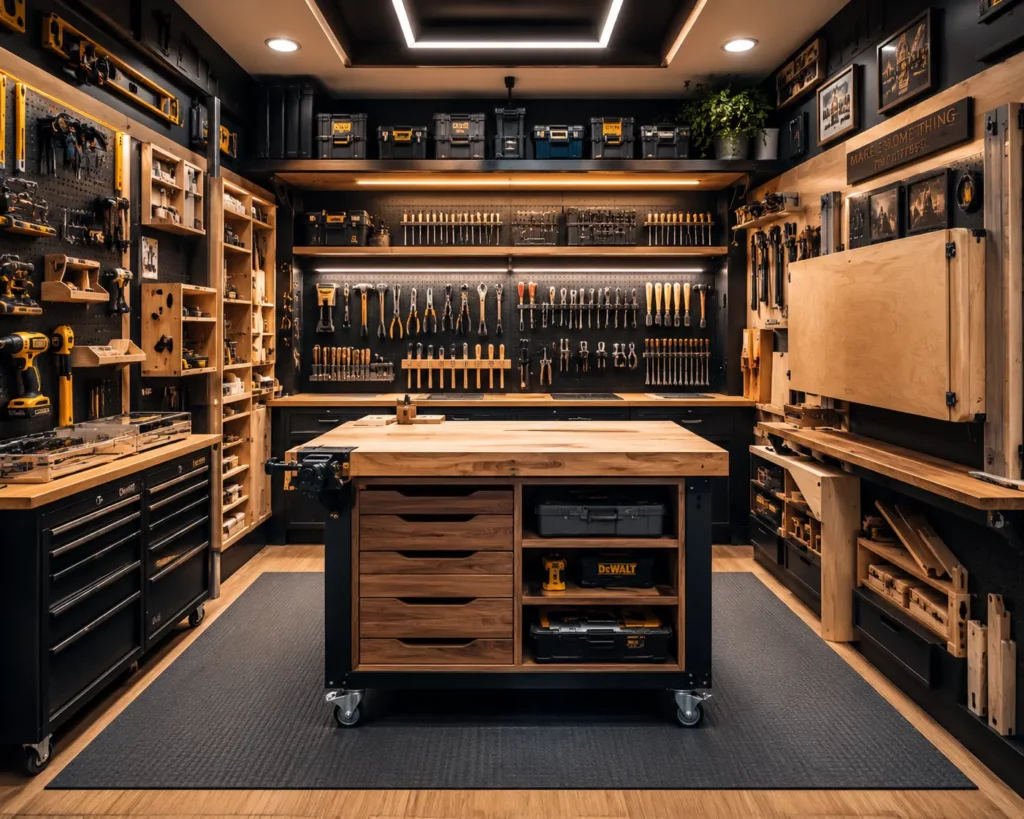
Add vertical storage above the bench and suddenly an ignored corner becomes highly productive space.
10. Modular Workbench With Replaceable Top
Eventually every bench top gets damaged.
Glue stains. Saw cuts. Burn marks. Dents.
Modular tops solve that problem elegantly.
Best Surface Options
- MDF sacrificial layers
- laminated plywood
- replaceable hardboard panels
Instead of rebuilding the entire bench, you simply refresh the working surface.
11. Foldable Jobsite Workbench
Designed for movement.
These benches prioritize portability without becoming flimsy.
Ideal For
- contractors
- outdoor builders
- temporary workspaces
- mobile repair work
Integrated clamp tracks make these surprisingly capable despite their size.
12. Workbench With Built-In Clamp Storage
Every experienced woodworker eventually develops a clamp addiction.
Then comes the problem:
where do they all go?
Why Integrated Clamp Racks Matter
They:
- reduce clutter
- speed up glue-ups
- prevent damage
- improve organization
And when clamps become easier to grab, projects become easier to start.
13. Pegboard-Back Workstation Bench
There’s something psychologically satisfying about visible tools.
Your brain relaxes when everything has a place.
Why Pegboards Still Work
Because visibility matters.
You instantly see:
- what’s missing
- what’s available
- what needs putting away
That reduces mental friction before work even begins.
14. Drawer-Based Storage Workbench
Drawers create calm.
Not glamorous calm. Practical calm.
The kind that comes from knowing exactly where your chisels, squares, drill bits, and marking knives live.
Smart Drawer Strategy
- shallow top drawers for precision tools
- deep lower drawers for power tools
- divided sections for hardware
The workshop starts feeling intentional instead of improvised.
15. French Cleat Storage Workbench System
French cleats are addictive once you use them.
The entire storage system evolves with your workshop instead of locking you into one permanent layout.
Why Advanced Woodworkers Prefer Them
- endlessly modular
- easy to rearrange
- scalable over time
- ideal for growing tool collections
It’s one of the few organization systems that actually adapts as your skills improve.
16. Torsion-Box Workbench
Flatness matters more than beginners expect.
Especially for cabinetry and large assemblies.
Why Torsion Boxes Are So Effective
They create exceptional rigidity without excessive weight.
Perfect for:
- cabinetmaking
- precision glue-ups
- large sheet goods
- assembly work
The surface stays remarkably stable over time.
17. The Ultimate Garage Workshop Bench System
This is less “bench” and more ecosystem.
Integrated cabinets. Charging stations. Lighting. Rolling storage carts. Dust collection. Dedicated power access.
Everything connected. Everything intentional.
What Makes It Different
It’s designed around workflow psychology.
Every tool has a destination.
Every movement has a purpose.
Every interruption gets reduced.
At a certain point, the bench stops being furniture.
It becomes infrastructure.
The Mistakes That Quietly Ruin Most DIY Workbenches
Not immediately.
That’s the dangerous part.
The flaws reveal themselves slowly over months of frustration.
Building the Bench Too Deep
Deep benches seem useful until tools start disappearing into unreachable corners.
For most people:
- 24 inches is comfortable
- 30 inches is generous
Anything beyond that often creates wasted space.
Ignoring Mobility Completely
Even permanent workshops benefit from movement.
Casters create flexibility:
- easier cleaning
- layout changes
- temporary expansion
- better workflow adjustments
Fixed benches aren’t automatically superior.
Choosing Appearance Over Stability
A beautiful bench that flexes under pressure becomes irritating fast.
Rigidity matters more than aesthetics.
Always.
Underestimating Future Storage Needs
Your workshop grows faster than you think.
Tools multiply quietly.
Build extra storage now:
- more drawers
- more shelves
- more wall organization
You will use it.
The Small Storage Upgrades That Make Workshops Feel Professional
The biggest improvements are rarely dramatic.
Usually they’re subtle.
Integrated Power Strips
Simple upgrade. Huge impact.
No more tangled extension cords hanging across the floor.
Hidden Charging Stations
Cordless tool batteries spread everywhere if you let them.
Dedicated charging drawers create instant visual order.
Dust Collection Compartments
Fine dust changes how a workshop feels.
Integrated collection systems improve:
- air quality
- cleanup
- visibility
- tool lifespan
A cleaner shop quietly becomes a more inviting shop.
Under-Shelf LED Lighting
Once you add task lighting beneath shelves and cabinets, you’ll wonder why you waited so long.
It improves:
- visibility
- organization
- nighttime workflow
- precision tasks
Tiny detail. Massive usability upgrade.
Choosing the Right Workbench for the Way You Actually Work
Not the workshop you fantasize about.
The one you genuinely use.
That distinction matters.
Ask yourself:
- Do you mostly build furniture?
- Need mobility?
- Share garage space with vehicles?
- Use hand tools heavily?
- Need large assembly surfaces?
- Work in tight quarters?
The best woodworking bench plans solve your specific constraints.
Not someone else’s.
Learn more: DIY Woodworking Bench Plans with Exact Dimensions: Professional Plans Anyone Can Build in One Weekend
The Questions Most People Are Really Asking
“Do I actually need hardwood for a good workbench?”
No.
Hardwood is wonderful, but stability and design matter more. Plenty of excellent benches are built from plywood and construction lumber.
A smart layout beats expensive material every time.
“Why does every workbench eventually feel too small?”
Because workshops evolve.
Projects get bigger. Tool collections expand. Storage fills up faster than expected.
That’s why modular systems and vertical organization matter so much.
“Is a mobile workbench less stable?”
Not if it’s built correctly.
Heavy-duty locking casters combined with strong bracing can create extremely solid benches while still allowing movement when needed.
“What’s the biggest mistake beginners regret later?”
Building without enough storage.
Almost everyone wishes they added more drawers, shelves, and organization from the start.
“Can I build a serious bench on a tight budget?”
Absolutely.
Some of the best beginner woodworking bench plans with storage use:
- plywood
- 2×4 lumber
- basic screws
- affordable hardware
Good design scales far further than expensive materials.
Products / Tools / Resources
Essential Tools for Building a Workbench
- Circular saw
- Cordless drill/driver
- Pocket hole jig
- Bar clamps
- Speed square
- Orbital sander
- Tape measure
- Carpenter’s level
Recommended Materials
- 3/4″ plywood sheets
- MDF sacrificial top panels
- 2×4 framing lumber
- Hardwood edging strips
- Heavy-duty locking casters
- Drawer slides
- Construction screws
- Wood glue
Smart Storage Add-Ons
- French cleat wall kits
- Magnetic tool holders
- Under-bench power strips
- Battery charging stations
- Pegboard systems
- Clamp racks
- Rolling storage bins
- LED task lighting
Helpful Workshop Upgrades
- Dust collection shop vac
- Air filtration system
- Adjustable shop stool
- Anti-fatigue floor mats
- Foldable outfeed supports
- Modular wall cabinets