
Part 1: Why Most Beginners Never Make It Past Their First Project
There’s a moment almost every aspiring woodworker experiences.
It usually happens before a single board is cut.
Before the first shelf is built. Before the first screw bites into wood. Before sawdust settles across a workbench.
It happens while staring at a screen.
One video recommends a table saw.
Another insists a router is essential.
A third claims you need thousands of dollars’ worth of woodworking tools before you can build anything worth keeping.
And just like that, excitement quietly turns into hesitation.
The irony is difficult to ignore.
Woodworking is one of the oldest hands-on skills in human history, yet modern beginners often feel less prepared to start than ever before.
Not because the craft is complicated.
Because the information is.
The truth is surprisingly simple.
You do not need a professional workshop to become a woodworker.
You need a handful of reliable tools, a willingness to make imperfect things, and enough momentum to finish what you start.
Everything else comes later.
And that’s exactly where this guide begins.
The Most Expensive Mistake New Woodworkers Make
When people search for the best woodworking tools for beginners, they’re usually looking for equipment.
What they’re actually searching for is certainty.
They want reassurance that they’re buying the right tools.
That they aren’t wasting money.
That they won’t discover six months from now that they should have purchased something completely different.
It’s understandable.
Tools are tangible.
Skills are not.
Buying a new drill feels productive.
Learning to measure accurately feels slow.
One gives an immediate dopamine hit.
The other builds long-term capability.
Most beginners accidentally chase the first feeling.
Experienced woodworkers chase the second.
That’s why many garages end up filled with expensive tools that rarely get used.
The workshop grows.
The skill level doesn’t.
Meanwhile, the person working with a modest set of tools keeps building project after project, accumulating something far more valuable than equipment:
Experience.
Every successful woodworking project teaches lessons no tool can provide.
How wood moves.
How measurements compound.
How small mistakes become large ones.
How patience affects results.
How craftsmanship is often hidden inside details nobody notices at first glance.
These lessons cannot be purchased.
They can only be earned.
Why a Smaller Tool Collection Often Creates Better Woodworkers
This sounds counterintuitive.
Most people assume more tools create more capability.
In reality, the opposite is often true.
Limitations force learning.
When you own twenty specialized tools, it’s easy to depend on equipment to solve problems.
When you own five or six carefully chosen essentials, you learn to understand materials, techniques, and process.
You become resourceful.
Creative.
Observant.
The same principle appears everywhere.
Great photographers don’t begin with massive collections of lenses.
Chefs don’t become experts because they own every kitchen gadget.
Musicians don’t master an instrument because they purchased more gear.
Woodworking follows the same pattern.
Mastery grows from repetition.
Not accumulation.
That’s why the toolkit you’ll discover in this guide is intentionally minimal.
Not because these are the cheapest woodworking tools.
Not because they’re the simplest.
Because they create the highest learning return for every dollar spent.
The Beginner Woodworking Toolkit That Actually Gets Projects Finished
The goal isn’t building the ultimate workshop.
The goal is building your first ten projects.
That distinction changes everything.
Once you focus on completed projects instead of endless tool acquisition, priorities become remarkably clear.
You need tools that accomplish five fundamental tasks:
- Measuring
- Marking
- Cutting
- Joining
- Finishing
Every woodworking project—from a simple storage crate to a handmade coffee table—depends on those five functions.
Everything else is enhancement.
Useful enhancement, certainly.
But enhancement nonetheless.
The beginner woodworker who understands this gains an enormous advantage.
Instead of asking:
“What tool should I buy next?”
They start asking:
“What problem am I trying to solve?”
That single shift in thinking often saves hundreds, sometimes thousands, of dollars.
More importantly, it accelerates learning.
Because the focus returns to craftsmanship.
Not consumption.
Tool #1: Tape Measure — The Tool That Decides Whether Everything Else Works
A woodworking project rarely fails because someone lacked a sophisticated saw.
It fails because measurements were wrong.
One sixteenth of an inch seems insignificant.
Until it appears four times across a project.
Then it becomes impossible to ignore.
Suddenly shelves don’t fit.
Joints don’t align.
Edges drift.
Frustration arrives.
This is why experienced woodworkers develop an almost obsessive respect for measurement.
A tape measure isn’t simply a measuring device.
It’s the foundation beneath every cut, every assembly, and every finished piece.
What Makes a Good Tape Measure?
For beginners, simplicity wins.
Look for:
- A durable housing
- Clear measurement markings
- Reliable blade lock
- Comfortable grip
- Length between 16 and 25 feet
The goal isn’t finding the most expensive option.
The goal is finding one you’ll trust every time you reach for it.
Trust matters.
Because woodworking is ultimately a game of consistency.
Skills You’ll Develop With a Tape Measure
At first glance, measuring seems obvious.
Yet accurate measurement is one of the defining characteristics separating beginners from experienced builders.
Over time you’ll learn:
- Material planning
- Cut optimization
- Dimensional consistency
- Error prevention
- Layout accuracy
Those skills compound across every future project.
The remarkable thing is that most people don’t notice the improvement happening.
They simply notice their projects fitting together more cleanly.
Less force.
Less correction.
Less frustration.
More flow.
And that’s usually the first sign real progress has begun.
Tool #2: Combination Square — The Quiet Hero of Precision
If there is one tool that consistently surprises new woodworkers, it’s the combination square.
It doesn’t make dramatic cuts.
It doesn’t make noise.
Nobody creates viral workshop videos about it.
Yet few tools have a greater impact on project quality.
Because most woodworking mistakes aren’t cutting mistakes.
They’re marking mistakes.
A saw can only follow the line you provide.
If the line is wrong, the cut is wrong before it even begins.
That’s where a combination square earns its place.
What Does a Combination Square Actually Do?
More than most beginners realize.
It helps you:
- Mark perfectly straight lines
- Check 90-degree corners
- Verify assembly alignment
- Measure depth
- Transfer dimensions accurately
In practical terms, it serves as a quality-control system for your entire workflow.
A few seconds spent checking alignment often prevents hours spent correcting mistakes later.
And unlike many tools that eventually become less important as your workshop grows, the combination square becomes more valuable over time.
Professionals reach for it just as often as beginners do.
Which tells you everything you need to know about its importance.
Why Precision Feels Different Than You Expect
Most people imagine precision as perfection.
Woodworking teaches a different lesson.
Precision isn’t about making everything flawless.
It’s about making everything predictable.
Predictable cuts.
Predictable joints.
Predictable outcomes.
That’s what builds confidence.
And confidence is what transforms woodworking from an intimidating skill into an enjoyable one.
The combination square quietly accelerates that transformation every single time you use it.
Part 2 will continue with the first power tools every beginner should own, why a cordless drill and jigsaw outperform many expensive workshop purchases, and how to build real projects before buying a table saw.
Part 2: The Power Tools That Actually Move You Forward
There’s a fascinating point in every beginner’s journey where hand tools stop feeling like enough.
Not because they’re inadequate.
Because your imagination begins to outrun your capabilities.
You start seeing possibilities everywhere.
A floating shelf in the hallway.
A storage bench near the front door.
A coffee table you’ve been meaning to replace for years.
Suddenly, woodworking isn’t an abstract hobby anymore.
It’s becoming practical.
Personal.
Useful.
And that’s usually when people start researching power tools.
Unfortunately, it’s also when marketing becomes loudest.
Every manufacturer promises faster cuts, cleaner results, and professional-level precision. Every advertisement suggests you’re one purchase away from becoming dramatically more capable.
But capability doesn’t arrive in cardboard boxes.
It arrives through repetition.
The right power tools simply make that repetition easier.
For most beginners, two tools unlock more project potential than almost anything else: a cordless drill and a jigsaw.
Not because they’re glamorous.
Because they solve real problems repeatedly.
And that’s what makes them indispensable.
Tool #3: Cordless Drill/Driver — The Most Useful Tool You’ll Ever Own
If your entire workshop disappeared tomorrow and you could save only one power tool, a cordless drill would probably be the smartest choice.
That statement surprises people.
Many expect a saw to take the top position.
But woodworking involves far more assembly than cutting.
Boards need fastening.
Hardware needs installation.
Pilot holes need drilling.
Projects need construction.
A cordless drill sits at the center of all of it.
In many ways, it’s the bridge between raw materials and finished projects.
Without it, progress slows dramatically.
With it, entire categories of woodworking become accessible.
Why Beginners Outgrow Basic Hand Tools So Quickly
Imagine building a simple bookshelf.
You can measure with a tape measure.
Mark with a combination square.
Cut pieces using basic tools.
But eventually those pieces need to become a structure.
That’s where the drill enters the story.
A good cordless drill allows you to:
- Drill pilot holes
- Drive screws
- Install hardware
- Build jigs
- Assemble furniture
- Secure brackets and supports
The versatility is difficult to overstate.
One moment you’re building a storage crate.
The next you’re mounting shelves to a wall.
The same tool handles both tasks effortlessly.
Few woodworking tools offer that level of flexibility.
Features Worth Looking For
Beginners often assume more power equals better performance.
Not necessarily.
Balance matters more.
Look for:
- Variable speed control
- Adjustable clutch settings
- Lithium-ion battery system
- Comfortable grip
- 18V or 20V platform
A drill that feels comfortable in your hands will be used more often.
And the tool you actually use is always better than the one with the longest specification sheet.
The Hidden Skill a Drill Teaches
Most people think drills teach drilling.
They don’t.
They teach control.
Controlling pressure.
Controlling alignment.
Controlling speed.
Controlling patience.
Push too hard and wood can split.
Rush the process and screws wander.
Work carefully and assemblies tighten perfectly.
Those lessons transfer into every other aspect of woodworking.
And that’s why a cordless drill often becomes a beginner’s most valuable teacher.
Tool #4: Jigsaw — The Most Underrated Beginner Saw
Ask a group of beginners what saw they think they need first.
Most will answer:
“A table saw.”
It’s an understandable assumption.
Table saws dominate woodworking content.
They’re large.
Powerful.
Impressive.
They look like the centerpiece of a serious workshop.
What most beginners don’t realize is that many successful projects never require one.
In fact, a jigsaw often provides significantly more value during the early stages of learning.
Because woodworking isn’t just about straight lines.
It’s about adaptability.
And few tools are more adaptable than a jigsaw.
Why a Jigsaw Earns Its Place in Every Beginner Workshop
A jigsaw performs tasks that would otherwise require multiple specialized tools.
With practice, it can:
- Cut straight lines
- Cut curves
- Create openings
- Trim shapes
- Handle plywood
- Work with dimensional lumber
This flexibility creates opportunities.
Opportunities to experiment.
Opportunities to solve problems.
Opportunities to build projects that don’t fit neatly into a single category.
For beginners, versatility matters more than specialization.
The more projects a tool can support, the faster your skills grow.
Learning Through Imperfect Cuts
Here’s something experienced woodworkers rarely discuss.
Your first cuts will not be perfect.
Neither were theirs.
The beauty of a jigsaw is that it teaches tool control in a forgiving way.
Every cut becomes feedback.
You learn how wood responds.
How blade pressure affects direction.
How speed changes accuracy.
How patience improves results.
These lessons cannot be absorbed through videos.
They must be felt.
And a jigsaw provides those learning experiences repeatedly without demanding a major financial investment.
Straight Cuts vs Curved Cuts: Why Both Matter
Many beginners focus exclusively on straight cuts.
That makes sense.
Furniture often relies on clean lines.
But curved cuts teach a different kind of craftsmanship.
They develop:
- Hand-eye coordination
- Tool awareness
- Material understanding
- Fine motor control
The result is a more complete woodworking foundation.
Instead of learning one type of cut exceptionally well, you begin understanding how cutting itself works.
That’s a subtle distinction.
Yet it dramatically accelerates skill development.
The Trap of Buying Tools Before You Need Them
At this point, many readers start wondering:
What about routers?
What about miter saws?
What about table saws?
The answer is simple.
Not yet.
This isn’t because those tools lack value.
Far from it.
Many eventually become essential.
The problem is timing.
Every workshop purchase should solve an existing problem.
Not an imagined future problem.
A beginner who buys a table saw before understanding measurement, layout, assembly, and finishing often discovers something surprising:
The expensive tool doesn’t improve the project.
Because the project wasn’t limited by equipment.
It was limited by experience.
That’s an important distinction.
And understanding it can save years of unnecessary spending.
When More Tools Actually Slow Progress
There’s a psychological effect that appears in almost every hobby.
Researchers sometimes refer to it as “productive procrastination.”
It feels like progress.
But it isn’t.
You spend hours researching tools.
Comparing specifications.
Watching reviews.
Building wish lists.
Planning future purchases.
Meanwhile, no projects get built.
No skills improve.
No mistakes create learning opportunities.
Everything remains theoretical.
Woodworking rewards action far more than preparation.
A simple project completed imperfectly teaches more than a hundred hours of tool research.
The challenge isn’t knowing this intellectually.
The challenge is acting on it.
Because buying tools feels safe.
Building something exposes uncertainty.
And uncertainty is where growth happens.
The Emerging Shape of a Real Workshop
At this stage, your beginner woodworking toolkit includes:
- Tape Measure
- Combination Square
- Cordless Drill
- Jigsaw
Four tools.
That’s all.
Yet something important has happened.
You can now:
- Measure accurately
- Mark precisely
- Cut materials
- Assemble projects
In other words, you’ve established the structural foundation of woodworking itself.
The remaining tools aren’t about creating capability.
They’re about improving quality, efficiency, and finish.
And that’s where the next phase becomes interesting.
Because the difference between a project that looks homemade and a project that looks handcrafted often comes down to what happens after the cutting is finished.
That’s where sanding, surface preparation, and work-holding begin to transform everything.
And that’s exactly where we’ll go next.
Part 3: The Tools That Make Beginner Projects Look Surprisingly Professional
Most people assume woodworking is won at the saw.
That’s what the videos focus on.
The dramatic cuts.
The flying sawdust.
The roar of machines transforming rough lumber into perfectly sized pieces.
It makes for great content.
But it misses an important truth.
The projects people admire most are rarely defined by how they were cut.
They’re defined by how they were finished.
Run your hand across a beautifully crafted table and you don’t immediately think about the saw blade.
You notice the surface.
The edges.
The smoothness.
The way every component seems intentional.
In other words, you notice the details.
And details are where many beginner projects either come alive—or quietly fall apart.
That’s why the next tools in your workshop aren’t focused on cutting more wood.
They’re focused on improving the wood you’ve already cut.
This is the stage where projects begin looking less “DIY” and more “crafted.”
And the difference is often far greater than most beginners expect.
Tool #5: Random Orbital Sander — The Tool That Changes Everything
There are few moments more frustrating than completing a project only to discover it still looks unfinished.
The dimensions are correct.
The assembly is solid.
Nothing is structurally wrong.
Yet something feels off.
Almost every beginner experiences this.
The culprit is usually surface preparation.
Woodworking has a way of exposing shortcuts.
A rough edge catches light differently.
Uneven sanding becomes obvious after stain is applied.
Tiny imperfections suddenly become impossible to ignore.
The random orbital sander exists to solve these problems.
And once you use one properly, it’s difficult to imagine working without it.
Why Sanding Matters More Than Most Beginners Realize
Wood communicates through touch.
Long before someone notices joinery or construction methods, they interact with the surface.
Their hand glides across it.
Their fingers find the edges.
Their eyes follow reflected light.
That interaction creates an impression.
Smooth surfaces feel intentional.
Rough surfaces feel unfinished.
The difference isn’t merely visual.
It’s emotional.
A well-sanded project feels complete.
A poorly sanded project feels almost complete.
And “almost” is where disappointment lives.
What a Random Orbital Sander Actually Does
Unlike basic sanding methods, a random orbital sander combines rotation and oscillation.
That movement helps eliminate visible sanding patterns while producing a more consistent finish.
For beginners, this means:
- Faster material removal
- Smoother surfaces
- Better stain absorption
- Improved paint adhesion
- More professional-looking results
The improvement is immediate.
Projects simply look better.
Not because you’re suddenly more talented.
Because surface quality improves dramatically.
Understanding Sandpaper Grits
Many beginners buy a sander and assume the tool does all the work.
In reality, sandpaper selection matters just as much.
Think of grit progression like refining a photograph.
Each stage removes imperfections left by the previous one.
Common Sandpaper Grits
80 Grit
- Removes rough surfaces
- Levels uneven material
- Aggressive shaping
120 Grit
- General-purpose smoothing
- Excellent starting point for many projects
180 Grit
- Fine preparation
- Common pre-finish grit
220 Grit
- Final smoothing
- Finish-ready surfaces
Learning how grits interact teaches patience.
And patience, more than almost anything else, improves woodworking outcomes.
Tool #6: Clamps — The Tool Everyone Wishes They Bought Sooner
Ask experienced woodworkers what they underestimated when they started.
The answer appears again and again.
Clamps.
Not saws.
Not routers.
Not specialty joinery systems.
Clamps.
It’s almost humorous until you begin building projects yourself.
Then it becomes obvious.
Wood has a habit of moving at exactly the wrong moment.
Boards shift.
Joints slide.
Corners drift.
Glue creates slipperiness where you desperately need stability.
Suddenly, an extra set of hands would be invaluable.
That’s essentially what clamps provide.
Reliable, tireless assistance.
Why Clamps Matter During Every Stage of a Project
Many beginners think clamps are only for glue-ups.
In reality, they’re useful almost constantly.
They help:
- Hold workpieces securely
- Maintain alignment
- Improve accuracy
- Reduce movement during assembly
- Increase safety while cutting and drilling
The more projects you build, the more frequently you reach for them.
Eventually, grabbing a clamp becomes as automatic as grabbing a measuring tape.
The Three Clamp Types Beginners Should Know
You don’t need dozens immediately.
A small collection goes a surprisingly long way.
Quick-Grip Clamps
Perfect for:
- Temporary holding
- Fast adjustments
- One-handed operation
Bar Clamps
Ideal for:
- Furniture assembly
- Larger glue-ups
- Maintaining pressure across longer surfaces
Spring Clamps
Useful for:
- Lightweight tasks
- Holding templates
- Securing small components
Together, these cover the vast majority of beginner woodworking projects.
The Strange Lesson Clamps Teach
At first, clamps seem like accessories.
Over time, you realize they’re teaching something deeper.
Control.
Woodworking isn’t merely shaping material.
It’s managing movement.
The more effectively you control movement, the more predictable your outcomes become.
And predictability is where craftsmanship begins.
Tool #7: Chisels — Where Precision Starts Feeling Personal
Power tools remove material quickly.
Chisels remove it thoughtfully.
There’s something fundamentally different about working with a sharp chisel.
The process slows down.
Attention sharpens.
Every movement becomes deliberate.
For beginners accustomed to measuring, drilling, and cutting, chisels introduce a new dimension of woodworking:
Refinement.
This is where projects stop being assembled and start being tuned.
Why Every Beginner Needs a Basic Chisel Set
Even in modern workshops filled with power tools, chisels remain indispensable.
Because no machine handles fine adjustments quite like a skilled hand.
Common uses include:
- Cleaning joints
- Trimming excess material
- Fine-tuning fitment
- Creating hardware recesses
- Refining edges
These aren’t glamorous tasks.
They’re important tasks.
And important tasks often determine whether a project feels average or exceptional.
The Three Chisel Sizes That Cover Most Beginner Needs
A massive collection isn’t necessary.
Start with:
- 1/4-inch chisel
- 1/2-inch chisel
- 3/4-inch chisel
These sizes provide versatility without overwhelming complexity.
More importantly, they encourage mastery.
A few well-used tools outperform a large collection of rarely used ones.
Every time.
Sharpness Changes Everything
One lesson surprises nearly every beginner.
Sharp tools are safer than dull tools.
A dull chisel requires force.
Force creates unpredictability.
Unpredictability creates mistakes.
Sharp tools cut cleanly and predictably.
They respond to intention rather than brute strength.
Understanding this principle often changes how people view woodworking entirely.
Precision isn’t about force.
It’s about control.
The Moment Projects Begin Looking Different
By now your toolkit includes:
- Tape Measure
- Combination Square
- Cordless Drill
- Jigsaw
- Random Orbital Sander
- Clamps
- Chisels
Notice what’s happening.
The toolkit is still remarkably small.
Yet your capabilities have expanded dramatically.
You can now:
- Measure accurately
- Mark precisely
- Cut confidently
- Assemble reliably
- Refine details
- Improve surface quality
Most beginner woodworking projects require nothing more.
In fact, many experienced woodworkers could build impressive furniture using exactly these tools.
The difference wouldn’t be equipment.
It would be experience.
And that’s encouraging.
Because experience can be earned immediately.
Not after another purchase.
Not after another upgrade.
Not after one more month of research.
Today.
With the tools already in front of you.
The final pieces of this toolkit aren’t about expanding what you can build.
They’re about creating a safer, more enjoyable environment for building it.
And as you’ll discover next, those tools are often the ones beginners overlook until they desperately need them.
Part 4: The Overlooked Tools That Quietly Determine Your Success
By this point, most beginners have a picture in their minds of what a workshop should look like.
Rows of tools hanging neatly on walls.
Large machines standing in formation.
Perfectly organized drawers.
An endless collection of accessories and attachments.
It’s a compelling image.
It’s also one of the reasons so many people delay getting started.
Because they mistake a finished workshop for a starting point.
What experienced woodworkers eventually learn is something far less glamorous:
Great projects are usually built in imperfect spaces.
Garages with limited room.
Basements with low ceilings.
Shared workshops.
Tiny backyard sheds.
Even apartment corners converted into temporary workstations.
The quality of your woodworking is rarely determined by the size of your workshop.
It’s determined by how effectively you use what you already have.
And that’s where the final pieces of this beginner toolkit become surprisingly important.
Not because they make dramatic improvements.
Because they remove friction.
They create stability.
Safety.
Consistency.
And those things compound over time.
Tool #8: Hammer — Simple, Reliable, and Still Essential
The hammer might be one of the oldest tools humanity has ever created.
And despite centuries of innovation, it’s still remarkably difficult to replace.
That says something.
In a world filled with advanced power tools and specialized woodworking equipment, the humble hammer remains a constant presence.
Not because it’s sophisticated.
Because it works.
Why Every Beginner Still Needs One
Many new woodworkers assume a cordless drill eliminates the need for a hammer.
In reality, the two tools complement each other.
A hammer helps with:
- Driving nails
- Light assembly work
- Hardware installation
- Small adjustments
- Persuading components into alignment
Anyone who has built furniture knows there are moments when a piece needs encouragement.
Not force.
Just encouragement.
A hammer provides exactly that.
Used thoughtfully, it becomes less of a striking tool and more of a precision instrument.
Choosing the Right Hammer
For beginners, simplicity wins again.
A 16-ounce claw hammer handles nearly everything you’ll encounter early on.
Look for:
- Comfortable grip
- Balanced weight
- Durable steel head
- Quality construction
The goal isn’t finding the heaviest hammer.
The goal is finding one that feels natural.
Because control always beats power.
What a Hammer Quietly Teaches
There’s an interesting lesson hidden inside hammer work.
Wood responds differently than people expect.
Too much force damages.
Too little force accomplishes nothing.
The sweet spot lies somewhere in between.
Woodworking is full of this principle.
Progress often comes from controlled effort rather than maximum effort.
A hammer simply makes that lesson impossible to ignore.
Tool #9: Safety Equipment — The Tools That Matter Most
There is a tendency among beginners to view safety equipment as secondary.
Something to buy later.
Something less exciting than a new saw or drill.
That mindset usually disappears after the first flying wood chip.
Or the first hour spent sanding without proper dust protection.
Or the first ringing sensation in your ears after extended tool use.
The reality is straightforward.
Every woodworking tool can be replaced.
Your eyesight cannot.
Your hearing cannot.
Your lungs cannot.
Which means safety equipment isn’t an accessory.
It’s foundational equipment.
Why Safety Should Be Part of Every Project
Woodworking is enjoyable partly because it feels tangible.
You can see progress.
Touch materials.
Create something physical.
But every process introduces risk.
Cutting generates debris.
Sanding creates airborne dust.
Power tools create noise.
Ignoring those realities doesn’t eliminate them.
It only delays the consequences.
Professionals understand this.
That’s why experienced woodworkers rarely debate whether safety gear is necessary.
They debate which safety gear works best.
Essential Safety Equipment for Beginners
Safety Glasses
Protect against:
- Flying debris
- Dust particles
- Wood splinters
- Tool-generated fragments
Even simple projects can create unexpected hazards.
Eye protection should become automatic.
Just like fastening a seatbelt.
Hearing Protection
Power tools may not seem excessively loud at first.
The problem isn’t a single moment.
It’s accumulation.
Repeated exposure gradually damages hearing over time.
Quality hearing protection helps preserve one of your most important senses while making long workshop sessions more comfortable.
Dust Mask or Respirator
Many beginners underestimate dust.
After all, sawdust appears harmless.
The issue is what you can’t see.
Fine airborne particles remain suspended long after visible dust settles.
Protecting your respiratory health isn’t dramatic.
It’s intelligent.
And it’s one of the easiest improvements you can make to your workshop environment.
First Aid Kit
No matter how careful you are, minor incidents happen.
Having supplies nearby transforms small interruptions into manageable inconveniences.
Preparation creates confidence.
Confidence improves focus.
And focus improves safety.
The Psychological Side of Safety
Something unexpected happens when you’re properly protected.
You relax.
Not recklessly.
Confidently.
Instead of worrying about every movement, your attention shifts toward craftsmanship.
Toward accuracy.
Toward learning.
Safety equipment doesn’t merely reduce risk.
It improves concentration.
And concentration improves results.
Tool #10: The Workbench — Where Everything Comes Together
Every woodworking project needs a home.
A place where measurements happen.
Where parts are assembled.
Where mistakes are corrected and successes take shape.
That place is your workbench.
And despite all the attention given to cutting tools and machinery, the workbench often influences daily woodworking more than any other single item.
Because every task happens there.
Every project begins there.
And eventually, every project returns there.
Why Stability Changes Everything
Imagine trying to drill into a board that keeps shifting.
Or sanding a surface that slides across the floor.
Or measuring lumber balanced on unstable supports.
Technically possible.
Practically frustrating.
A stable workbench removes countless small obstacles.
Those obstacles might seem insignificant individually.
Together, they drain energy and attention.
A good workbench creates the opposite effect.
It simplifies work.
And simplicity is often the fastest route to improvement.
What Makes a Good Beginner Workbench?
Many people imagine they need a professional-grade bench costing hundreds or thousands of dollars.
Most don’t.
A beginner workbench should provide:
- Stability
- Comfortable working height
- Durable surface
- Clamping capability
- Enough space for typical projects
That’s it.
Nothing complicated.
In fact, one of the best first woodworking projects is often building your own workbench.
Not because it’s cheaper.
Because it teaches fundamental skills while creating a tool you’ll use for years.
Small Spaces Can Still Produce Exceptional Work
One of the most persistent myths in woodworking is that great projects require large workshops.
History suggests otherwise.
Many craftspeople began in spaces most people would consider inadequate.
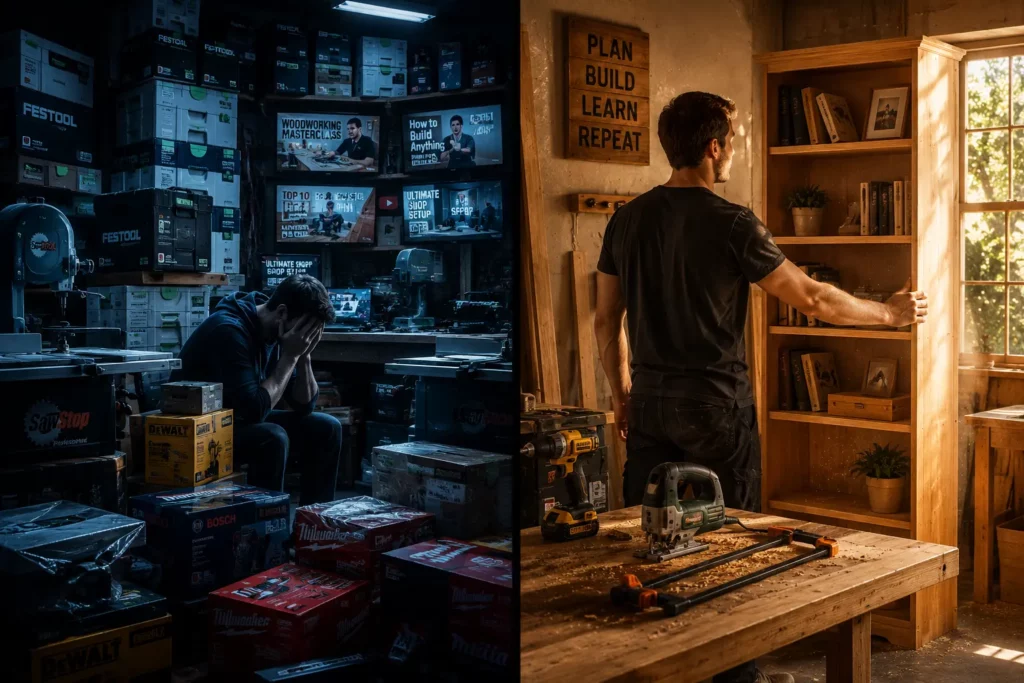
What mattered wasn’t square footage.
It was consistency.
A small corner used regularly beats a large workshop used occasionally.
Every time.
The workspace doesn’t create the craftsperson.
The craftsperson creates the workspace.
Your Complete Beginner Woodworking Toolkit
At this stage, your workshop consists of:
Measuring & Layout Tools
- Tape Measure
- Combination Square
Cutting & Shaping Tools
- Jigsaw
- Chisel Set
Assembly Tools
- Cordless Drill/Driver
- Hammer
- Clamps
Finishing Tools
- Random Orbital Sander
Workshop Essentials
- Safety Equipment
- Stable Workbench
Ten tools.
That’s all.
No table saw.
No router.
No miter saw.
No expensive specialty equipment.
Just enough capability to build meaningful projects while developing genuine woodworking skills.
And that’s exactly the point.
Because the next stage isn’t about adding more tools.
It’s about putting these tools to work.
The real transformation begins when wood starts moving through your hands and projects start emerging from your workshop.
That’s where theory becomes experience.
And experience becomes confidence.
Part 5: The First 10 Projects That Turn Beginners Into Woodworkers
At some point, every beginner reaches the same crossroads.
You can continue researching.
Continue comparing tools.
Continue watching other people build.
Or you can walk into the workshop, pick up a piece of wood, and start.
The difference between someone who “wants to learn woodworking” and someone who eventually becomes a woodworker is surprisingly small.
It’s usually one completed project.
Then another.
Then another after that.
Confidence rarely appears before action.
It appears because of action.
That’s why the projects below aren’t just recommendations.
They’re stepping stones.
Each one introduces new skills while reinforcing old ones. Each one teaches lessons the previous project couldn’t. And together, they create a progression that feels natural, rewarding, and achievable.
The goal isn’t perfection.
The goal is momentum.
Project 1: Floating Shelves
Few beginner projects deliver a bigger reward for the effort involved.
A floating shelf immediately changes a room.
It creates storage.
Adds character.
Makes a space feel intentional.
More importantly, it teaches some of the most important fundamentals in woodworking.
Skills You’ll Learn
- Accurate measuring
- Straight cuts
- Drilling pilot holes
- Hardware installation
- Basic sanding and finishing
The project is simple enough to complete in a weekend yet valuable enough to use every day afterward.
That combination makes it an ideal starting point.
Project 2: Picture Frames
Picture frames reveal something many beginners don’t expect.
Small projects often demand greater precision than large ones.
Tiny alignment errors become obvious immediately.
Corners expose inaccuracies.
Measurements matter.
Suddenly, you’re paying attention to details that seemed insignificant before.
Skills You’ll Learn
- Precision layout
- Consistent measurements
- Corner alignment
- Surface preparation
Picture frames teach craftsmanship in miniature.
And that lesson tends to carry forward into every future project.
Project 3: Wooden Storage Crates
This is where repetition becomes a teacher.
The first crate feels straightforward.
The second feels easier.
By the third, processes begin to develop.
You start thinking ahead.
Planning cuts.
Organizing assembly.
Working more efficiently.
Skills You’ll Learn
- Repetition and workflow
- Assembly sequencing
- Screw placement
- Structural strength
Many woodworking breakthroughs happen during projects like this because the focus shifts from individual tasks to overall process.
Project 4: Entryway Organizer
Now woodworking starts solving real-world problems.
Keys need a home.
Mail needs organization.
Daily clutter needs structure.
An entryway organizer introduces functionality into the equation.
Skills You’ll Learn
- Multi-component assembly
- Hardware installation
- Layout planning
- Design thinking
This project helps bridge the gap between simple construction and practical furniture.
Project 5: Plant Stand
Plant stands are deceptively valuable learning projects.
They appear simple.
Yet stability becomes critical.
Visual balance matters.
Symmetry becomes noticeable.
Skills You’ll Learn
- Structural balance
- Consistent dimensions
- Sanding and finishing
- Design proportion
It’s often the first project where aesthetics become as important as functionality.
Project 6: Tool Tote
There’s something satisfying about building something that supports future projects.
A tool tote becomes both storage and proof of progress.
You build it once.
Then use it constantly.
Skills You’ll Learn
- Handle construction
- Structural assembly
- Layout accuracy
- Practical design
The project introduces more complex geometry while remaining beginner-friendly.
Project 7: Coffee Table
This is often the first project that feels like “real furniture.”
Not because it’s complicated.
Because it occupies space differently.
People notice it.
Use it.
Interact with it daily.
And that changes your relationship with woodworking.
Skills You’ll Learn
- Larger-scale assembly
- Surface preparation
- Structural support
- Finishing techniques
Many beginners discover a new level of confidence after completing a coffee table.
The project feels substantial.
Because it is.
Project 8: Bookshelf
Bookshelves teach discipline.
Every shelf must align.
Every measurement compounds.
Every inconsistency becomes visible.
Yet that’s precisely why they’re such effective learning projects.
Skills You’ll Learn
- Shelf spacing
- Repetition accuracy
- Structural alignment
- Load-bearing design
Bookshelves reward careful planning and punish shortcuts.
Which makes them excellent teachers.
Project 9: Outdoor Bench
Outdoor projects introduce a new challenge.
The environment.
Wood movement becomes more noticeable.
Material selection matters more.
Durability enters the conversation.
Skills You’ll Learn
- Outdoor material considerations
- Structural reinforcement
- Weather-resistant finishing
- Long-term durability planning
The project broadens your understanding of woodworking beyond indoor furniture.
Project 10: Build Your Own Workbench
This is where everything comes together.
Not because a workbench is the most difficult project.
Because it represents a transition.
You’re no longer building isolated projects.
You’re building infrastructure.
A platform for future work.
A tool that supports every project that follows.
Skills You’ll Learn
- Dimensional planning
- Structural design
- Assembly efficiency
- Workshop optimization
By the time you complete a workbench, something important has changed.
You’re not wondering whether you can learn woodworking anymore.
You’re already doing it.
The Skill Stack Hidden Inside These 10 Projects
What makes these projects powerful isn’t the finished products.
It’s the progression.
Without realizing it, you’ll practice:
- Measuring
- Layout
- Cutting
- Drilling
- Fastening
- Clamping
- Sanding
- Finishing
- Problem-solving
- Design thinking
Again and again.
The repetition creates competence.
Competence creates confidence.
And confidence changes everything.
Because once you trust yourself to figure things out, woodworking becomes far less intimidating.
The Mistakes Nearly Everyone Makes (And Why They’re Actually Useful)
If you’re worried about mistakes, there’s good news.
You’re going to make them.
Everyone does.
The experienced woodworker.
The furniture maker.
The cabinet builder.
The person with a workshop worth thousands of dollars.
All of them still make mistakes.
The difference is perspective.
Beginners see mistakes as proof they aren’t good enough.
Experienced builders see mistakes as information.
A measurement error teaches accuracy.
A poor finish teaches preparation.
A misaligned assembly teaches patience.
Every project leaves behind two things:
The item you built.
And the lessons you earned.
The second is usually more valuable than the first.
Frequently Asked Questions
“Do I really need all ten of these tools before I start?”
No.
In fact, many people begin with fewer.
The point isn’t collecting tools before taking action.
The point is understanding which tools genuinely contribute to learning and project completion.
Start with what you can afford.
Add thoughtfully.
Keep building.
“What if my projects don’t look very good at first?”
They probably won’t.
And that’s perfectly normal.
Every skilled woodworker has a history of uneven cuts, rough finishes, crooked assemblies, and disappointing results.
Those early projects aren’t evidence of failure.
They’re evidence of participation.
Nobody skips that stage.
“Should I buy a table saw before building furniture?”
Most beginners don’t need one immediately.
A cordless drill, jigsaw, clamps, measuring tools, and a sander can accomplish far more than many people realize.
Build projects first.
Let actual needs guide future purchases.
“How much money should I spend on beginner woodworking tools?”
Enough to buy reliable equipment.
Not enough to create financial regret.
A modest collection of quality essentials will outperform an oversized collection of tools you barely use.
Skill produces results.
Tools support skill.
The order matters.
“Can I learn woodworking in a garage, basement, or apartment?”
Absolutely.
Some of the most creative builders work in surprisingly small spaces.
Consistency matters far more than workshop size.
A small workspace used regularly beats a dream workshop that never sees action.
“When will I know it’s time to upgrade my tools?”
Usually when a tool begins limiting projects you’ve already built several times.
Not when marketing convinces you an upgrade is necessary.
The best purchases solve recurring problems.
They don’t create new ones.
Products / Tools / Resources
If you’re building your first woodworking toolkit, these are the categories worth prioritizing before anything else:
Essential Measuring & Layout Tools
- 16–25 ft Tape Measure
- Combination Square
- Carpenter Pencil
- Marking Knife
Core Power Tools
- Cordless Drill/Driver Kit
- Jigsaw
- Random Orbital Sander
Assembly & Workholding Tools
- Quick-Grip Clamps
- Bar Clamps
- Spring Clamps
- 16 oz Claw Hammer
Precision & Refinement Tools
- 1/4″ Wood Chisel
- 1/2″ Wood Chisel
- 3/4″ Wood Chisel
- Sharpening Stone or Honing Guide
Workshop Safety Essentials
- ANSI-Rated Safety Glasses
- Hearing Protection
- Dust Mask or Respirator
- Basic First Aid Kit
Materials for First Projects
- Pine Boards
- Plywood Sheets
- Wood Screws
- Wood Glue
- Sandpaper (80, 120, 180, 220 Grit)
Recommended Beginner Project Sequence
- Floating Shelf
- Picture Frame
- Storage Crate
- Entryway Organizer
- Plant Stand
- Tool Tote
- Coffee Table
- Bookshelf
- Outdoor Bench
- DIY Workbench
Additional Resources for Continued Learning
- Beginner Woodworking Project Plans
- Woodworking Safety Guides
- Wood Finishing Tutorials
- Workshop Organization Systems
- Joinery Fundamentals for Beginners
- Furniture Design Basics
- Wood Selection and Lumber Buying Guides
The most valuable resource, however, won’t be found in a store, tool catalog, or workshop wall.
It’s the next project you decide to build.