
What Are Premium Woodworking Plans for Small Spaces?
Premium woodworking plans for small spaces are detailed furniture blueprints designed to solve a problem most homeowners face every day: not having enough room for the life they want to live.
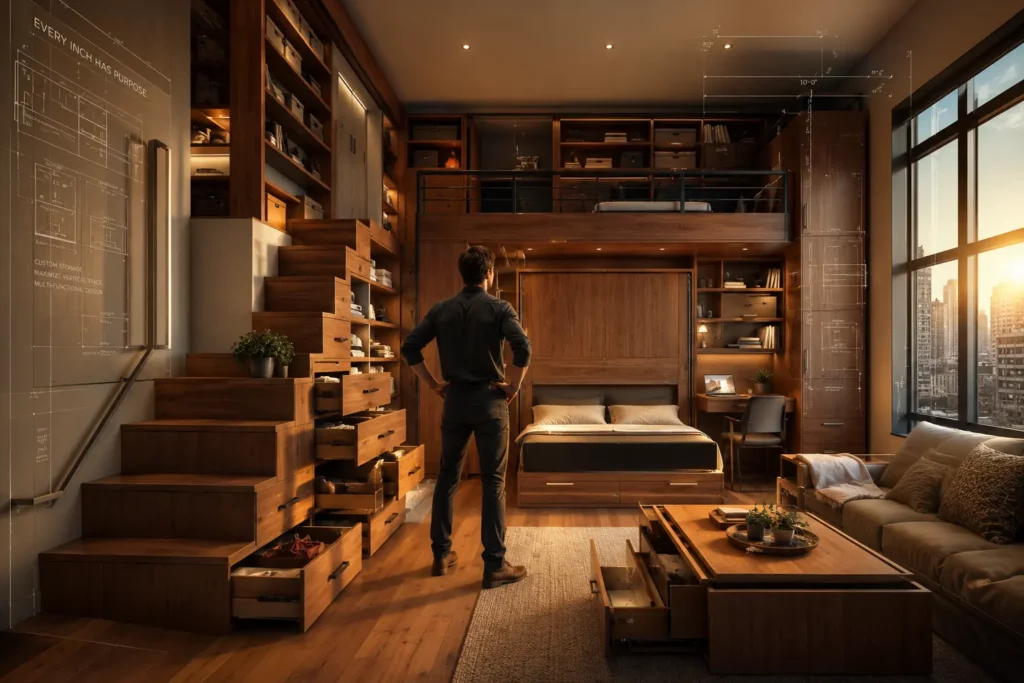
Unlike basic DIY sketches or generic furniture plans, premium woodworking plans are engineered with purpose. They account for dimensions, storage capacity, material efficiency, hardware selection, and real-world usability. Every cut, compartment, and measurement is designed to help a small space function like a much larger one.
The best plans don’t just tell you how to build furniture.
They show you how to reclaim space.
Projects such as fold-down desks, Murphy beds, lift-top coffee tables, floating shelves, hidden-storage benches, and modular closet systems all share a common goal: turning overlooked square footage into useful living space.
And in a world where every square foot matters, that changes everything.
The Real Problem Isn’t Your Home—It’s the Furniture Inside It
Most people eventually arrive at the same conclusion.
They need a bigger house.
A larger apartment.
An extra room.
More storage.
But if you step back and look closely, something interesting emerges.
Many homes aren’t suffering from a lack of space. They’re suffering from furniture that wastes it.
A dresser leaves unusable gaps along the wall. A coffee table occupies valuable floor area while offering little storage. Shelving stops a foot below the ceiling, leaving vertical space untouched. Closets are filled inefficiently. Corners become clutter catchers.
Little by little, the room starts feeling smaller than it actually is.
The visual effect is subtle. The emotional effect is not.
Clutter creates friction. Wasted space creates frustration. Rooms begin to feel crowded long before they are truly full.
This is where premium woodworking plans become more than a woodworking project.
They become a design strategy.
Because the smartest homes are rarely the largest homes. They’re the homes where every object serves a purpose—and preferably two or three.
Why Premium Woodworking Plans Often Outperform Store-Bought Furniture
Custom Dimensions Unlock Space You Didn’t Know You Had
Walk through a furniture showroom and you’ll notice something.
Everything is designed for the average room.
The average wall.
The average layout.
The average homeowner.
The problem is that no room is truly average.
Every home contains awkward corners, unusual dimensions, narrow hallways, empty vertical zones, and underused spaces that mass-produced furniture simply ignores.
Premium woodworking plans allow furniture to fit your home rather than forcing your home to adapt to furniture.
That six-inch gap beside a wardrobe?
It can become a vertical storage tower.
The dead space beneath a window?
A built-in bench with hidden compartments.
The awkward corner you’ve never known what to do with?
A custom workstation or shelving system.
Small adjustments create surprisingly large gains.
Storage Density Matters More Than Furniture Size
Many people assume larger furniture equals more storage.
Often the opposite is true.
Premium woodworking plans focus on storage efficiency rather than visual bulk. The goal isn’t to make furniture larger. The goal is to make every inch work harder.
A storage bench can provide seating, organization, concealed storage, and visual appeal—all within the footprint of a simple chair.
A lift-top coffee table can replace multiple pieces of furniture while consuming no additional space.
This principle sits at the heart of small-space design:
One footprint. Multiple functions.
The Economics Make More Sense Than Most People Expect
Quality furniture has become increasingly expensive.
A well-built Murphy bed can cost several thousand dollars. Custom closet systems can quickly climb into five-figure territory. Even basic storage furniture often carries premium pricing despite mediocre materials.
Premium woodworking plans shift that equation.
Instead of paying for shipping, branding, warehouse costs, and retail markups, you’re investing directly in materials, craftsmanship, and functionality.
The result is often stronger, longer-lasting furniture tailored to your exact needs.
The Three Principles Behind Every Great Small-Space Furniture Build
1. Vertical Space Is Your Most Undervalued Asset
When most people think about storage, they look around.
Professional designers look up.
Walls are often the largest unused storage resource in a home.
Yet many rooms leave enormous vertical opportunities untouched.
Floor-to-ceiling shelving, floating storage systems, wall-mounted cabinets, and vertical towers can dramatically increase storage without consuming additional floor space.
More importantly, vertical storage changes how a room feels.
When storage rises upward rather than spreading outward, rooms maintain openness. Movement improves. Sight lines stay clean.
The space feels lighter.
Bigger.
Calmer.
2. Every Piece of Furniture Should Earn Its Footprint
Small-space living rewards versatility.
Furniture that performs a single function is often a luxury compact homes can’t afford.
The most successful woodworking projects share a common characteristic: they solve multiple problems simultaneously.
A lift-top coffee table becomes a workspace.
A storage ottoman becomes seating.
A Murphy bed becomes an office.
A fold-down desk disappears when the workday ends.
The transformation is practical, but it’s also psychological.
Rooms stop feeling crowded because fewer objects are competing for attention.
3. Hidden Storage Changes How a Room Feels
Humans don’t simply experience space physically.
We experience it visually.
A room packed with visible items often feels smaller than a room with the same amount of storage concealed behind doors, drawers, and panels.
That’s why premium woodworking plans frequently incorporate:
- Hidden compartments
- Pull-out drawers
- Under-seat storage
- Concealed shelving
- Integrated organization systems
The effect is immediate.
Less visual noise.
Less mental clutter.
More breathing room.
Premium Woodworking Projects That Deliver the Biggest Space Gains
Fold-Down Wall Desk
For apartment dwellers and remote workers, few projects offer a better return on space.
When open, it functions as a productive workspace. When closed, it disappears into the wall, restoring the room to its original purpose.
Many premium plans also include integrated shelving, cable management, and hidden storage compartments that keep work materials organized and out of sight.
Lift-Top Coffee Table
This project remains one of the most efficient examples of multifunctional furniture.
On the surface, it appears to be a standard coffee table.
Lift the top and it transforms into a workstation, dining surface, or storage hub.
The hidden compartment beneath often stores blankets, electronics, books, and daily essentials without adding visual clutter to the room.
Entryway Storage Bench
Entryways tend to collect life.
Shoes. Bags. Jackets. Keys.
Without intentional storage, the space becomes chaotic almost instantly.
A custom storage bench introduces order while maintaining a clean aesthetic. Seating, storage, and organization come together in a single footprint.
For smaller homes, that efficiency matters.
Murphy Bed Storage System
Few furniture projects create a more dramatic transformation.
During the day, valuable floor space becomes available for work, exercise, entertaining, or simply moving around comfortably.
At night, the room effortlessly transitions back into a bedroom.
Premium woodworking plans often elevate the concept further through integrated shelving, side cabinets, lighting systems, and hidden drawers.
Floating Nightstands
Sometimes the most effective projects are also the simplest.
By removing visual weight from the floor, floating nightstands create openness that traditional furniture cannot.
The effect isn’t merely aesthetic.
Rooms genuinely feel larger because the eye can travel uninterrupted across the floor surface.
Choosing Materials That Balance Strength, Beauty, and Longevity
Baltic Birch Plywood
Among experienced furniture builders, Baltic birch remains a favorite for good reason.
Its strength, stability, durability, and clean appearance make it ideal for storage furniture, shelving systems, cabinets, and multifunctional projects.
For many premium woodworking plans, it represents the sweet spot between performance and value.
Hardwood Options
Hardwoods continue to be the gold standard for furniture expected to last decades.
Popular choices include:
- Oak
- Maple
- Walnut
- Cherry
Each offers a distinct appearance while providing excellent durability and structural integrity.
Don’t Overlook Hardware
The difference between furniture that feels ordinary and furniture that feels exceptional often comes down to hardware.
Soft-close slides.
Premium hinges.
Heavy-duty drawer systems.
Adjustable shelf supports.
These components rarely attract attention, yet they influence daily experience more than almost anything else.
The best furniture isn’t simply beautiful.
It feels effortless to use.
Building Furniture in a Small Workshop
One of the biggest misconceptions about woodworking is that it requires a massive workshop.
It doesn’t.
Many exceptional projects begin in garages, spare rooms, balconies, and compact workspaces.
A practical setup often includes:
- Circular saw
- Drill and driver
- Orbital sander
- Pocket-hole jig
- Clamps
- Measuring tools
Beyond the tools themselves, organization becomes the real advantage.
Foldable workbenches, mobile carts, and vertical storage systems allow a small workshop to function with surprising efficiency.
The same principles that improve a home often improve a workshop as well.
How to Choose the Right Premium Woodworking Plan
Not every project deserves your time.
Before starting, ask three simple questions.
How Much Space Will This Actually Recover?
Some projects look impressive but create minimal practical benefit.
Others dramatically improve storage and functionality.
Focus on impact first.
Will I Use It Every Day?
The highest-value furniture serves daily needs.
Projects that improve everyday routines tend to deliver the greatest long-term satisfaction.
Does It Solve More Than One Problem?
Storage plus seating.
Workspace plus organization.
Sleeping plus storage.
The strongest designs rarely address a single challenge.
Common Mistakes That Quietly Waste Valuable Space
Buying Before Measuring
Few mistakes create more frustration.
Accurate measurements should always guide furniture decisions.
Ignoring Vertical Opportunities
Walls are often the largest unused storage area in a home.
Treat them accordingly.
Prioritizing Style Over Function
Beautiful furniture should enhance daily living, not complicate it.
The best designs accomplish both.
Choosing Cheap Hardware
Weak slides and low-quality hinges eventually become daily annoyances.
Premium furniture deserves premium components.
Frequently Asked Questions
Are premium woodworking plans really worth paying for?
If your goal is accuracy, efficiency, and long-term durability, they often are. Premium plans reduce guesswork, optimize materials, and dramatically increase the likelihood of a successful build.
What’s the best woodworking project for a small apartment?
For most people, fold-down desks, Murphy beds, lift-top coffee tables, and storage benches deliver the greatest improvement per square foot.
I’m a beginner. Can I still use premium woodworking plans?
Absolutely. Many premium plans are specifically designed with beginners in mind and include diagrams, step-by-step instructions, and detailed material lists.
Which wood works best for space-saving furniture?
Baltic birch plywood, maple, oak, walnut, and cherry remain among the most popular options because they balance durability, appearance, and structural performance.
How much money can custom-built furniture save?
Depending on the project, many builders spend significantly less than they would purchasing equivalent retail furniture while gaining the benefit of fully customized dimensions.
Products / Tools / Resources
Recommended Project Types
- Fold-down wall desks
- Murphy bed systems
- Storage benches
- Lift-top coffee tables
- Floating shelves
- Modular closet organizers
- Under-stair storage cabinets
- Hidden-storage ottomans
Essential Woodworking Tools
- Circular saw
- Drill/driver combo
- Random orbital sander
- Pocket-hole jig
- Clamps
- Speed square
- Tape measure
- Stud finder
Recommended Materials
- Baltic birch plywood
- Maple hardwood
- Oak hardwood
- Walnut hardwood
- Soft-close drawer slides
- Concealed cabinet hinges
- Adjustable shelf supports
Helpful Learning Resources
- Furniture design fundamentals
- Space-saving furniture engineering
- Cabinetmaking techniques
- Small workshop organization
- Joinery methods for beginners
- Material optimization strategies
- Interior storage planning
- Multifunctional furniture design