
The difference usually reveals itself when the board refuses to stay still.
You take a plane to the edge. The bench shifts a fraction. You reset the board, tighten a clamp, try again—and lose the rhythm you had a moment ago.
Later, while chopping a joint, the top flexes beneath the work. Nothing catastrophic happens. The project simply becomes more tiring, less precise, and far less enjoyable than it ought to be.
That is the quiet difference between a bench that merely holds things and a bench that helps you work.
The terms woodworking bench and workbench are often used as if they mean the same thing. In everyday conversation, they can. In the workshop, however, they tend to point toward different priorities.
A woodworking bench is built around precision workholding, hand tools, stability, and control.
A general-purpose workbench is expected to do more: support assembly, sanding, repairs, maintenance, storage, and sometimes portable power tools.
Neither one is automatically the better choice. The right answer depends on what you make, how much force your tools create, how much room you have, and whether you want a specialized tool or a flexible foundation that can change with you.
Quick answer: A woodworking bench is a specialized workholding system for planing, chiseling, sawing, and joinery. A general workbench is a versatile surface for assembly, repairs, sanding, storage, and mixed workshop tasks. Choose the woodworking bench when stability and precision workholding are central. Choose the general workbench when flexibility, mobility, and storage matter more. A strong general workbench can also be upgraded into a capable woodworking bench.
Woodworking Bench vs Workbench: The Differences at a Glance
| Feature | Woodworking bench | General-purpose workbench |
|---|---|---|
| Main purpose | Planing, chiseling, joinery, sawing, and precision workholding | Assembly, repairs, sanding, maintenance, and mixed projects |
| Workholding | Often includes a vise, bench dogs, holdfasts, or a planing stop | May rely on portable clamps or a basic vise |
| Stability | Designed to resist downward and lateral forces | Ranges from light portable designs to heavy shop benches |
| Top | Usually thick, flat, rigid, and repairable | May be plywood, MDF, metal, laminate, or a replaceable surface |
| Height | Tuned to the user and the main woodworking tasks | Usually chosen for general comfort and access |
| Mobility | Often stationary or difficult to move | Frequently built around casters, folding legs, or portability |
| Storage | Secondary to clamping access and leg clearance | Shelves, drawers, cabinets, and pegboards are common priorities |
| Best fit | Furniture makers, hand-tool users, and serious woodworkers | DIY users, repair work, mixed workshops, and beginners |
The label on a product page is only a starting point. The more useful question is what happens when you push, pull, clamp, plane, or strike against the bench.
Contents
- Woodworking Bench vs Workbench: The Differences at a Glance
- 1. The First Difference: What the Bench Is Meant to Do
- 2. Workholding: Where a Flat Top Stops Being Enough
- 3. Stability, Mass, and Rigidity: The Feel of a Bench That Stays Put
- 4. Height, Depth, and Dimensions: The Fit Between Your Body and the Work
- 5. Storage and Mobility: Convenience on One Side, Control on the Other
- 6. Materials and Surface Construction: What Your Hands Will Notice Over Time
- 7. Cost, Build Complexity, and Upgrade Potential
- Which One Fits Your Workshop?
- Can You Use a General Workbench for Woodworking?
- Is a Dedicated Woodworking Bench Worth It?
- Five Common Mistakes to Avoid
- Frequently Asked Questions
- Products / Tools / Resources
1. The First Difference: What the Bench Is Meant to Do
Before comparing thicknesses, vises, or price tags, ask a simpler question: What job is this bench supposed to make easier?
A woodworking bench is built around control
When you plane a board, pare a shoulder, chop a mortise, or fit a dovetail, the bench is not passive furniture. It is part of the tool system.
The workpiece has to stay put while your hands guide a blade. That means the bench must give you useful places to clamp, push, brace, and support the wood. A front vise, tail vise, bench dogs, holdfast holes, a planing stop, and an open apron are not decorative details. They are ways of turning force into accuracy instead of movement.
This is why a traditional woodworking bench can feel almost unusually serious. It is heavy. Its top is thick. Its base is deliberately overbuilt. The design assumes that the user will lean into the work and expect the bench to remain quiet beneath it.
A general workbench is built around versatility
A general workbench may spend one afternoon supporting a cabinet assembly and the next holding a bicycle wheel, a small appliance, a stack of hardware, or a portable power tool.
It may include drawers, shelves, pegboards, cabinets, casters, a replaceable top, or a folding frame. Those features are genuinely useful. In a home workshop, one surface often has to do the work of several specialized stations.
The tradeoff is that a flexible workbench may not offer the same clamping reach or resistance to hand-tool forces. It can be perfectly good at supporting a project while being less good at holding that project still.
Why the names overlap
There is no universal rule controlling the names. A manufacturer may call a heavy woodworking bench a workbench. A light assembly table may be marketed as a woodworking bench. Search results mix the terms constantly.
So do not make the decision by vocabulary alone. Look for the design intention hidden in the details.
Useful rule: If your main problem is holding wood securely during precision work, think woodworking bench. If your main problem is needing one practical surface for many kinds of work, think general workbench.
2. Workholding: Where a Flat Top Stops Being Enough
The single most important difference between a woodworking bench and a general workbench is workholding.
Workholding is the art of keeping a workpiece supported, aligned, and secure while you cut, plane, drill, chisel, sand, or assemble it. A flat top helps. It is not the whole solution.
Vises give your hands somewhere to trust
A purpose-built woodworking bench may use a face vise, front vise, leg vise, end vise, or tail vise. The designs vary, but the purpose remains consistent: grip the work without damaging it and position the work where your tools can reach it comfortably.
A general workbench may have a small metal vise, a clamp-on vise, or no built-in vise at all. Portable clamps can compensate, but they often take more time to arrange. They can also leave the work supported at only one or two points.
That difference becomes obvious when you are working through a long edge or trying to fit a joint repeatedly. Good workholding removes little interruptions. The project starts to flow.
Bench dogs support boards along their length
Bench dogs are removable pins that work with a vise or stop. A row of dog holes lets you support boards of different lengths without forcing every piece into an edge clamp.
Imagine planing a long board. With a tail vise and bench dog, the board can be held between two points and supported along the top. The bench becomes an extension of the vise system rather than a slippery table underneath it.
A general workbench can be drilled for bench dogs, but its top and frame need enough thickness and strength to accept the modification. A hole pattern is only useful when the surrounding structure can handle the pressure.
Holdfasts and planing stops solve awkward problems
Holdfasts press a workpiece down against the bench top. A planing stop gives the end of a board something solid to push against. Together, these simple devices can hold thin, wide, or oddly shaped workpieces that do not sit comfortably in a traditional vise.
This is the kind of detail that matters after the novelty of a new bench has worn off. You reach for a solution, it is already there, and the work continues.
Clamp access is part of the design
Even without bench dogs or a tail vise, a useful bench needs room for clamps to reach the work. Deep cabinets, thick aprons, and crowded storage can make a bench look efficient while quietly blocking the working perimeter.
Open leg clearance and a sensible overhang may appear to waste space. In practice, they give you more ways to approach the work.
Recommended reading: The Ultimate Woodworking Bench with Vise and Dog Holes (The Lifetime Workbench Every Serious Woodworker Should Build)
3. Stability, Mass, and Rigidity: The Feel of a Bench That Stays Put
You do not fully understand stability until you work on a bench that lacks it.
The first time a bench walks across the floor while you plane, the movement feels almost comical. By the tenth time, it is exhausting.
Planing and chiseling create real forces
A hand plane applies downward pressure, but not downward pressure alone. The stroke also creates forward and lateral force. Chiseling introduces short, sharp impacts. Even sanding can make a light structure tremble or creep when the workpiece is not held firmly.
If the bench rocks, racks, or slides, your effort is partly spent stabilizing the station instead of shaping the wood. Accuracy becomes harder. Your shoulders work more. A simple operation takes longer.
Weight helps, but weight is not the entire answer
A heavy top and solid base can make a woodworking bench feel anchored. Still, a bench can be heavy and poorly behaved if its frame flexes or its joints allow side-to-side movement.
Look at the whole structure:
- The top should resist bending under normal loads.
- The legs should have a broad, stable footprint.
- Stretchers or a rigid frame should reduce racking.
- The connection between top and base should be secure.
- The feet should meet the floor evenly.
Stability is a conversation between all of those parts. No single measurement tells the whole story.
General workbenches occupy a wide range
Some general workbenches are light folding tables meant to be carried, stored, and set up quickly. Others are heavy garage benches with thick tops and substantial frames. The word “general” does not automatically mean fragile.
It simply suggests that the design may be balancing stability against other demands: portability, storage, cost, or access from several sides.
Fix the actual weakness instead of adding weight blindly
If you already own a general workbench, diagnose the movement before modifying it.
If it slides, improve the feet, add grip, or anchor it. If it racks, strengthen the frame with stretchers or better bracing. If the top flexes, reinforce the underside or replace the top. If the entire structure feels too light, a lower shelf or ballast may help—but only after the frame itself is sound.
Adding weight to a weak structure can make the bench heavier without making it better.
4. Height, Depth, and Dimensions: The Fit Between Your Body and the Work
The best workbench height is not a universal number waiting to be discovered. It is a fit between your body, your tools, and the kind of work you repeat most often.
Heavy planing and fine detail ask different things of you
A lower surface can make heavy planing feel more controlled because it lets you put force through the tool comfortably. Fine carving, detail work, and small joinery may feel better on a higher surface that brings the work closer to your eyes and hands.
A general assembly bench is often set at a comfortable standing height—a sensible compromise, but not necessarily the perfect height for every woodworking task.
Before building a permanent bench, test the height. Use sawhorses, scrap lumber, or a temporary platform. Pretend to plane. Hold a chisel. Assemble a box. Sand an edge.
Notice your shoulders, wrists, lower back, and line of sight. The body tells the truth quickly.
Depth determines reach and clamping freedom
A deep bench gives you room for large components, but the far edge can become a dead zone if you cannot reach it comfortably. Deep storage underneath may make that problem worse by blocking your knees or clamp handles.
A narrower bench is often easier to use in a small workshop. It can keep the work close and leave more room to walk around the station. Choose the depth that supports your common projects—not the depth that looks most impressive in a photograph.
Length should follow your real projects
Long boards, doors, and cabinet parts benefit from length. Small boxes, carving, repairs, and compact furniture may not.
Think about how lumber enters the room, where you stand, what is stored nearby, and whether a long bench will block the path to another tool. A bench that fits the work but chokes the workshop can become its own obstacle.
5. Storage and Mobility: Convenience on One Side, Control on the Other
The choice between storage and open access is easy to underestimate. A drawer is useful. So is the empty space beneath the bench when a clamp needs to reach the work from an awkward angle.
General workbenches often make storage part of the architecture
Shelves, drawers, cabinets, pegboards, and tool racks keep supplies close. In a small garage or shared workshop, that convenience can be worth more than a traditional open base.
There is a hidden cost, though. A cabinet beneath the top can block clamps. A shelf can interfere with long workpieces. A drawer bank can remove the leg clearance you did not realize you needed until the first oversized project arrives.
Storage should serve the workflow, not quietly dictate it.
Woodworking benches protect the working perimeter
Traditional woodworking benches often leave more of the lower structure open. That space accepts clamps, holdfasts, long boards, and the user’s legs. It also lets you approach the work from more than one direction.
The open area may look less efficient than a wall of drawers. It is not empty in functional terms. It is access.
Wheels are helpful until they are not
Mobility matters when the bench must move for cleaning, storage, shared-room access, or a change in workshop layout. But wheels introduce movement at exactly the moment hand-tool work demands stillness.
If you need both qualities, look for retractable casters, leveling feet, or locking wheels that truly immobilize the bench. A mobile base should lift the bench securely during movement and let it settle firmly during use.
A practical rule: Easy to move is convenient. Moving while you work is a design flaw.
6. Materials and Surface Construction: What Your Hands Will Notice Over Time
The material on top of a bench matters. The support beneath it matters just as much.
Hardwood tops bring weight and repairability
Traditional woodworking benches often use laminated hardwood. A thick hardwood top can tolerate clamps, hand tools, and years of use. It can also be flattened or repaired when the surface eventually shows the story of the work.
The drawbacks are real: hardwood costs more, weighs more, and may demand careful preparation before it becomes truly flat.
Plywood and construction lumber can make excellent foundations
Well-supported plywood offers strength and dimensional stability. Construction lumber can be economical and readily available, although it may need careful selection, drying, flattening, and reinforcement.
For a first bench, an upgradeable plywood or construction-lumber design can be a smart choice. It gives you a working surface without forcing you to predict the entire future of your workshop on day one.
MDF is useful when treated as a working layer
MDF can provide a flat, inexpensive surface for assembly and finishing. It is less tolerant of moisture and edge damage than many hardwood options, so it often works best as a replaceable sacrificial top rather than the sole structural solution.
That replaceability is valuable. Glue, paint, scratches, drill-throughs, and accidental cuts are not signs of failure in a working shop. They are part of the surface’s job.
Flatness depends on support, not thickness alone
A thick top that sags between supports is still a poor working surface. A thinner top with strong support may perform better than a massive slab resting on a weak frame.
When evaluating a bench, ask two questions: Is the surface flat enough for the work? And will the frame keep it that way under load?
7. Cost, Build Complexity, and Upgrade Potential
The least expensive bench is not always the least expensive decision.
Time matters. So does the cost of rebuilding a top, replacing a vise, correcting an uncomfortable height, or living with a bench that makes every project harder.
A general workbench can be the right first move
A basic workbench gives a beginner a surface immediately. That can be useful when you are still learning which tools, projects, and working positions will become permanent parts of your workshop.
It also makes sense when the same bench must handle repairs, household jobs, finishing, and woodworking.
A woodworking bench earns its cost through repetition
A purpose-built bench may require a substantial top, strong joinery, a quality vise, bench-dog hardware, holdfasts, and careful flattening. That investment becomes easier to justify when the same features solve the same problem week after week.
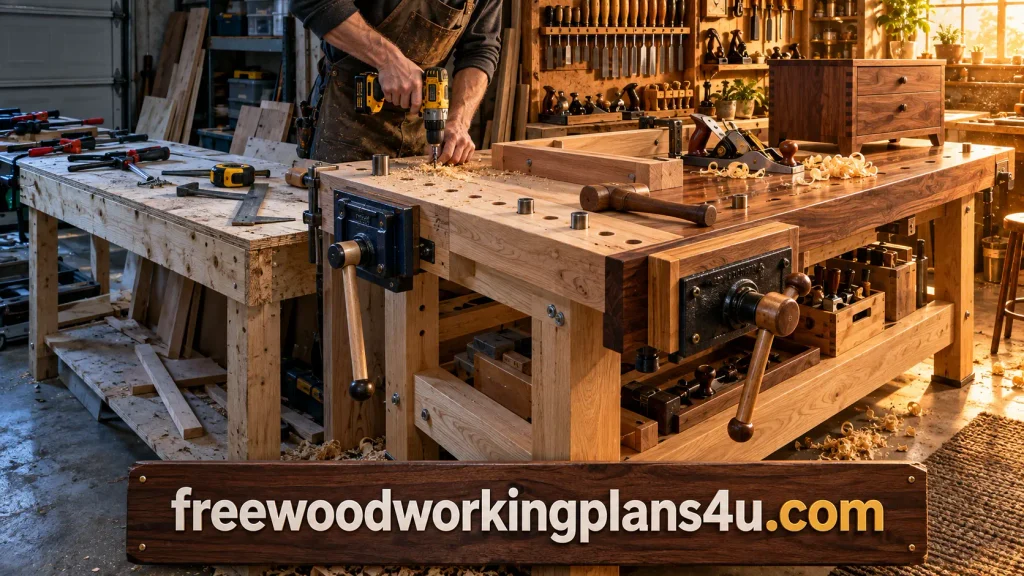
The value is not status. It is reduced friction. When the bench holds the work without argument, attention returns to the cut, the surface, and the joint.
An upgradeable hybrid protects both money and momentum
You do not have to choose between building a perfect traditional bench and settling permanently for a light utility table. A stable general workbench can grow in stages:
- Eliminate flex and improve the top.
- Add a reliable vise.
- Drill dog holes or install a planing stop.
- Strengthen the base, feet, or anchoring.
- Add storage only where it does not interfere with clamps.
That order matters. Workholding and stability usually improve the experience more than another drawer.
Recommended guide: The Ultimate Solid Hardwood Woodworking Bench Guide: How to Choose or Build a Lifetime Workbench
Which One Fits Your Workshop?
The answer becomes clearer when you replace “Which bench is best?” with “What do I need the bench to do repeatedly?”
Choose a woodworking bench if you mainly:
- Use hand planes and chisels.
- Build furniture or joinery-heavy projects.
- Need the workpiece held securely from several directions.
- Value stability more than portability.
- Expect to use a vise, bench dogs, holdfasts, or a planing stop often.
Choose a general workbench if you mainly:
- Assemble projects and cabinets.
- Sand, finish, repair, or maintain equipment.
- Use portable power tools.
- Need drawers, shelves, or a replaceable top.
- Share the workshop with other household activities.
- Need to move or fold the bench when the room changes.
Choose a hybrid setup if you:
- Are still discovering your preferred workflow.
- Use both hand tools and power tools.
- Have limited space or a limited budget.
- Want a useful surface now and specialized workholding later.
There is no shame in beginning with a general workbench. There is also no virtue in forcing a traditional woodworking bench to perform jobs it was never designed to make convenient.
Can You Use a General Workbench for Woodworking?
Yes—provided the bench is flat enough, stable enough, and easy enough to clamp to.
Before relying on it for planing or chiseling, run through this quick check:
- Does the bench slide or rock when you apply force?
- Does the top flex under pressure?
- Can you clamp work without hitting a cabinet or shelf?
- Is there room for a vise or temporary workholding system?
- Is the surface large enough for your typical projects?
- Can the bench be anchored or upgraded if a weakness appears?
If most answers are favorable, use the bench. Let actual projects reveal what needs changing. You may discover that the top is fine but the clamping is poor, or that the vise works well while the base racks. Fix the limiting part rather than rebuilding everything out of habit.
Is a Dedicated Woodworking Bench Worth It?
A dedicated woodworking bench becomes worthwhile when workholding starts limiting the work itself.
You may notice that you spend more time chasing boards, shifting clamps, bracing the bench, or improvising supports than planing, chiseling, or fitting joints. That is not simply a patience problem. It is information.
The bench is asking for a more deliberate system.
A specialized woodworking bench can make the same tools feel calmer. The board stays where you put it. The vise opens to the right place. A planing stop is waiting when you need it. The work feels less like negotiation.
Five Common Mistakes to Avoid
1. Choosing by appearance alone
A beautiful bench can still have poor workholding, insufficient mass, an awkward height, or limited clamp access. Good looks are welcome. They are not a performance specification.
2. Making the bench too light for the work
A folding surface may be perfect for light assembly and completely wrong for aggressive hand-planing. Design stability around the forces your tools create, not the photograph in the product listing.
Recommended reading: Free Woodworking Plans for a Folding Workbench: Build a Sturdy Space-Saving Bench With a Printable Cut List
3. Filling the base with storage before testing the workflow
Drawers and cabinets are useful, but they can block your legs, clamps, or access to an oddly shaped workpiece. Use the bench first. Then decide what storage the work actually asks for.
4. Treating the vise as an afterthought
The vise position should suit your dominant hand, the direction of your work, and the sizes of the pieces you hold most often. A strong bench with an awkward vise can feel strangely difficult to use.
5. Assuming wheels automatically create useful mobility
Mobility only helps when the bench becomes stable again. Make sure wheels lock firmly or retract completely, and test the mechanism under real pressure.
Frequently Asked Questions
“Is a woodworking bench actually different from a workbench?”
Usually, yes—but the names overlap. A woodworking bench is a specialized kind of workbench designed around precision workholding, hand tools, stability, and clamping. A general workbench is usually designed for a broader mix of assembly, repair, sanding, storage, and maintenance. The features reveal the intended use more reliably than the label.
“Can I start woodworking on the regular workbench I already own?”
In many cases, yes. If it is flat, stable, and easy to clamp to, it can support a surprising amount of woodworking. Add a vise, dog holes, a planing stop, or more mass only when a real limitation appears.
“Do I need a heavy bench, or is rigidity enough?”
You need a bench that resists movement. Mass helps, but it is only part of the answer. A heavy bench with weak joints can still rack and flex. A strong base, supported top, solid connections, and secure contact with the floor matter just as much.
“Are bench dogs necessary for a woodworking bench?”
Not for every kind of woodworking. They are especially useful when you plane boards or need to support a workpiece between a vise and a stop. They reduce your dependence on portable clamps and can make surface preparation much faster.
“What height should my woodworking bench be?”
It depends on your body and the work you do most often. Heavy planing may feel better at a lower height; detail work and assembly may suit a higher surface. Mock up the height before building permanently, and let your shoulders, wrists, back, and line of sight guide the decision.
“Is a portable workbench good enough for serious woodworking?”
It can be good enough for light woodworking, assembly, and small projects. For aggressive planing, chiseling, or large workpieces, the frame must resist movement. Look for a rigid base, a dependable locking system, and a way to brace or anchor the bench when necessary.
Recommended guide: The Complete Beginner’s Guide to Choosing a Portable Woodworking Workbench That You’ll Never Outgrow
“Should I build or buy my first woodworking bench?”
Buy if you need a reliable setup quickly and do not yet know which features suit you. Build if you enjoy the process, have the necessary tools, and want to customize the size, height, storage, or workholding. An upgradeable general workbench is a sensible middle path.
Products / Tools / Resources
Products worth considering
A substantial bench vise: Choose a vise that opens wide enough for your common work and mounts securely to the bench. The best vise is not necessarily the largest; it is the one that holds without flexing and places the work comfortably in front of you.
Bench dogs and a planing stop: These are small additions with an outsized effect on long boards and surface preparation. Match the dog size and hole pattern to the bench top.
Holdfasts: A pair of well-fitting holdfasts can secure wide or awkward pieces without covering the top with clamps.
Reliable woodworking clamps: Keep a mixture of quick clamps, bar clamps, and smaller clamps available. The bench becomes more useful when the work can be approached from several directions.
A replaceable plywood or MDF top: This is particularly practical for an assembly-focused general workbench. It lets you work without treating every scratch as a disaster.
Leveling feet or retractable casters: Choose these when the bench must move occasionally but still needs to become solid during planing and chiseling.
Tools that improve the bench experience
- A dependable hand plane for testing flatness and working board edges.
- Sharp chisels for joinery and checking whether the bench resists impact.
- A straightedge and reliable square for checking the top and frame.
- A tape measure, marking gauge, and combination square for layout.
- A drill and appropriate bits for installing vises, stops, and dog holes.
- A soft-faced mallet for bench work that should not bruise the project.
- Good task lighting so the work surface and layout marks stay visible.
Resources for building a better workshop
Look for plans and guides that explain not only what to build, but why each dimension and workholding feature exists. A good woodworking bench plan should make the structure clear. A useful vise guide should discuss placement and clearance. A small-workshop resource should treat walking space and tool access as part of the design rather than leftover space.
The most useful resource is usually the one that helps you make the next decision with less guesswork: how high the bench should be, where the vise belongs, how the dog holes should run, or which limitation is worth fixing first.