
A jig earns its place in a small shop when it saves you from repeating the same fiddly setup by hand. The trouble is that a crowded kit can take up the very space it’s supposed to help you use well.
The answer is to start with a few tools that match the work ahead: one jig for the kind of joinery you use, one way to guide your saw or router, and a handful of simple aids for holding and positioning parts.
The short answer: start with three kinds of help
For most small shops, a useful starter setup has one joinery jig, one guided-cutting setup, and basic workholding and measuring aids. Choose a pocket-hole jig for quick assembly when the screw pockets can be hidden, or a dowel jig for concealed alignment. Pair it with a circular-saw guide or table-saw sled, depending on your tools. Add specialty jigs when a project gives you a reason.
That combination can handle many everyday jobs without turning a drawer into a graveyard of accessories. The right kit depends on what you build, how much room you have, and which machines are already in your shop.
| What you need help with | A space-smart starting choice | Useful for |
|---|---|---|
| Joining boards | Pocket-hole jig or dowel jig | Shelves, cabinets, small furniture |
| Cutting panels and straight edges | Circular-saw guide or straightedge | Plywood and guided cuts |
| Repeating measurements | Stop blocks and a reliable square | Matching parts and consistent layouts |
| Holding work securely | Clamps, bench hooks, or hold-downs | Drilling, routing, assembly, and sanding |
| Shaping or specialty joinery | Router guide or template jig | Add when your projects call for it |
The number of pieces in the case matters less than whether the kit fits your work.
What counts as a woodworking jig kit for a small shop?
“Kit” can mean a boxed set built around one jig, or a small collection of tools you’ve chosen for your own shop. Either can be useful. What matters is the work each item helps you do.
A jig guides a tool or workpiece through a repeatable operation. A stop block helps position a part. A clamp holds things still. Those simple distinctions make it easier to build a kit that solves real problems instead of collecting accessories because they came in the box.
Before buying, think about three projects you might build next. A bookshelf, a small cabinet, and a side table don’t ask for exactly the same setup. Do you need to drill matching holes? Cut plywood into manageable pieces? Assemble square frames? The answer points you toward the jig that will earn its space.
Recommended reading: Which Woodworking Jig Should a Beginner Use? Match the Jig to the Job
Pick the joinery jig that fits how you build
You don’t need to buy every joinery jig at once. Begin with the joint you expect to use most often.
Pocket-hole jig: quick assembly when the pockets can be hidden
A pocket-hole jig guides a stepped drill bit at an angle, making holes for screws that pull two pieces together. It can be handy for shelves, cabinets, and straightforward furniture when you can place the pockets on an unseen face—or plug them as part of the design.
When comparing pocket-hole kits, check the material-thickness range, guide arrangement, bit and stop collar, clamp method, and included accessories. Kits vary: some list thickness stops, a clamp adapter, driver bits, screws, or a carrying case; others include a more limited set. Check the current product details and instructions before choosing.
Dowel jig: alignment without visible fasteners
A dowel jig guides holes for wooden dowels that connect two parts. It can suit projects where you want a cleaner-looking joint, but getting the mating holes in line takes care. A test fit in scrap can reveal a setup problem before it turns into a gap in the finished piece.
Look for clear alignment marks, drill-guide sizes that suit your work, and a way to hold the jig steady. Some doweling jigs use self-centering features or an adjustable fence, but the details vary by model. Read the manual to see how a particular jig registers against the workpiece.
If you’re torn between the two, choose the method that suits the appearance and construction of your planned projects. You can always add another jig later.
A straight cut in a cramped room starts with the right guide
A table saw can be useful, but it isn’t the only way to make accurate cuts. If you work with a circular saw, a clamped straightedge or compatible guide can help guide the saw across plywood and boards. That can be easier than maneuvering a large panel through a stationary machine.
If you already have a table saw and often cut shorter parts, a suitable crosscut sled or other crosscut jig may help you repeat the setup. Think about storage before building or buying one: a full-size sled needs somewhere to live between projects.
For more options in a small shop without a table saw, see our guide to woodworking without a table saw.
The small helpers that make the whole setup work
Some of the most useful shop aids don’t arrive in a “jig kit.” Clamps, stop blocks, bench hooks, and sacrificial fences may seem modest, but they help keep a setup steady and repeatable.
- Clamps hold a guide or workpiece in place during drilling, routing, or assembly.
- Stop blocks help position multiple pieces consistently.
- Bench hooks help control small parts during hand-sawing or layout.
- Sacrificial fences or backing boards can support the work and protect the bench during a cut.
- A reliable square and straightedge help you check whether the workpiece and guide are aligned.
If your workspace depends on a folding or portable bench, the portable woodworking workbench guide looks at ways to add workholding without making the bench harder to move or store.
Let your projects choose the setup
A short list of likely projects can narrow the choices faster than a long list of tools.
- Shelves and basic cabinets: A pocket-hole jig may suit the design when the screw pockets can be hidden. Add a guided cutting method and clamps.
- Furniture with visible faces: Consider a dowel jig or another joinery method that fits the look you want. Careful layout and test fitting matter.
- Plywood projects in a tight shop: A circular-saw guide and stable panel support can make panel breakdown more manageable.
- Repeated parts: Stop blocks or a suitable sled can save time when the same measurements come up again and again.
- Decorative edges or template work: Add a router guide or template when your projects actually call for those cuts.
If you’re still deciding how much to spend on the rest of your setup, our guide to the cost of starting woodworking can help you sort the immediate needs from the “maybe later” purchases.
Before you buy, check the details that matter
A compact case looks appealing on a shelf. The more useful questions are about what happens when you put the jig to work.
Will it fit the material you use?
Check the jig’s thickness and size range. If you work with both solid boards and sheet goods, make sure the adjustment system covers the materials you expect to use. Pay attention to whether the instructions and scales use inches, millimeters, or both.
What comes in the box?
Read the included-items list. A kit may come with a drill bit, stop collar, driver bit, thickness gauge, clamp adapter, screws, or storage case—or leave some of those for you to buy separately. Look for compatible replacement bits and accessories, too.
Will the jig stay put?
A jig can only guide the work if it stays aligned. Check how it clamps, whether the instructions are clear, and how you’ll support larger or longer pieces before and after the cut.
Where will it live?
Measure a drawer, shelf, or section of wall before choosing a kit. A jig that stores neatly with its bits and stops is easier to reach when the next project begins. A bulky system that has to be unpacked from under a pile of tools may not get used as often as you expect.
Keep the setup small—and avoid these common traps
It’s easy to buy a large bundle because every extra seems like a future possibility. But each tool takes up space and asks you to learn another setup. Start with the operations you repeat, then expand when a real project makes the case.
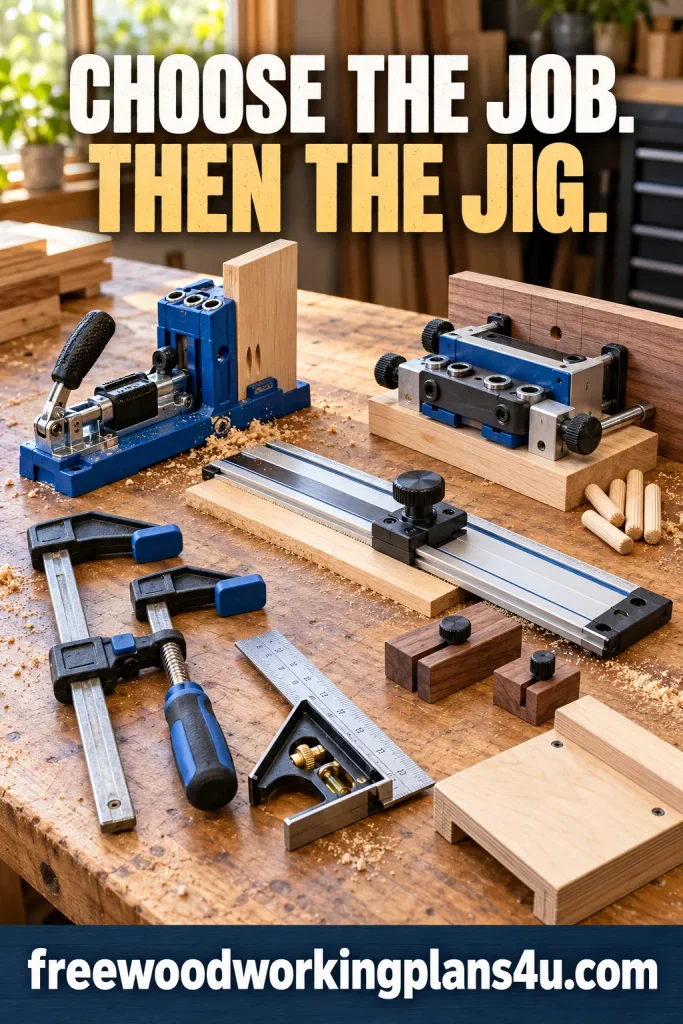
Don’t choose by piece count alone. A smaller kit with the right guides and a reliable clamping method may suit your work better than a box full of extras. And don’t assume a jig makes every cut or joint automatic: check the layout, test the settings on scrap, and make sure the workpiece is supported.
For repeated cuts, think about what happens to the offcut as well as the finished piece. Use a stop or support designed for that operation, positioned so it won’t trap the cutoff or create an unstable setup.
Give every jig a safe, stable setup
A jig can make an operation more repeatable, but it doesn’t replace safe machine use. Support the workpiece, secure the jig, keep hands away from the blade or bit, and use the guards and safety equipment specified for your machine. If a jig interferes with a guard or makes the workpiece unstable, stop and adjust the setup. OSHA’s woodworking guidance discusses hazards around saws and routers, including guarding and safe work procedures. www.osha.gov
Before using an unfamiliar jig, read its manual and try the settings on scrap. Make sure the piece is held securely and the tool can travel through the cut without binding or striking a clamp.
The questions that come up before buying
“What should my first woodworking jig be?”
Start with the jig that solves a repeated task in your next few projects. That might be a pocket-hole jig for quick furniture assembly, or a circular-saw guide for straight cuts in sheet goods. If you don’t yet know which operation you’ll repeat, wait until you have a specific project in mind.
“Is an all-in-one jig kit worth it?”
It can be, if the tools inside match your machines and the work you do. Look past the piece count and compare the actual contents, material capacity, compatibility, and availability of replacement parts.
“Can I make my own jigs?”
Yes. Simple shop-made aids—bench hooks, stop blocks, and sacrificial fences, for example—can be tailored to your space and projects. For any jig that depends on precise alignment or will be used repeatedly with a machine, build it carefully, test it, and replace it if it becomes damaged or unreliable.
“Do I need a table saw to use jigs?”
No. Jigs can guide drills, routers, handheld saws, and other tools. A circular-saw guide may be a practical way to make straight cuts in a small shop. The right choice depends on your projects and how you can support the material.
“Should I buy both a pocket-hole jig and a dowel jig?”
Not unless both solve problems you expect to encounter. They make different kinds of joints. Start with the one that suits your project plans and preferred appearance, then add another if a recurring need shows up.
Products / Tools / Resources
A compact starter setup might include:
- One joinery jig: a pocket-hole jig for quick assembly where pockets can be hidden, or a dowel jig for aligned holes and less visible fasteners.
- One guided-cutting option: a circular-saw guide or straightedge if you use a handheld saw; a suitable crosscut jig if you already use a table saw.
- Basic workholding: clamps, stop blocks, and a bench hook or sacrificial backing board.
- Layout tools: a reliable square and straightedge to check your work and align guides.
- An optional router guide: useful when a project calls for repeatable edge work or templates.
For more help fitting tools and work surfaces into a small shop, explore our guides to woodworking without a table saw, portable woodworking workbenches, and woodworking startup costs.