
It’s easy to get lost in lists of “essential” shop jigs. A crosscut sled, a router guide, a pocket-hole jig, a tapering jig—each one has its fans. But the useful question is simpler: What are you trying to make, and which part of the work feels hardest to repeat?
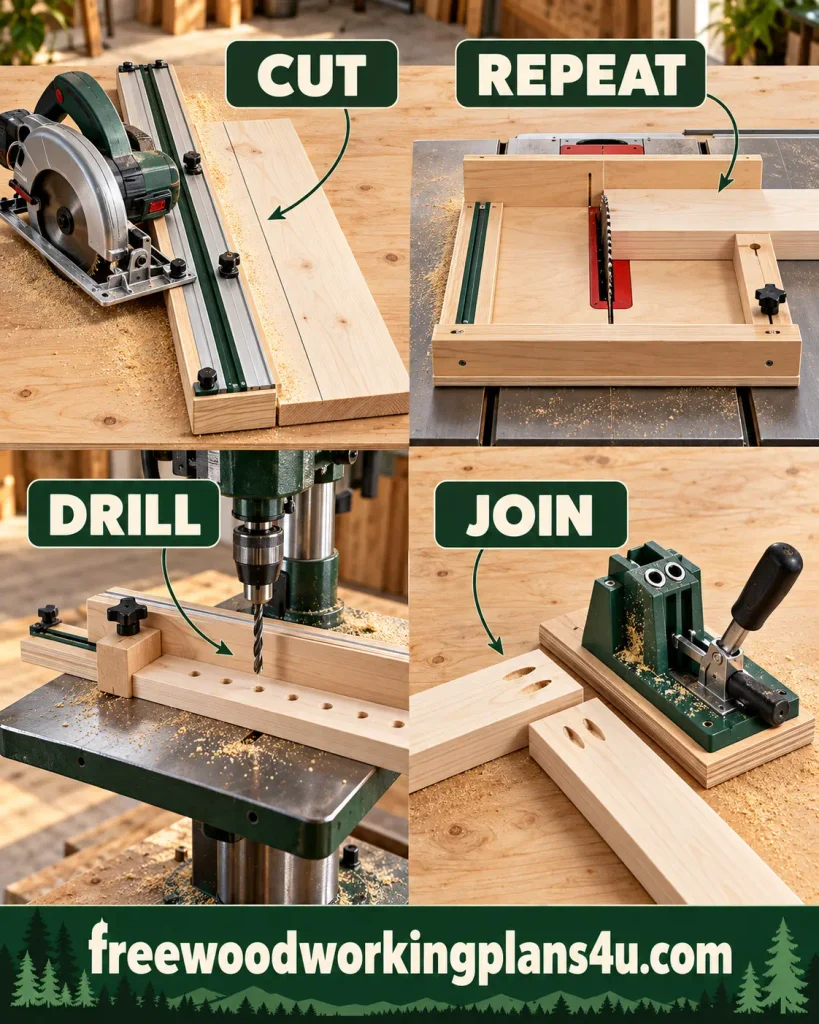
For straight cuts with a circular saw, start with a straightedge guide. For frequent crosscuts on a table saw, consider a crosscut sled. A drill press fence and stop block can help position repeated holes, while a pocket-hole jig guides angled holes for screw joinery.
There’s no single best woodworking jig for every beginner. The right one is the jig that helps with a task you’re doing now.
| The job | Jig to consider | It may suit you if… |
|---|---|---|
| Straight cuts with a circular saw | Straightedge guide | You need a straight cut and don’t have a table saw |
| Repeatable square cuts on a table saw | Crosscut sled | You use a table saw often and want to guide crosscuts |
| Repeated holes | Drill press fence and stop block | You need holes in matching locations |
| Screw joinery | Pocket-hole jig | You’re assembling a frame or simple cabinet |
| Straight grooves | Router guide or dado jig | Your project needs shelf grooves or channels |
| Matching angled parts | Tapering jig | You’re making table legs or other tapered pieces |
Start with the job in front of you
A woodworking jig can guide a tool, hold a workpiece, or help you put pieces in the same position again and again. Some jigs are simple enough to make from scrap; others are specialized tools you may prefer to buy.
Before choosing one, picture the task. Are you cutting one board, or a dozen matching parts? Are you trying to make a straight line, position a row of holes, or join two pieces? The answer narrows the options quickly.
Are you making one cut—or making the same cut all afternoon?
For a single straight cut, a clamped straightedge may be all you need. If you’re cutting several pieces to the same length, a stop block could help you repeat the measurement without starting from zero each time.
That’s where jigs earn their space in a small shop: they can make repeated steps easier to set up and follow. A jig still needs careful positioning, though. It won’t fix a measurement error or make a loose workpiece behave.
Will the jig work with the tools you own?
A crosscut sled needs a table saw. A circle-cutting jig needs a router. A doweling jig works with a drill, but the holes still need to line up.
Check the jig’s size and setup against your actual tool and workbench before you build or buy it. A jig that doesn’t fit your equipment is likely to spend more time on a shelf than in use.
Where does consistency matter most?
Jigs are helpful when you need a result to repeat: cuts at the same length, holes in the same place, or grooves running straight and parallel to an edge.
Think about the part of your project you’d least like to redo. That’s often a better starting point than buying the most complicated jig you can find.
For straight cuts, choose a guide that fits your saw
Straight cuts appear in shelves, boxes, workbenches, and furniture. The best jig depends on your saw and the shape of the cut.
Straightedge guide for a circular saw
A straightedge guide is a practical first jig if you own a circular saw. Clamp a straight guide to the workpiece, then guide the saw along it. It can help with long cuts in boards or sheet goods.
Keep the setup simple: check where the blade will travel, clamp the guide securely, and support the workpiece so it won’t shift as you cut.
Crosscut sled for a table saw
A crosscut sled rides in the table saw’s miter slots and supports the workpiece as it passes the blade. Depending on its design and setup, it can help guide square crosscuts and repeated cuts.
If you already use a table saw often, a sled may be a worthwhile shop project. If you need only a few crosscuts, the saw’s miter gauge may be enough. Read the saw’s manual and follow its instructions when building or using a sled.
Recommended guide: Woodworking Without a Table Saw: 9 Better Alternatives for Every Cut, Project, and Workshop
Stop block for matching lengths
A stop block helps position several pieces at the same measurement. Set the stop, bring each workpiece against it, and make the cuts using a setup suited to your saw and the task.
Don’t let the stop block trap an offcut or interfere with the blade. Test the arrangement on scrap and check your tool’s manual before cutting project parts.
When the challenge is alignment: holes and joinery
A row of holes can look fine one moment and frustratingly uneven the next. Joinery has its own pressure: the parts need to meet, and small alignment errors can show up in the finished piece.
Drill press fence and stop block
A fence supports the workpiece; a stop block helps locate it. Together, they can help position pieces consistently for a series of holes.
This setup can be useful when the project calls for regular spacing. Mark and test it on scrap first, especially if the holes will show on the finished piece.
Doweling jig
A doweling jig helps align holes for a dowel joint. It can be used for joining boards or assembling a simple frame, where matching holes need to meet cleanly.
The important part is keeping your reference edges consistent. Mark the pieces from the same edge, and check that the jig sits squarely before drilling. If your priority is quick screw assembly, a pocket-hole jig may be a better fit.
Pocket-hole jig
A pocket-hole jig guides a drill bit at an angle to create a pocket for a screw. Beginners often consider one for simple cabinets, face frames, and other projects where speed matters.
Think about how the joint will look and how the project will be used. Pocket-hole joinery is one option; it isn’t automatically right for every project. If you want a visible, traditional joint, another method may suit the design better.
Box-joint or dovetail jig
Box joints and dovetails make attractive corners for boxes and drawers. Jigs can guide the repeated cuts, but the setup usually takes more care than a simple straightedge or stop block.
Start with the joint you want and the tools you own. A ready-made jig may make sense if it supports the stock and joint sizes you plan to use. Whichever method you choose, practice on scrap before cutting your finished pieces.
For grooves, curves, and matching angles
Some jigs guide a router or saw along a particular path. Others hold the workpiece in a position that would be awkward to maintain by hand.
Router guide or dado jig for straight grooves
A router guide can help you cut a straight groove, such as a dado for a shelf. Some designs use a straightedge; others are made for a specific task.
A simple guide sized for your project may be enough. Check the bit, guide setup, and cut depth before routing. If you’re still learning how a router table is set up, see our router table guide.
Circle-cutting jig for curves
A circle-cutting jig lets a router follow a circular path. It can help with a round tabletop, a template, or another curved part.
Circle jigs vary in design and size, so check the smallest and largest circles the jig can make and whether it fits your router. If you need just one circle, another method may be simpler.
Tapering jig for angled parts
A tapering jig holds or guides a workpiece so you can cut an angle along its length. It can help when you’re making matching table legs or similar parts.
If you need only one angled edge, a simpler layout and cutting method may be enough. If you’re making several matching tapers, a jig can make the setup easier to repeat. Test it on scrap and follow the saw manufacturer’s instructions.
Build it, buy it, or leave it for later?
A homemade jig can be a satisfying first shop project, especially when the design is simple. But “homemade” isn’t always the best choice. Consider the accuracy you need, how often you’ll use the jig, and whether you can build it safely with your tools.
Build it when the design is straightforward
A straightedge guide, basic stop block, or simple router guide can be an approachable first build. You can size it for your tool and the work you plan to do.
If you’re looking for an easy first project, browse our quick woodworking projects guide for ideas that fit your tools and available time.
Consider buying when adjustment matters
A ready-made pocket-hole or dovetail jig may be useful if you expect to use it regularly and want a system designed for repeat setup. Before choosing one, check what it supports: workpiece thickness, clamping, and adjustability can all matter.
Don’t choose by the number of accessories alone. A simple jig that fits your projects may be more useful than a large system with features you rarely need.
Before the first cut, give the setup a test
A jig can guide or support your work, but it doesn’t replace safe tool use, a secure workpiece, or the tool’s guards. Read the machine’s manual, check the jig for looseness or damage, and test the arrangement on scrap.
Keep your hands clear of blades and bits. Use push sticks or push blocks when appropriate for the machine and cut; the Canadian Centre for Occupational Health and Safety recommends them for woodworking machines, including table saws.
Before using a jig, check that:
- The workpiece sits flat and is secured.
- The jig moves or guides the work as intended.
- Clamps, stops, and fences won’t interfere with the blade or bit.
- The first test is on scrap, with the tool set up according to its manual.
If anything shifts, binds, or feels hard to control, stop and adjust the setup before continuing.
Questions beginners ask before choosing a jig
“Is there one jig I should buy first?”
There isn’t one right answer for everyone. A straightedge guide suits a circular-saw user; a crosscut sled may help someone who uses a table saw often; and a pocket-hole jig may suit someone assembling simple frames or cabinets. Start with the task you expect to repeat.
“Do I need a crosscut sled if I have a miter gauge?”
Not necessarily. A crosscut sled can be useful for frequent table-saw crosscuts, but it may not be needed for occasional cuts. Consider your projects, your saw, and whether the miter gauge already handles the work you need to do.
“Should I build a jig or buy one?”
Build a simple jig if you can make it accurately and safely with the tools you own. Consider buying a specialized jig when you need adjustment or repeatability that would be difficult to build yourself. Test any homemade setup on scrap first.
“Can I use the same jig for different projects?”
Often, yes. A straightedge guide can help with different straight cuts, and a stop block can position parts for more than one project. Check the jig’s fit and setup each time you use it with a new tool or workpiece.
“How do I know if the jig is safe to use?”
Start with the tool’s manual and the jig’s instructions. Check that the jig is secure, the workpiece is supported, and the blade or bit has a clear path. If you’re unsure about the setup, don’t make the cut until you’ve resolved the problem.
Products / Tools / Resources
Choose tools to match the work you do most often:
- Straightedge guide: for guiding straight cuts with a circular saw.
- Crosscut sled: a build-from-plans or ready-made option for frequent table-saw crosscuts.
- Drill press fence and stop block: for positioning repeated holes.
- Pocket-hole jig: for guided pocket holes in simple frames and cabinets.
- Doweling jig: for aligning holes in dowel joints.
- Router guide or dado jig: for guiding straight grooves.
- Tapering jig: for making matching angled parts.
- Clamps and push sticks or blocks: for securing and guiding work as appropriate to your tool and cut.