
A few clamps, a portable bench, and a project you can finish in an afternoon: that can be enough to make woodworking feel at home in an apartment. The harder part is choosing a setup that works when you’re using it and tucks away when dinner, guests, or everyday life need the room again.
Quick answer: For light cutting, measuring, and assembly, a folding clamp-style workbench can be a practical starting point. Detailed hand-tool work may call for a compact bench or tabletop model secured to a sturdy surface. Measure the open and folded footprint before choosing, and check that the bench can hold your work securely.
Is woodworking in an apartment practical?
Yes, when the projects fit the room and the tools fit the neighbors. Small boxes, trays, picture frames, drawer organizers, and similar pieces are easier to handle than long boards or full-size furniture.
A portable workbench gives you a place to clamp, shape, and assemble small parts. Then it folds away. That rhythm matters in a shared home: set up, work, clean up, and let the room return to its usual life.
The limits deserve a little thought up front. A dining table may flex under pressure, while a lightweight folding bench may slide during planing.
Larger power tools can bring noise, vibration, and dust that are difficult to manage in an apartment. Check your lease and building rules, and save work that needs more space or better dust control for a suitable workshop.
The aim is a small, dependable place for the projects you can do safely and store easily.
Measure the space before you choose the bench
A portable workbench needs room while it’s open and a home while it’s folded. Measure both spaces before you buy or build.
Check:
- Working clearance: Leave room to stand, reach clamps, and move the workpiece without hitting a wall, door, or nearby furniture.
- Storage space: Measure the cupboard, closet, or corner where you’ll keep the folded bench.
- Access: Check doorways and tight turns if the bench has to move between rooms.
- Project materials: Long boards take room to carry, cut, and store. Ask whether your supplier can make rough cuts, or plan to cut stock somewhere suitable.
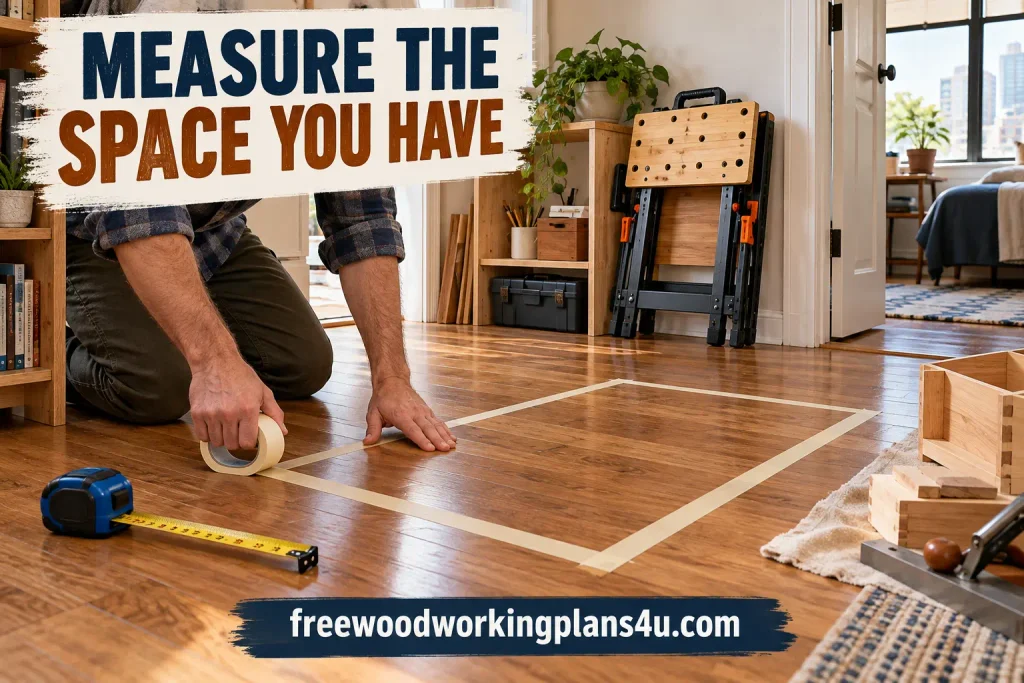
A roll of masking tape can turn guesswork into a useful test. Mark the bench’s open footprint on the floor, stand where you’d work, and imagine turning a board or reaching for a clamp. If the taped outline already feels cramped, the bench will be harder to use once the tools and workpiece are in place.
Choose a portable workbench for apartment woodworking
The right portable workbench depends on what you plan to make. Compare how it holds your work, how steady it feels, and where you’ll put it between projects.
| Workbench type | Often suits | Check before choosing |
|---|---|---|
| Folding clamp-style bench | Assembly, small repairs, light cutting, and occasional projects | Jaw opening, working height, stability, and folded size |
| Compact bench with a vise | Small hand-tool projects and detailed work | Whether it can be secured to a sturdy table or base |
| Tabletop woodworking bench | Carving, small joinery, and projects that need workholding | How it attaches to the supporting table and whether the table can handle the pressure |
| Folding-leg work surface | Larger assemblies and workpieces that need more room | Leg locks, floor grip, storage space for the top, and load information |
Folding clamp-style workbench
This style is quick to open and easy to move. Its adjustable jaws can hold a small board while you measure, sand by hand, or assemble a project.
Look closely at the jaw opening and the shapes it can grip. Check for holes or slots that accept clamps, and read the manufacturer’s load guidance. A bench that’s easy to carry may feel too light for forceful planing or chopping.
Compact or tabletop woodworking bench
For fine handwork, a compact bench with a vise or dog holes can give you more control over small parts. Some models need to be clamped or fastened to a heavier table before use. That table is part of the setup: if it flexes or slides, your compact bench can feel unsteady too.
This style is worth considering for carving, small joinery, and other detailed work when the supporting surface is firm and the workpiece is secured.
Folding-leg work surface
A folding-leg table or removable worktop gives you more room for assembly. It also needs more storage space, and some lightweight models can move under sideways pressure. Check that the legs lock firmly and the feet sit securely on your floor.
Wall-mounted fold-down bench
A fold-down bench can free up floor space, though it requires a secure installation and won’t travel with you. If you rent, ask permission before drilling. Measure the open working area as well as the folded panel; you’ll need clear space in front of the bench when it’s in use.
Recommended guide: The Complete Beginner’s Guide to Choosing a Portable Woodworking Workbench That You’ll Never Outgrow
How steady does a portable workbench need to be?
Steady enough to hold the work without rocking, sliding, or folding unexpectedly. This matters when you push a hand plane, use a chisel, or saw.
Before starting a project:
- Open the bench on a level floor and lock its supports.
- Press gently on different parts of the top to check for movement.
- Clamp a scrap piece and see whether it stays put.
- Confirm that the bench and its supports suit the task, following the manufacturer’s instructions.
Choose a vise or clamps that fit the thickness and shape of your workpiece. A scrap of wood between the clamp and your project can help prevent dents. If workholding is new to you, our guide to woodworking jigs for beginners covers simple ways to support and position small parts.
Match the bench to the work you want to do
Start with the projects you’re genuinely looking forward to making. A bench that supports those projects is more useful than one chosen for a future workshop you may never have room for.
| Project or task | Setup to consider |
|---|---|
| Assembling a small box or organizer | Folding clamp-style bench with suitable clamps |
| Carving or shaping a small piece | Compact bench or tabletop bench secured to a firm surface |
| Sanding a small component by hand | Stable bench with a way to hold the piece and manage cleanup |
| Building a small shelf | Bench and supports sized for the parts; plan where longer boards will be cut and stored |
| Cutting or machining long stock | Have the stock prepared elsewhere or use a suitable shared workshop |
If you have a larger project in mind, check the dimensions of every part before you begin. The bench may fit neatly in a closet; the boards still need room to come inside and move around the workspace. Our guides to a fold-down wall desk and a narrow shoe shelf offer projects to compare with your available space.
Which tools belong in a small apartment workspace?
A modest hand-tool kit can handle many small projects: a measuring tape, square, pencil, hand saw, clamps, and tools for the joints you plan to make. Start with what your first project needs. Add tools as your projects—and your confidence—grow.
Before bringing in a power tool, think through noise, vibration, dust, and working clearance. Follow the tool’s manual, keep its guards and safety features in place, and secure the workpiece. When the task calls for more room or dust control than your apartment can offer, take it to a suitable workshop.
Keep dust, noise, and finishes in mind
Wood dust is more than a cleanup nuisance. OSHA identifies possible skin and respiratory health effects from wood dust and describes capturing it close to its source as a primary control for powered woodworking operations. A tool-connected extractor may help, but follow the tool and extractor manufacturers’ instructions; don’t assume every particle will be captured.
For apartment woodworking:
- Choose lower-dust tasks when your space has limited ventilation.
- Use dust collection suited to the tool, where available.
- Keep dust out of shared areas and clean up before putting tools away.
- Don’t use compressed air or a fan to blow dust around the home.
- Move a task to a better-equipped workspace if you can’t manage its dust.
Noise and vibration can travel through walls and floors. Check your building’s quiet hours and rules for power tools. A mat may protect the floor, but it won’t silence a loud machine. Hand tools may be quieter for some jobs; sawing, tapping, and other impacts can still carry to neighbors.
Finishes, adhesives, and cleaners need care of their own. Read the label for instructions on use, ventilation, protective equipment, storage, and disposal. EPA guidance for indoor projects recommends minimizing and containing dust, protecting other occupants from pollutants, and following manufacturers’ instructions for paints, sealants, adhesives, and similar products.
Make setup and cleanup part of the routine
The workbench is only one part of a small workshop. A setup you can open and pack away without fuss makes it easier to come back to your project.
- Clear the floor and open the bench on a stable surface.
- Gather the tools, clamps, and materials for the task.
- Secure the workpiece before cutting, sanding, or assembling.
- Keep offcuts and cords out of walkways.
- Clean up dust and scraps using methods suited to your tools and home.
- Fold and store the bench once the work area is clear.
Keep tools in a case or lidded container. Store lumber where it can’t fall or block a doorway. If the bench is awkward to move or takes too long to set up, simplify the tool kit or find a better storage spot.
Should you buy a portable bench or build one?
A folding workbench is a straightforward option when you want a ready-made surface with integrated clamping. Compare its open and folded dimensions, weight, workholding, and manufacturer’s instructions before ordering.
Building your own bench lets you tailor the size to your room and projects. Account for the materials, hardware, tools, build space, and somewhere to store the finished bench.
Either way, decide where the bench will live before it arrives—or before you start building. A few minutes of planning can make the difference between a workbench that gets used and one that stays in the way.
Frequently asked questions
Will a folding workbench stay still while I plane?
It depends on the bench, the floor, and how much force you apply. Check the manufacturer’s guidance, secure the workpiece, and test the setup with scrap. If the bench slides or rocks, stop and choose a sturdier support.
Which portable workbench is best for a small apartment?
There’s no single best fit for every home. A folding clamp-style bench can suit light, occasional work. A compact vise bench may be better for detailed hand-tool projects. Compare the open and folded dimensions, stability, and workholding before choosing.
Can I do woodworking in my apartment without a garage?
Yes, if your projects, tools, and workspace suit your home and building rules. Small projects and hand-tool tasks are often easier to manage than jobs requiring large machines, extensive dust collection, or long stock.
How can I keep sawdust from spreading through my home?
Choose lower-dust tasks when possible and use dust collection close to a power tool when the tool supports it. Clean the immediate area carefully and avoid blowing dust into shared rooms. If dust is difficult to control, use a different workspace for that operation.
Can I attach a workbench to my apartment wall?
Only if your lease or building rules allow it and the bench can be attached safely to suitable structural support. If you rent, ask permission before drilling. A portable model may be simpler when permanent changes aren’t allowed.
What projects can I make on a small workbench?
Boxes, trays, organizers, picture frames, and other compact projects can make good starting points. Check the dimensions of each project’s parts and decide where you’ll cut and store longer boards.
Products / Tools / Resources
- Folding clamp-style workbench: Handy for light projects and occasional setup. Check jaw capacity, working height, stability, and folded size.
- Compact bench with a vise or dog holes: Consider one for small hand-tool projects if you can secure it to a sturdy surface.
- Clamps that fit your projects: A few suitable clamps help hold parts during handwork and assembly.
- Measuring and marking tools: A tape measure, square, and pencil help you plan the project and the space around it.
- Dust collection suited to your tools: Check the tool and extractor instructions to understand how to use them and what they can capture.
- Small-space project ideas: Browse our woodworking plans and choose a design that fits your bench, tools, and storage.