There is a strange moment that happens in almost every workshop sooner or later.
You finish something, brush away the sawdust, run your hand across the grain, and think:
Someone would probably pay for this.
Sometimes they would.
Sometimes they absolutely would not.
That gap between something people admire and something people actually buy is where woodworking gets interesting.
A beautiful project can be satisfying to build. A profitable woodworking project has to survive a harder test. It needs enough demand, enough perceived value, and enough margin to justify the lumber, hardware, finish, selling fees, mistakes, packaging, delivery, and time that went into it.
That is why a $500 dining table is not automatically more profitable than a $70 cutting board.
The table may swallow two days of work and hundreds of dollars in hardwood. The cutting board might come together in a batch, ship easily, require less material, and sell again and again.
So the real question is not:
What woodworking projects sell?
It is:
Which woodworking projects give you the best balance of demand, material cost, build time, perceived value, repeatability, and selling price?
That is what this guide is built to answer.
You will find 15 potentially profitable woodworking projects below, ranging from compact gift items to larger pieces of furniture. Along the way, we will look at what makes each one commercially interesting, what can quietly destroy the margin, how to price your work more intelligently, and how to test demand before your workshop fills with products nobody asked for.
Quick answer: Profitable woodworking projects usually combine manageable material costs, reasonable build times, strong perceived value, repeatable construction, and proven customer demand. Cutting boards, floating shelves, planter boxes, serving trays, personalized signs, raised garden beds, pet furniture, coffee tables, nightstands, benches, bookshelves, storage chests, dining tables, and keepsake boxes can all have profit potential when they are produced efficiently and priced properly.
Table of Contents
- What Makes a Woodworking Project Profitable?
- Quick Comparison: 15 Profitable Woodworking Projects
- Cutting Boards
- Floating Shelves
- Wooden Planter Boxes
- Personalized Wooden Signs
- Serving Trays
- Raised Garden Beds
- Entryway Organizers
- Pet Feeding Stations
- Coffee Tables
- Outdoor Benches
- Nightstands
- Bookshelves
- Storage Chests
- Dining Tables
- Personalized Keepsake Boxes
- Small Projects vs. Furniture
- How to Calculate Woodworking Profit
- How to Validate Demand
- How to Price Your Projects
- How to Increase Profit
- Where to Sell
- Projects That May Not Be Worth Selling
- Frequently Asked Questions
- Products / Tools / Resources
What Makes a Woodworking Project Profitable?
Profit starts long before the finish dries.
One of the easiest mistakes to make is looking at a $20 board, imagining a finished product selling for $100, and quietly deciding there must be $80 of profit hiding inside it.
There usually is not.
Woodworking has a way of hiding costs in plain sight.
There is the lumber, of course. Then glue. Screws. Hardware. Sandpaper. Finish. Brushes. Saw blades. Router bits. Packaging. Marketplace fees. Payment processing. Shipping. Electricity. Tool wear.
And then there is time.
Time spent measuring.
Time spent milling.
Time spent fixing the cut you wish you had not made.
Time spent sanding a surface that somehow still shows scratches under the shop light.
Time spent answering a customer who wants to know whether the shelf can be two inches wider and “maybe slightly darker.”
The numbers get real very quickly.
Recommended reading: The Science of High-Profit Woodworking: Why Certain DIY Projects Sell Out While Others Never Sell
The Five Traits Profitable Woodworking Projects Usually Share
There are exceptions to everything, but products with solid profit potential often have a few things in common.
1. The Material Cost Makes Sense
Cheap materials are not automatically better.
A walnut cutting board can be more profitable than a pine one if the buyer happily pays a premium for the wood, appearance, and craftsmanship.
The important relationship is not simply low cost.
It is:
What does this cost me to build compared with what the customer believes it is worth?
That difference is where margin lives.
2. The Finished Piece Feels More Valuable Than the Raw Material
A stack of maple and walnut strips may not look like much on the bench.
Glue them carefully. Flatten the panel. Ease the edges. Sand it smooth. Add a food-safe finish. Photograph it beside a beautiful kitchen.
Now it is no longer just lumber.
It is a wedding gift.
It is a Christmas gift.
A housewarming present.
A piece someone leaves on the counter because it looks too good to hide.
This is perceived value, and it matters enormously in handmade products.
Wood species, craftsmanship, proportions, finishing, usefulness, personalization, photography, packaging, and story all shape what a customer believes something is worth.
3. You Can Build It Without Losing Your Weekend
Complex projects can be impressive.
They can also be financial traps.
A product selling for $150 sounds appealing until you realize it takes nine hours to make.
Another product may sell for only $75, but if you can make it in ninety minutes, the economics begin to look very different.
Production time matters because revenue and profit are not the same thing.
4. You Can Build the Next One Faster
The first version of almost anything is slow.
You think.
Measure twice.
Check the plan.
Move the fence.
Change the bit.
Redo something.
By the fifth or tenth version, the project can become almost rhythmic.
Templates, jigs, standard dimensions, cut lists, batch sanding, repeatable assembly, and predictable finishing all reduce friction.
That is why simple, repeatable woodworking projects often outperform more glamorous one-off builds.
5. People Already Want the Thing
This sounds obvious.
It is also where many people go wrong.
A clever product is not automatically a wanted product.
You can spend days building something technically impressive only to discover that potential buyers smile politely and keep scrolling.
Demand matters.
And the smartest time to look for it is before you buy a pile of lumber.
Quick Comparison: 15 Potentially Profitable Woodworking Projects
The ranges and classifications below are best treated as guides rather than promises. Lumber prices, project dimensions, local demand, wood species, finishing quality, selling platform, craftsmanship, and geography can all move the numbers substantially.
| Woodworking Project | Relative Material Cost | Build Difficulty | Shipping | Selling Potential |
|---|---|---|---|---|
| Cutting boards | Low–Medium | Beginner–Intermediate | Easy | Strong |
| Floating shelves | Low–Medium | Beginner | Moderate | Strong |
| Planter boxes | Low | Beginner | Moderate | Strong |
| Personalized signs | Low | Beginner | Easy | Strong |
| Serving trays | Low–Medium | Beginner | Easy | Strong |
| Raised garden beds | Medium | Beginner | Difficult | Strong locally |
| Entryway organizers | Low–Medium | Beginner | Moderate | Strong |
| Pet feeding stations | Low–Medium | Beginner | Moderate | Good |
| Coffee tables | Medium | Intermediate | Difficult | Strong locally |
| Outdoor benches | Medium | Intermediate | Difficult | Strong locally |
| Nightstands | Medium | Intermediate | Difficult | Good |
| Bookshelves | Medium | Beginner–Intermediate | Difficult | Good |
| Storage chests | Medium | Intermediate | Difficult | Good |
| Dining tables | High | Intermediate–Advanced | Very difficult | High-ticket |
| Keepsake boxes | Low–Medium | Intermediate | Easy | Strong gift potential |
The table gives you the broad picture.
The real value appears when you start looking at why each project can work.
Because two woodworkers can sell the same type of product, charge similar prices, and end up with completely different results.
1. Cutting Boards
The cutting board is almost absurdly simple in concept.
A flat piece of wood.
That is it.
Yet a beautifully made cutting board can sell for many times the cost of the raw timber because the buyer is not comparing it with a plank from the lumber rack.
They are comparing finished objects.
That makes cutting boards one of the clearest examples of how craftsmanship creates value.
Why Cutting Boards Can Be Profitable
They have a lot going for them:
- Familiar product
- Broad customer base
- Strong gift appeal
- Relatively simple shipping
- Premium hardwood options
- Easy personalization
- Excellent batch-production potential
A basic edge-grain board and an intricate end-grain butcher block are two very different products, though.
The more complexity you introduce, the more labor you introduce.
That can be worth it—but only if the price rises enough to compensate.
Approximate Economics
A relatively simple hardwood cutting board might use around $15–$40+ in materials, while elaborate end-grain designs or large butcher blocks can cost substantially more.
Finished boards may sell anywhere from approximately $40 to well over $150, depending on dimensions, wood species, construction, finish, brand positioning, and personalization.
The number that matters is not the selling price.
It is what remains afterward.
How to Make a Cutting Board Feel More Valuable
A plain board has to compete with every other plain board.
Details create distance.
You might add:
- Juice grooves
- Finger grips
- Handles
- Contrasting hardwood
- Unusual shapes
- Engraving
- Names or dates
- Gift packaging
- Matching board sets
Suddenly the product is not “a chopping board.”
It is something a customer can imagine giving at a wedding.
That shift in context changes perceived value dramatically.
2. Floating Shelves
Floating shelves live in a sweet spot.
They are simple enough for many beginners to build, yet once installed they can look expensive, architectural, and intentional.
They also solve a problem nearly every home has.
Where do you put the books?
The plants?
The photographs?
The bathroom bottles?
The kitchen jars?
The little collection of things you want visible but not scattered everywhere?
A shelf handles all of it.
Why Floating Shelves Sell
They combine two kinds of value:
function and appearance.
That is useful.
A purely decorative object has to win on taste.
A shelf can win because it looks good and because the customer needs somewhere to put things.
Approximate Economics
Depending on the wood, dimensions, construction method, and mounting system, a shelf might require approximately $10–$30+ in materials before specialized hardware.
Selling prices vary widely based on thickness, width, species, finish, hardware, and whether shelves are sold individually or in sets.
The Quiet Power of Selling Sets
Most people do not always want one shelf.
They want a wall.
That makes bundles interesting.
One shelf might be a $45 purchase.
A matching set of three becomes a room solution.
The customer gets cohesion.
You get a larger order.
That is a much better transaction for both sides.
3. Wooden Planter Boxes
A planter box rarely looks complicated on paper.
Four sides. A base. Maybe feet. Maybe a liner.
Yet the finished product can fit neatly into several strong markets at once: gardening, patios, balconies, landscaping, gifts, and outdoor décor.
Seasonality also gives this category a pulse.
The first warm days of spring have a strange effect on people.
Suddenly everyone wants to repair the deck, tidy the yard, buy herbs, grow tomatoes, and make the patio look like somewhere they actually want to sit.
That is when planter boxes begin to feel timely.
Why Planter Boxes Can Work
They are often:
- Straightforward to build
- Easy to standardize
- Suitable for common lumber
- Good for batch production
- Appealing in sets
- Practical for local selling
Approximate Economics
Small planters might use roughly $10–$35+ in materials, depending on lumber type and dimensions.
Larger cedar boxes, elevated planters, and decorative designs can cost much more.
Standard Sizes Beat Endless Customization
You could offer any dimension imaginable.
You could also spend your life answering measurement questions.
A cleaner approach is often:
- Small
- Medium
- Large
Then offer a few optional finishes or features.
The customer still has choice.
Your workshop still has order.
4. Personalized Wooden Signs
A wooden sign with a generic phrase is décor.
A wooden sign carrying a family name, wedding date, cabin name, business name, or meaningful phrase becomes something else entirely.
It belongs to someone.
That sense of ownership has economic value.
Why Personalization Changes the Product
Personalized woodworking can fit naturally into:
- Weddings
- Anniversaries
- Housewarmings
- Birthdays
- Cabins
- Family homes
- Businesses
- Memorial gifts
The material may remain inexpensive.
The emotional value does not.
Approximate Economics
Smaller wooden sign blanks can require relatively little material, sometimes below $10–$20 before paint, engraving, vinyl, mounting hardware, and finishing supplies.
Selling prices depend heavily on design, dimensions, customization, and craftsmanship.
Watch the Customization Trap
There is one danger.
Every customer can become a new design job.
Different size.
Different font.
Different wording.
Different stain.
Different layout.
Different everything.
If each order begins from scratch, personalization starts eating your margin.
The solution is to create boundaries.
Offer defined choices for:
- Sizes
- Fonts
- Layouts
- Finishes
- Wood types
The customer still gets something personal.
You keep a process you can actually repeat.
5. Wooden Serving Trays
Serving trays are easy to underestimate.
They are functional, attractive, compact enough to ship, suitable for gifting, and easy to upgrade without reinventing the project.
A basic pine tray works.
A walnut tray with premium handles, clean joinery, and a deep satin finish feels like a completely different object.
Same function.
Very different perceived value.
Why Serving Trays Have Profit Potential
They can offer:
- Modest material requirements
- Straightforward construction
- Good gift appeal
- Easy personalization
- Manageable shipping
- Efficient batch production
Approximate Economics
Depending on lumber and hardware, a tray might require roughly $15–$40+ in materials.
Premium hardwood, brass handles, decorative joinery, engraving, or special finishing can push the cost—and potentially the selling price—higher.
Stop Thinking One Product at a Time
A single serving tray is fine.
But what if the same visual style becomes:
- Serving tray
- Cutting board
- Coaster set
- Small charcuterie board
Now you have a collection.
This is how one successful woodworking idea starts doing more work for you.
6. Raised Garden Beds
Raised garden beds are big, awkward, and inconvenient to ship.
That sounds like a disadvantage.
It can actually become the opportunity.
Large products often discourage national competition because shipping them is so unpleasant.
Local selling changes the economics completely.
Why Raised Beds Can Sell Locally
The customer may want a vegetable garden.
What they do not necessarily want is to:
- Calculate dimensions
- Buy the lumber
- Haul it home
- Cut every piece
- Figure out the construction
- Assemble the bed
You are selling the finished product, yes.
But you are also selling convenience.
Approximate Economics
Depending on dimensions, lumber type, board thickness, and hardware, material costs might range from approximately $30 to well above $100.
Large cedar beds can easily exceed those figures.
Delivery Can Become Part of the Offer
Instead of fighting the size of the product, lean into it.
You might offer:
- Local delivery
- Assembly
- Installation
- Multiple-bed packages
Some products are poor candidates for nationwide shipping and excellent candidates for local sales.
Those are not contradictions.
They are different markets.
7. Entryway Organizers
The entryway is where household clutter goes to gather.
Keys.
Mail.
Dog leads.
Coats.
Sunglasses.
Bags.
Receipts.
The one glove nobody can find the partner for.
A good entryway organizer turns that mess into order.
That gives it a strong advantage: it solves several small annoyances at once.
Why Problem-Solving Products Sell
Décor has to appeal to taste.
Problem-solving products can appeal to frustration.
A wall-mounted organizer might combine:
- Shelf
- Hooks
- Mail slot
- Key holder
- Small storage area
Not much lumber.
A lot of usefulness.
Give It a Specific Person to Serve
A generic organizer is fine.
A product clearly designed for a type of buyer becomes easier to understand.
You might create versions for:
- Small apartments
- Busy families
- Dog owners
- Farmhouse interiors
- Minimalist homes
- Mudrooms
People notice products that seem made for their life.
8. Pet Feeding Stations
People are wonderfully irrational about their pets.
That is not criticism.
It is affection.
A dog does not care whether the food bowl sits on the floor or inside a beautifully finished walnut stand.
The owner might care quite a lot.
That emotional layer changes the market.
Why Pet Products Can Work
Pet feeding stations naturally support variation:
- Small dogs
- Large dogs
- Cats
- Single bowls
- Double bowls
- Storage compartments
- Personalized versions
Approximate Economics
Materials might fall somewhere around $15–$50+, depending on wood, dimensions, bowls, hardware, and finish.
Premium hardwood or integrated storage can raise costs significantly.
Personalization Creates Attachment
Add the pet’s name and the station becomes more than a stand.
It feels made for their dog.
That is the power of emotional specificity.
The wood has not become more expensive.
The meaning has.
9. Coffee Tables
Coffee tables mark the point where things become more serious.
The selling prices are higher.
So are the stakes.
Furniture uses more material, consumes more floor space, takes longer to build, and creates more expensive mistakes.
It can still be very profitable.
You simply have less room for careless arithmetic.
Why Coffee Tables Can Be Attractive Products
They are highly visible pieces of furniture, which means buyers care about details:
- Wood species
- Dimensions
- Style
- Storage
- Leg design
- Finish
- Joinery
- Compatibility with the room
That creates room to differentiate.
Learn more: The Complete Outdoor Coffee Table Woodworking Plans Guide: Designs, Materials, Costs & Pro Secrets
Approximate Economics
A coffee table could require anywhere from approximately $40 to several hundred dollars in materials, depending on design and lumber choice.
Selling prices vary just as widely.
Local Selling Often Makes More Sense
Shipping a finished coffee table across the country can become an expensive exercise in frustration.
Local marketplaces remove much of that burden.
The customer picks it up.
Or you charge for delivery.
Either way, the product no longer has to survive national parcel economics.
Revenue Can Fool You
Suppose the table sells for $350.
Nice.
Now subtract $140 in materials.
Then finishing supplies.
Then selling costs.
Then twelve hours of your time.
The number suddenly feels different.
That is why profitable woodworking always comes back to the same discipline:
calculate what remains, not what comes in.
10. Outdoor Benches
Outdoor benches sell something beyond seating.
They sell a picture.
A quiet corner under a tree.
A place beside the cottage.
A seat on the porch.
A bench beside the garden where someone drinks coffee early in the morning.
That emotional scene matters because furniture is rarely purchased as a purely functional object.
Recommended guide: Farmhouse Outdoor Bench Woodworking Plans: The 7-Step Blueprint That Saves Hundreds and Delivers an Heirloom-Worthy Backyard Showpiece
Potential Customers
Outdoor benches can appeal to:
- Homeowners
- Gardeners
- Cottage owners
- Cafés
- Businesses
- Community spaces
- Gift buyers
Material Choice Becomes Part of the Promise
Outdoor furniture lives a harder life than indoor furniture.
Rain.
Sunlight.
Temperature swings.
Moisture.
Dirt.
That means wood selection, joinery, drainage, fasteners, and finishing are not background details.
They determine whether the bench still looks good after a season outside.
11. Nightstands
Nightstands sit in an interesting middle ground.
They are smaller than most furniture.
They still feel substantial.
And quite often, the customer needs two.
That last detail matters.
Why Nightstands Can Work
Designs can include:
- Drawers
- Open shelves
- Charging access
- Cable management
- Premium hardwood
- Decorative joinery
- Custom heights
Because bedrooms vary so much, custom sizing can also create a useful advantage over mass-produced furniture.
Selling Pairs Changes the Economics
Building two nightstands does not necessarily take twice as long as building one.
Once the tools are set.
Once the measurements are established.
Once the jig is positioned.
Once the finish is open.
The second unit often moves faster.
This is batch production on a furniture scale.
12. Bookshelves
Bookshelves have escaped the library.
Today they hold almost anything:
Plants.
Records.
Baskets.
Photos.
Office supplies.
Collectibles.
Speakers.
Books, occasionally.
That broad usefulness keeps them relevant.
Why Bookshelves Still Sell
Storage never really stops being a problem.
And custom woodworking has one advantage mass-produced furniture often cannot match:
fit.
You can build for:
- Narrow walls
- Alcoves
- Children’s rooms
- Home offices
- Record collections
- Window spaces
- Odd dimensions
Learn more: 15 Modern Bookshelf Woodworking Plans Ranked by Skill Level (From Absolute Beginner to Master Builder)
Do Not Compete With Flat-Pack Furniture on Price
You probably will not win.
And you do not need to.
Compete on:
- Fit
- Material
- Strength
- Craftsmanship
- Appearance
- Custom dimensions
If the buyer sees your bookshelf as simply “another shelf,” price becomes everything.
If they see it as the shelf that finally fits that impossible wall, comparison becomes much harder.
13. Storage Chests
A storage chest is one of those projects that can quietly serve several markets at once.
It can be a:
- Blanket chest
- Toy box
- Entryway bench
- Bedroom storage unit
- Keepsake chest
- Window-seat style bench
That versatility helps.
Multi-Purpose Furniture Feels Useful
Space is expensive.
In small homes and apartments, furniture that performs two jobs can feel especially valuable.
A storage chest that also becomes seating is not simply a wooden box.
It is storage plus furniture.
That matters to buyers.
Learn more: 25 Easy Chest Woodworking Plans That Look Like Expensive Custom Furniture
Safety Is Not Optional
If you are building toy chests or anything used around children, take lid support, hinges, edges, stability, ventilation where appropriate, and finish safety seriously.
Good woodworking is not only about what looks beautiful.
It is also about what behaves safely in the real world.
14. Dining Tables
Dining tables are where woodworking can move into serious money.
They are also where mistakes become seriously expensive.
A dining table consumes more lumber, more workshop space, more finishing material, more time, and more physical effort than most smaller projects.
The customer expectations rise right alongside the price.
Why Dining Tables Command Higher Prices
A table is central to a home.
Meals happen there.
Birthdays happen there.
Homework happens there.
Guests gather there.
People can live with a dining table for years.
That gives the object both functional and emotional weight.
High Price Does Not Automatically Mean High Profit
The selling price might look exciting.
Then you begin subtracting.
Premium hardwood.
Hardware.
Finish.
Hours of milling.
Joinery.
Glue-ups.
Flattening.
Sanding.
Transport.
Delivery.
One bad board or finishing mistake can become expensive very quickly.
Custom Orders Can Reduce the Risk
Rather than filling your shop with speculative $1,000 tables, a made-to-order model can let you agree on the details first:
- Dimensions
- Wood species
- Style
- Finish
- Price
- Delivery
- Timeline
Then you build.
With high-cost furniture, avoiding unnecessary inventory can be part of profitability.
15. Personalized Keepsake Boxes
Keepsake boxes sit at the opposite end of the size spectrum.
Tiny compared with a table.
Potentially enormous in emotional value.
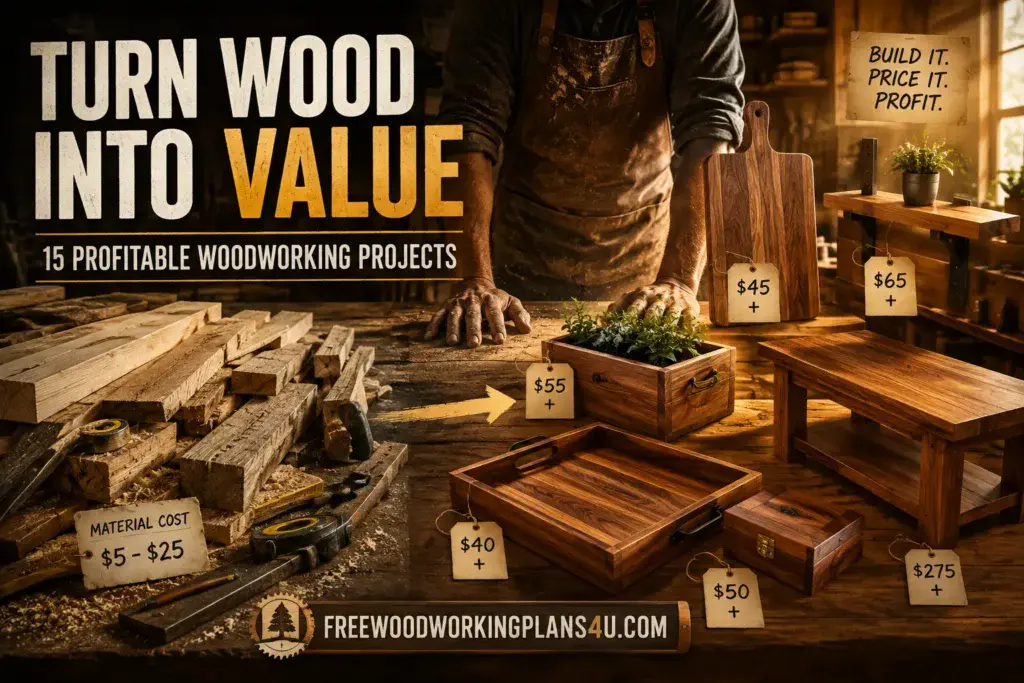
A box made for someone’s wedding, graduation, retirement, new baby, or memorial is not bought because someone desperately needs more rectangular storage.
It carries meaning.
Why Keepsake Boxes Can Sell
They fit naturally into emotional buying occasions:
- Weddings
- Anniversaries
- Births
- Graduations
- Memorials
- Retirement
- Family heirlooms
- Special gifts
Approximate Economics
Small boxes can use relatively little hardwood, although premium hinges, lining, engraving, and advanced joinery increase cost.
Their compact size also makes them far easier to ship than furniture.
Small Projects Reveal Your Craftsmanship
With a large rustic bench, a minor imperfection can disappear into the design.
A small keepsake box gives you nowhere to hide.
The buyer sees:
- Corners
- Joinery
- Grain alignment
- Surface preparation
- Finish quality
- Lid fit
Small objects reward precision.
And premium buyers notice it.
Small Woodworking Projects vs. Furniture: Which Is More Profitable?
There is no single winner.
They are different games.
Small Woodworking Projects
Potential advantages include:
- Lower startup cost
- Faster builds
- Easier batch production
- Lower inventory risk
- Easier storage
- Easier shipping
- Strong gift potential
The tradeoff is obvious.
You may need more transactions.
Furniture
Potential advantages include:
- Higher selling prices
- Greater customization
- Strong local-market potential
- Higher perceived craftsmanship
The downsides include:
- More expensive materials
- Longer build times
- More storage
- More difficult delivery
- Greater financial risk
For a beginner, chasing the highest selling price is rarely the smartest starting point.
A better formula is:
Demand × Margin × Build Speed × Repeatability
That combination often tells you more than price alone ever will.
The Profitability Formula Most Beginners Miss
Here is the simplest version:
Woodworking Profit = Selling Price − Materials − Selling Expenses − Overhead − Labor Value
Imagine you sell a product for $100.
Materials cost $25.
Selling and payment fees cost $10.
Consumables and overhead add another $5.
You now have $60 before labor.
If the project took six hours, that is one business.
If it took ninety minutes, that is another.
Material Costs
Include everything that physically goes into the product:
- Lumber
- Plywood
- Hardware
- Fasteners
- Glue
- Finish
- Decorative components
Consumables
Then count the things you slowly use up:
- Sandpaper
- Saw blades
- Router bits
- Drill bits
- Brushes
- Rags
- Abrasives
You are not charging one customer for an entire saw blade.
But pretending those costs do not exist does not make them disappear.
Overhead
Depending on how seriously you approach woodworking as a business, overhead may include:
- Electricity
- Workshop rent
- Tool depreciation
- Insurance
- Website costs
- Advertising
- Accounting
- Packaging supplies
Selling Costs
Selling online may bring:
- Listing fees
- Transaction fees
- Payment-processing fees
- Advertising costs
- Shipping
- Returns
This is why a project can look wildly profitable while sitting on the bench and much less exciting once it reaches the customer.
The Sweet Spot: High Perceived Value, Low Production Complexity
Some of the best woodworking opportunities are not the most complicated builds.
In fact, complexity can work against you.
Imagine:
Product A: $150 selling price, eight hours of work.
Product B: $75 selling price, ninety minutes of work.
Product A creates more revenue per sale.
Product B may create much better value per hour.
Customers do not know how difficult your project was.
Mostly, they do not care.
They care about what the finished object does for them.
How it looks.
How it fits.
How useful it is.
How it makes the room feel.
How personal it feels.
That is why perceived value often matters more than technical complexity.
How to Validate Demand Before Building Anything
You can learn a lot about profitability without touching a saw.
That is useful because lumber is cheaper before you buy it.
Before you produce ten units, look for signs that buyers actually exist.
Search Existing Marketplaces
Study products similar to the idea you are considering.
Pay attention to:
- Styles
- Prices
- Dimensions
- Materials
- Personalization
- Product photos
- Reviews
- Variations
The goal is not imitation.
It is understanding the market.
Read Reviews Like a Product Designer
Reviews are free research.
People tell you what works.
They also tell you what drives them crazy.
Watch for repeated complaints:
- Shelf too shallow
- Finish looks cheap
- Hardware feels weak
- Assembly is difficult
- Dimensions are awkward
- Packaging is poor
A repeated complaint is sometimes a gap waiting for a better product.
Look Locally Too
Some woodworking markets barely make sense online.
A six-foot bench might sell beautifully within 30 miles and be ridiculous to ship nationwide.
Local listings can reveal what people around you are already buying.
Build One Prototype
One.
Not twenty.
Build it.
Time the process.
Calculate the real material usage.
Photograph it.
Offer it for sale.
Then watch what happens.
A prototype can save you from manufacturing a pile of optimism.
How to Price Handmade Woodworking Projects Without Guessing
Pricing makes many otherwise confident woodworkers uncomfortable.
They can cut dovetails.
Flatten slabs.
Fit drawers.
Dial in a finish.
Then someone asks:
“How much?”
Silence.
The difficulty often comes from thinking price should somehow emerge naturally from the object.
It does not.
You need a method.
Cost-Plus Pricing
Start with the actual cost of producing the product.
Add the margin needed to make the project worthwhile.
This gives you a financial floor.
Market-Based Pricing
Then look outward.
What are comparable products selling for?
Be careful with comparisons.
A handmade solid-walnut nightstand is not directly comparable to a veneered flat-pack product just because both sit beside a bed.
Compare like with like as closely as possible.
Value-Based Pricing
Some products carry emotional or contextual value well beyond their material cost.
Personalized wedding pieces are an obvious example.
The lumber does not suddenly become more expensive because you engraved a date.
The meaning changes.
That can change what the buyer is willing to pay.
How to Increase Woodworking Profit Without Simply Working Longer
The instinct is usually:
If I want to earn more, I need to build more.
Not necessarily.
Sometimes the better move is making each hour in the workshop worth more.
Batch Similar Operations
Do not finish one cutting board completely before touching the next if you are producing several.
Group tasks.
Cut everything.
Glue everything.
Flatten everything.
Sand everything.
Finish everything.
Constantly changing tools and setups wastes time.
Standardize Dimensions
Unlimited choice sounds wonderful on a sales page.
It can be brutal in the shop.
A carefully chosen set of standard sizes simplifies:
- Material purchasing
- Cut lists
- Jigs
- Packaging
- Pricing
- Production
Customization can still exist.
It just needs boundaries.
Add Premium Options
Not every customer wants the cheapest version.
Give them somewhere to go.
Possible upgrades include:
- Premium hardwood
- Larger size
- Personalization
- Better hardware
- Premium finish
- Gift packaging
Sell Sets
One shelf is useful.
Three matching shelves feel like a complete arrangement.
One cutting board is practical.
A board plus serving board and coasters feels gift-ready.
One nightstand is furniture.
A matching pair feels finished.
Bundles increase order value without requiring you to find an entirely new customer.
Improve the Photography
Online, customers cannot touch your work.
They cannot feel the finish.
They cannot inspect the edges.
They cannot run a finger over the grain.
Photography has to carry all of that weight.
Show:
- Grain detail
- Joinery
- Scale
- Finish
- Hardware
- The product being used
- The product inside a real room
Excellent craftsmanship deserves photographs that allow people to see it.
Where Should You Sell Woodworking Projects?
The right sales channel depends heavily on what you build.
Do not choose the marketplace first and force every product into it.
Local Marketplaces
Often useful for:
- Dining tables
- Coffee tables
- Benches
- Garden beds
- Larger shelving
- Furniture
The obvious advantage is avoiding long-distance shipping.
Craft Fairs and Local Markets
Good candidates include:
- Cutting boards
- Wooden signs
- Serving trays
- Keepsake boxes
- Small décor
- Gift products
Handmade woodworking benefits from being touched and examined.
Markets allow customers to do exactly that.
Online Marketplaces
Small, standardized, shippable products are often easier to sell online on Etsy.
You gain access to a much larger customer base.
You also gain competition, platform fees, and shipping complexity.
Your Own Website
A website gives you control over:
- Branding
- Product education
- Customer relationships
- Search traffic
- Long-term visibility
It also means you have to attract your own audience.
This is where helpful woodworking content can become valuable. Someone may first arrive looking for advice about choosing lumber or building a planter box and later become interested in products, plans, tools, or other woodworking resources.
Learn more: Woodworking Craft Business Ideas: 37 Profitable Products You Can Make and Sell
When a Popular Woodworking Project Is Still a Bad Product
Popularity can be misleading.
Something can sell frequently and still be completely wrong for your workshop.
The Margin Is Too Thin
If customers will pay $30 and it costs you $25 before labor, popularity does not rescue the product.
It Takes Too Long
Some projects are enjoyable precisely because they are intricate.
That does not make them commercially sensible.
If customers will not pay for the complexity, simplify the design or choose something else.
Shipping Destroys the Numbers
Large, heavy, fragile, or awkward products can look profitable until the courier enters the conversation.
Always think about delivery before committing to a product.
Everyone Is Competing on Price
Handmade woodworking has a difficult time when the customer sees no meaningful difference between products.
If all they see is “wooden shelf,” the cheapest seller has an advantage.
If they see “solid oak floating shelf made to fit an awkward 93 cm wall,” the comparison changes.
Custom Orders Take Over Your Life
Customization can be profitable.
Unlimited customization can turn every order into a project-management job.
Set boundaries.
A profitable product should not require a new business model every time someone places an order.
The Five-Minute Woodworking Profit Test
Before you start another project, ask yourself five questions.
1. What Will the Materials Really Cost?
Not just lumber.
Everything.
2. How Long Will It Actually Take?
Estimate first.
Then time the prototype.
Your memory is usually kinder than the clock.
3. What Do Comparable Products Sell For?
Check the places where you realistically intend to sell.
4. What Does the Sale Cost?
Include:
- Fees
- Packaging
- Shipping
- Delivery
- Payment processing
5. What Is Left After Labor?
Use:
Selling Price − Total Costs − Labor Value
Then ask one final question:
Would I happily make another one for that amount?
That answer matters more than almost anything else.
Frequently Asked Questions About Profitable Woodworking Projects
“I just want to know—what woodworking projects are actually the most profitable?”
There is no single winner for everyone.
Projects tend to have better profit potential when material costs are relatively low, production is efficient, buyer demand is strong, and the finished product carries high perceived value.
Cutting boards, floating shelves, serving trays, personalized products, planter boxes, smaller furniture, and certain custom pieces can all fit that profile.
Your own efficiency and market matter just as much as the product itself.
“What woodworking projects are easiest to sell if I am just starting?”
Familiar products are usually easier for customers to understand.
That can include:
- Shelves
- Cutting boards
- Planters
- Storage pieces
- Pet products
- Simple furniture
- Gift items
You do not need to invent something revolutionary.
You need to make something people already understand and give them a reason to choose yours.
“What small woodworking projects could I sell from home?”
Good possibilities include:
- Cutting boards
- Keepsake boxes
- Serving trays
- Signs
- Small shelves
- Desk organizers
- Coasters
- Pet accessories
- Small planters
Smaller products also tend to be easier to store, photograph, package, and ship.
“Can a beginner really make money selling woodworking?”
Potentially, yes.
You do not need advanced joinery or a professional cabinet shop to start testing products.
Simple, repeatable projects can teach you a great deal about:
- Production
- Pricing
- Photography
- Selling
- Customer service
- Demand
The first goal does not need to be building a woodworking empire.
It can simply be making one product someone willingly pays for.
“Is handmade furniture actually profitable?”
It can be.
Furniture has higher selling prices, but the materials, labor, workshop space, skill requirements, and delivery challenges are also greater.
The big price tag alone tells you very little about the true margin.
“Should I start with small products or furniture?”
Small products are often easier to batch, store, and ship.
Furniture may work especially well for local sales and custom orders.
A lot depends on your workshop, tools, skills, local market, and how much money you are comfortable tying up in each build.
“How much should I charge for handmade woodworking?”
Your price should account for:
- Materials
- Consumables
- Overhead
- Selling expenses
- Labor
- Margin
- Market expectations
Do not price a project based only on what the lumber cost.
You are selling the finished product, not the pile of boards it came from.
“Should I build inventory first and hope it sells?”
Usually, testing a prototype is safer.
Make one.
List it.
See what happens.
Once you have clearer evidence of demand, producing several units becomes easier to justify.
“How do woodworkers make projects more profitable?”
Common approaches include:
- Batch production
- Standardized designs
- Better material yield
- Premium options
- Personalization
- Bundles
- Improved photography
- Higher-value positioning
- Faster workflows
- Choosing projects with favorable build-time-to-price ratios
Sometimes the best way to make more is not building faster.
It is choosing better products.
Products / Tools / Resources
You do not need a workshop packed with every tool in the catalog to start building woodworking projects for sale. A few reliable basics, good measuring equipment, and sensible finishing supplies can take you surprisingly far.
A dependable table saw or circular saw: Useful for breaking down lumber and sheet goods accurately. A table saw becomes especially valuable when you begin batch-producing projects with repeatable dimensions.
Random orbital sander: Sanding can quietly consume a huge amount of production time. A good random orbital sander helps you prepare surfaces faster and more consistently.
Quality clamps: Cutting boards, furniture panels, trays, shelves, and boxes all benefit from reliable clamping pressure. You will almost always find a use for more clamps than you expected.
Combination square: Accurate woodworking starts with accurate layout. A solid combination square is one of those simple tools that ends up being used on almost every project.
Digital caliper: Helpful when checking thickness, hardware dimensions, bit sizes, and small measurements where guesswork gets expensive.
Pocket-hole jig: Particularly useful for beginner-friendly furniture, planters, benches, storage pieces, and simple carcass construction when speed and repeatability matter.
Router: Useful for edge profiles, grooves, rabbets, templates, lettering, and decorative details. A router can add perceived value to relatively simple projects without requiring an entirely different build process.
Food-safe cutting-board finish: If you plan to sell cutting boards or serving boards, use a finish specifically suitable for the intended food-contact application and follow the manufacturer’s directions carefully.
Exterior wood finish: Outdoor benches, planters, and garden projects need finishes appropriate for outdoor exposure. Match the finish to the wood species and expected conditions.
Woodworking plans and cut lists: Repeatable plans save time. Once you have a design that works, document the measurements, hardware, material quantities, and assembly order so the next build does not require reinventing the process.
Cost-tracking spreadsheet: One of the least exciting tools in the workshop may also be one of the most profitable. Record material cost, build time, consumables, fees, selling price, and final margin for every product you test.
Marketplace research: Before buying lumber for a new product, spend time studying comparable listings, customer reviews, styles, dimensions, and price ranges. The market can tell you a lot before the saw ever starts.
Prototype notebook: Keep notes on what slowed you down, where material was wasted, which measurements should change, which jigs would help, and how long each stage took. The second version should almost always be smarter than the first.