
Can You Really Build Beautiful Outdoor Furniture from Ordinary 2×4 Lumber?
At first glance, a stack of 2×4 boards doesn’t look like much.
It’s the same lumber used behind drywall, beneath roofs, and inside the walls of houses we rarely think about. Most people walk past it without a second look.
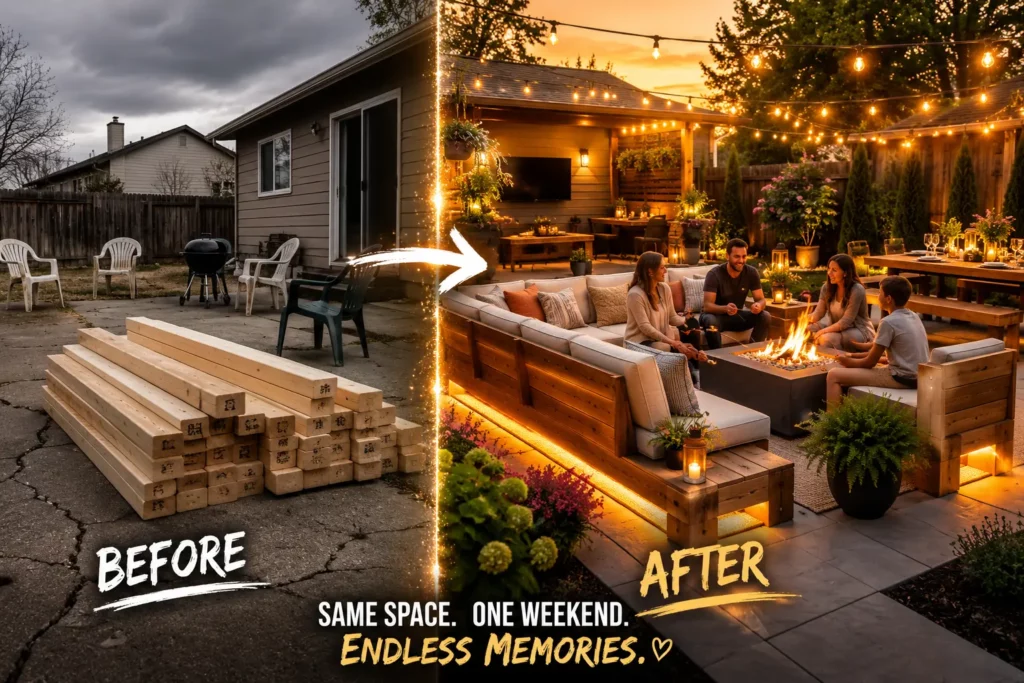
Yet in backyards across the country, those same boards are becoming outdoor sofas, Adirondack chairs, dining tables, fire pit benches, and complete patio furniture sets that look as though they came from a designer showroom.
That’s the part that surprises people.
Not because it sounds impossible—but because once you see it, it suddenly feels obvious.
The truth is that great outdoor furniture has never been about expensive materials. It’s about proportion. Structure. Comfort. The small details most people never notice consciously but immediately feel when they sit down.
With a few basic tools, some patience, and the right outdoor furniture woodworking plans using 2×4 lumber, you can build pieces that are durable, attractive, and tailored specifically to your space.
No professional workshop required.
No specialty machinery.
No thousand-dollar tool collection gathering dust in the garage.
Just lumber, a plan, and a weekend.
Quick Answer
If you’re looking for the shortest path to success, here’s what matters most:
Best beginner projects
- Outdoor bench
- Garden side table
- Patio coffee table
- Simple lounge chair
Best value projects
- Outdoor sofa
- Outdoor dining table
- Fire pit bench
- Modular sectional seating
Most important lesson
Spend more effort selecting quality boards and preparing surfaces than chasing expensive tools. Furniture remembers craftsmanship far longer than it remembers equipment.
Why 2×4 Lumber Has Become the Foundation of Modern DIY Outdoor Furniture
Something interesting has happened over the last decade.
Outdoor furniture prices have climbed dramatically.
A patio sofa that once felt expensive at $500 now regularly sells for two or three times that amount. Complete seating collections routinely stretch into the thousands. Add cushions, delivery fees, and assembly costs, and the total can become difficult to justify.
At the same time, DIY builders discovered something furniture manufacturers have always known:
The materials themselves are often only a small part of the final cost.
Design drives value.
Presentation drives value.
Perception drives value.
A thoughtfully built outdoor sofa made from standard 2×4 lumber can create the same visual impact as furniture costing ten times as much.
That’s why searches for outdoor woodworking projects continue growing year after year. Homeowners aren’t simply looking for ways to save money anymore.
They’re looking for ownership.
They’re looking for personalization.
They’re looking for the satisfaction that comes from stepping onto a patio and knowing every board, every joint, and every detail was built by their own hands.
And that feeling is difficult to buy.
What Makes 2×4 Lumber So Effective for Outdoor Furniture Projects?
The answer isn’t just affordability.
If cost were the only factor, builders would use cheaper materials.
Instead, 2×4 lumber occupies a unique space where strength, availability, flexibility, and simplicity intersect.
Exceptional Strength for Everyday Use
Outdoor furniture lives a harder life than indoor furniture.
It faces rain.
Heat.
Humidity.
Direct sunlight.
Temperature swings.
Constant movement.
A well-designed 2×4 frame handles these stresses remarkably well.
Whether you’re building a patio bench, outdoor dining table, lounge chair, or sectional sofa, the structural integrity of standard construction lumber provides a reliable foundation that can support years of daily use.
That durability becomes especially important for furniture intended to host family gatherings, backyard cookouts, and long summer evenings outdoors.
Easy to Find, Easy to Replace
One of the most overlooked advantages of working with 2×4 lumber is accessibility.
Need additional boards?
Almost every home improvement center stocks them.
Need a replacement piece years from now?
Finding matching material is rarely difficult.
That accessibility makes long-term maintenance easier and less expensive compared with furniture built from specialty hardwoods that may become difficult to source.
Surprisingly Versatile Design Potential
Many people still associate 2×4 projects with bulky furniture.
That assumption couldn’t be further from reality.
Today’s outdoor furniture trends lean heavily toward:
- Modern outdoor furniture
- Minimalist patio design
- Farmhouse-inspired seating
- Contemporary lounge collections
- Modular outdoor living spaces
These styles work exceptionally well with the dimensions of standard lumber.
When paired with thoughtful proportions and clean lines, 2×4 construction can feel intentional, sophisticated, and custom-built.
The material disappears.
The design takes center stage.
Choosing the Right Lumber Before You Build
Not all 2×4 boards are created equal.
Selecting the right lumber before making a single cut can dramatically affect the appearance, longevity, and overall quality of your finished furniture.
The extra ten minutes spent sorting through a lumber stack may save hours of frustration later.
Pressure-Treated Lumber
Pressure-treated lumber remains one of the most popular choices for outdoor woodworking projects.
It is specifically engineered to resist:
- Moisture damage
- Insect activity
- Rot and decay
- Ground-contact deterioration
This makes it especially useful for benches, structural frames, and furniture exposed to challenging weather conditions.
Advantages
- Long lifespan
- Excellent durability
- Budget-friendly pricing
- Widely available
Considerations
- Heavier than standard lumber
- Often requires drying before finishing
- May not offer the refined appearance some builders want
For projects where longevity is the primary goal, pressure-treated lumber is difficult to beat.
Cedar Lumber
Few materials have earned a stronger reputation in outdoor furniture construction than cedar.
Its natural oils help resist moisture and insects without chemical treatment.
More importantly, cedar possesses a visual warmth that instantly elevates a project.
The grain feels richer.
The color feels more intentional.
The finished piece often looks custom-made before the first coat of finish is even applied.
Advantages
- Naturally weather resistant
- Lightweight
- Attractive grain patterns
- Premium appearance
Considerations
- Higher material cost
- Softer surface than some alternatives
For builders seeking a furniture-grade look, cedar often represents the sweet spot between beauty and practicality.
Douglas Fir and SPF Lumber
For budget-conscious builders, standard construction lumber remains a powerful option.
Douglas fir and SPF (spruce, pine, fir) boards are commonly available and can produce excellent results when properly sealed and maintained.
The secret lies in preparation.
Careful board selection, thorough sanding, and a quality exterior finish can dramatically transform ordinary lumber into outdoor furniture that feels far more expensive than its material cost suggests.
Advantages
- Affordable
- Easy to source
- Strong structural performance
Considerations
- Requires regular maintenance
- Must be protected from moisture
- Benefits greatly from high-quality finishing systems
The Tool Myth That Stops Most People Before They Start
One of the biggest misconceptions in woodworking is that better tools automatically create better furniture.
They don’t.
A master builder can create beautiful work with modest equipment.
A beginner can own an entire workshop and still struggle with basic execution.
Skill scales tools—not the other way around.
That’s good news because most outdoor furniture woodworking plans using 2×4 lumber require surprisingly little equipment to get started.
The Tool Myth That Stops Most People Before They Start
Walk into a woodworking forum long enough and you’ll eventually encounter the same conversation.
Someone asks how to build an outdoor sofa.
A few replies later, they’re staring at a shopping list that includes thousands of dollars worth of equipment.
Table saws.
Jointers.
Planers.
Specialized jigs.
And somewhere along the way, the original goal—building a simple piece of outdoor furniture—gets buried beneath the idea that woodworking is only for people with fully equipped shops.
It isn’t.
In fact, some of the most attractive outdoor furniture projects begin with a surprisingly small collection of tools.
The goal isn’t perfection.
The goal is progress.
And for most weekend builders, progress starts with mastering a handful of versatile tools rather than collecting dozens of expensive ones.
The Essential Tool Kit for Building Outdoor Furniture
If you’re building your first outdoor furniture woodworking project using 2×4 lumber, this list will handle nearly everything you’ll encounter.
Circular Saw
If there is one tool that consistently earns its place in a beginner workshop, it’s the circular saw.
Why?
Because it solves the biggest challenge in woodworking: turning long boards into usable parts.
A quality circular saw allows you to:
- Crosscut lumber
- Rip boards when necessary
- Break down long materials safely
- Build nearly every project in this guide
Many experienced builders still rely on a circular saw daily, even after upgrading to larger equipment.
Drill and Driver
Every outdoor furniture project relies on strong connections.
The drill is what makes those connections possible.
You’ll use it to:
- Drive screws
- Create pilot holes
- Attach hardware
- Assemble frames
A cordless model offers flexibility and convenience, especially when working outdoors.
Measuring Tape and Speed Square
Furniture succeeds or fails long before assembly begins.
It succeeds when measurements are accurate.
It fails when assumptions replace measurements.
A reliable tape measure and speed square help ensure:
- Consistent cuts
- Accurate layouts
- Square assemblies
- Better overall fit
Simple tools.
Massive impact.
Orbital Sander
The difference between furniture that feels homemade and furniture that feels professional often comes down to touch.
Run your hand across a rough board.
Then run it across a properly sanded surface.
The distinction is immediate.
A random orbital sander helps create:
- Smooth surfaces
- Softer edges
- Better stain absorption
- More comfortable furniture
People notice the feeling before they notice the appearance.
Clamps
Wood has a tendency to move at exactly the wrong moment.
They act as an extra set of hands during assembly, helping maintain alignment while fasteners are installed.
Many builders underestimate clamps until they use them.
After that, they wonder how they ever worked without them.
Helpful Upgrades That Make Building Easier
None of these tools are required.
All of them can improve efficiency.
Pocket Hole Jig
One of the fastest ways to make outdoor furniture look more refined.
Benefits include:
- Hidden fasteners
- Cleaner appearance
- Strong joinery
- Faster assembly
For modern furniture designs, pocket-hole construction remains one of the most effective techniques available to DIY builders.
Miter Saw
If you plan to build multiple projects, a miter saw can significantly speed up production.
It excels at:
- Repeated cuts
- Accurate angles
- Consistent dimensions
Not necessary.
Very useful.
Impact Driver
An impact driver doesn’t replace a drill.
It complements it.
Driving long exterior screws becomes easier, faster, and less fatiguing.
Especially during larger projects like outdoor sofas and dining tables.
Project #1: Modern Outdoor Sofa
If there’s a single project that convinces people they’re capable of building premium furniture, it’s the outdoor sofa.
Few pieces create a bigger transformation.
One weekend, you have an empty patio.
The next, you have a comfortable seating area that instantly changes how the space feels.
More inviting.
More intentional.
More lived in.
Why Outdoor Sofas Deliver Exceptional Value
Outdoor sofas are often among the most expensive furniture items sold at retail.
Even modest designs frequently exceed four figures.
The reason is simple.
They’re large.
They’re visible.
They’re perceived as premium.
Building your own version allows you to capture much of that value without paying retail markups.
Design Characteristics
Modern 2×4 outdoor sofas typically feature:
- Wide armrests
- Deep seating
- Clean geometric lines
- Modular construction
- Cushioned comfort
The visual language aligns naturally with contemporary outdoor design trends.
As a result, even simple builds can appear remarkably sophisticated.
Builder Tips
Focus on:
- Consistent spacing
- Straight lumber selection
- Careful sanding
- Symmetrical assembly
Most people notice design first.
But they feel craftsmanship second.
And those small details are what separate average builds from furniture people ask about.
Project #2: Adirondack Chair
Some furniture pieces never go out of style.
The Adirondack chair belongs firmly in that category.
Its silhouette is instantly recognizable.
The angled back.
The wide armrests.
The relaxed seating position.
Together, these elements create one of the most comfortable outdoor chairs ever designed.
Why People Love Adirondack Chairs
They’re more than seating.
They’re symbols.
A well-built Adirondack chair evokes:
- Summer evenings
- Lakeside cabins
- Backyard fires
- Slow weekends
Few furniture projects create such an immediate emotional connection.
Building Considerations
Although still approachable for beginners, Adirondack chairs require greater precision than simple tables or benches.
Pay close attention to:
- Backrest angles
- Seat slope
- Armrest alignment
- Symmetry between sides
Comfort depends on geometry.
A few degrees can make a surprising difference.
Best Placement
Adirondack chairs work beautifully around:
- Fire pits
- Patios
- Garden paths
- Lakeside properties
- Pool areas
They create instant visual anchors within outdoor spaces.
Project #3: Patio Coffee Table
Not every project needs to dominate a backyard.
Sometimes the smallest pieces create the biggest improvement.
A patio coffee table is a perfect example.
It’s often the first thing guests interact with when they sit down.
Drinks land there.
Books rest there.
Conversations gather around it.
Despite its simplicity, it quietly becomes one of the hardest-working pieces of outdoor furniture.
Why Beginners Love This Project
The patio coffee table offers something valuable:
A fast win.
Most versions require:
- Simple cuts
- Minimal joinery
- Limited materials
- Basic assembly
The learning curve remains manageable while still producing a highly functional result.
Design Options
Popular styles include:
Modern Slat Top
Clean lines and excellent drainage.
Farmhouse Style
Heavier construction with rustic character.
Contemporary Block Design
Minimalist appearance with strong visual presence.
Storage Coffee Table
Adds hidden functionality without significantly increasing complexity.
Pro Tip
Leave small gaps between tabletop boards.
Those gaps allow water to drain rather than collect on the surface.
A simple adjustment that dramatically improves durability.
Project #4: Outdoor Dining Table
Few woodworking projects influence a backyard as dramatically as a dining table.
Furniture shapes behavior.
A dining table shapes gathering.
Once it exists, people naturally find reasons to use it.
Family dinners move outside.
Weekend breakfasts linger longer.
Friends stay later than planned.
The furniture becomes part of the experience.
Why Outdoor Dining Tables Are Worth Building
Large dining tables often carry substantial retail markups.
Building your own offers several advantages:
- Lower cost
- Custom dimensions
- Material flexibility
- Design control
You can build specifically for your space rather than compromising around available store inventory.
Popular Dining Table Styles
Modern Patio Dining Table
Characterized by:
- Clean edges
- Minimal ornamentation
- Strong geometric forms
Farmhouse Dining Table
Features:
- Thick tops
- Substantial bases
- Rustic charm
Contemporary Outdoor Table
Combines:
- Simplicity
- Durability
- Architectural presence
Common Mistakes to Avoid
Many builders focus entirely on tabletop construction.
The base deserves equal attention.
A beautiful top paired with a weak base quickly becomes frustrating.
Prioritize:
- Stability
- Leg placement
- Structural bracing
- Weight distribution
A dining table should feel solid from every angle.
When someone leans on it, the furniture should inspire confidence—not concern.
What Happens After Your First Project
Most people assume the goal is to build a single piece of outdoor furniture.
Rarely does it end there.
Because once you complete one successful project, something shifts.
You stop seeing lumber as raw material.
You start seeing possibilities.
An empty patio corner becomes a future bench.
A fire pit becomes a seating area waiting to happen.
A backyard becomes a collection of ideas rather than unused space.
And that’s usually where the next projects begin.
When a Backyard Starts Feeling Like a Destination
There’s a moment that happens after the first successful project.
It usually arrives quietly.
You step outside with a cup of coffee, glance across the patio, and notice something different.
The space feels more complete.
Not because it’s finished.
Because it’s beginning to tell a story.
One chair becomes a seating area.
One table becomes a gathering space.
One bench becomes a reason to stay outside a little longer.
This is where many DIY builders discover that outdoor furniture isn’t really about furniture.
It’s about shaping experiences.
The next six projects build on that idea, turning isolated pieces into connected outdoor living spaces.
Project #5: Storage Bench
A storage bench solves two problems at once.
And that’s exactly why it remains one of the smartest outdoor furniture woodworking plans using 2×4 lumber.
Outdoor spaces always seem to collect things.
Cushions.
Garden gloves.
Children’s toys.
Outdoor blankets.
Tools.
Seasonal decorations.
The challenge isn’t acquiring them.
It’s finding a place to put them.
A well-designed storage bench creates seating while quietly eliminating clutter.
Why Storage Benches Consistently Deliver High Value
Unlike decorative furniture, storage benches earn their keep every day.
They provide:
- Extra seating
- Hidden storage
- Visual organization
- Space efficiency
For smaller patios and decks, that combination is incredibly powerful.
Every square foot works harder.
Design Features Worth Including
As you plan your build, consider incorporating:
Hinged Lid Construction
The most popular configuration.
Easy access.
Clean appearance.
Simple hardware.
Soft-Close Hinges
A small upgrade that immediately makes furniture feel more premium.
Ventilation Gaps
Important for preventing trapped moisture inside storage compartments.
Integrated Armrests
Creates a more finished, furniture-grade appearance.
The Secret to a Better Storage Bench
Most builders focus entirely on the box.
The best projects focus on the seating experience.
Comfort matters.
Even a storage bench should invite someone to sit down.
Project #6: Fire Pit Bench
Certain furniture exists to support activity.
Fire pit benches exist to support connection.
The furniture itself is simple.
The experiences it creates are not.
Think about the most memorable outdoor evenings you’ve had.
Chances are they weren’t centered around a table.
They happened around a fire.
People naturally gather there.
Stories emerge.
Conversations stretch longer.
Time slows down.
A fire pit bench helps shape that environment.
Why This Project Continues to Grow in Popularity
Outdoor living trends have shifted dramatically.
Homeowners increasingly prioritize:
- Conversation spaces
- Social seating arrangements
- Multi-use patios
- Outdoor entertaining zones
A fire pit bench addresses all four.
Common Configurations
Straight Bench
Simple.
Flexible.
Easy to reposition.
Curved Bench
Creates stronger visual flow around circular fire features.
Modular Bench Sections
Allows layouts to evolve over time.
Ideal for larger patios.
Design Considerations
Safety should always come first.
Maintain appropriate spacing between:
- Seating surfaces
- Heat sources
- Decorative materials
- Cushions
Good design balances comfort with practicality.
Project #7: Outdoor Lounge Chair
The difference between a chair and a lounge chair is intention.
One provides a place to sit.
The other encourages you to stay.
A well-built lounge chair changes how outdoor space feels.
Suddenly a backyard becomes somewhere to read.
Somewhere to nap.
Somewhere to spend an afternoon that wasn’t originally planned.
Why Lounge Chairs Feel Expensive
Luxury resorts understand something homeowners often overlook:
Comfort creates value.
Not materials.
Not branding.
Not price.
Comfort.
That is why lounge chairs consistently command premium retail prices.
And why building your own can generate such dramatic savings.
Design Elements That Matter Most
Reclined Back Angle
Perhaps the most important detail.
Small adjustments significantly influence comfort.
Seat Depth
Too shallow and the chair feels restrictive.
Too deep and support suffers.
Balance is everything.
Armrest Width
Wide armrests instantly elevate perceived quality.
They also increase functionality by providing space for drinks, books, and personal items.
Ideal Pairings
Lounge chairs work especially well alongside:
- Outdoor sofas
- Fire pit areas
- Side tables
- Pool decks
- Garden retreats
Together they create complete relaxation zones.
Project #8: Garden Side Table
It’s easy to underestimate a side table.
Until you don’t have one.
Then every drink needs a place.
Every book needs a landing spot.
Every outdoor seat feels slightly less useful.
Small furniture often performs the biggest jobs.
Why Side Tables Are Perfect Beginner Projects
Few builds provide a better balance between simplicity and usefulness.
Most designs require:
- Minimal lumber
- Straight cuts
- Basic assembly
- Limited hardware
Yet the finished result gets used constantly.
Popular Styles
Modern Cube Table
Clean.
Simple.
Architectural.
Slatted Outdoor Table
Excellent drainage and visual texture.
Rustic Farmhouse Table
Adds warmth and character.
Compact Multi-Level Design
Offers additional storage without increasing footprint.
A Valuable Lesson for New Builders
The garden side table teaches an important woodworking principle:
Precision becomes more visible as projects become smaller.
Tiny inconsistencies that disappear on large furniture become noticeable on compact builds.
Which makes side tables surprisingly useful skill-builders.
Project #9: Outdoor Ottoman
If outdoor sofas are about gathering and lounge chairs are about relaxation, ottomans are about comfort.
They’re rarely the centerpiece.
They’re rarely the first item people notice.
But they’re often the reason a seating arrangement feels complete.
Why Ottomans Make Furniture Feel Finished
Professional furniture collections rarely stop at primary seating.
They include supporting pieces.
Accessories.
Extensions.
Elements that increase flexibility.
Ottomans serve exactly that purpose.
Functional Uses
An outdoor ottoman can function as:
- Footrest
- Extra seating
- Small table
- Cushion platform
- Decorative accent
That versatility makes it one of the highest utility projects in this entire collection.
Construction Advantages
For builders, ottomans offer:
- Fast assembly
- Low material costs
- Limited complexity
- Excellent customization potential
They are ideal weekend projects that deliver immediate results.
Project #10: Modular Sectional Corner Unit
This is where many builders begin thinking bigger.
Not just individual furniture pieces.
Systems.
A sectional isn’t a chair.
It isn’t a sofa.
It’s an ecosystem.
One designed around flexibility.
Why Sectionals Dominate Modern Outdoor Living
People rarely entertain the same way twice.
One weekend might involve a family dinner.
The next could involve neighbors, friends, or a larger gathering.
Modular furniture adapts.
That adaptability is exactly why sectional seating has become one of the most searched outdoor furniture categories online.
Advantages of Modular Design
Expandability
Add new sections later.
Flexible Layouts
Reconfigure based on occasion.
Easier Transportation
Individual pieces move more easily than one large structure.
Better Long-Term Value
The furniture evolves alongside your needs.
Planning Before Building
Sectional projects reward thoughtful preparation.
Consider:
- Patio dimensions
- Traffic flow
- Cushion sizing
- Future expansion
Building with growth in mind prevents costly redesigns later.
The Design Secrets That Make 2×4 Furniture Look Custom-Built
This is where many projects separate themselves.
Because the truth is that beautiful furniture rarely comes from complex construction.
It comes from thoughtful execution.
The difference between a project that looks homemade and one that looks professionally crafted often comes down to a handful of details.
Details most people can’t identify.
But immediately feel.
Secret #1: Sand Beyond the Point Where You Think You’re Finished
Most beginners stop sanding too early.
Professionals don’t.
They understand that surface quality influences:
- Appearance
- Comfort
- Finish performance
- Perceived value
A properly sanded board feels different.
And that feeling changes how people judge the entire piece.
Secret #2: Hide the Hardware Whenever Possible
Visible fasteners draw attention to construction.
Hidden fasteners draw attention to design.
Whenever practical, consider:
- Pocket-hole joinery
- Concealed brackets
- Plugged screw holes
- Internal attachment systems
The result feels cleaner, more intentional, and significantly more expensive.
Secret #3: Consistency Beats Complexity
Many beginners try to impress through complexity.
Experienced builders focus on consistency.
Consistent spacing.
Consistent reveals.
Consistent alignment.
The human brain naturally associates repetition and symmetry with quality craftsmanship.
That’s why even simple furniture can feel premium when executed carefully.
Secret #4: Soften Every Edge
Sharp edges create visual harshness.
Softened edges create comfort.
A few passes with a sander can dramatically improve:
- Touch
- Appearance
- Safety
- User experience
This small step contributes disproportionately to a professional finish.
Why People Assume Furniture Is More Expensive Than It Actually Is
An interesting thing happens when furniture is designed well.
People stop thinking about materials.
They stop asking what it’s made from.
They stop looking for clues that reveal cost.
Instead, they focus on the experience.
How it looks.
How it feels.
How naturally it belongs in the space.
And that’s precisely why a carefully built 2×4 project can compete visually with furniture costing many times more.
Because design has always mattered more than lumber.
The Moment a Backyard Stops Looking Temporary
Most outdoor spaces begin the same way.
A few chairs.
A grill.
Maybe a table.
Functional, certainly. But unfinished.
They serve a purpose without creating a feeling.
Then something changes.
A carefully placed seating area appears. A statement piece anchors the patio. Furniture starts working together instead of existing separately.
Suddenly the backyard feels designed.
Not decorated.
Designed.
The next projects move beyond individual furniture pieces and into something larger: creating outdoor environments people genuinely want to spend time in.
Project #11: Outdoor Daybed
Few DIY projects create more visual impact than an outdoor daybed.
Even before anyone sits down, it communicates something.
Relaxation.
Comfort.
Escape.
Luxury resorts have understood this for decades. Daybeds aren’t simply furniture. They’re invitations.
An invitation to slow down.
To read one more chapter.
To stay outside a little longer than planned.
Why Outdoor Daybeds Feel So Luxurious
Part of the appeal comes from scale.
Most outdoor furniture is built around activity.
Dining tables encourage meals.
Benches encourage conversation.
Daybeds encourage stillness.
That distinction immediately changes how a space feels.
Design Elements That Matter Most
Generous Dimensions
Comfort begins with space.
The most successful daybeds never feel restrictive.
Strong Structural Support
Because of their size, daybeds require thoughtful framing and bracing.
This isn’t the place to cut corners.
Cushion Compatibility
Many builders design the frame first and think about cushions later.
The best projects reverse that process.
Build around comfort.
Not around lumber dimensions.
Best Locations
Outdoor daybeds work beautifully in:
- Poolside settings
- Covered patios
- Garden retreats
- Pergola-covered lounges
- Large backyard seating zones
Placed correctly, they become natural focal points.
Project #12: Patio Bar
A patio bar changes the flow of an outdoor gathering.
Without one, people tend to move back and forth between indoor and outdoor spaces.
With one, everything becomes more centralized.
The result feels effortless.
Guests linger.
Conversations continue.
The backyard becomes the destination rather than the overflow area.
Why Patio Bars Are Growing in Popularity
Modern outdoor living increasingly mirrors indoor living.
People want:
- Outdoor kitchens
- Entertaining spaces
- Conversation areas
- Functional gathering zones
A patio bar supports all of those goals simultaneously.
Features Worth Including
Counter Space
More is usually better.
Preparation space quickly becomes serving space.
Shelving
Simple storage dramatically increases usability.
Foot Rails
A small detail that adds surprising comfort.
Integrated Storage
Perfect for:
- Drinkware
- Outdoor accessories
- Serving supplies
Design Tip
Think beyond parties.
The best outdoor bars function equally well during quiet mornings and busy weekends.
Furniture should adapt to life, not the other way around.
Project #13: Outdoor Bar Stools
Bar stools often arrive as an afterthought.
They shouldn’t.
A beautifully built patio bar paired with uncomfortable seating immediately loses impact.
The two projects are inseparable.
Why Bar Stools Require Extra Attention
Comfort becomes increasingly important as seating height increases.
Small mistakes become noticeable quickly.
Pay attention to:
- Seat height
- Foot support
- Stability
- Weight distribution
A well-built stool feels secure the moment someone sits down.
Popular Design Styles
Modern Square Frame
Simple and architectural.
Backless Stool
Minimal footprint.
Easy storage.
Stool with Back Support
Increased comfort for longer gatherings.
Industrial-Inspired Design
Combines clean lines with visual strength.
Project #14: Porch Swing Frame
There is something timeless about a porch swing.
It crosses generations effortlessly.
Children love it.
Adults return to it.
Visitors notice it.
And unlike many furniture pieces, it creates movement as well as comfort.
Why Porch Swings Never Go Out of Style
Part of their appeal is emotional.
A swing slows people down.
The gentle motion naturally encourages relaxation.
Conversations unfold differently.
Moments linger longer.
The experience feels almost nostalgic—even when it’s brand new.
Structural Considerations
Safety must drive every design decision.
Focus on:
- Load-bearing capacity
- Hardware quality
- Connection strength
- Structural stability
Unlike stationary furniture, porch swings experience dynamic loads.
That movement creates additional stress that must be accounted for.
Placement Ideas
Porch swings work beautifully on:
- Front porches
- Covered patios
- Garden structures
- Pergolas
- Dedicated swing frames
Wherever they’re installed, they tend to become favorite spots quickly.
Project #15: Conversation Set Chairs
Some furniture is designed around activities.
Conversation chairs are designed around people.
The goal isn’t dining.
It’s interaction.
The seating arrangement itself encourages connection.
Why Conversation Spaces Matter
One of the biggest shifts in outdoor design has been the move away from purely functional layouts.
Homeowners increasingly prioritize:
- Social interaction
- Comfortable seating
- Flexible arrangements
- Relaxed gathering spaces
Conversation chairs support that evolution perfectly.
Design Priorities
Comfort First
A chair can look beautiful and still fail.
Comfort determines whether people stay.
Sight Lines
Good conversation furniture encourages eye contact naturally.
Proportion
Chairs should feel balanced within the overall furniture collection.
Ideal Pairings
Conversation chairs work especially well with:
- Fire pits
- Outdoor sofas
- Coffee tables
- Side tables
- Sectional seating
Together they create cohesive outdoor living environments.
Project #16: Planter Bench Combination
Few projects blend landscaping and furniture as effectively as a planter bench.
It solves multiple design challenges simultaneously.
Seating.
Greenery.
Space definition.
Visual structure.
Why This Project Feels Professionally Designed
Landscape designers frequently use plants to create transitions between spaces.
A planter bench achieves that goal while adding functionality.
The result feels intentional.
Architectural.
Integrated.
Benefits
Space Definition
Creates natural boundaries.
Increased Privacy
Plants soften sight lines and improve comfort.
Added Visual Interest
Furniture and landscaping work together.
Multi-Purpose Functionality
Every element earns its place.
Best Plant Choices
Consider:
- Ornamental grasses
- Lavender
- Boxwood
- Herbs
- Seasonal flowers
The furniture evolves visually as the plants grow.
Project #17: Picnic Table
Few woodworking projects have stood the test of time like the picnic table.
Generations have used them.
Families continue building them.
And despite changing design trends, their practicality remains unmatched.
Why Picnic Tables Endure
The appeal is simple.
They solve a problem elegantly.
One structure provides:
- Dining space
- Seating
- Durability
- Simplicity
No additional furniture required.
Modern Picnic Table Variations
Today’s designs extend far beyond traditional forms.
Popular options include:
Contemporary Picnic Tables
Clean lines.
Minimalist profiles.
Farmhouse-Inspired Designs
Heavy construction and rustic character.
Detached Bench Configurations
Improved flexibility.
Compact Patio Versions
Ideal for smaller outdoor spaces.
The Finishing Techniques That Separate Good Furniture from Great Furniture
Construction creates the structure.
Finishing creates the experience.
It’s often the final 10% of effort that produces 90% of the perceived quality.
Yet finishing remains one of the most overlooked stages in DIY woodworking.
Surface Preparation Changes Everything
Before stain.
Before paint.
Before sealer.
Comes preparation.
Every scratch, dent, and rough patch becomes more visible once finish is applied.
That’s why experienced builders spend so much time here.
A properly prepared surface reflects care.
Even if visitors can’t explain why.
Sanding Progression for Furniture-Grade Results
A common sequence includes:
- 80 grit
- 120 grit
- 180 grit
- 220 grit
Each step removes the marks left by the previous grit.
Rushing this process almost always shows in the final result.
Breaking Sharp Edges
Furniture rarely feels premium when every edge remains perfectly sharp.
Slightly softened edges create:
- Better comfort
- Improved appearance
- Reduced splinter risk
- More refined craftsmanship
It’s a small detail with outsized impact.
Weatherproofing: The Difference Between One Season and Ten Years
Outdoor furniture faces challenges indoor furniture never encounters.
Sunlight.
Rain.
Humidity.
Snow.
Temperature fluctuations.
Ignoring these forces eventually leads to failure.
Working with them creates longevity.
Choose Exterior-Rated Fasteners
Fasteners are often the first components to fail.
Use:
- Stainless steel screws
- Exterior construction screws
- Galvanized hardware
The extra investment is minimal compared to the lifespan gained.
Protect Every Surface
A common mistake is finishing only visible areas.
Moisture doesn’t care what’s visible.
Protect:
- Undersides
- End grain
- Hidden faces
- Interior surfaces
Complete protection creates complete durability.
Establish a Maintenance Routine
Outdoor furniture rewards consistency.
A simple annual inspection helps identify:
- Loose fasteners
- Finish wear
- Moisture damage
- Minor repairs
Addressing small issues early prevents larger problems later.
Why Certain Furniture Pieces Become Backyard Favorites
An interesting pattern emerges over time.
The furniture people expect to use most isn’t always the furniture they actually use most.
Sometimes it’s the daybed.
Sometimes the fire pit bench.
Sometimes the porch swing.
The common factor isn’t design style.
It’s emotional connection.
The pieces that encourage people to linger, gather, relax, and return often become the most valuable additions to an outdoor space—regardless of what they cost to build.
The Hidden Reasons Outdoor Furniture Fails Long Before It Should
Most outdoor furniture doesn’t wear out.
It gets neglected.
That’s an important distinction.
When people imagine furniture failure, they often picture years of exposure gradually breaking down materials. Sometimes that’s true. More often, however, problems begin much earlier—with small decisions that seem insignificant in the moment.
A skipped coat of sealer.
The wrong screw.
A board that should have been rejected at the lumber yard.
A joint that felt “good enough.”
Months later, those tiny compromises become visible.
Then structural.
Then expensive.
The good news is that nearly every common failure can be prevented before the first piece of lumber is assembled.
Mistake #1: Buying the First Boards You See
This is probably the most common mistake beginners make.
They arrive at the home center with a project in mind, load the nearest stack of 2×4 lumber onto a cart, and head for checkout.
Unfortunately, lumber selection matters far more than most people realize.
Two boards may look similar from a distance yet behave completely differently during construction.
What to Look For
Before purchasing any board, check for:
- Twisting
- Bowing
- Cupping
- Large loose knots
- Cracks
- Excessive moisture
Hold the board at eye level and look down its length.
The straighter it appears now, the easier every future step becomes.
Why Lumber Selection Impacts Finished Appearance
Many builders blame themselves for poor results when the material itself created the challenge.
Even perfect measurements become difficult when working with warped lumber.
Starting with straight boards simplifies:
- Assembly
- Alignment
- Joinery
- Surface consistency
Good furniture often begins before the first cut.
Mistake #2: Ignoring Wood Movement
Wood is alive in ways many people don’t expect.
Even after milling, drying, and installation, it continues responding to its environment.
Humidity changes.
Temperature shifts.
Seasonal weather patterns.
All influence movement.
What Happens When Movement Is Ignored?
Problems often include:
- Cracks
- Splits
- Warped tabletops
- Loose joints
- Uneven surfaces
These issues aren’t always caused by poor craftsmanship.
Sometimes they’re caused by designing against the natural behavior of wood.
Build With Movement in Mind
Allow room for:
- Expansion
- Contraction
- Seasonal changes
Outdoor furniture that accommodates movement typically lasts far longer than furniture that attempts to resist it completely.
Mistake #3: Choosing the Wrong Fasteners
Fasteners rarely attract attention when furniture is new.
Years later, they’re often the first thing to reveal quality—or the lack of it.
Rust stains.
Loose joints.
Corroded hardware.
These issues can undermine an otherwise excellent project.
Recommended Hardware
For outdoor furniture woodworking plans using 2×4 lumber, prioritize:
- Stainless steel screws
- Exterior construction screws
- Galvanized bolts
- Weather-resistant hardware
The difference in cost is relatively small.
The difference in lifespan can be substantial.
Mistake #4: Treating Outdoor Furniture Like Indoor Furniture
Outdoor environments are relentless.
Sunlight degrades finishes.
Moisture penetrates exposed grain.
Freeze-thaw cycles create stress.
Heat expands materials.
Ignoring these realities almost guarantees premature deterioration.
Exterior Finishes Matter
Indoor products often fail quickly outdoors.
Choose finishes specifically designed for:
- UV protection
- Moisture resistance
- Temperature fluctuations
- Exterior durability
A finish isn’t merely cosmetic.
It’s protective equipment for your furniture.
Mistake #5: Rushing the Final 10 Percent
The final stage of a project is often when enthusiasm begins to fade.
The furniture is assembled.
It already looks good.
The temptation to rush becomes strong.
This is exactly where many projects lose their potential.
The Difference Is Usually in the Details
Professional-looking furniture often benefits from:
- Additional sanding
- Careful edge treatment
- Thorough finish application
- Consistent hardware installation
Small refinements create large visual improvements.
People may never identify the details individually.
They absolutely notice the result.
Questions Real Builders Ask Before Starting
The internet is filled with FAQs that sound like they were written by search engines for search engines.
Real questions sound different.
They usually appear halfway through a project.
Or standing in a lumber aisle.
Or late at night while staring at photos of furniture and wondering whether building it yourself is actually realistic.
Let’s answer those questions.
“Can Outdoor Furniture Made from 2×4 Lumber Actually Look Expensive?”
Yes.
And that’s what surprises most people.
Expensive-looking furniture isn’t usually expensive because of the wood.
It’s expensive because of design, proportion, craftsmanship, and finishing.
A carefully built outdoor sofa made from ordinary 2×4 lumber can create a stronger visual impression than a poorly designed piece built from premium hardwood.
People respond to aesthetics first.
Materials second.
“How Long Will My Furniture Really Last?”
The honest answer depends on three factors:
- Material selection
- Construction quality
- Maintenance
Well-built outdoor furniture that is properly sealed and maintained can easily remain functional for a decade or longer.
Many projects exceed that.
Especially when annual maintenance becomes part of the routine.
“What’s the Best First Project If I’ve Never Built Furniture Before?”
Start small.
Not because you’re incapable of larger projects.
Because momentum matters.
The best beginner projects include:
- Garden side tables
- Patio coffee tables
- Simple benches
- Outdoor ottomans
Each teaches essential skills while producing something immediately useful.
Success builds confidence.
Confidence builds capability.
Capability opens the door to larger projects.
“Do I Need Expensive Tools to Get Professional Results?”
No.
In fact, many beginners overestimate the role tools play in quality.
Good furniture comes from:
- Accurate measurements
- Careful assembly
- Thoughtful design
- Patience
Professional tools can improve efficiency.
They cannot replace craftsmanship.
“Should I Build or Buy Outdoor Furniture?”
That depends on what you’re looking for.
If the goal is convenience, buying may make sense.
If the goal is customization, skill development, personal satisfaction, and long-term value, building often wins.
There’s also something difficult to quantify.
Furniture built by your own hands tends to carry a different kind of value.
Not monetary value.
Personal value.
And that tends to grow over time.
Creating a Cohesive Outdoor Furniture Collection
One challenge many homeowners encounter isn’t building individual pieces.
It’s making multiple projects feel connected.
The solution isn’t complexity.
It’s consistency.
Repeat Design Language
Choose a visual style and carry it throughout your projects.
Examples include:
- Modern outdoor furniture
- Farmhouse outdoor furniture
- Contemporary patio furniture
- Minimalist outdoor design
Consistency creates cohesion.
Cohesion creates professionalism.
Repeat Finishes
Using the same stain, paint color, or finish system across projects helps create visual unity.
A collection feels intentional when materials speak the same design language.
Repeat Proportions
Maintain similar:
- Board spacing
- Leg dimensions
- Armrest widths
- Edge treatments
These details create subtle harmony that most people feel even when they don’t consciously notice it.
Products / Tools / Resources
The following items consistently provide value when building outdoor furniture from 2×4 lumber. None are mandatory, but each can improve results, efficiency, durability, or overall enjoyment of the building process.
Essential Building Tools
Circular Saw
The most versatile cutting tool for beginners and experienced builders alike.
Best for:
- Crosscuts
- Breaking down lumber
- General furniture construction
Cordless Drill/Driver
Used on virtually every outdoor furniture project.
Best for:
- Driving screws
- Pilot holes
- Hardware installation
Random Orbital Sander
One of the highest-impact upgrades for furniture quality.
Best for:
- Surface preparation
- Edge softening
- Finish readiness
Speed Square
A simple tool that dramatically improves accuracy.
Best for:
- Marking cuts
- Checking alignment
- Maintaining square assemblies
Clamps
Often overlooked until the first assembly begins.
Best for:
- Holding parts in place
- Improving alignment
- Reducing assembly frustration
Recommended Hardware
Stainless Steel Screws
Excellent corrosion resistance.
Ideal for:
- Coastal climates
- High-moisture environments
- Premium furniture projects
Exterior Construction Screws
Strong, durable, and widely available.
Ideal for:
- General outdoor furniture construction
- Structural assemblies
- Framing components
Galvanized Bolts and Washers
Useful for high-load connections.
Ideal for:
- Porch swings
- Benches
- Heavy-duty furniture
Recommended Finishing Products
Exterior Wood Stains
Enhance appearance while providing weather protection.
Marine-Grade Sealers
Excellent moisture resistance.
Particularly useful in wet climates.
UV-Protective Finishes
Help reduce fading and surface degradation caused by prolonged sun exposure.
Exterior Paint Systems
Ideal for builders pursuing modern, farmhouse, or contemporary color palettes.
Helpful Project Accessories
Pocket Hole Jig
Creates cleaner joinery and helps conceal fasteners.
Outdoor Furniture Cushions
Instantly improve comfort and visual appeal.
Furniture Covers
Extend lifespan by reducing exposure to rain, snow, and UV radiation.
Moisture Meter
Useful for evaluating lumber before finishing.
Additional Project Ideas for Future Builds
Once you’ve completed the projects in this guide, consider expanding your outdoor living space with:
- Outdoor kitchen cabinets
- Pergola seating systems
- Garden trellises
- Raised planter boxes
- Outdoor storage cabinets
- Potting benches
- Poolside furniture collections
- Outdoor serving carts
- Privacy screens
- Built-in patio seating
Each builds upon the same foundational skills developed through these outdoor furniture woodworking plans using 2×4 lumber while opening new opportunities to transform an ordinary backyard into a space that feels personal, functional, and uniquely your own.