
Snippet
The right woodworking power equipment doesn’t just make projects easier—it changes the way you work. Whether you’re setting up your first workshop or refining an established one, this in-depth guide explains which machines truly matter, which purchases can wait, and how to build a professional-quality workspace without wasting money on tools you’ll rarely use.
Table of Contents
- Why the Best Workshops Aren’t Built by Accident
- Understanding the Different Types of Woodworking Power Equipment
- Choosing Equipment That Matches Your Woodworking Goals
- The Essential Machines Every Serious Workshop Needs
- Power Tools That Can Wait Until You’re Ready
- Corded vs. Cordless: Which Is Better?
- How to Buy Quality Without Overspending
- Designing a Workshop That Works With You
- Dust Collection and Clean Air
- Safe Habits That Every Woodworker Should Develop
- Keeping Your Equipment Accurate for Years
- Costly Buying Mistakes—and How to Avoid Them
- Questions Every Woodworker Eventually Asks
- Products / Tools / Resources
Bonus: Professional Workshop Equipment Buying Checklist
1. Why the Best Workshops Aren’t Built by Accident
Spend enough time around experienced woodworkers and you’ll begin to notice something interesting.
The workshops that produce the finest furniture rarely contain every machine on the market.
Instead, they feel… intentional.
Nothing seems out of place. Every saw, every router, every sander has earned its spot because it serves a purpose. The layout flows naturally. The tools work together. Even the smallest details seem considered.
That’s no coincidence.
A professional workshop isn’t created by buying more equipment than everyone else. It’s built one thoughtful decision at a time.
Ironically, that’s exactly where many beginners head in the opposite direction.
The excitement of starting a new hobby often leads to a shopping list long before there’s a clear plan. A few videos recommend one machine. A forum insists another is absolutely essential. Suddenly, the workshop is filling up while the experience to use those tools is still catching up.
It’s an easy trap to fall into.
The good news is that it’s also completely avoidable.
Recommended reading: Woodworking Equipment List by Project Type: Buy Only What You Actually Need
Start With the Projects—Not the Tools
One question has guided generations of skilled woodworkers.
What do I actually want to build?
It sounds almost too simple.
Yet the answer influences every decision you’ll make about woodworking power equipment.
Someone dreaming of handcrafted dining tables needs a different workshop than someone who enjoys turning bowls on a lathe.
A cabinet maker has different priorities than a hobbyist building birdhouses on weekends.
The equipment follows the work—not the other way around.
Once you understand that, buying tools becomes far less confusing.
Instead of chasing every recommendation you see online, you begin selecting machines that solve specific problems.
That shift alone can save an enormous amount of money.
Think Like a Builder Instead of a Collector
There’s a subtle difference between collecting tools and building a workshop.
Collectors often purchase equipment because it’s impressive.
Builders purchase equipment because it removes obstacles.
Every new machine should answer a practical question.
Will it help you work more accurately?
Will it make repetitive tasks easier?
Will it improve safety?
Will it expand the kinds of projects you can confidently tackle?
If the answer is yes, it’s probably a worthwhile investment.
If not, that money might be better spent on quality lumber, better blades, or simply more time building.
Interestingly, this is one of the habits that separates professionals from enthusiastic beginners.
Professionals rarely buy out of excitement.
They buy out of necessity.
Every Board Tells the Same Story
Imagine placing a rough hardwood board onto your workbench.
Before it becomes part of a beautiful piece of furniture, it travels through a series of predictable steps.
It may begin at the jointer.
Then move to the thickness planer.
Next, the table saw.
Perhaps the router.
Eventually, the sander.
Finally, assembly and finishing.
Every stage depends on different woodworking power equipment, but together they form one continuous process.
That’s exactly how a well-designed workshop should function.
Machines aren’t isolated purchases.
They’re links in a chain.
When each one supports the next, woodworking becomes smoother, faster, and infinitely more enjoyable.
Precision Is Quiet
There’s something almost invisible about quality equipment.
It doesn’t shout for attention.
Instead, you notice what doesn’t happen.
Cuts line up perfectly.
Panels fit together without forcing them.
Drawer fronts sit flush.
Glue-ups require less correction.
The machine simply does its job.
That’s why experienced woodworkers often invest in accuracy before they invest in capacity.
A perfectly adjusted table saw is worth more than three poorly aligned ones.
A reliable fence is more valuable than dozens of unnecessary accessories.
Good woodworking isn’t built on horsepower alone.
It’s built on repeatability.
The Workshop You Want Doesn’t Need to Exist Today
One of the biggest misconceptions in woodworking is believing your workshop has to be finished before you can begin building.
In reality, workshops are never truly finished.
They evolve.
The first version may contain nothing more than a circular saw, a cordless drill, and a sturdy workbench.
Months later, perhaps a router joins the collection.
A planer follows.
Eventually, maybe a band saw.
Years pass almost unnoticed, and one day you realize you’ve built something remarkable—not through one enormous purchase, but through hundreds of thoughtful decisions.
That’s how nearly every outstanding workshop comes to life.
Patiently.
Purposefully.
One project at a time.
The Real Investment Isn’t the Machine
Every woodworking machine eventually wears.
Blades become dull.
Belts need replacing.
Motors require maintenance.
But the knowledge you gain while using those tools continues growing long after the purchase has been forgotten.
Each project teaches something new.
A tighter joint.
A cleaner cut.
A smarter setup.
A faster workflow.
Slowly, almost without noticing, your confidence begins replacing hesitation.
That confidence—not the machinery itself—is what transforms a collection of woodworking power equipment into a workshop capable of producing work you’re genuinely proud of.
And once that transformation begins, every future purchase becomes easier because you’re no longer buying tools based on hope.
You’re buying them based on experience.
In the next section, we’ll explore the major categories of woodworking power equipment and uncover what each machine is designed to do, where it shines, and how it fits into the natural rhythm of a productive workshop.
2. Understanding the Different Types of Woodworking Power Equipment
Walk into a well-stocked woodworking store for the first time and it’s easy to feel overwhelmed.
Rows of gleaming machines stretch in every direction. Table saws stand beside band saws. Routers share shelf space with planers, jointers, drill presses, and sanders. Every box promises cleaner cuts, greater precision, or faster results.
It’s tempting to think you need all of them.
You don’t.
The secret isn’t learning every machine at once. It’s understanding the role each one plays. Once you see how every category of woodworking power equipment fits into the larger picture, the confusion begins to disappear.
Instead of looking at dozens of unrelated tools, you’ll start seeing a complete woodworking system—one where every machine has a clear job and supports the next step in the process.
Every Machine Exists to Solve a Specific Problem
Wood doesn’t become furniture in a single operation.
A rough board is transformed little by little.
It needs to be flattened.
Straightened.
Cut to size.
Joined.
Shaped.
Smoothed.
Finished.
Different machines handle different stages of that journey.
That’s why experienced woodworkers rarely ask, “What’s the best tool?”
Instead, they ask, “What’s the next step?”
The answer tells them exactly which machine belongs in the workflow.
Cutting Equipment: Where Every Project Begins
Every woodworking project starts with cutting material into manageable pieces.
Whether you’re building a bookshelf, a dining table, or a set of kitchen cabinets, accurate cutting lays the foundation for everything that follows.
Table Saw
If one machine has earned the title of workshop centerpiece, it’s the table saw.
Its versatility is difficult to overstate.
A quality table saw can perform:
- Rip cuts
- Crosscuts
- Bevel cuts
- Dados
- Rabbets
- Grooves
- Tenons
- Panel sizing
Add a crosscut sled or a few carefully chosen jigs, and its capabilities expand even further.
What makes the table saw so valuable isn’t just what it can do.
It’s how consistently it can do it.
Repeatable accuracy is one of the defining characteristics of professional woodworking, and few machines contribute more to that than a well-tuned table saw.
Miter Saw
Where the table saw excels at ripping long boards, the miter saw specializes in quick, accurate crosscuts.
It’s the machine you’ll appreciate when cutting:
- Trim
- Face-frame components
- Furniture rails
- Framing lumber
- Moldings
- Repetitive-length parts
A sliding compound miter saw increases capacity, making it easier to work with wider boards while maintaining impressive accuracy.
For many workshops, it’s the perfect companion to a table saw rather than a replacement for one.
Circular Saw
Not every cut happens inside the workshop.
Sometimes portability matters more than absolute precision.
That’s where the circular saw shines.
It’s especially useful for:
- Breaking down plywood
- Cutting construction lumber
- Outdoor woodworking
- Remodeling projects
- Deck building
- Rough dimensioning
Pair it with a quality guide rail, and you’ll be surprised how clean and accurate the results can be.
Many experienced woodworkers continue relying on a circular saw even after investing in larger stationary woodworking power equipment.
Band Saw
Few machines inspire as much loyalty as the band saw.
Ask ten experienced woodworkers which machine they would never give up, and the band saw often appears near the top of the list.
Its continuous blade allows operations that other saws simply can’t perform safely or efficiently.
It’s ideal for:
- Curved cuts
- Resawing thick lumber
- Creating veneers
- Rough shaping
- Irregular cuts
- Template work
Because the blade cuts downward into the table rather than toward the operator, many woodworkers also consider it one of the safest major workshop machines.
Scroll Saw
Some woodworking projects demand patience more than power.
The scroll saw is designed for intricate work where precision matters above all else.
It’s commonly used for:
- Decorative signs
- Wooden puzzles
- Fine fretwork
- Intarsia
- Personalized gifts
- Delicate ornaments
If detailed artistic work brings you the most satisfaction, a scroll saw can become one of the most enjoyable machines in your workshop.
Jigsaw
Think of the jigsaw as the workshop’s problem solver.
Whenever a cut becomes too awkward for larger equipment, the jigsaw often steps in.
It’s perfect for:
- Interior cutouts
- Sink openings
- Curved furniture components
- Quick modifications
- DIY repairs
- Home improvement projects
While it doesn’t replace a band saw for precision, its flexibility makes it one of the most useful portable woodworking tools available.
Milling Equipment: Creating Perfect Lumber
Even expensive lumber isn’t always perfectly flat or square.
Professional-looking furniture depends on accurately milled stock, and this is where milling machines become invaluable.
Jointer
The jointer performs one deceptively simple task.
It creates one perfectly flat face and one perfectly straight edge.
Those two reference surfaces become the foundation for every operation that follows.
Without them, even the finest woodworking power equipment struggles to produce truly accurate results.
It’s difficult to overstate how important this machine becomes once you begin milling rough hardwood.
Thickness Planer
After the jointer creates one flat face, the thickness planer handles the opposite side.
Its purpose is to produce lumber that’s uniformly thick from end to end.
That consistency improves:
- Glue joints
- Furniture parts
- Cabinet components
- Panel construction
- Overall project accuracy
Many woodworkers discover that owning a planer completely changes how they buy lumber, opening the door to rough hardwood that’s often less expensive and available in a wider range of species.
Electric Hand Planer
Unlike stationary planers, the electric hand planer excels at making quick adjustments directly on the workpiece.
It’s commonly used for:
- Trimming doors
- Leveling framing lumber
- Fitting beams
- Correcting uneven surfaces
- Remodeling projects
Although it’s less common in furniture shops, it’s an incredibly practical tool for carpentry and renovation work.
Joinery Equipment: Where Individual Pieces Become Furniture
Cutting boards accurately is only part of woodworking.
Eventually, those boards need to come together.
Strong, precise joinery is what transforms separate pieces into cabinets, tables, chairs, and countless other projects.
Learn more: The 25 Best Woodworking Joinery Books Every Woodworker Should Own (From Beginner to Master Craftsman)
Router
Few machines rival the router for versatility.
Change the bit, and the machine takes on an entirely new role.
A router can create:
- Dados
- Rabbets
- Mortises
- Decorative edges
- Grooves
- Flush trimming
- Pattern routing
- Raised panels
Install it in a router table, and it becomes even more capable.
Many professional woodworkers describe the router as one of the hardest-working tools in the entire workshop.
Biscuit Joiner
Sometimes speed matters as much as strength.
A biscuit joiner cuts matching slots that accept compressed wooden biscuits, helping align workpieces during glue-ups.
It’s particularly useful for:
- Cabinet assembly
- Tabletops
- Edge-glued panels
- Face frames
While stronger joinery systems exist, biscuit joiners remain popular because they’re simple, affordable, and surprisingly effective for many everyday projects.
Domino Joiner
The domino joiner has earned a reputation for dramatically speeding up furniture construction.
Using floating tenons, it creates exceptionally strong joints with remarkable precision.
Its advantages include:
- Fast setup
- Excellent alignment
- Repeatable accuracy
- Strong mechanical joints
- Reduced assembly time
Although it’s considered premium woodworking power equipment, many professionals view it as one of the most productive investments available for serious furniture building.
Every Category Has Its Place
The beauty of woodworking isn’t found in individual machines.
It’s found in how they work together.
The jointer prepares the lumber.
The planer refines it.
The table saw sizes it.
The router shapes it.
The sander perfects it.
Piece by piece, machine by machine, a rough board gradually becomes something useful—and often beautiful.
Once you understand these categories, choosing woodworking power equipment becomes far less intimidating.
Instead of asking what everyone else owns, you’ll know exactly which machine belongs in your own workshop and why.
In the next section, we’ll take that one step further by matching equipment choices to the kinds of projects you actually want to build, making every future purchase more purposeful and far more rewarding.
3. Choosing Equipment That Matches Your Woodworking Goals
One of the biggest myths in woodworking is that there’s such a thing as the “perfect” workshop.
There isn’t.
The perfect workshop for a cabinet maker looks very different from the perfect workshop for someone who enjoys turning bowls on a Saturday morning. A furniture builder has different priorities than a person restoring antique doors. Even two professionals working side by side may rely on completely different collections of woodworking power equipment because they solve different problems every day.
That’s why copying someone else’s shop is rarely the right approach.
Your workshop should reflect the work you love to do.
When your equipment supports your goals instead of someone else’s, every purchase feels worthwhile. Every machine gets used. Every project becomes a little more satisfying.
Let Your Projects Shape Your Workshop
Before buying another tool, forget brands, prices, and online recommendations for a moment.
Think about the projects that genuinely excite you.
What do you picture yourself building a year from now?
Maybe it’s a handcrafted dining table that becomes the centerpiece of family gatherings.
Perhaps it’s a wall of custom cabinets that transforms your garage.
Or maybe it’s something much smaller—a jewelry box, a keepsake chest, or a wooden toy that gets passed down through generations.
That vision matters.
It determines which woodworking power equipment deserves a place in your shop and which machines can comfortably wait.
If Furniture Building Is Your Passion
Furniture making asks a lot from both the woodworker and the workshop.
Boards need to be flat.
Joinery has to be precise.
Surfaces must be smooth.
Tiny inaccuracies become obvious once the finish is applied.
For that reason, furniture builders tend to rely heavily on machines that emphasize precision.
A strong foundation often includes:
- Table saw
- Thickness planer
- Router
- Random orbital sander
- Miter saw
- Drill press
- Band saw
As your projects become more ambitious, additional equipment naturally starts making sense.
You might eventually add:
- Jointer
- Router table
- Domino joiner
- Drum sander
- Wood lathe
Notice something important.
None of these machines need to arrive on the same day.
They appear when your projects begin demanding them.
That’s how professional workshops grow.
If Cabinetmaking Is Your Goal
Cabinetmaking rewards consistency.
Building one accurate cabinet is satisfying.
Building twelve identical cabinets requires an entirely different level of precision.
Repeatability becomes everything.
Cabinet makers often prioritize woodworking power equipment capable of producing identical components over and over again.
Their workshops commonly revolve around:
- Cabinet-style table saw
- Router table
- Thickness planer
- Miter saw
- Drill press
- Dust collection system
As production increases, additional equipment often finds its way into the shop.
Examples include:
- Track saw
- Edge-banding tools
- Pocket-hole systems
- Assembly tables
- Large outfeed surfaces
Because sheet goods play such a significant role in cabinetry, machines designed to handle plywood efficiently become especially valuable.
If Small Projects Bring You the Most Joy
Not every woodworking project needs to fill an entire room.
Many woodworkers find just as much satisfaction creating smaller pieces that demand patience rather than size.
Projects such as:
- Jewelry boxes
- Cutting boards
- Picture frames
- Birdhouses
- Wooden toys
- Decorative signs
- Keepsake boxes
can be built in surprisingly compact workshops.
A practical setup might include:
- Benchtop table saw
- Router
- Random orbital sander
- Jigsaw
- Cordless drill
- Scroll saw
This combination provides enormous creative freedom without requiring a large building or a massive investment.
Sometimes simplicity becomes a workshop’s greatest strength.
Outdoor Projects Require a Different Mindset
Building outdoor furniture introduces different priorities.
Precision still matters, but portability often becomes just as important.
Projects commonly include:
- Garden benches
- Picnic tables
- Pergolas
- Raised planting beds
- Deck furniture
- Storage sheds
- Fence panels
These builds frequently involve larger dimensions and construction lumber rather than finely milled hardwood.
For that reason, many outdoor woodworkers rely heavily on:
- Circular saw
- Sliding miter saw
- Cordless drill
- Impact driver
- Router
- Orbital sander
Because work often takes place outside the workshop, lightweight cordless woodworking power equipment becomes particularly valuable.
Freedom of movement saves both time and effort.
Woodturning Follows Its Own Path
Walk into a woodturner’s workshop and you’ll immediately notice something different.
Instead of long boards moving across saws, blocks of wood spin gracefully on a lathe.
Everything revolves around rotation.
The centerpiece is, naturally, the wood lathe.
Supporting equipment often includes:
- Band saw
- Bench grinder
- Drill press
- Dust extractor
- Sanding equipment
From this relatively focused collection of tools come remarkable creations.
Bowls.
Pens.
Pepper mills.
Table legs.
Decorative vessels.
Tool handles.
It’s a reminder that woodworking isn’t one craft.
It’s many crafts sharing the same material.
Home Improvement Calls for Versatility
If your woodworking projects revolve around improving your home, your equipment priorities will likely be very different from someone building heirloom furniture.
You may spend more time:
- Installing trim
- Hanging doors
- Building shelves
- Framing walls
- Remodeling kitchens
- Constructing closets
- Repairing cabinetry
These tasks reward flexibility.
A highly practical collection of woodworking power equipment often includes:
- Circular saw
- Sliding compound miter saw
- Cordless drill
- Impact driver
- Oscillating multi-tool
- Jigsaw
- Router
Rather than focusing on elaborate joinery, these machines help you complete a wide range of everyday projects efficiently.
Build for the Woodworker You’re Becoming
One mistake almost everyone makes at some point is buying only for today’s project.
Experienced woodworkers think further ahead.
They ask different questions.
Will this machine still serve me five years from now?
Can it handle more ambitious projects as my skills improve?
Will I outgrow it quickly?
Thinking this way changes the way you invest in woodworking power equipment.
Instead of solving a temporary problem, you’re building a workshop with room to grow.
That doesn’t mean buying the largest machine available.
It means choosing equipment that supports both where you are today and where you hope to be tomorrow.
Grow Your Workshop in Stages
Trying to buy everything at once usually leads to unnecessary spending.
A smarter approach is to let your workshop develop naturally.
Stage One: Build the Foundation
Focus on versatile machines that allow you to complete a wide variety of projects.
Examples include:
- Table saw
- Circular saw
- Cordless drill
- Router
- Random orbital sander
These tools provide remarkable flexibility and form the backbone of many successful workshops.
Stage Two: Improve Accuracy
Once you’re building regularly, you’ll begin noticing opportunities to increase precision.
At this stage, many woodworkers add:
- Thickness planer
- Miter saw
- Drill press
- Router table
These upgrades improve consistency and make more complex projects far easier to complete.
Stage Three: Increase Efficiency
As projects become larger and more frequent, time-saving equipment starts earning its place.
This often includes:
- Jointer
- Band saw
- Dust collection system
- Larger workbench
- Better workshop lighting
Instead of simply expanding your collection, you’re improving your workflow.
Stage Four: Specialize
Eventually, your interests become clearer.
This is when specialized woodworking power equipment begins making sense.
Depending on your passion, you might choose:
- Scroll saw
- Wood lathe
- Domino joiner
- Drum sander
- CNC router
- Oscillating spindle sander
These machines don’t define your workshop.
They refine it.
Your Workshop Should Tell Your Story
If someone walked into your workshop without knowing anything about you, they should be able to guess what you love building.
That’s the mark of a thoughtfully designed space.
Every machine has a reason for being there.
Every purchase reflects experience rather than impulse.
Every addition supports the work that inspires you most.
The best workshops aren’t assembled from shopping lists.
They’re shaped by curiosity, patience, countless hours of practice, and a genuine love of making things with your hands.
In the next section, we’ll explore the core woodworking power equipment that forms the backbone of almost every successful workshop and discover why these machines continue to earn their place generation after generation.
4. The Essential Machines Every Serious Workshop Needs
There comes a point in every woodworker’s journey when the excitement of buying tools gives way to something more practical.
You stop asking, “What’s new?”
Instead, you start asking, “What will I use every single week?”
The answer almost always leads to the same group of machines.
These are the workhorses of the woodworking world. They don’t simply make projects faster—they make them better. They improve accuracy, reduce frustration, and allow you to tackle a far wider range of work with confidence.
Whether you’re building furniture, cabinets, home décor, or outdoor projects, these are the pieces of woodworking power equipment that earn their place over and over again.
The Table Saw: The Workshop’s Command Center
If a woodworking shop has a heartbeat, it’s usually the table saw.
Walk into almost any professional workshop, and you’ll find it positioned near the center—not because it looks impressive, but because so much of the workflow depends on it.
Very few machines offer the same combination of precision, versatility, and repeatability.
A quality table saw handles tasks such as:
- Ripping hardwood and softwood
- Crosscutting with a sled
- Cutting bevels
- Producing dados
- Creating rabbets
- Cutting grooves
- Preparing cabinet parts
- Sizing sheet goods
With carefully chosen jigs, it becomes even more capable.
That’s why many woodworkers consider it the single most important investment they’ll ever make.
Accuracy Matters More Than Size
It’s easy to become distracted by motor horsepower or cutting capacity.
Those specifications certainly matter.
But the characteristics you’ll appreciate every day are often much simpler.
Look for:
- A fence that locks square every time
- Smooth blade height adjustment
- Reliable bevel controls
- Minimal vibration
- Flat work surfaces
- Consistent alignment
These features quietly improve every project you build.
You won’t necessarily notice them during the first cut.
You’ll notice them after the hundredth.
The Router: One Machine, Hundreds of Possibilities
Some tools perform one job extremely well.
The router is different.
Change the bit, and it becomes an entirely different machine.
That’s what makes it one of the most versatile pieces of woodworking power equipment available.
A router can create:
- Decorative edge profiles
- Dados
- Rabbets
- Mortises
- Grooves
- Flush trimming
- Pattern routing
- Raised panels
- Sign carving
- Joinery
It transitions effortlessly between fine furniture, cabinetry, home improvement, and decorative woodworking.
Few tools offer so much creative freedom.
Router Tables Expand the Possibilities
While handheld routing offers tremendous flexibility, mounting the router beneath a router table opens an entirely new world of precision.
Smaller workpieces become easier to control.
Repeated cuts become more consistent.
Edge profiles become smoother.
For many woodworkers, the router table eventually becomes one of the busiest stations in the workshop.
The Thickness Planer: The Machine That Changes How You Buy Lumber
Few purchases have as dramatic an impact on woodworking as adding a thickness planer.
Before owning one, many people rely exclusively on pre-surfaced lumber.
Afterward, an entirely different market opens up.
Rough hardwood often costs less, offers greater variety, and allows you to mill boards exactly the way your projects require.
A planer helps you:
- Produce uniform thickness
- Improve glue joints
- Remove sawmill marks
- Prepare rough lumber
- Create custom stock dimensions
- Improve project accuracy
For anyone building furniture regularly, it’s difficult to imagine working without one.
The Random Orbital Sander: Where Great Finishes Begin
Ask someone what creates a beautiful finish, and they’ll probably mention oil, stain, or varnish.
Experienced woodworkers know better.
A beautiful finish starts long before the first coat is applied.
It starts with careful surface preparation.
A random orbital sander removes milling marks while leaving an exceptionally smooth surface that’s ready for finishing.
It’s ideal for:
- Tabletops
- Cabinet doors
- Furniture components
- Face frames
- Cutting boards
- Decorative projects
Unlike more aggressive sanders, it balances efficiency with control, making it suitable for nearly every woodworking project.
The Cordless Drill and Impact Driver
Some tools become so familiar that you almost stop noticing them.
The cordless drill is one of those tools.
It’s used constantly.
Pilot holes.
Hardware installation.
Assembly.
Adjustments.
Workshop jigs.
Repairs.
Most experienced woodworkers eventually pair it with an impact driver.
Instead of repeatedly changing drill bits and driver bits, one tool drills while the other drives screws.
The workflow feels smoother, faster, and surprisingly more enjoyable.
Modern battery systems have also made cordless woodworking power equipment powerful enough for the vast majority of workshop tasks.
The Miter Saw: Built for Speed and Consistency
There are countless ways to crosscut a board.
Few are as fast—or as repeatable—as a miter saw.
Whether you’re preparing face-frame parts, trimming molding, or cutting furniture components to identical lengths, the miter saw delivers dependable results with minimal setup.
It’s especially useful for:
- Repetitive crosscuts
- Compound angles
- Trim installation
- Framing lumber
- Cabinet components
- Furniture rails
Sliding models increase capacity significantly, making them an excellent choice for workshops that frequently process wider stock.
The Band Saw: Quiet Versatility
The band saw doesn’t usually receive the same attention as the table saw.
Yet many experienced woodworkers would hesitate to work without one.
Its continuous blade makes it uniquely suited for operations such as:
- Resawing thick boards
- Cutting curves
- Creating veneers
- Rough shaping
- Cutting irregular forms
- Preparing turning blanks
It also removes material efficiently while producing remarkably little waste.
Because of its cutting action, many woodworkers appreciate the band saw for both its versatility and its reassuring sense of control.
The Drill Press: Precision You Can Feel
Handheld drills offer flexibility.
A drill press offers confidence.
Every hole begins exactly where intended.
Every depth remains consistent.
Every angle stays square.
That precision becomes especially valuable when building furniture, cabinets, or projects requiring repeated drilling operations.
Typical uses include:
- Dowel joinery
- Hardware installation
- Large Forstner bits
- Mortising attachments
- Repetitive drilling
- Accurate hole placement
It’s one of those machines that quietly improves the quality of countless projects.
Dust Collection Deserves a Place Beside Every Machine
Many people think of dust collection as something to add later.
Professionals often think the opposite.
Every major piece of woodworking power equipment creates dust.
Some generate large chips.
Others produce microscopic particles that remain suspended in the air for hours.
A well-designed dust collection system helps:
- Protect your lungs
- Improve visibility
- Reduce cleanup
- Keep machines cleaner
- Improve finish quality
- Extend equipment life
It’s difficult to overestimate its value in a productive workshop.
Don’t Overlook Measuring and Setup Tools
Ironically, some of the most important tools in the workshop don’t use electricity at all.
Accurate woodworking depends on accurate measurement.
Keep dependable setup tools close at hand, including:
- Combination square
- Precision ruler
- Tape measure
- Digital calipers
- Marking gauge
- Straightedge
- Digital angle gauge
- Bevel gauge
These simple tools ensure your woodworking power equipment performs to its full potential.
Without them, even premium machines struggle to deliver consistent results.
Buy Capability, Not Clutter
There’s a temptation every woodworker feels sooner or later.
Another machine appears.
A new accessory promises incredible results.
A sale seems impossible to ignore.
Pause before reaching for your wallet.
Ask one question instead.
Will this tool genuinely expand what I’m able to build?
If the answer is yes, it’s probably worth serious consideration.
If the answer is no, your workshop may already have everything you need for the next project.
The best workshops aren’t filled with unnecessary equipment.
They’re filled with tools that earn their place every time the lights come on and another piece of wood finds its way onto the bench.
In the next section, we’ll look at the woodworking power equipment that often tempts buyers early on—but usually makes far more sense once your skills, projects, and workshop have naturally reached the next stage.
5. Power Tools That Can Wait Until You’re Ready
There’s a moment almost every woodworker experiences.
You finish a few successful projects, your confidence grows, and suddenly every new machine starts looking like the missing piece of the puzzle.
A drum sander promises flawless surfaces.
A CNC router seems capable of anything.
A premium joinery system looks like it could cut your build time in half.
It’s exciting.
It’s also where many workshops begin filling with equipment that rarely gets used.
One of the smartest lessons you can learn is this:
Not every great tool needs to become your next tool.
Some machines are transformative—but only when they solve a problem you actually have.
Until then, they’re simply taking up floor space and stretching your budget.
Upgrade Because of Need, Not Excitement
There’s nothing wrong with admiring new woodworking power equipment.
The danger comes when excitement replaces strategy.
Before making any major purchase, stop and ask yourself a few honest questions.
- What problem am I trying to solve?
- How often does this problem occur?
- Will this machine save me meaningful time?
- Will it noticeably improve my work?
- Could I achieve the same result with the tools I already own?
Those questions have a way of cutting through marketing noise.
Sometimes the answer confirms you’re ready for the upgrade.
Other times, it reminds you that your current equipment still has plenty to offer.
Scroll Saws: A Specialist Rather Than an All-Rounder
A scroll saw is capable of astonishing precision.
Watch a skilled craftsperson create delicate fretwork or intricate wooden puzzles, and it’s easy to understand why these machines have such devoted fans.
They’re ideal for:
- Decorative signs
- Wooden ornaments
- Intarsia
- Fine fretwork
- Personalized gifts
- Delicate inlays
- Toy making
For woodworkers who love artistic detail, a scroll saw may become one of the busiest machines in the shop.
For someone building dining tables or kitchen cabinets, however, it may spend weeks without being switched on.
That’s why it’s usually better viewed as a specialty purchase than an essential one.
Wood Lathes: A Different World Entirely
Woodturning isn’t simply another woodworking technique.
It feels like a completely different craft.
Instead of guiding wood through a blade, the wood spins while sharp tools shape it into smooth curves and elegant forms.
A wood lathe allows you to create:
- Bowls
- Pens
- Pepper mills
- Candle holders
- Table legs
- Tool handles
- Decorative vessels
Many people fall in love with turning after trying it once.
Others discover they prefer traditional furniture making.
Neither path is better.
They’re simply different.
If turning isn’t something you’re actively interested in, there’s no reason to rush into buying a lathe.
Drum Sanders: Wonderful—but Not Immediately Necessary
Anyone who’s spent hours sanding a large tabletop by hand has probably dreamed about owning a drum sander.
These machines transform rough surfaces into beautifully consistent panels with remarkable efficiency.
They’re especially useful for:
- Dining tables
- Cabinet doors
- Cutting boards
- Wide glue-ups
- Veneers
- End-grain projects
If you’re producing large panels regularly, the time savings can be substantial.
But if you’re building smaller projects on weekends, a quality random orbital sander will continue serving you extremely well for a long time.
A drum sander becomes valuable when volume increases—not before.
Wide Belt Sanders Belong in Production Shops
Wide belt sanders are impressive machines.
They’re designed to process large panels quickly and consistently, making them indispensable in commercial cabinet shops and furniture factories.
Their strengths include:
- Exceptional consistency
- High production speed
- Large capacity
- Superior finish preparation
They’re also expensive, physically large, and often require significant electrical capacity.
For most home workshops, they’re simply unnecessary.
It’s one of the clearest examples of woodworking power equipment that’s best appreciated from afar until your workflow genuinely demands it.
Domino Joiners: Speed Meets Precision
Few modern woodworking tools inspire as much admiration as the domino joiner.
It’s easy to see why.
It creates strong, accurately aligned joints in remarkably little time.
Benefits include:
- Excellent repeatability
- Fast assembly
- Precise alignment
- Strong floating-tenon joints
- Reduced fitting time
Professional furniture makers often describe it as one of their favorite investments.
Even so, it’s important to remember something.
Beautiful furniture existed long before domino joiners did.
Traditional mortise-and-tenon joints, dowels, biscuits, and pocket-hole systems continue producing outstanding work every day.
The domino joiner speeds up excellent woodworking.
It doesn’t replace excellent woodworking.
CNC Routers: Technology Meets Craftsmanship
Few innovations have changed woodworking more dramatically than CNC technology.
A CNC router can produce intricate carvings, repeated parts, engraved signs, and complex furniture components with extraordinary precision.
It’s capable of:
- Decorative carvings
- Cabinet components
- Sign making
- Custom engraving
- Pattern production
- Relief carving
- Repeat manufacturing
- Complex geometric designs
For businesses producing identical parts every day, it’s often a game-changing investment.
For hobby woodworkers, however, the decision deserves careful thought.
A CNC machine introduces more than new woodworking power equipment.
It also introduces software, digital design, machine setup, maintenance, and an entirely new learning process.
For many people, that’s exciting.
For others, traditional woodworking remains the greater joy.
Oscillating Spindle Sanders: The Curve Specialist
Flat surfaces are easy to sand.
Curves tell a different story.
That’s where an oscillating spindle sander earns its reputation.
It’s particularly useful for:
- Chair parts
- Decorative cutouts
- Curved furniture
- Scroll saw projects
- Wooden toys
- Templates
If curved work becomes a regular part of your projects, this machine can save an enormous amount of time.
If not, handheld sanding methods remain perfectly effective.
Dedicated Mortising Machines
Traditional furniture often relies on mortise-and-tenon joinery.
A dedicated mortising machine makes creating square mortises quick and repeatable.
It’s especially valuable in production environments where dozens—or hundreds—of identical joints are required.
For most home workshops, though, similar results can be achieved using:
- Routers
- Drill presses
- Domino joiners
- Hollow-chisel attachments
- Traditional hand tools
That’s why many woodworkers delay purchasing a dedicated mortiser until joinery becomes a significant part of their workflow.
Edge Banding Equipment
Cabinet makers working with plywood frequently need to cover exposed edges.
Professional edge banding machines automate this process, trimming and finishing edges with impressive speed.
They’re incredibly efficient in production shops.
For occasional cabinetry, however, handheld methods remain both affordable and highly effective.
Again, production volume—not curiosity—should guide the purchase.
Sometimes the Best Upgrade Isn’t Another Machine
It’s surprisingly easy to assume that improving your workshop always means buying more equipment.
Quite often, the opposite is true.
Instead of another major machine, you might benefit more from:
- Higher-quality saw blades
- Premium router bits
- Better measuring tools
- Improved workshop lighting
- Additional clamps
- A stronger dust collection system
- Better storage solutions
- A larger workbench
These upgrades often influence every project you build, making them some of the highest-value investments available.
Let Experience Decide What’s Next
One of the most satisfying things about woodworking is that your workshop gradually reveals what it needs.
You stop guessing.
Instead, recurring challenges point naturally toward future purchases.
Perhaps you’re spending too much time milling rough lumber.
Maybe curved projects are becoming more common.
Or perhaps repetitive joinery is slowing production.
Those are genuine reasons to expand your collection of woodworking power equipment.
The workshop begins guiding its own evolution.
And that’s exactly how the best workshops grow—not through impulse, but through experience.
In the next section, we’ll explore one of woodworking’s longest-running debates: corded versus cordless power tools, comparing the strengths of each and helping you decide where mobility matters most and where continuous power still reigns supreme.
6. Corded vs. Cordless: Which Is Better?
Not long ago, this question had a simple answer.
If you wanted serious power, you bought corded tools.
If you wanted convenience, you accepted the compromises that came with cordless equipment.
That line has become much harder to draw.
Battery technology has advanced at an incredible pace. Brushless motors are more efficient than ever. Modern lithium-ion battery systems deliver performance that would have seemed impossible just a few years ago.
Today, many professional woodworkers reach for cordless tools without giving it a second thought.
Yet walk into almost any cabinet shop, and you’ll still find rows of corded woodworking power equipment quietly doing the heavy lifting.
So which is actually better?
The honest answer is refreshingly simple.
Neither.
Each shines in situations where the other struggles.
The smartest workshops don’t choose one over the other—they take advantage of both.
It’s Not About Power. It’s About Purpose.
When people compare corded and cordless tools, the conversation often begins with horsepower or battery life.
Those factors matter, but they’re rarely the deciding factor in everyday woodworking.
A better question is this:
Where will this tool be used?
Some machines never leave one location.
Others spend their entire lives moving from bench to bench, project to project, or even job site to job site.
The answer usually tells you whether a cord belongs on the tool.
Why Corded Equipment Still Dominates the Workshop
There’s a reason stationary machines continue to rely on wall power.
Consistency.
When a machine is expected to run for long periods without interruption, continuous electricity simply makes sense.
Corded woodworking power equipment delivers dependable performance from the first cut of the morning until the last.
There’s no battery indicator to watch.
No charging schedule to remember.
No interruptions halfway through a milling session.
That reliability becomes especially valuable during demanding projects.
Endless Runtime Means Better Workflow
Imagine milling an entire stack of rough hardwood through a thickness planer.
Or ripping dozens of cabinet parts on a table saw.
Stopping every so often to recharge batteries would quickly become frustrating.
Corded machines eliminate that concern entirely.
That’s why equipment such as:
- Table saws
- Thickness planers
- Jointers
- Band saws
- Drill presses
- Dust collectors
- Router tables
continues to rely almost exclusively on continuous electrical power.
They’re built to work as long as you do.
Steady Power Under Heavy Loads
Hard maple doesn’t care whether your battery is nearly empty.
Neither does white oak.
Dense hardwood places significant demands on motors.
Corded machines maintain consistent power even during prolonged heavy cutting, helping blades maintain speed and reducing strain on the equipment.
That dependable performance is one reason professional shops continue investing in corded woodworking power equipment for their primary machines.
Why Cordless Tools Have Changed the Way We Work
Convenience isn’t a luxury.
It’s productivity.
Every time you avoid untangling an extension cord, searching for an outlet, or dragging a cable across the floor, you save time and maintain momentum.
Those small moments add up surprisingly quickly.
Modern cordless tools allow you to focus on the work rather than the setup.
That’s one of the biggest reasons they’ve become so popular.
Freedom Makes Everything Easier
Without a cord trailing behind you, movement feels effortless.
This is especially noticeable when you’re:
- Breaking down plywood
- Installing cabinets
- Building outdoor furniture
- Working on ladders
- Remodeling rooms
- Moving around large assemblies
The freedom is subtle at first.
Then, after using cordless tools for a while, going back to cords feels surprisingly restrictive.
Less Clutter, Fewer Hazards
Power cords don’t just limit movement.
They create obstacles.
They catch on workpieces.
They wrap around table legs.
They become tripping hazards.
Removing those cords creates a cleaner workspace and reduces distractions while you’re working.
It’s a small improvement that contributes to a smoother, safer workflow.
Brushless Motors Changed Everything
One technological advancement deserves much of the credit for the cordless revolution.
The brushless motor.
Unlike traditional brushed motors, brushless designs rely on electronic controls instead of physical brushes.
The result is a longer-lasting motor that’s also more efficient.
Benefits include:
- Greater torque
- Longer battery life
- Less heat
- Reduced maintenance
- Quieter operation
- Improved efficiency
These improvements have dramatically narrowed the gap between corded and cordless woodworking power equipment, particularly among handheld tools.
The Best Candidates for Battery Power
Some tools seem almost made for cordless operation.
Once you’ve used them without a cord, it’s difficult to imagine going back.
Cordless Drill
If there’s one cordless tool almost every woodworker should own, it’s the drill.
It handles countless daily tasks, including:
- Pilot holes
- Hardware installation
- Jig construction
- Assembly
- Repairs
Its portability makes it one of the hardest-working tools in any workshop.
Impact Driver
Pairing an impact driver with a cordless drill creates an efficient workflow.
One tool drills.
The other drives screws.
No more stopping to swap bits every few minutes.
It’s a simple upgrade that quickly becomes second nature.
Circular Saw
Modern cordless circular saws deliver impressive performance while remaining easy to transport.
They’re perfect for:
- Cutting plywood
- Framing lumber
- Outdoor woodworking
- Home improvement projects
Combined with a guide rail, they can produce surprisingly accurate results.
Jigsaw
Large panels and curved cuts become much easier when you aren’t constantly managing a trailing cord.
Cordless jigsaws provide flexibility that’s difficult to appreciate until you’ve experienced it.
Random Orbital Sander
One unexpected advantage of cordless sanders is that the power cord never drags across freshly sanded surfaces.
It’s a small detail.
But it’s one you’ll notice almost immediately.
Oscillating Multi-Tool
Compact, versatile, and frequently used in awkward positions, the oscillating multi-tool benefits enormously from cordless freedom.
Whether trimming, cutting, or scraping, mobility makes every task easier.
Which Machines Should Stay Plugged In?
While cordless technology continues improving, certain machines are still better suited to continuous electrical power.
These include:
- Table saw
- Thickness planer
- Jointer
- Band saw
- Drill press
- Dust collector
- Router table
These machines often operate for long periods under heavy loads.
Their performance depends on uninterrupted power rather than portability.
For most workshops, corded versions remain the practical choice.
Choose a Battery Platform Carefully
One of the smartest long-term decisions you can make involves something many beginners overlook.
Your battery system.
Many manufacturers design entire families of cordless woodworking power equipment around a shared battery platform.
Staying within one ecosystem offers several advantages.
You can:
- Share batteries across multiple tools
- Use fewer chargers
- Reduce overall costs
- Simplify storage
- Expand your collection more economically
Instead of investing in several incompatible systems, one well-chosen platform grows alongside your workshop.
Don’t Chase Technology—Solve Problems
Every year brings faster chargers.
Bigger batteries.
More powerful motors.
Improved electronics.
Those developments are exciting.
But before replacing perfectly good tools, ask yourself one question.
Will this upgrade noticeably improve the way I work?
Sometimes the answer is yes.
Sometimes your existing equipment continues serving you exceptionally well.
The goal isn’t owning the newest technology.
It’s owning the right technology.
The Strongest Workshops Embrace Both
The debate between corded and cordless tools often suggests you must choose a side.
In reality, most experienced woodworkers never do.
They let each type do what it does best.
Corded woodworking power equipment provides dependable power for stationary machines that demand accuracy and endurance.
Cordless tools provide flexibility, speed, and freedom wherever mobility matters.
Together, they create a workshop that’s efficient, adaptable, and ready for almost any project.
In the next section, we’ll explore how to recognize genuine quality when buying woodworking power equipment, helping you spend your budget wisely while avoiding costly mistakes that many woodworkers wish they could undo.
7. How to Buy Quality Without Overspending
Every woodworker remembers that first major purchase.
You stand in front of two machines that appear almost identical.
One costs considerably less.
The other promises better performance, tighter tolerances, and professional-grade construction.
The question immediately follows:
Is the expensive one really worth it?
Sometimes it is.
Sometimes it isn’t.
Learning the difference is one of the most valuable skills you’ll develop—not just because it saves money, but because it helps you build a workshop where every machine genuinely earns its place.
The smartest woodworkers don’t buy the cheapest tools.
They don’t automatically buy the most expensive ones either.
They buy value.
And value has very little to do with the price tag.
Cheap Isn’t Always Affordable
At first glance, saving a few hundred dollars feels like a smart decision.
Until the machine refuses to stay aligned.
Or vibrates during every cut.
Or requires constant adjustments just to stay accurate.
Those hidden costs rarely appear on the sales label.
They show up later as:
- Wasted lumber
- Poor-fitting joints
- Lost time
- Frustration
- Premature replacement
Suddenly, the “budget” purchase isn’t such a bargain anymore.
Reliable woodworking power equipment pays for itself in ways that aren’t immediately obvious.
Every accurate cut saves time.
Every smooth adjustment makes work more enjoyable.
Every dependable machine keeps you focused on building instead of troubleshooting.
Price and Value Are Two Different Things
It’s easy to confuse cost with quality.
They’re related—but they’re not the same.
A premium machine often includes features that hobby woodworkers may never actually use.
Industrial production capacity has real value in a commercial shop.
It has far less value if you’re building one project each month.
Ask yourself:
Will this feature genuinely improve the work I do?
Or am I paying for capabilities I’ll rarely use?
The answer helps separate useful investments from expensive distractions.
Spend More Where Precision Matters Most
Some machines influence nearly every project.
Those deserve extra attention.
Others play only occasional supporting roles.
It’s perfectly reasonable to spend more on woodworking power equipment that directly affects accuracy every single day.
That usually includes:
- Table saw
- Thickness planer
- Router
- Random orbital sander
- Dust collection system
- Measuring tools
If your budget is limited, prioritize these purchases.
You’ll notice the difference every time you step into the workshop.
Construction Quality Is Worth Looking At Closely
Manufacturers love advertising impressive specifications.
Horsepower.
RPM.
Cutting capacity.
Digital displays.
Those details certainly matter.
But experienced woodworkers often notice something else first.
How the machine feels.
Does it feel solid?
Do adjustments move smoothly?
Does everything lock securely?
Is there noticeable vibration?
Is the work surface flat?
Good construction creates confidence.
And confidence allows you to work more accurately.
Why Cast Iron Still Has Such a Strong Reputation
Walk through older professional workshops and you’ll notice one thing almost immediately.
Heavy cast-iron machines are everywhere.
There’s a reason.
Cast iron offers several advantages:
- Excellent stability
- Reduced vibration
- Long-term durability
- Smooth work surfaces
- Better accuracy
Portable machines naturally rely on lighter materials, and that’s perfectly appropriate.
But when choosing stationary woodworking power equipment, additional weight often works in your favor.
Heavy machines simply stay put.
Don’t Chase Horsepower Alone
More power sounds impressive.
In practice, it isn’t always necessary.
The right motor depends entirely on the type of woodworking you do.
Weekend hobbyists often have very different needs than professional cabinet makers processing hardwood every day.
Rather than focusing on the biggest number available, ask yourself:
Can this machine comfortably handle the materials I actually work with?
If the answer is yes, extra horsepower may add little real-world benefit.
Accuracy almost always contributes more to project quality than raw power.
Precision Is What You’ll Notice Years Later
The excitement of a new purchase eventually fades.
Precision doesn’t.
Months—or even years—after buying woodworking power equipment, you’ll still appreciate:
- Accurate fences
- Reliable alignment
- Smooth adjustments
- Consistent repeatability
- Stable work surfaces
- Minimal vibration
These qualities quietly improve every project without demanding attention.
They’re often what separates equipment you’ll love from equipment you’ll eventually replace.
Dust Collection Should Influence Your Decision
Dust ports aren’t particularly exciting.
Yet they matter far more than many people realize.
Efficient dust collection helps:
- Keep machines cleaner
- Improve visibility
- Reduce cleanup
- Protect motors
- Improve air quality
- Produce cleaner finishes
When comparing similar machines, don’t overlook how effectively each one manages dust.
You’ll appreciate that design choice every time you clean your workshop.
Think About Maintenance Before You Buy
Every machine eventually needs attention.
Belts wear.
Switches fail.
Bearings age.
Blades dull.
Before purchasing woodworking power equipment, spend a few minutes researching questions many buyers never ask.
Can replacement parts still be purchased?
Are accessories readily available?
Is the manufacturer known for long-term support?
Can the machine be serviced without excessive difficulty?
These details often determine whether a machine serves you for decades—or becomes difficult to maintain after only a few years.
Reviews Tell a Story—If You Read Them Carefully
Online reviews can be incredibly helpful.
But don’t focus only on star ratings.
Instead, look for patterns.
Do experienced owners repeatedly praise:
- Accuracy?
- Reliability?
- Build quality?
- Ease of adjustment?
- Customer support?
Likewise, pay close attention if multiple reviewers mention the same problems.
Repeated complaints usually deserve serious consideration.
One negative review means very little.
Twenty similar reviews often reveal a genuine issue.
Buy for the Workshop You’re Building
Every woodworking purchase should fit into a larger picture.
Think beyond today’s project.
Ask yourself:
Will this machine still serve me several years from now?
Can it grow with my skills?
Will I eventually outgrow it?
Can I add accessories later?
Thinking this way changes how you evaluate woodworking power equipment.
Instead of solving short-term problems, you’re building a workshop with lasting capability.
Sometimes the Best Upgrade Isn’t a Bigger Machine
It’s easy to assume that spending more automatically means buying larger equipment.
Often, the smartest investment is improving the quality of what you already own.
Consider upgrades such as:
- Premium saw blades
- Better router bits
- Precision measuring tools
- Higher-quality clamps
- Improved lighting
- Better dust extraction
- More efficient storage
These improvements influence nearly every project while often costing far less than another major machine.
Buy Tools You’ll Be Happy to Use for Years
A woodworking machine isn’t simply another purchase.
It’s something you’ll interact with hundreds—perhaps thousands—of times.
Every adjustment.
Every cut.
Every project.
Choose woodworking power equipment that inspires confidence every time you switch it on.
Not because it has the longest list of features.
Not because it’s the most expensive.
But because it performs its job consistently, accurately, and without unnecessary frustration.
Those are the tools that quietly become trusted companions in the workshop.
And those are the ones you’ll still appreciate long after the excitement of buying them has faded.
In the next section, we’ll step away from the machines themselves and explore how thoughtful workshop design can dramatically improve efficiency, safety, and enjoyment—often without purchasing a single new tool.
8. Designing a Workshop That Works With You
A workshop can have every major machine a woodworker dreams about and still feel frustrating to work in.
On the other hand, a modest garage with only a handful of carefully arranged tools can feel effortless.
That’s because productivity isn’t determined by square footage alone.
It’s determined by flow.
When your workshop is designed around the way you actually work, projects seem to move naturally from one stage to the next. You spend less time carrying lumber across the room, searching for tools, or constantly rearranging equipment.
Instead, your attention stays where it belongs—on the craft itself.
Well-planned woodworking power equipment isn’t just about choosing the right machines.
It’s about putting them in the right places.
Follow the Journey of the Wood
One of the simplest ways to organize a workshop is to imagine you’re following a rough board from the moment it enters the shop.
Where does it go first?
Most woodworking projects follow a familiar sequence.
The lumber arrives.
It gets flattened.
Then planed.
Cut to size.
Joined together.
Shaped.
Sanded.
Assembled.
Finished.
If your woodworking power equipment follows that same natural progression, you’ll spend far less time walking back and forth carrying heavy materials.
Instead of fighting your workspace, you’ll move through it almost without thinking.
Professional workshops rarely feel efficient by accident.
They feel efficient because every station supports the next.
Create Areas With a Purpose
Rather than placing machines wherever they happen to fit, think in terms of work zones.
Each area should support one stage of the building process.
Once those zones are established, the entire workshop begins to feel more organized.
Lumber Storage
Heavy boards are easiest to move before they become part of a project.
Position lumber storage close to the workshop entrance whenever possible.
Doing so makes unloading easier and reduces unnecessary lifting.
Store lumber so you can quickly identify:
- Wood species
- Thickness
- Width
- Length
The less time you spend searching through stacks of boards, the more time you spend building.
Milling Area
This is where rough lumber becomes usable stock.
Machines commonly grouped together include:
- Jointer
- Thickness planer
- Dust collection connections
Because boards usually move directly from one machine to the next, keeping this woodworking power equipment close together creates a smooth, efficient workflow.
Leave generous infeed and outfeed space so long boards can travel freely through each machine.
Cutting Zone
The cutting area often becomes the busiest part of the workshop.
Most woodworkers naturally build this section around the table saw.
Nearby you’ll often find:
- Miter saw
- Band saw
- Crosscut sleds
- Push sticks
- Measuring tools
- Blade storage
Keeping frequently used cutting equipment within easy reach reduces interruptions and helps projects move forward without unnecessary steps.
Joinery Station
After the parts have been cut, they usually move to the joinery area.
Depending on your style of woodworking, this section may include:
- Router table
- Drill press
- Domino joiner
- Biscuit joiner
- Mortising equipment
Grouping these machines together simplifies setup and keeps related accessories organized.
Assembly Space
Unlike machine stations, the assembly area benefits from openness.
Large projects need room.
A sturdy workbench becomes the heart of this part of the workshop.
Nearby storage often includes:
- Clamps
- Glue
- Squares
- Mallets
- Assembly jigs
- Fasteners
A clean assembly area reduces stress during glue-ups, where every minute matters.
Finishing Area
Dust and fresh finishes are poor companions.
Whenever possible, create a separate area dedicated to finishing.
Even a small corner reserved for applying oil, stain, or protective coatings can produce noticeably better results.
Good ventilation and clean surroundings matter just as much as the finish itself.
Think Beyond Machine Footprints
One of the most common planning mistakes is measuring only the size of the machine.
That’s only part of the story.
A table saw might occupy just a few square feet.
A full sheet of plywood moving across that saw requires many times more space.
The same applies to:
- Thickness planers
- Jointers
- Miter saws
- Band saws
Whenever you position woodworking power equipment, think about the material moving through it—not just the machine sitting on the floor.
This simple shift in perspective prevents countless layout frustrations later.
Why the Table Saw Usually Belongs Near the Center
In many workshops, the table saw functions almost like an island.
Material approaches from one direction, exits another, and often returns later during the project.
Placing it near the center provides:
- Better access
- Longer infeed space
- Longer outfeed space
- Greater flexibility
- Easier movement around large projects
It naturally becomes the hub around which much of the workshop revolves.
Mobile Bases Can Transform Small Shops
Limited space doesn’t necessarily require fewer machines.
It simply requires greater flexibility.
Mobile bases allow stationary woodworking power equipment to move when necessary and disappear when it isn’t.
They’re especially useful for:
- Band saws
- Jointers
- Planers
- Dust collectors
- Drill presses
Rolling a machine into position only when needed creates valuable open space for assembly and finishing.
For smaller workshops, this flexibility can feel like gaining several extra square metres without expanding the building.
Good Lighting Is a Productivity Tool
Poor lighting hides mistakes.
Good lighting reveals them before they become problems.
A bright workshop improves:
- Measuring accuracy
- Joinery quality
- Sanding consistency
- Finish inspection
- Overall safety
Natural daylight is ideal whenever available, but quality overhead lighting makes an enormous difference during evening work.
Many experienced woodworkers also install dedicated task lighting over key woodworking power equipment where detailed work takes place.
Seeing clearly is one of the simplest ways to improve craftsmanship.
Keep Everyday Tools Within Arm’s Reach
Not every tool deserves equal storage space.
The items you reach for dozens of times each day should always be easy to access.
These often include:
- Tape measure
- Combination square
- Pencil
- Push stick
- Safety glasses
- Hearing protection
- Clamps
- Drill bits
Less frequently used accessories can be stored farther away without slowing your workflow.
Organization isn’t about perfection.
It’s about reducing unnecessary movement.
Plan for Electricity Before You Need It
Every growing workshop eventually reaches the same point.
There are never enough outlets.
Instead of relying on extension cords stretched across the floor, think ahead.
Position electrical outlets:
- Near stationary machines
- Above workbenches
- Along walls
- Where future equipment may be added
Larger woodworking power equipment may also require dedicated circuits depending on motor size and electrical demand.
Planning ahead saves both time and expense later.
Dust Collection Should Be Part of the Layout
Dust collection works best when it’s considered during workshop design rather than added afterward.
Keep duct runs as short and direct as practical.
Place high-dust machines such as:
- Table saws
- Planers
- Jointers
- Router tables
where they’re easy to connect to the collection system.
Efficient dust collection improves machine performance, keeps the workshop cleaner, and creates a healthier environment for every project.
Leave Room for the Workshop You’ll Have Tomorrow
It’s tempting to fill every empty corner with another machine.
Resist that urge.
Workshops change.
Your interests evolve.
New projects introduce new challenges.
Leaving some open space allows your workshop to grow naturally without requiring a complete redesign every time you invest in new woodworking power equipment.
The best workshops are flexible enough to adapt as their owners do.
That’s one of the reasons they remain enjoyable places to work year after year.
In the next section, we’ll explore why dust collection and air quality deserve just as much attention as any saw or planer—and how a cleaner workshop leads to better woodworking, healthier habits, and longer-lasting equipment.
9. Dust Collection and Clean Air
There’s something deeply satisfying about stepping into a woodworking shop.
The scent of freshly cut cedar.
The warm color of walnut shavings curling onto the floor.
The quiet hum of a machine doing exactly what it was designed to do.
What you don’t notice is often the thing that matters most.
The finest dust created by woodworking power equipment is nearly invisible. It hangs in the air long after the machine has stopped, settles inside motors, coats every surface in the shop, and—more importantly—finds its way into your lungs.
That’s why experienced woodworkers don’t think of dust collection as an optional upgrade.
They think of it as another essential tool.
One that protects both the workshop and the person working in it.
Not All Wood Dust Is the Same
Sweep your floor after cutting lumber and you’ll see piles of shavings.
They’re easy to spot.
Easy to collect.
Easy to forget.
The real concern is much smaller.
Woodworking creates several different types of debris, and each behaves differently.
Large Chips
Machines such as jointers and thickness planers produce long curls and heavy chips.
These fall quickly and are relatively easy to collect.
Fine Sawdust
Table saws, routers, and band saws generate much smaller particles.
These drift through the workshop before settling on every available surface.
Without effective collection, they quickly cover machinery, benches, and projects.
Airborne Dust
Sanding creates the smallest particles of all.
They’re so fine that they often remain suspended for hours.
You may not see them.
That doesn’t mean you’re not breathing them.
Understanding this difference changes how you think about workshop cleanliness.
A spotless floor doesn’t necessarily mean clean air.
Why Dust Collection Deserves Your Attention
Many people install dust collection because they’re tired of sweeping.
That’s certainly one benefit.
But it’s far from the most important one.
An effective dust collection system helps:
- Improve air quality
- Protect your lungs
- Reduce cleanup time
- Improve visibility
- Produce cleaner finishes
- Protect machine components
- Lower fire risks
- Create a more enjoyable workshop
In many ways, it quietly supports every aspect of woodworking without asking for much attention in return.
Which Machines Produce the Most Dust?
Every machine creates some amount of debris.
Some create much more than others.
Among the biggest dust producers are:
- Thickness planers
- Jointers
- Table saws
- Routers
- Belt sanders
- Drum sanders
- Random orbital sanders
Whenever possible, this woodworking power equipment should be connected directly to a dust collection system.
Capturing dust where it’s created is always more effective than cleaning it up later.
Shop Vacuum or Dust Collector?
This is one of the most common questions among new woodworkers.
The answer depends on the equipment you’re using.
Shop Vacuums
Shop vacuums generate strong suction through relatively narrow hoses.
That makes them ideal for portable tools such as:
- Routers
- Circular saws
- Jigsaws
- Random orbital sanders
- Track saws
They’re also excellent for cleaning benches, floors, and machine surfaces.
For smaller workshops, a quality shop vacuum can handle a surprising amount of daily work.
Dust Collectors
Dust collectors work differently.
Rather than producing extremely high suction, they move a much larger volume of air.
That’s exactly what’s needed for stationary woodworking power equipment.
They’re especially effective when connected to:
- Table saws
- Thickness planers
- Jointers
- Band saws
- Router tables
Their larger hoses transport both fine dust and heavy wood chips before they accumulate inside the machine.
Central Dust Collection Makes the Entire Shop Better
As workshops grow, many woodworkers eventually install permanent ductwork.
Instead of wheeling one collector from machine to machine, every major station connects to a central system.
The advantages become obvious almost immediately.
You spend less time changing hoses.
Cleanup becomes easier.
Machines stay cleaner.
The workshop simply feels more organized.
Blast gates allow airflow to be directed only where it’s needed, increasing efficiency while reducing wasted suction.
For larger workshops, it’s one of the most worthwhile improvements you can make.
Dust Collection and Air Filtration Are Different Jobs
These two systems often get confused.
They’re related—but they aren’t the same.
Dust collection captures debris directly from woodworking power equipment before it spreads through the shop.
Air filtration cleans the air after dust has already escaped.
Ceiling-mounted filtration units continuously pull air through fine filters, removing the particles that would otherwise remain suspended long after you’ve stopped working.
Used together, these systems create a workshop that’s dramatically cleaner than either one could achieve alone.
Better Air Leads to Better Finishes
Every woodworker has experienced it.
You spend hours preparing a tabletop.
The finish goes on beautifully.
Then, as it dries, tiny dust particles settle into the surface.
It’s frustrating.
Clean air helps prevent problems like:
- Dust nibs
- Surface contamination
- Uneven finishes
- Additional sanding
- Extra finishing coats
Professional woodworkers often allow their air filtration systems to run well before—and after—applying finishes.
The difference is immediately noticeable.
Your Machines Benefit Too
Dust doesn’t stop at the surface of your tools.
Over time, fine particles work their way into:
- Bearings
- Motors
- Cooling vents
- Adjustment mechanisms
- Fence rails
- Lead screws
Left unchecked, that buildup increases wear and makes adjustments less smooth.
Keeping woodworking power equipment clean isn’t simply about appearance.
It’s preventative maintenance.
Machines that stay clean generally stay accurate longer.
Build Better Habits, Not Just Better Systems
The best dust collection system in the world can’t compensate for poor workshop habits.
Simple routines make an enormous difference.
Try to:
- Vacuum instead of sweeping whenever possible.
- Empty dust containers before they overflow.
- Wipe down machines after each project.
- Clean filters regularly.
- Store lumber neatly.
- Remove sawdust from corners and shelves.
These habits take only a few minutes but help keep the entire workshop cleaner and healthier.
Personal Protection Still Matters
Even an excellent dust collection system can’t capture every particle.
That’s why experienced woodworkers continue wearing personal protective equipment whenever the situation calls for it.
Depending on the task, that may include:
- Dust mask
- Respirator
- Safety glasses
- Hearing protection
Some hardwood species produce particularly fine or irritating dust, making respiratory protection even more important.
A few seconds spent putting on the right protection is a small investment compared to years of healthy woodworking.
A Cleaner Workshop Changes the Way You Work
There’s an unexpected benefit to good dust management.
The workshop simply feels better.
Machines stay cleaner.
Benches remain usable.
Projects don’t disappear beneath layers of sawdust.
The air feels fresher.
You spend less time cleaning and more time creating.
That’s one of the quiet strengths of a well-planned shop.
Dust collection doesn’t demand attention.
It simply removes distractions, allowing your woodworking power equipment—and your craftsmanship—to perform at their very best.
In the next section, we’ll move from protecting your workshop to protecting yourself, exploring the safety habits that experienced woodworkers develop over a lifetime and why those habits matter just as much as choosing the right tools.
10. Safe Habits That Every Woodworker Should Develop
The most experienced woodworkers all seem to share one quality.
It’s not that they’re fearless.
It’s that they never stop paying attention.
Spend a day in a professional workshop and you’ll notice something almost quiet about the way people move. There’s no rushing from machine to machine. No unnecessary distractions. Every adjustment has a purpose. Every cut begins with a moment of preparation.
That isn’t caution born from fear.
It’s confidence built on respect.
Woodworking power equipment is incredibly capable. It can transform rough lumber into heirloom furniture with astonishing precision. The same machines, however, demand your full attention every time they’re switched on.
Fortunately, safe woodworking isn’t complicated.
It comes down to developing habits that eventually become second nature.
Safety Begins Before the First Cut
Many accidents happen before a blade ever touches wood.
A loose fence.
A dull blade.
Poor lighting.
A cluttered floor.
An unstable workpiece.
These small issues often seem insignificant—until they combine.
Before turning on any woodworking power equipment, pause for a moment and look around.
Ask yourself:
- Is the machine properly adjusted?
- Is the blade or bit secure?
- Is the workpiece stable?
- Is the floor clear?
- Can I comfortably complete this cut?
- Am I fully focused?
That brief pause often becomes the safest habit you’ll ever develop.
Protect Yourself Before You Protect the Project
A perfect piece of furniture is never worth risking your eyesight or hearing.
Personal protective equipment should become as routine as plugging in a machine.
Safety Glasses
Wood chips travel much faster than most people realize.
Even a tiny fragment can cause serious injury.
Keep safety glasses within easy reach so wearing them becomes automatic rather than optional.
If they’re inconvenient to find, you’re less likely to use them.
Hearing Protection
Many woodworking machines produce sound levels that gradually damage hearing over time.
Particularly noisy equipment includes:
- Thickness planers
- Routers
- Table saws
- Circular saws
- Dust collectors
Hearing loss happens slowly.
Protecting your hearing today helps ensure you’ll still enjoy the sounds of woodworking years from now.
Respiratory Protection
Fine wood dust often remains invisible.
That doesn’t make it harmless.
Whenever sanding, routing, or producing large amounts of airborne dust, wear appropriate respiratory protection—even if your workshop has excellent dust collection.
Clean air is part of safe woodworking.
Dress for the Workshop
Loose clothing and spinning machinery are a dangerous combination.
Before using woodworking power equipment, take a quick look at what you’re wearing.
Good workshop clothing should allow comfortable movement while eliminating unnecessary risks.
Remember to:
- Roll up loose sleeves.
- Remove necklaces and bracelets.
- Tie back long hair.
- Wear closed-toe shoes with good grip.
- Avoid anything that could become caught in moving parts.
It’s a simple routine that takes less than a minute.
Leave Safety Features in Place
Every major woodworking machine includes safety devices for a reason.
Examples include:
- Blade guards
- Riving knives
- Splitters
- Emergency stop switches
- Anti-kickback devices
- Blade brakes
Occasionally you’ll hear someone suggest removing them because they’re “in the way.”
Experienced woodworkers usually think differently.
Whenever practical, they leave those features exactly where they belong.
Good safety equipment protects you without preventing quality work.
Understand What Causes Kickback
Few woodworking hazards are as sudden—or as powerful—as kickback.
It occurs when a workpiece becomes trapped by a spinning blade and is thrown back toward the operator.
The speed can be startling.
Fortunately, kickback is often preventable.
Common causes include:
- Twisted lumber
- Poor fence alignment
- Improper feed pressure
- Removing the riving knife
- Standing directly behind the cut
- Attempting unsafe cutting techniques
Learning proper machine setup dramatically reduces the risk.
Equally important is developing the habit of standing slightly to one side whenever appropriate rather than directly in line with the blade.
Let Push Sticks Do Their Job
Your hands are incredibly valuable.
Protect them accordingly.
Whenever a cut brings your fingers close to a blade, reach for a push stick or push block instead.
These simple accessories improve both control and safety.
They’re especially useful when:
- Ripping narrow boards
- Cutting thin strips
- Feeding stock through a jointer
- Completing long rip cuts
Many experienced woodworkers keep several different styles within easy reach of their table saw and jointer.
Sharp Tools Are Safer Tools
It sounds backwards at first.
Wouldn’t a dull blade be safer?
Actually, no.
Sharp blades cut efficiently.
Dull blades require extra force.
Extra force often leads to slips, binding, burning, and loss of control.
Inspect blades and router bits regularly for:
- Burn marks
- Chipped teeth
- Excessive pitch buildup
- Rough cuts
- Increased resistance
Replacing or sharpening them promptly makes woodworking power equipment both safer and more enjoyable to use.
Eliminate Distractions
Woodworking demands attention.
A quick glance at your phone.
A conversation across the workshop.
Thinking about tomorrow’s meeting.
These seem harmless until they interrupt your concentration at exactly the wrong moment.
When you’re operating woodworking power equipment:
- Silence notifications.
- Finish conversations first.
- Stay mentally present.
- Complete one task before starting another.
Your full attention is one of the most effective safety tools you own.
Wait Until Everything Stops Moving
Modern machines slow down surprisingly quickly.
Not instantly.
A blade that’s almost stopped is still capable of causing serious injury.
Make it a habit to wait until every moving part has come to a complete stop before:
- Removing offcuts
- Measuring workpieces
- Clearing dust
- Changing blades
- Adjusting fences
- Leaving the machine
Those few extra seconds become almost effortless with experience.
Keep Your Workshop Working for You
A cluttered workshop creates unnecessary hazards.
Offcuts pile up.
Extension cords cross walkways.
Tools disappear beneath scraps of wood.
Maintaining an organized shop improves both safety and productivity.
Simple habits include:
- Returning tools after use
- Vacuuming regularly
- Keeping walkways clear
- Organizing cords
- Cleaning machine tables
- Storing lumber securely
The cleaner the environment, the easier it becomes to focus on your work.
Learn One Machine Thoroughly Before Moving On
Modern woodworking power equipment is remarkably capable.
Trying to master every machine at once can feel overwhelming.
Instead, spend time learning each one properly.
Understand:
- Correct setup
- Safe operating procedures
- Proper feeding techniques
- Routine adjustments
- Regular maintenance
Confidence built through repetition lasts far longer than confidence built through guesswork.
Know When to Walk Away
Sometimes the safest decision is also the simplest.
Stop.
If you’re tired…
Frustrated…
Rushing to finish…
Or struggling to concentrate…
Come back tomorrow.
Woodworking rewards patience far more often than speed.
The project will still be waiting.
And you’ll approach it with clearer thinking and steadier hands.
Safe Habits Build Better Woodworkers
Safety isn’t something separate from craftsmanship.
It’s woven into it.
The best furniture, cabinets, and woodworking projects aren’t produced by taking unnecessary risks.
They’re created by people who respect both the material and the machines they’re using.
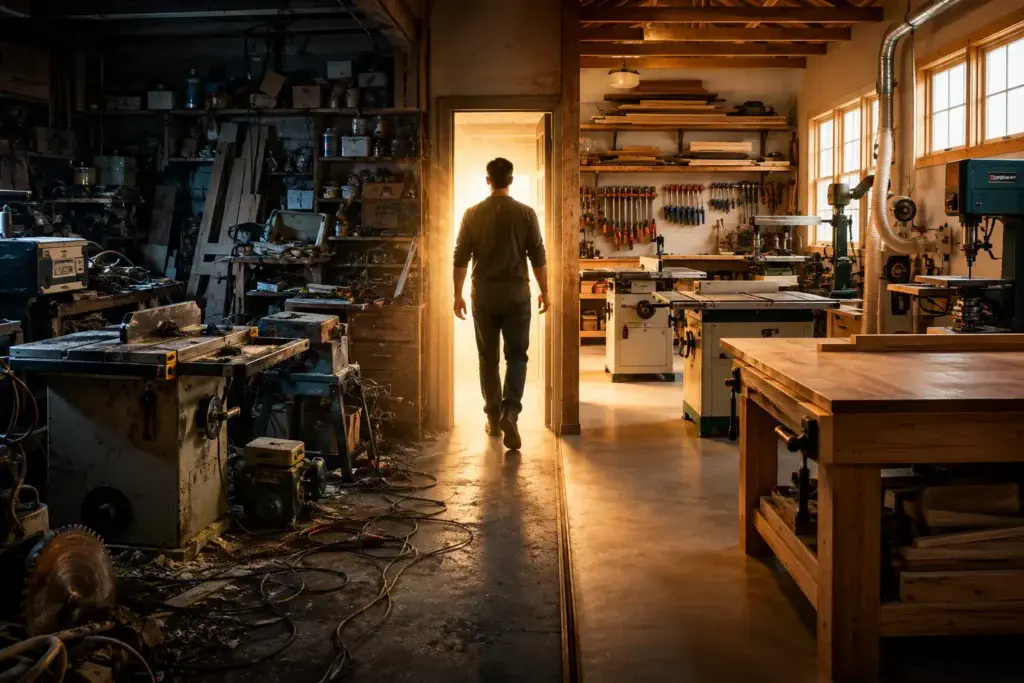
Every thoughtful habit you develop today becomes part of every project you’ll build tomorrow.
Over time, those habits become almost invisible.
You no longer think about them.
You simply work.
And that’s where true confidence begins—not in owning impressive woodworking power equipment, but in knowing how to use it responsibly, consistently, and with complete attention.
In the next section, we’ll look at how proper maintenance keeps your woodworking power equipment performing like new, extending its lifespan while preserving the accuracy and reliability every great workshop depends on.
11. Keeping Your Equipment Accurate for Years
There’s a certain satisfaction that comes from using a machine that feels perfectly dialed in.
The fence glides smoothly and locks exactly where you expect.
The blade slices through hardwood without hesitation.
Boards emerge flat, square, and ready for the next step.
It almost feels effortless.
What many people don’t realize is that this kind of performance rarely happens by accident.
It’s the result of consistent care.
Even the best woodworking power equipment gradually drifts out of adjustment if it’s ignored. Dust works its way into moving parts. Belts stretch. Blades lose their edge. Tiny changes in alignment slowly affect accuracy until projects no longer fit together the way they once did.
The encouraging part?
Most of that can be prevented with simple, regular maintenance.
Small Habits Prevent Big Problems
Machine maintenance doesn’t have to become a weekend project.
In fact, the most effective routines usually take only a few minutes.
A quick inspection at the end of each woodworking session often prevents issues that would otherwise grow into expensive repairs.
Developing these habits helps you:
- Maintain cutting accuracy
- Extend machine life
- Reduce unexpected breakdowns
- Improve workshop safety
- Protect your investment
- Produce consistently better work
Think of maintenance as sharpening your workshop rather than repairing it.
Clean Machines Perform Better
Every cut creates dust.
Every sanding session creates even more.
Left alone, that dust settles into places where it doesn’t belong.
Over time it can interfere with:
- Height adjustments
- Fence movement
- Bearings
- Cooling vents
- Drive systems
- Electrical components
That’s why experienced woodworkers rarely leave a machine covered in sawdust after finishing for the day.
Instead, they make cleanup part of the process.
A few minutes with a vacuum and a clean cloth keeps woodworking power equipment operating far more smoothly than many people expect.
Protect Cast-Iron Surfaces
Cast iron has earned its reputation for good reason.
It’s stable.
Exceptionally flat.
Highly durable.
But it has one weakness.
Moisture.
Without protection, cast-iron tables can develop surface rust surprisingly quickly, especially in humid environments.
Fortunately, prevention is simple.
Keep surfaces clean.
Wipe away moisture immediately.
Apply a protective paste wax designed for woodworking machines.
The result is a smooth surface that allows workpieces to glide effortlessly while helping prevent corrosion.
It’s one of the easiest maintenance habits you can develop.
Sharp Blades Make Better Woodworking
One of the biggest improvements you can make doesn’t involve buying another machine.
It involves maintaining the cutting tools you already own.
Sharp blades:
- Cut cleaner.
- Reduce burning.
- Require less effort.
- Place less strain on motors.
- Produce smoother surfaces.
Watch for signs that a blade needs attention.
Common indicators include:
- Burn marks
- Rough edges
- Increased resistance
- Excessive tear-out
- Louder cutting noise
Sometimes a thorough cleaning removes built-up resin and restores performance.
Other times, sharpening—or replacement—is the better choice.
Either way, your woodworking power equipment performs best when its cutting edges are in excellent condition.
Don’t Forget Your Router Bits
Router bits work incredibly hard.
They’re spinning at extremely high speeds while shaping hardwood with remarkable precision.
That kind of work naturally causes wear.
Inspect them regularly for:
- Chipped carbide
- Resin buildup
- Dull cutting edges
- Bent shanks
- Heat discoloration
Keeping router bits clean not only improves cut quality but also reduces stress on the router itself.
A few minutes of maintenance often restores performance you didn’t realize had gradually disappeared.
Belts Deserve Occasional Attention
Many stationary machines rely on belts to transfer power efficiently.
Over time those belts can:
- Stretch
- Crack
- Slip
- Become glazed
- Wear unevenly
Fortunately, belt inspections are quick and inexpensive compared to repairing damage caused by a sudden failure.
Replacing a worn belt before it breaks often prevents downtime at exactly the wrong moment.
Lubrication Makes Every Adjustment Smoother
Machine adjustments should feel effortless.
If height wheels become stiff or fences begin sticking, it’s usually a sign that maintenance is overdue.
Depending on the machine, occasional lubrication may be appropriate for:
- Lead screws
- Fence rails
- Height mechanisms
- Tilt adjustments
- Sliding tables
- Guide systems
Always use products recommended for woodworking equipment.
Heavy lubricants that attract sawdust often create more problems than they solve.
Clean, lightly lubricated mechanisms tend to perform best.
Check Accuracy Before It Becomes a Problem
Machines rarely lose alignment overnight.
The change happens gradually.
That’s why periodic calibration is so valuable.
Every few weeks—or before beginning an important project—check items such as:
- Fence alignment
- Blade parallelism
- Miter gauge accuracy
- Table flatness
- Router table setup
- Jointer fence squareness
- Planer knife adjustment
These simple checks keep woodworking power equipment producing the precise results it was designed to deliver.
Tiny corrections today prevent frustrating fitting problems tomorrow.
Your Dust Collection System Needs Maintenance Too
Dust collectors quietly work in the background, so it’s easy to forget they also require attention.
A well-maintained system continues removing dust efficiently.
A neglected one gradually loses effectiveness.
Routine maintenance includes:
- Emptying collection bags
- Cleaning filters
- Inspecting hoses
- Checking duct connections
- Removing blockages
- Testing airflow
Good airflow protects both your workshop and your machines.
Take Care of Cordless Batteries
Modern battery technology is remarkably reliable, but a few simple habits can extend its lifespan considerably.
Store batteries:
- In moderate temperatures
- Away from direct sunlight
- In clean, dry conditions
Avoid leaving batteries completely discharged for extended periods, and keep electrical contacts free from dust and debris.
Well-maintained battery systems often provide years of dependable service.
Keep Accessories Organized
A workshop becomes more enjoyable when everything has its place.
Proper storage protects:
- Saw blades
- Router bits
- Drill bits
- Sanding discs
- Measuring tools
- Jigs
- Specialty accessories
Organization also makes routine maintenance easier because worn accessories are easier to spot before they affect project quality.
Sometimes efficiency has less to do with buying new woodworking power equipment and more to do with knowing exactly where everything is.
Build a Simple Maintenance Routine
Maintenance becomes much easier when it’s divided into small, predictable tasks.
After Every Project
- Vacuum machine surfaces.
- Remove sawdust.
- Check blades visually.
- Empty dust ports if needed.
Once Each Week
- Wipe down cast-iron tables.
- Inspect power cords.
- Clean fences and guide rails.
- Organize frequently used accessories.
Once Each Month
- Verify machine alignment.
- Inspect belts.
- Lubricate moving parts where appropriate.
- Check dust collection performance.
Twice a Year
- Deep-clean machines.
- Replace worn consumables.
- Inspect bearings.
- Review overall calibration.
Breaking maintenance into manageable intervals prevents it from ever becoming overwhelming.
Learn to Listen to Your Machines
One of the most valuable maintenance skills can’t be found in a manual.
It’s learning to notice change.
Machines often tell you something is wrong long before they fail.
Pay attention to:
- New vibrations
- Unusual sounds
- Burning odors
- Rough cuts
- Increased resistance
- Unexpected heat
These early warning signs are opportunities.
Responding quickly often prevents larger, more expensive problems later.
Well-Maintained Equipment Builds Better Projects
Reliable woodworking doesn’t happen because machines are new.
It happens because they’re cared for.
A clean table saw cuts more accurately.
A properly adjusted planer produces smoother boards.
A sharp router bit leaves cleaner edges.
Over months and years, those small improvements add up to better craftsmanship, greater confidence, and a workshop that feels ready whenever inspiration strikes.
Looking after your woodworking power equipment isn’t simply another chore on the list.
It’s one of the most valuable investments you can make in every project you’ll build from this point forward.
In the next section, we’ll explore the buying mistakes that catch even experienced woodworkers off guard—and how avoiding them can save you both money and frustration as your workshop continues to grow.
12. Costly Buying Mistakes—and How to Avoid Them
If you ask a group of experienced woodworkers about the tools they regret buying, you’ll hear some surprisingly honest stories.
A machine that seemed indispensable but barely gets used.
A bargain purchase that never stayed properly adjusted.
An oversized tool that consumed valuable workshop space without making projects any easier.
Almost everyone has one.
Sometimes two.
Occasionally a whole corner of the workshop serves as a reminder.
The encouraging part is that those experiences also reveal something important.
The best buying decisions rarely happen by accident.
They’re the result of patience, planning, and understanding what your workshop truly needs.
If you can avoid the mistakes below, you’ll save money, reduce frustration, and build a collection of woodworking power equipment that serves you faithfully for many years.
Mistake #1: Buying Tools Before Defining Your Goals
It’s easy to become excited about machinery.
Videos make every new tool look indispensable.
Reviews praise the latest innovations.
Social media workshops seem filled with equipment that appears impossible to live without.
Then reality arrives.
You realize the machine doesn’t actually fit the type of woodworking you enjoy.
Before buying any major tool, ask yourself one simple question:
What do I love building?
That answer should guide every purchasing decision.
When your equipment reflects your projects, your workshop begins feeling intentional instead of crowded.
Mistake #2: Choosing Price Over Quality
Everyone enjoys saving money.
But choosing the least expensive option simply because it’s inexpensive often becomes an expensive lesson.
Lower-quality woodworking power equipment frequently suffers from:
- Poor alignment
- Inconsistent adjustments
- Excessive vibration
- Limited durability
- Reduced accuracy
- Inferior materials
None of these issues may seem significant on the day you make the purchase.
You’ll notice them months later—when repeated adjustments become routine and projects no longer fit together as easily as they should.
Buying quality once is often less expensive than replacing disappointment later.
Mistake #3: Assuming Expensive Means Perfect
The opposite mistake can be just as costly.
Professional-grade equipment is wonderful.
That doesn’t automatically mean it’s the right choice.
Commercial shops often need:
- Higher production capacity
- Continuous operation
- Larger motors
- Industrial durability
Weekend woodworkers often don’t.
There’s little benefit in paying for capabilities you’ll never actually use.
Choose machines that match your workload rather than your aspirations.
Your future self will appreciate the balance.
Mistake #4: Forgetting About Workshop Space
A machine’s footprint tells only part of the story.
You also need space to use it comfortably.
Think about:
- Infeed clearance
- Outfeed clearance
- Walking space
- Dust collection
- Maintenance access
- Material storage
A table saw squeezed against a wall may technically fit.
Using it effectively is another matter entirely.
Before buying woodworking power equipment, imagine yourself building an actual project—not simply placing the machine on the floor.
That mental exercise often reveals layout problems before they become expensive ones.
Mistake #5: Treating Dust Collection as an Afterthought
Many workshops begin with impressive machines and very little thought given to dust management.
Eventually the consequences appear.
Dust covers every surface.
Machines become harder to maintain.
Air quality suffers.
Finishes become more difficult to apply.
Planning dust collection from the beginning creates a cleaner, healthier workshop while helping every machine perform better.
It’s one of the highest-value investments many woodworkers delay for far too long.
Mistake #6: Ignoring Safety Features
Power and capacity often dominate equipment comparisons.
Safety deserves just as much attention.
When evaluating woodworking power equipment, look beyond horsepower.
Pay attention to features such as:
- Blade guards
- Riving knives
- Emergency stop switches
- Stable fences
- Effective dust ports
- Well-designed controls
Machines that encourage safe operation usually become more enjoyable to use as well.
Confidence grows naturally when equipment feels predictable and dependable.
Mistake #7: Chasing Every New Release
Woodworking manufacturers introduce exciting new products every year.
That’s part of what makes the hobby so enjoyable.
Innovation never stops.
Neither does marketing.
Before buying the latest machine, ask yourself:
Will this genuinely improve the way I work?
Or am I simply excited because it’s new?
Sometimes the answer is obvious.
Other times, your existing woodworking power equipment already performs everything you need exceptionally well.
Experience often delivers greater improvements than another purchase.
Mistake #8: Overlooking Comfort
Woodworking sessions often last hours.
Machines that feel awkward on day one rarely become more comfortable over time.
Pay attention to details such as:
- Handle placement
- Fence adjustments
- Control locations
- Visibility
- Working height
- Ease of setup
Comfort influences both accuracy and fatigue.
A machine that’s pleasant to use naturally encourages better craftsmanship.
Mistake #9: Skipping Research
Impulse purchases have a way of becoming expensive stories.
Before investing in major woodworking power equipment, spend some time learning from people who already own it.
Read detailed reviews.
Watch demonstrations.
Compare specifications.
Look for recurring strengths and weaknesses.
Most importantly, look for patterns.
One negative review means very little.
Dozens of people describing the same issue usually tells you something worth knowing.
Mistake #10: Forgetting the Accessories
Sometimes the machine isn’t missing anything.
Your setup is.
A table saw becomes dramatically more capable with:
- Quality blades
- Crosscut sleds
- Featherboards
- Push sticks
- Outfeed support
A router benefits enormously from:
- Premium router bits
- Guide bushings
- Edge guides
- Router tables
These accessories often improve woodworking more than upgrading the machine itself.
They’re easy to overlook because they don’t receive as much attention as major purchases.
Mistake #11: Buying Only for Today’s Projects
The workshop you’re building today probably won’t be the workshop you own five years from now.
Your skills will improve.
Your interests will evolve.
Your projects will become more ambitious.
Whenever possible, choose woodworking power equipment that leaves room for growth.
Ask yourself:
- Will this machine still meet my needs later?
- Can it accept useful upgrades?
- Is it built to last?
- Will I outgrow it quickly?
Thinking ahead often prevents replacing perfectly good equipment far sooner than expected.
Mistake #12: Believing Better Tools Automatically Create Better Woodworking
Perhaps the biggest misconception in woodworking is believing equipment creates craftsmanship.
It doesn’t.
Outstanding work comes from:
- Practice
- Patience
- Careful measurement
- Good technique
- Experience
- Curiosity
Quality woodworking power equipment makes those skills easier to apply consistently.
It doesn’t replace them.
Some of the finest furniture ever built was created using machines—and even hand tools—that would seem remarkably simple by today’s standards.
Skill has always mattered more than technology.
It always will.
Build Your Workshop One Thoughtful Decision at a Time
The workshops people admire most weren’t assembled in a single shopping trip.
They grew gradually.
Every machine solved a genuine problem.
Every purchase reflected experience rather than impulse.
Over time, those thoughtful decisions created something much more valuable than an impressive collection of equipment.
They created a workshop where every tool had a purpose.
And that’s ultimately what separates a room full of machines from a place where exceptional woodworking happens.
In the next section, we’ll answer the questions nearly every woodworker asks sooner or later, from choosing a first machine to deciding when it’s finally time to upgrade, helping you make confident decisions as your workshop continues to evolve.
13. Questions Every Woodworker Eventually Asks
No matter how many years you’ve spent in the workshop, certain questions have a way of resurfacing.
Should I upgrade now or wait?
Is this machine really worth the money?
Do professionals actually need all these tools?
The answers aren’t always black and white.
They depend on the projects you build, the space you have, and the way you enjoy working with wood.
Below are some of the questions woodworkers ask most often—and the practical answers that can help you make better decisions as your workshop grows.
What’s the First Piece of Woodworking Power Equipment I Should Buy?
If you’re starting from scratch, it’s hard to overlook the value of a quality table saw.
It’s one of the most versatile machines you’ll ever own and forms the backbone of countless woodworking projects.
A table saw allows you to:
- Rip boards accurately
- Crosscut with a sled
- Cut sheet goods
- Create dados and rabbets
- Produce repeatable parts
That said, the “best” first machine always depends on what you want to build.
Someone focused on home renovation may get more immediate value from a circular saw and a miter saw.
A woodturner will naturally place the lathe at the center of the workshop.
The right answer begins with your projects—not someone else’s shopping list.
Can I Build a Professional Workshop Without Spending a Fortune?
Absolutely.
In fact, that’s how many professional workshops started.
Instead of buying everything at once, build your workshop in stages.
Invest in versatile machines first.
Learn them thoroughly.
Expand only when your work begins revealing genuine limitations.
This approach spreads costs over time while ensuring every piece of woodworking power equipment has a clear purpose.
It’s slower.
It’s also far smarter.
Should I Buy New or Used Equipment?
Both options can be excellent.
Buying new often provides:
- Manufacturer warranty
- Modern safety features
- Current technology
- Immediate parts availability
Buying used can offer:
- Better value
- Heavier cast-iron construction
- Higher-quality machines within the same budget
- Proven long-term durability
When purchasing used equipment, inspect carefully for:
- Rust
- Motor condition
- Fence accuracy
- Bearing noise
- Missing components
- Excessive vibration
A well-maintained older machine can easily outperform a poorly built new one.
Which Machine Should I Upgrade First?
Focus on the equipment you use most often.
For many woodworkers, the upgrade path looks something like this:
- Table saw
- Dust collection system
- Thickness planer
- Router
- Random orbital sander
- Miter saw
- Band saw
Improving frequently used woodworking power equipment usually produces the biggest gains in both productivity and project quality.
Are Cordless Tools Powerful Enough for Serious Woodworking?
Modern cordless tools have come a long way.
Brushless motors and advanced battery technology now deliver impressive performance across a wide range of applications.
Cordless tools excel for:
- Drilling
- Driving screws
- Circular sawing
- Sanding
- Jigsaws
- Jobsite work
Stationary workshop machines such as table saws, jointers, and thickness planers still benefit from continuous corded power.
The strongest workshops combine both systems instead of choosing only one.
How Much Workshop Space Do I Really Need?
Probably less than you think.
Excellent woodworking happens every day in:
- Single garages
- Double garages
- Basements
- Garden sheds
- Spare rooms
- Small detached workshops
Organization matters far more than size.
A compact workshop with an efficient layout often feels more productive than a large space with poorly arranged woodworking power equipment.
Good planning always beats extra square footage.
How Often Should I Maintain My Machines?
Regular maintenance is far easier than major repairs.
A simple schedule works well for most workshops.
After Every Session
- Remove dust.
- Wipe machine surfaces.
- Check blades visually.
Every Month
- Inspect alignment.
- Lubricate moving parts where needed.
- Check dust collection performance.
Twice Each Year
- Deep-clean machines.
- Replace worn consumables.
- Inspect belts and bearings.
- Verify calibration.
Small, consistent maintenance keeps machines performing accurately for years.
What’s the Most Important Safety Equipment?
No workshop should operate without basic personal protection.
Keep these items within easy reach:
- Safety glasses
- Hearing protection
- Respirator or dust mask
- Push sticks
- Push blocks
- First-aid kit
- Fire extinguisher
Good safety equipment becomes part of your routine—not something you search for after the machine is already running.
Do I Really Need a Dust Collection System?
If you’re doing occasional DIY work with portable tools, a quality shop vacuum may be enough to get started.
As your collection of woodworking power equipment grows, however, dedicated dust collection becomes increasingly valuable.
It helps:
- Improve air quality
- Reduce cleanup
- Protect machines
- Produce cleaner finishes
- Create a healthier workspace
Many woodworkers eventually say they wish they’d invested in dust collection sooner.
Is Expensive Equipment Always Better?
Not necessarily.
Higher prices often bring:
- Better materials
- Greater precision
- Longer durability
- Improved adjustability
- Increased capacity
But none of those advantages matter if they don’t match the work you actually do.
The best machine isn’t always the most expensive one.
It’s the one that consistently helps you build better projects.
How Long Should Quality Woodworking Power Equipment Last?
With proper care, many woodworking machines remain productive for decades.
Their lifespan depends on:
- Build quality
- Regular maintenance
- Proper calibration
- Clean working conditions
- Thoughtful operation
It’s not uncommon to find well-maintained cast-iron machines still producing exceptional work after thirty or even forty years.
Quality equipment rewards those who look after it.
Should I Buy Tool Kits or Individual Machines?
For cordless systems, starter kits often provide excellent value because they include compatible batteries and chargers.
For larger woodworking power equipment, individual purchases usually make more sense.
This allows you to choose each machine based on:
- Performance
- Accuracy
- Features
- Workshop needs
Rather than accepting compromises across an entire package.
Building your workshop one carefully chosen machine at a time usually produces better long-term results.
What’s the Best Advice for Someone Just Starting Out?
Slow down.
You don’t need every machine immediately.
Learn each tool thoroughly before adding another.
Focus on building projects instead of collecting equipment.
Maintain what you own.
Stay curious.
Accept mistakes as part of learning.
Most importantly, remember that every accomplished woodworker once stood exactly where you are now—looking at an empty workspace and imagining what it might someday become.
Every board you cut.
Every joint you improve.
Every lesson you learn.
They all become part of that journey.
In the final section, you’ll find a practical bonus buying checklist followed by a carefully selected Products / Tools / Resources guide featuring equipment and accessories that consistently prove their value in woodworking workshops of every size.
14. Products / Tools / Resources
By now, you’ve seen that building a capable workshop isn’t about chasing every new machine that reaches the market.
It’s about choosing equipment that supports the way you work.
The following recommendations aren’t meant to become one enormous shopping list.
Instead, think of them as a practical roadmap. Some items belong in almost every workshop from the beginning. Others become worthwhile only after your projects start demanding more precision, efficiency, or production capacity.
The goal isn’t to own everything.
The goal is to own the right things.
Essential Workshop Machines
These are the pieces of woodworking power equipment that form the backbone of most successful workshops.
If you’re building your shop over time, they’re usually the best place to invest first.
Core Machines
- Table saw
- Router
- Thickness planer
- Random orbital sander
- Cordless drill
- Impact driver
- Miter saw
- Band saw
- Drill press
- Dust collection system
Together, these machines allow you to build everything from simple household projects to fine furniture and custom cabinetry.
Measuring and Layout Tools
Accurate woodworking begins long before the first cut.
Reliable measuring tools improve every project regardless of your experience level.
Keep these close at hand:
- Tape measure
- Combination square
- Precision engineer’s square
- Marking gauge
- Sliding bevel
- Digital angle gauge
- Steel ruler
- Straightedge
- Digital calipers
- Marking knife
- Mechanical pencils
Many woodworking mistakes can be traced back to inaccurate layout rather than poor machine performance.
Cutting Accessories Worth Owning
Even premium woodworking power equipment performs only as well as the blades installed on it.
Investing in quality cutting accessories often delivers greater improvements than upgrading the machine itself.
Consider keeping:
- Combination table saw blade
- Fine crosscut blade
- Rip blade
- Dado blade set
- High-quality router bit set
- Flush-trim bit
- Round-over bits
- Chamfer bits
- Rabbeting bit
- Spiral up-cut bit
Sharp, clean cutting tools reduce tear-out, improve accuracy, and leave smoother surfaces.
Sanding Supplies
A beautiful finish begins with careful surface preparation.
Maintain a variety of sanding materials, including:
- 80-grit discs
- 120-grit discs
- 150-grit discs
- 180-grit discs
- 220-grit discs
- Sanding blocks
- Detail sanding pads
- Abrasive cleaning stick for sanding belts
Replacing worn abrasives regularly often produces better results than applying additional finishing products later.
Clamps: The Silent Helpers
Ask experienced woodworkers if they own enough clamps and you’ll probably hear laughter.
Clamps have a way of disappearing during glue-ups.
A well-equipped workshop often includes:
- Bar clamps
- Parallel clamps
- Pipe clamps
- F-style clamps
- Spring clamps
- Corner clamps
- Quick-grip clamps
- Hand-screw clamps
Quality clamps reduce stress during assembly and help produce tighter, more accurate glue joints.
Dust Collection Essentials
Clean air should be part of every workshop plan.
Useful additions include:
- Shop vacuum
- Dust collector
- Air filtration unit
- Dust separator
- Flexible collection hose
- Blast gates
- Hose adapters
- Fine-particle filters
Keeping your woodworking power equipment clean helps protect both your investment and your health.
Workshop Safety Equipment
Safety is never a one-time purchase.
Every woodworking session should begin with the right protective equipment nearby.
Keep these items readily available:
- Safety glasses
- Hearing protection
- Dust respirator
- Push sticks
- Push blocks
- Featherboards
- Fire extinguisher
- First-aid kit
- Anti-fatigue floor mats
- Bright task lighting
Simple preparations create a workshop that’s both safer and more enjoyable to use.
Maintenance Supplies
Well-maintained machines remain accurate far longer than neglected ones.
A basic maintenance kit should include:
- Paste wax for cast-iron tables
- Machine lubricant
- Blade cleaner
- Router bit cleaner
- Soft brushes
- Vacuum attachments
- Microfiber cloths
- Hex key set
- Screwdrivers
- Spare drive belts where appropriate
Spending a few minutes maintaining your woodworking power equipment after each project often prevents hours of repairs later.
Helpful Workshop Upgrades
Once your workshop is established, these additions can make everyday woodworking noticeably more efficient.
Consider adding:
- Mobile machine bases
- Outfeed table
- Router table
- Wall-mounted tool storage
- Clamp rack
- Lumber storage rack
- Sharpening system
- LED task lighting
- Assembly table
- Rolling tool cabinet
None of these upgrades are essential on day one.
Over time, however, they make the workshop feel more organized, more productive, and far more enjoyable to work in.
Bonus: Professional Workshop Equipment Buying Checklist
Before purchasing any new woodworking power equipment, work through this checklist.
If you answer “yes” to most of these questions, you’re probably making a smart investment.
□ Does this machine solve a real problem in my current workflow?
Avoid buying equipment simply because it’s popular or currently on sale.
□ Will I use it regularly?
Machines that stay busy almost always provide better value than machines that collect dust.
□ Will it improve safety?
Look for dependable safety features, stable construction, and effective dust collection.
□ Will it improve accuracy?
Precision has a greater impact on woodworking quality than simply adding more machines.
□ Do I have enough space?
Remember to account for:
- Infeed
- Outfeed
- Walking space
- Dust collection
- Maintenance access
Not just the machine’s footprint.
□ Can my workshop support it?
Check:
- Electrical requirements
- Dust collection needs
- Storage space
- Assembly area
- Future expansion
Planning ahead prevents expensive surprises.
□ Is it built to last?
Quality woodworking power equipment should continue serving your workshop for many years.
Look for dependable construction, smooth adjustments, and good long-term parts availability.
□ Will it still be valuable five years from now?
The best purchases continue supporting your woodworking as your skills grow.
Buying with the future in mind often saves money in the long run.
□ Am I investing in capability rather than simply adding another machine?
This may be the most important question of all.
Every worthwhile purchase should help you build better projects, work more efficiently, or enjoy your time in the workshop even more.
When your equipment is chosen with intention instead of impulse, your workshop gradually becomes more than a place filled with machines.
It becomes a creative space where ideas become finished projects, new skills develop naturally, and every piece of woodworking power equipment contributes to work you’ll be proud of for years to come.