The finished project is the part that catches your eye: a clean shelf, a solid little table, a box with corners that meet.
Then you look at the plan and the practical questions arrive. Do I have the right tools? Are the dimensions clear? What happens after the first cut?
That is where a woodworking plan proves its value. A huge library can feel full of possibility, but possibility alone does not get a project onto the workbench.
A beginner needs instructions that make the next step clear, and a project that fits the tools, space, and time available.
Quick answer: If you want lessons and plans together, Ana White’s Beginning Woodworking Bundle is the more instruction-focused option in this comparison: its listing describes an 81-page beginner course, video lessons, and 28 beginner plan PDFs. If you would rather have a collection of project plans with links to build videos, 731 Woodworks lists a 14-plan bundle. If you are still deciding what to build, start with one free plan and buy a bundle only when you know what it would add.
The product details below come from the providers’ own listings; this is not a hands-on review. When checked on October 30, 2026, the listings displayed $39 for Ana White’s bundle and $29.97 for 731 Woodworks’ bundle. Prices and included materials can change, so check the current page before purchasing.
In this guide
- Bundle, starter set, or free plans
- Beginner woodworking plan bundles to compare
- What a beginner plan should include
- How to evaluate a bundle before buying
- When a bundle is worth it
- Are free plans good enough?
- Choosing a first plan
- Estimating the real cost
- Safety check
- Frequently asked questions
- Products, tools, and resources
Bundle, starter set, or free plans: what should a beginner choose?
There is no single right answer for every new woodworker. The choice comes down to how much guidance you want and whether you already have a project in mind.
| Choose… | If you… | What it gives you | What to check |
|---|---|---|---|
| A course-and-plans bundle | Want instruction as well as several project ideas | Learning material and plans in one purchase | Whether the lessons and projects match your tools and skill level |
| A project-plan bundle | Know the basics and want more choices | Several projects collected in one place | Whether you can inspect complete plans, not only finished-project photos |
| A small starter set | Have one or two builds in mind | A manageable path from one project to the next | Whether each plan has the detail you need to build it |
| Free plans | Are exploring or have a particular project in mind | A way to try woodworking without paying for plan access | Whether the individual plan is clear, complete, and suitable for your setup |
The plan count is the least interesting number if you will never open most of the files. What matters is whether you can find a project you want, understand the instructions, and build it with the resources you have.
When a small starter set is enough
A starter set does not have to be a product with a special label. It can be three plans you choose for yourself: one simple project, another that lets you repeat the basics, and a third that introduces one new skill.
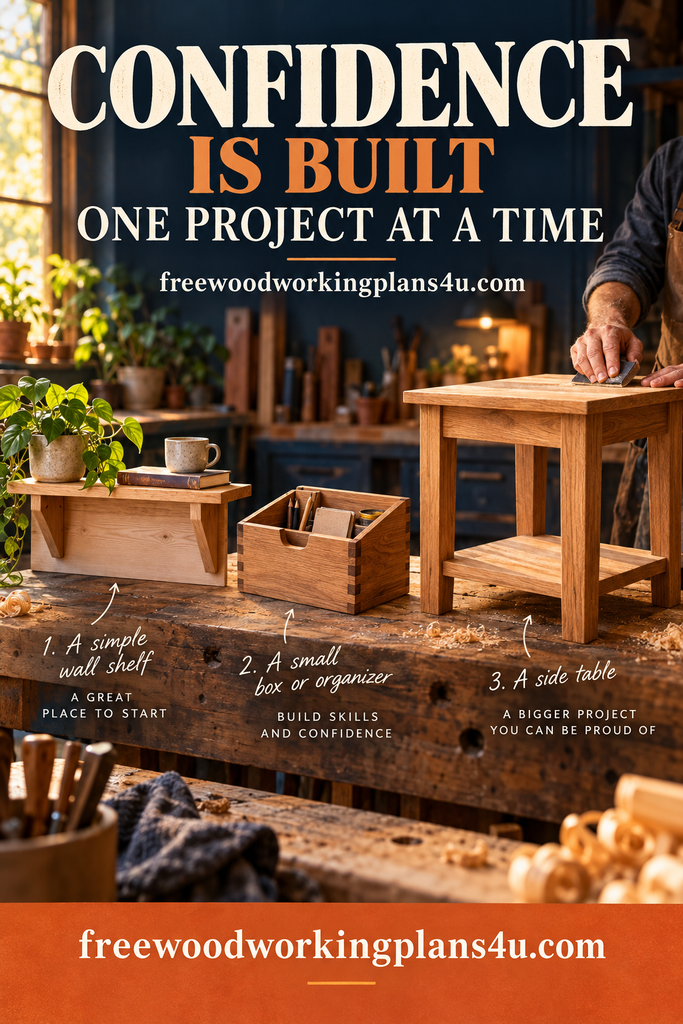
A shelf might give you practice with measuring, straight cuts, and assembly. A box or organizer can help you square the parts and bring them together neatly. A small table may ask you to pay closer attention to alignment and stability. These are examples, not a fixed curriculum. Let your interests and your available tools guide the choices.
The benefit is focus. You can find out whether you enjoy planning, cutting, fitting, sanding, and finishing before buying a library of projects for some future workshop. If you complete the starter set and want more, you will have a clearer sense of what belongs in your next bundle.
A sensible place to begin
If you are not sure what you want to make, choose one free plan. Read it all the way through, check the tools and materials, and see whether the instructions make sense before you spend money on a collection.
If you know you want a guided introduction, compare a course-and-plans bundle with a plan-only bundle. The course may be useful if you want someone to explain the basics; a plan library may be enough if you already know how to follow a build sequence.
And if you have a specific piece of furniture in mind, start there. A single well-matched plan can be more useful than hundreds of unrelated options.
Beginner woodworking plan bundles worth comparing
The two paid examples below solve different problems. One combines lessons with plans; the other focuses on project plans and video references. Both descriptions are taken from their providers’ listings, rather than independent testing.
If you want lessons along with the plans: Ana White’s Beginning Woodworking Bundle
Ana White’s Beginning Woodworking Bundle is listed as a digital course-and-plans package. The seller describes it as including:
- An 81-page beginner woodworking course PDF
- Video lessons
- 28 ad-free woodworking plan PDFs
- Instructions, cut lists, and diagrams
- Projects designed, according to the seller, around a drill, a saw, and common lumber
The listing displayed $39 when checked on October 30, 2026. Treat that as a dated price, not a promise of what you will see later.
This is the more instruction-focused fit if you would like a course beside your first projects. Before buying, check exactly how the videos are delivered, what files are included, and whether the described tool requirements suit your own workspace. A course can make a bundle more useful, but only if it teaches the things you want to learn.
If you want project plans with video references: 731 Woodworks
The Ultimate Beginner Woodworker Plan Bundle is listed as a 14-plan package. 731 Woodworks describes the projects as a mix of shop builds, indoor furniture, and outdoor furniture. The listing also describes material lists, cut lists, step-by-step instructions, and links to related build videos.
The page displayed $29.97 when checked on October 30, 2026. Confirm the current price and package contents on the seller’s page.
This may fit someone who wants a selection of project plans and a video reference for the build, without a separate course. If the provider offers a sample plan, inspect it. A video can show how a project comes together, but the written plan still needs to give you dimensions, materials, and a usable order of operations.
So which bundle is the better choice?
It depends on what would make your first few projects easier.
- Choose Ana White’s bundle if you want a beginner course and plan PDFs together.
- Choose 731 Woodworks if you prefer a plan collection with related build-video links.
- Wait before buying either if you have not decided what you want to build. Try a free plan first.
Neither package is a universal winner. These are comparisons of the published product details, not claims that either bundle has been built from or independently tested. The best woodworking plan bundle for beginners is the one whose plans, instruction style, tools, and terms fit the next project you actually want to make.
What should a beginner woodworking plan include?
A plan should help you picture the work before you buy lumber or make a cut. The format will differ from one publisher to another, but a few details make a real difference at the bench.
Finished dimensions and labeled parts
Look for the project’s finished dimensions and clear names for its parts. The drawings should show how the pieces fit together, not just what the finished item looks like.
If a drawing is shown to scale, do not measure the picture on your screen and treat that as a cut dimension. Use the written measurements. Our guide to how to read woodworking blueprints walks through the dimensions and drawing details to check before you begin.
A material list and a cut list
A material list tells you what stock, hardware, and supplies the project calls for. A cut list breaks that stock into individual pieces and dimensions.
The two lists do different jobs. A broad shopping list may tell you to buy boards without spelling out how those boards become the project parts. For a first build, look for enough detail to work out what to purchase and what to cut.
A plan without a cut list is not automatically unusable. You may be able to work out the pieces yourself. But if the calculations feel uncertain, it is kinder to your lumber—and to your confidence—to choose a clearer plan for your first project.
An assembly sequence
A finished drawing can look perfectly clear while leaving the build order a mystery. A useful plan tells you what to assemble first, what comes next, and when to check fit or alignment.
That order matters. A joint or fastener that is easy to reach at the start can become awkward after another part is attached. Read the plan from beginning to end before you set up. If the sequence still feels hard to follow, look for a build video or choose another plan.
Tool requirements and skill level
“Easy” is a vague label. A project marked easy may still call for a table saw, router, specialty jig, or technique you have never tried.
Check the tools and skills the plan actually names. Compare those requirements with what you own, can borrow, or can access in a shared workshop. Our woodworking tools for beginners guide can help you match equipment to the project instead of shopping for tools in the abstract.
Hardware, finishing, and fit
Check whether the plan identifies the fasteners and hardware, gives any important clearances, and explains how the pieces should fit. If the project uses hinges, slides, or another component, confirm the dimensions before cutting. A plan that depends on an unavailable or poorly identified part may need adapting.
Finishing notes may be brief. Still, you should be able to tell whether a project is intended for indoors or outdoors and whether the surface needs particular protection.
How to evaluate a woodworking plan bundle before buying
A bundle can look like a bargain and still be the wrong purchase for your shop. These checks help you judge what the plans will let you do, rather than how large the headline number looks.
1. Pick a project you can picture building
Start with a shelf, box, small table, planter, bench, or another project you would actually use. Imagine where it will go and what you need it to do.
Then look for plans in that category. If the projects that interest you are all too advanced, rely on tools you do not own, or call for hard-to-find materials, the size of the library will not solve the problem.
2. Look at a complete sample plan
A polished project photo tells you very little about the instructions. If a seller provides a sample, open it and check for:
- Clear dimensions and labeled parts
- A material list and cut list
- Diagrams that explain the joints and assembly
- A sensible order for the build
- Tool and skill requirements
- Notes about hardware or finishing when needed
Do not assume that every file in a large library is as complete as the sample. If there is no complete preview, treat that as an unknown—not proof that the plans are poor, but a reason to be cautious about what you expect.
3. Match the plans to your tools and space
A small apartment setup, a shared garage, and a fully equipped shop are not the same starting point. Look beyond the project name. Consider board lengths, part sizes, cutting equipment, and how much room you will need to assemble the build.
A plan that uses a drill and saw might be a more comfortable first step than one built around a table saw or router. The more advanced plan is not necessarily a bad plan; it may simply belong later in your learning curve.
Before buying tools, compare the plan’s requirements with what you already have. This guide to the cost of starting woodworking explains how the first project, workspace, and existing equipment shape your real starting cost.
4. Find out how you will use the files
Plans may arrive as PDFs, web pages, videos, or a mix of formats. Think about what it will be like to use them while you work:
- Can you print the plan or save it for the workshop?
- Are the drawings easy to read on your usual screen?
- Do you keep the download, or does access depend on an account or subscription?
- Are video links included, and will you be able to return to them?
- Can you find a particular plan without digging through a maze of folders?
The best format is the one you will actually use. If you are constantly searching for a measurement on your phone, it is hard to keep your attention on the workpiece.
5. Count the projects you will really use
It is tempting to divide the bundle price by the advertised number of plans. That calculation gives every file equal value—even the plans you will never open.
Instead, count the projects you can realistically see yourself building. Compare the bundle price with buying those plans individually or choosing a smaller set. The lowest price per file is not necessarily the best value; the useful question is whether the collection gives you enough plans you want to build.
6. Read the purchase and access terms
Before paying, check the current total, what the package includes, how downloads work, and the seller’s support or refund terms. Words such as “lifetime access,” “updates,” or “guarantee” mean what the written policy says they mean.
Save the receipt and put your downloads somewhere you will find them again. If access depends on an account, keep the login details in a secure place.
When is a plan bundle worth it?
A bundle can make sense when it gives you a coherent set of projects you expect to build, includes instruction you want, and costs less than gathering those same resources one by one.
It is less likely to be a good fit if:
- You want only one project plan.
- Most of the projects are beyond your current skill level.
- You cannot preview a plan and do not know how complete the instructions are.
- The projects depend on tools you do not own and do not plan to use.
- You are buying because the plan count feels reassuring.
- You have not yet found out whether you enjoy woodworking.
A bundle does not save money just because its seller compares the price with the total cost of every included plan. The fair comparison is with the plans you will actually use and the alternatives you would truly buy.
Are free woodworking plans good enough for beginners?
They can be. A free plan is a sensible way to try woodworking, especially if you already have a project in mind and can find instructions that answer your questions.
Free does not automatically mean incomplete. Paid does not automatically mean clear. Judge the plan in front of you: Are the dimensions there? Can you identify the parts? Are the tool requirements and assembly steps understandable? Is there a cut list, or enough information to make one?
You can start with the free beginner woodworking plans and guides on this site, browse the free woodworking plan library, or explore Wood Magazine’s free woodworking plans. Each publisher and project can have different access terms, so check the individual plan page.
If you have two free plans in front of you, choose the one that fits your tools and explains the work more clearly. The prettiest finished photo cannot tell you whether the instructions will carry you through the build.
What you gain—and what you may have to piece together
Free plans are often spread across different sites, and the format can change from one publisher to another. You might need to find a cut list elsewhere, watch a separate video, or adjust a plan to lumber available near you. Some plans are complete and straightforward; others leave more decisions to the builder.
That can be fine if you are comfortable checking the details. If you want a single learning sequence, a curated set or course may feel easier to follow.
What is a good first woodworking plan?
A good first plan gives you a clear task and lets you practice a few useful skills without stacking several unfamiliar tools and techniques into one build.
Before you choose, take a breath and check:
- Can I picture the finished dimensions?
- Do I know what each part is and where it goes?
- Can I use or borrow the tools this plan needs?
- Can I get the materials without making difficult substitutions?
- Does the assembly order make sense to me?
- Will the project fit my workspace and the way I intend to use it?
If several answers are “no,” choose a simpler plan or ask an experienced woodworker to review it before you buy materials. Our 15-point pre-build plan check can help you spot missing details before the first cut.
What does a woodworking plan bundle really cost?
The price of the plan is only the beginning of the project budget. You may also need lumber, hardware, glue, abrasives, finish, safety equipment, or tools. A low-cost bundle can still point you toward projects that need materials or equipment you had not planned to buy.
A useful estimate is:
First-build total = plan access + materials + hardware + consumables + any tools or safety equipment you need
Before you purchase anything, write down the materials and operations for one project. Check what is already in your shop or home, then price what is missing. You do not need every tool other woodworkers own. Buy, borrow, or rent based on the plan in front of you.
A short safety check before you build
A set of instructions cannot replace knowing how your tools work. Read the manufacturer’s manual, use the guards and safety features as intended, and know how to stop the machine before you start a cut.
There is more to workshop safety than the blade. OSHA’s workplace-focused woodworking eTool also covers machine guarding, wood dust, and finishing chemicals. Follow the guidance and requirements that apply to your tools, workspace, and location.
If a plan calls for a cut or machine you have not used before, pause and get proper instruction. A beginner plan should make the work easier to understand; it should not push you to rush through something unfamiliar.
Frequently asked questions
Which woodworking plan bundle is best for a beginner like me?
It depends on what you want help with. Among the examples compared here, Ana White’s bundle is the more instruction-focused choice if you want a course alongside beginner plans. 731 Woodworks lists a plan collection with links to build videos. If you are still deciding what to make, try a free plan first.
Do I need to buy a woodworking bundle before I start?
No. If you want to build one particular item, a single plan—or a suitable free plan—may be all you need. A bundle makes more sense when you already want several included projects or when its lessons offer guidance you will use.
Are free woodworking plans reliable enough for my first project?
Some are clear and detailed; some leave questions unanswered. Read the whole plan before you start. Check the dimensions, tools, materials, diagrams, and build order, and follow the safety instructions for the tools you use whether the plan is free or paid.
What details should I look for in a beginner woodworking plan?
Look for finished dimensions, labeled parts, a material list, a cut list or enough detail to create one, clear diagrams, tool requirements, skill expectations, and an assembly sequence. You should be able to understand the build before you buy the lumber.
Will a bigger plan library make choosing easier?
Only if you can find plans you will use. A small starter set may be easier to work with when you are new, have limited tools, or want a clear first project. A large library becomes more useful when it is organized and its projects fit your interests and skill level.
Do woodworking plan bundles come with lumber or tools?
Usually, the plan or course is digital; lumber, hardware, and tools are separate. Check the current product page to see exactly what is included and what each project calls for.
Can I start woodworking if I do not have a full workshop?
That depends on the project and its tool requirements. Choose a plan that fits your available space and equipment; a dedicated shop is not the right starting assumption for everyone. Our beginner tool guide and woodworking startup-cost guide can help you plan around the setup you actually have.
Should I buy tools before I choose a woodworking plan?
Pick a project first. Then use its plan to see what operations and tools it requires. That way, your first purchases have a job to do. If you need a specialized tool for just one cut, see whether borrowing, renting, or getting help with that operation makes more sense.
Products / Tools / Resources
- Ana White Beginning Woodworking Bundle — course and beginner plans in one package; check the seller’s current contents and price.
- 731 Woodworks Ultimate Beginner Woodworker Plan Bundle — listed as a 14-plan collection with material lists, cut lists, instructions, and related video links.
- Free beginner woodworking plans and guides — a place to explore project ideas and basic guidance without first buying a plan collection.
- Wood Magazine’s free woodworking plans — a publisher’s collection of free project plans.
- How to read woodworking blueprints — a guide to dimensions and drawing details.
- How to check woodworking plans before cutting — a pre-build review for finding gaps before you buy materials or make cuts.