
Retirement does something curious to time.
For years, there never seems to be enough of it. Work gets the best hours. Weekends disappear into errands, repairs, family obligations, appointments, and the thousand small things that always seem more urgent than the project sitting half-imagined in the back of your mind.
Then retirement arrives, and suddenly the clock feels different.
There may finally be time to turn that unused corner of the garage into a workshop. Time to learn why one joint fits beautifully while another refuses to cooperate. Time to build a birdhouse with a grandchild, make a bench for the garden, or take on the dining table you once dismissed as something you’d tackle “someday.”
For many people, that makes woodworking for retirees much more than a way to fill an afternoon.
It becomes a rhythm.
You walk into the shop with a rough board and an idea. You measure. Cut. Adjust. Make a mistake. Fix it. Sand until the surface changes beneath your fingertips. Add finish and watch the grain suddenly come alive.
Then you stand back and look at something that didn’t exist before you made it.
That’s a difficult feeling to replace.
And you don’t need decades of experience to reach it.
You don’t need a vast workshop either. You certainly don’t need to buy every machine in the catalog before making your first cut.
A modest bench, a few dependable tools, some lumber, and one manageable project are enough to begin.
After that, woodworking has a habit of pulling you deeper.
One project teaches you enough to attempt the next.
Before long, you’re not searching for a retirement hobby anymore.
You’re becoming a woodworker.
Recommended reading: Woodworking Equipment List by Project Type: Buy Only What You Actually Need
Is Woodworking a Good Hobby for Retirees?
Yes. Woodworking can be an excellent retirement hobby because it combines creativity, practical problem-solving, lifelong learning, and the satisfaction of making useful things with your own hands. It can also be adapted to different budgets, workshop sizes, physical abilities, and experience levels.
One of its greatest strengths is that it doesn’t run out.
Some hobbies offer roughly the same experience each time you return to them. Woodworking keeps opening doors.
At first, you may simply be trying to cut a board square.
Later, you might learn to cut dados, build drawers, route an edge profile, fit cabinet doors, turn a bowl, restore an old table, or make a mortise-and-tenon joint that closes with that deeply satisfying little push of resistance.
There is always another skill waiting.
But retirement changes the experience in another way.
You don’t necessarily have to hurry.
A stubborn joint can take an entire Tuesday morning if that’s what it takes. You can stop halfway through a project, think about the problem over coffee, and come back later with a better idea.
That freedom is worth something.
Woodworking becomes less about getting the job done and more about enjoying the process of getting better.
Why Woodworking Feels Different in Retirement
There is something grounding about working with wood.
Most of modern life happens on screens. Messages disappear. Files live in clouds. Photos are buried in phones. Days can feel strangely intangible.
Woodworking pushes back against that.
You begin with material that has weight, grain, resistance, imperfections.
At the end, there is an object.
A shelf.
A tray.
A cabinet.
A toy chest.
A workbench.
A table.
You can touch the edge. Run your hand across the finish. Notice the corner you had to remake because the first attempt went wrong.
The object carries the story of the work.
Free Time Starts to Have Shape
Retirement offers freedom, but unlimited freedom can sometimes feel oddly shapeless.
A woodworking project gives the day a natural direction.
You choose something to build.
You find a plan or sketch your own.
You select the wood.
You measure, mark, cut, assemble, sand, finish.
There is always a next step.
And when one project is done, another tends to appear.
You Keep Learning Without Sitting in a Classroom
Woodworking is really a collection of smaller disciplines disguised as one hobby.
You learn about:
- measurement
- layout
- geometry
- wood species
- grain direction
- adhesives
- screws and fasteners
- joinery
- sharpening
- finishing
- tool setup
- furniture proportions
- wood movement
- problem-solving
Nobody expects you to master all of it.
You learn what the next project asks you to learn.
That is part of the appeal.
Recommended reading: How to Learn Woodworking and Carpentry from Scratch: The Fastest Beginner-to-Builder Roadmap (Without Wasting Money on the Wrong Tools)
You Can Build Things That Stay in the Family
There is a special pleasure in seeing something you made being used years later.
A cutting board comes out every Christmas.
A bookshelf sits in your daughter’s living room.
A toy chest eventually holds something completely different because the child who once filled it with toys is now grown.
A dining table becomes the place where the family gathers.
Woodworking can turn ordinary retirement hours into objects that outlast the afternoon in which they were made.
How to Start Woodworking After Retirement
The easiest way to make woodworking feel complicated is to begin by shopping for a complete workshop.
Don’t.
Start with something you want to build.
That single decision simplifies almost everything.
If your first project is a planter box, you need the tools required to build a planter box.
If the next project is a shelf, you add what the shelf requires.
Your workshop grows because your skills grow, not because a tool catalog convinced you that you are missing seventeen essential machines.
Learn the Basics First
Advanced joinery can wait.
In the beginning, a handful of dependable skills will carry you surprisingly far.
Learn how to:
- measure accurately
- mark a clean cut line
- make a straight cut
- drill a pilot hole
- drive screws without splitting the wood
- apply glue correctly
- clamp parts securely
- check an assembly for square
- sand through sensible grit progressions
- apply a simple finish
That is enough to build real things.
Not practice scraps.
Not pretend projects.
Real shelves, boxes, benches, planters, and tables.
Accuracy improves with repetition. So does confidence.
The tenth thing you build will almost certainly feel easier than the first, not because the project is easier, but because you’re no longer meeting every little problem for the first time.
Essential Woodworking Tools for Retirees
There is no perfect tool list for every retired woodworker.
Someone interested in carving has very different needs from someone building garden furniture. A box maker may care deeply about hand planes and chisels while another woodworker would rather rely on power tools.
Still, a basic setup usually begins with a few dependable categories.
Measuring and Marking Tools
Most woodworking mistakes begin before the saw is switched on.
A short list of useful measuring and marking tools includes:
- tape measure
- combination square
- pencils
- marking knife
- straightedge
- level
A good combination square becomes one of those tools you reach for constantly without thinking about it.
It checks ninety degrees. Marks lines. Measures depths. Helps with machine setup.
Simple tool. Endless uses.
Cordless Drill/Driver
A drill/driver is hard to avoid in a modern woodworking shop.
You can use it to drill pilot holes, drive screws, install hardware, assemble jigs, mount shelves, and handle a hundred small jobs that would otherwise become unnecessarily awkward.
For many beginners, this is one of the smartest first power-tool purchases.
Circular Saw
A circular saw is far more capable than beginners sometimes assume.
With a decent straightedge or cutting guide, it can handle accurate straight cuts in boards and sheet goods.
If you don’t want a table saw, or you simply don’t have space for one yet, a circular saw can carry a surprising amount of the workload.
Jigsaw
The jigsaw earns its place when straight lines stop being enough.
Curves. Cutouts. Decorative shapes. Irregular pieces.
Birdhouses, toys, garden furniture, signs, and countless smaller projects can benefit from a jigsaw.
Random-Orbit Sander
Sanding by hand is sometimes exactly what a project needs.
Sanding everything by hand is another matter.
A random-orbit sander can dramatically speed up surface preparation on tabletops, shelves, benches, boxes, cabinets, and broad panels.
Clamps
Eventually, every woodworker discovers the same thing.
You never seem to own quite enough clamps.
Useful types include:
- bar clamps
- pipe clamps
- F-style clamps
- quick-grip clamps
- spring clamps
- corner clamps
You do not need all of them on day one.
Buy a few versatile clamps first. Add others as projects give you a reason.
Learn more: Best Woodworking Tools for Beginners: Build Your First 10 Projects With These Tools and Nothing More
Do Retired Woodworkers Need a Table Saw?
No. You do not need a table saw to start woodworking.
A table saw is versatile, accurate, and extremely useful in the right shop.
It is not a membership requirement.
Plenty of woodworking can be done with a circular saw, track saw, jigsaw, miter saw, router, hand saw, or a combination of those tools.
A better approach is simple:
Let repeated problems justify new tools.
If you reach the point where you are constantly ripping boards and repeatedly wishing you had a reliable stationary saw, then a table saw may make sense.
Until that happens, there is no prize for buying one early.
Learn more: Woodworking Without a Table Saw: 9 Better Alternatives for Every Cut, Project, and Workshop
Designing a Comfortable Retirement Woodshop
A workshop should make you want to walk into it.
It should not feel like a storage unit with machinery squeezed between boxes.
A well-designed retirement woodshop is less about how many tools you own and more about how naturally the space supports the way you work.
Start With the Space You Already Have
Your woodworking shop might be in a:
- garage
- basement
- garden shed
- outbuilding
- spare room
- shared utility area
That is enough.
Small shops can be incredibly capable when tools, work surfaces, lumber, and storage are arranged with some thought.
Before buying equipment, picture the projects you actually want to make.
Birdhouses and small boxes have modest space requirements.
Dining tables do not.
Let the work determine the workshop.
Recommended reading: Best Woodworking Equipment for a Home Workshop: The Complete Setup Guide for Every Budget
Get the Workbench Height Right
Workbench height sounds like a small detail until you spend three hours working at a bench that is too low.
There is no single perfect height for every person or task.
Heavy hand-planing work may feel better at one height. Detailed assembly may feel better at another.
Before committing to a permanent bench, experiment.
Stand naturally.
Pretend to sand.
Lean over as though you’re clamping something.
Imagine cutting, assembling, and marking.
Your bench should fit you.
Not the other way around.
Learn more: The Ultimate Adjustable Height Woodworking Bench Guide: Find the Perfect Bench for Every Project and Budget
Learn more: How to Build a Woodworking Bench Without a Table Saw: The Complete Beginner-Friendly Guide
Learn more: The Best Woodworking Bench for Furniture Making: The 12-Point Test That Prevents an Expensive Mistake
Keep Everyday Tools Close
A workshop becomes noticeably easier to use when the tools you reach for most often are exactly where you expect them to be.
Keep frequently used items accessible:
- pencils
- combination squares
- tape measures
- safety glasses
- hearing protection
- drill bits
- glue
- common clamps
- screwdrivers
Tools used only occasionally can live farther away.
Heavy items are best stored where you won’t need to lift or carry them any more than necessary.
Lighting Is More Important Than It Looks
Poor lighting makes good woodworking harder.
It hides pencil lines, surface scratches, joint gaps, glue residue, and finishing defects.
A retirement workshop deserves good overhead lighting plus task lighting where detailed work happens.
You should not have to lean your head sideways to see whether a line is really on the mark.
Plan Dust Collection Before the Shop Gets Crowded
Woodworking dust has an annoying way of getting everywhere.
Some of it is obvious. Chips beneath the planer. Sawdust around the miter saw.
Fine airborne dust is another matter.
A thoughtful dust-control approach might include:
- dust extraction connected to power tools
- a shop vacuum
- a dedicated dust collector
- suitable filtration
- good ventilation
- appropriate respiratory protection
- regular cleaning
It is much easier to think about hoses, tool placement, and collection points before every wall and floor space is occupied.
Recommended reading: Woodworking Dust Collection Systems Explained: The Complete Guide to Cleaner Air, Safer Workshops & Better Performance
25 Rewarding Woodworking Projects for Retirees
The most rewarding project is not always the hardest one.
Sometimes it is the thing that teaches you exactly one new skill and ends up being used every day.
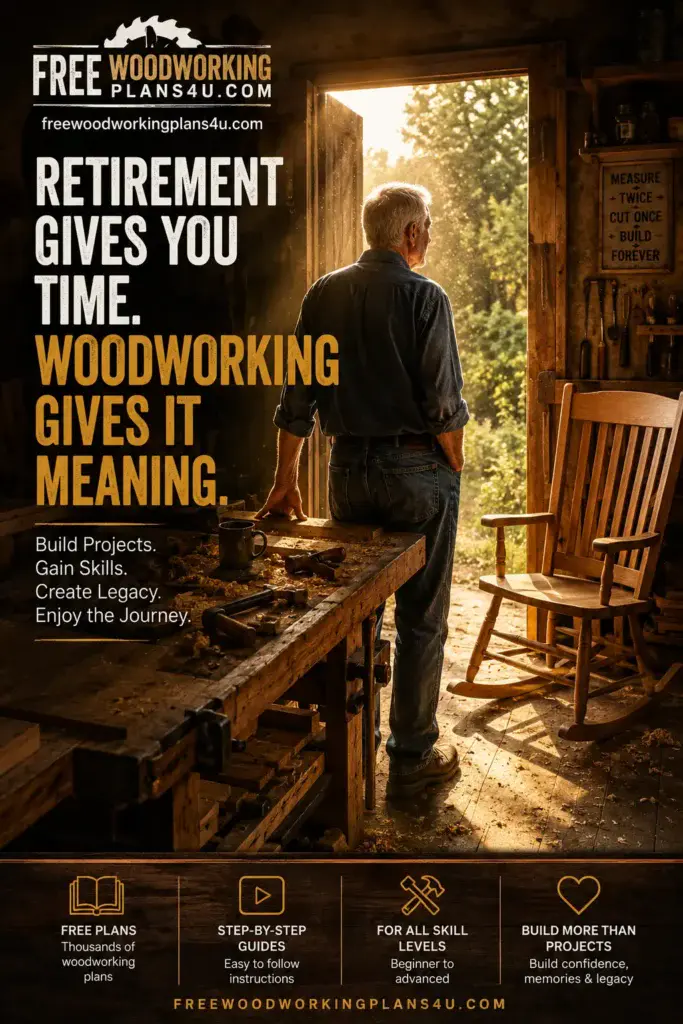
The projects below begin with approachable builds and gradually move toward furniture, family pieces, and projects you may spend weeks or months completing.
1. Birdhouse
Birdhouses are classics because they teach so much without demanding much material.
You measure. Cut. Drill. Assemble.
If something ends up a few millimeters off, the project usually remains perfectly usable.
That makes a birdhouse an ideal confidence-builder.
Learn more: The Ultimate Birdhouse Woodworking Plans Guide: 25 Proven Designs That Backyard Birds Actually Use
2. Wooden Planter Box
A planter box introduces longer boards and larger assemblies while remaining forgiving.
Build one for the garden, patio, or porch.
Once you’ve made the first, changing the dimensions for a second or third becomes easy.
3. Simple Wall Shelf
A wall shelf proves an important point.
Useful woodworking doesn’t have to be complicated.
You practice straight cuts, sanding, finishing, and installation, and the finished project solves an actual problem in your home.
4. Wooden Serving Tray
A tray is compact enough for a relaxed weekend project but still rewards careful workmanship.
Later versions can introduce decorative handles, contrasting woods, routed edges, or more refined joinery.
5. Tool Tote
A wooden tool tote is one of those satisfying workshop projects that immediately earns its keep.
It is also forgiving enough for beginners.
A tiny gap in a joint rarely matters when the finished tote is carrying your tools around the shop.
6. Cutting Board
Cutting boards can be as simple or elaborate as you want.
A basic hardwood board may be enough for your first attempt.
Later, you can explore laminated patterns, contrasting woods, or more complex designs.
Choose wood and finishes appropriate for the intended food-contact use.
7. Picture Frame
Picture frames look simple until you try to make four corners meet perfectly.
That is precisely why they are useful projects.
They reward careful measuring and accurate cutting.
And when the frame is finished, you have something worth putting on the wall.
8. Small Storage Box
Boxes are unforgiving teachers.
If the pieces are not square, you see it.
If one side is longer, you see it.
If your joinery is sloppy, the box quietly tells you.
That makes boxes excellent skill-builders.
Start with simple construction. Advance later to rabbets, splines, dovetails, or decorative joinery.
9. Garden Tool Rack
A garden tool rack is simple, practical, and easy to customize.
Instead of forcing your tools into a generic storage solution, you can build the rack around the exact shovels, rakes, hoes, hoses, and hand tools you already own.
10. Step Stool
A step stool introduces a different kind of responsibility.
It is not merely decorative. It has to support weight safely.
That means sound lumber, reliable joinery, and careful construction matter.
If a project is designed to support a person, use a proven design and conservative construction methods.
11. Bird Feeder
Bird feeders offer more design freedom than birdhouses.
You can build a basic platform feeder or add roofs, seed compartments, mounting systems, drainage, and weather-resistant details.
It is also the sort of project a grandchild may enjoy helping with.
12. Outdoor Planter Bench
A planter bench combines two satisfying things: gardening and woodworking.
Outdoor furniture tends to be forgiving enough for developing woodworkers while still feeling like a substantial build.
You also learn about weather exposure, outdoor wood choices, and exterior finishes.
13. Side Table
A side table is where woodworking starts to feel like furniture making.
Suddenly you notice different problems.
Is the top flat?
Are the legs aligned?
Does it rock?
Do the proportions look right?
It is a deceptively useful project because it teaches both construction and visual judgment.
14. Bookshelf
Bookshelves scale beautifully with your skills.
A beginner can make one with straightforward screwed construction.
Later, you can add dados, face frames, hardwood edging, adjustable shelving, or cabinet-style joinery.
It is the same basic object, but the craftsmanship can keep evolving.
15. Garden Bench
A garden bench feels substantial without automatically becoming overwhelming.
It teaches larger-scale assembly, careful alignment, and structural thinking.
Then comes the satisfying part.
You get to sit on something you made.
16. Adirondack Chair
The Adirondack chair has become a woodworking favorite for good reason.
The shape is instantly recognizable, the curved pieces make the build interesting, and the finished chair has a real destination.
Build one successfully and there is a good chance someone will ask you to build another.
17. Workshop Cabinet
Woodworking has a funny habit of creating its own storage problems.
At first you own a few tools.
Then somehow there are clamps everywhere, boxes of screws, routers, jigs, measuring tools, sharpening gear, bits, blades, and hardware.
A workshop cabinet lets the shop begin solving its own problems.
Recommended reading: The Ultimate Wall Cabinet Woodworking Plans Guide: Build a Professional-Grade Cabinet in One Weekend (Free Plans + Pro Techniques)
18. Mobile Tool Cart
In a smaller woodshop, mobility is almost a superpower.
A planer, miter saw, benchtop drill press, or other machine can be stored out of the way and rolled into position when needed.
One piece of floor can suddenly serve several purposes.
19. Coffee Table
A coffee table introduces broader surfaces and greater visual expectations.
Grain direction matters more.
Joinery matters more.
The finish becomes more visible.
It is a natural bridge between basic projects and more serious furniture making.
Recommended reading: The Ultimate Free Farmhouse Coffee Table Plan Library: 50 Rustic Builds Ranked by Cost, Skill Level & Style
20. Wooden Toy
Wooden toys have a warmth that mass-produced plastic rarely manages to imitate.
Cars, blocks, puzzles, trains, pull toys, and simple games can all become meaningful projects.
Anything intended for a child requires careful attention to design, hardware, dimensions, materials, finishes, small parts, and other safety concerns.
The emotional payoff can be enormous.
A toy bought in a store may eventually disappear.
A toy made by a grandparent sometimes survives long enough to become part of the family’s memory.
Recommended reading: 27 Free Woodworking Plans for Kids Furniture & Toys That Look Store-Bought (But Cost Almost Nothing)
21. Toy Chest
A toy chest combines storage, furniture making, and sentiment.
Done well, it can remain useful long after the toys are gone.
Because it is intended for children, thoughtful design matters enormously, especially around lids, hinges, pinch points, ventilation, and hardware.
22. Rocking Chair
A rocking chair is not usually where a beginner should start.
That is part of what makes it such a good long-term goal.
Curves, comfort, balance, proportions, joinery, and strength all have to work together.
The finished piece can become one of those projects you remember building for the rest of your life.
Learn more: 15 Rocking Chair Woodworking Plans Ranked from the Easiest Weekend Build to a True Heirloom Masterpiece
23. Dining Table
A dining table is a serious project.
There is nowhere to hide a poor finish across a large tabletop.
Joinery must be strong.
Wood movement has to be respected.
Everything needs to stay aligned.
But consider what you’re building.
Not just furniture.
A place.
Meals happen there. Birthdays. Christmases. Quiet mornings. Arguments. Laughter.
Build a good table and it may collect family history for decades.
Recommended reading: Best Woodworking Plans for Outdoor Dining Tables: 27 Designs Ranked by Build Difficulty, Cost & Backyard Impact
24. Keepsake Chest
A keepsake chest invites craftsmanship.
You can explore:
- hardwood construction
- frame-and-panel work
- decorative joinery
- contrasting species
- carving
- personalized details
- fine hardware
- fitted trays
At this point, woodworking begins to move beyond utility.
The object starts carrying meaning.
25. Build the Heirloom Piece
The twenty-fifth project is deliberately undefined.
It is the thing you want someone else to keep.
Maybe it is a desk.
A cabinet.
A rocking chair.
A dining table.
A chest.
A traditional workbench.
Or something so personal nobody else would have thought to build it.
Put your name underneath.
Add the year.
Maybe tuck a handwritten note into a hidden drawer.
Furniture grows old.
A piece with a story becomes something else.
Woodworking Projects to Build With or for Grandchildren
Some of the most memorable retirement woodworking projects never begin with the question, “What do I need for the house?”
They begin with someone’s name.
A grandchild.
A niece or nephew.
A son or daughter.
Possible family projects include:
- birdhouses
- wooden toys
- bookshelves
- toy storage
- picture frames
- keepsake boxes
- children’s furniture
- growth charts
- garden planters
- holiday decorations
You can also build together.
Depending on age and ability, children may be able to help with safe tasks such as measuring, marking, sanding under supervision, choosing paint colors, or assembling suitable components.
Of course, workshop safety comes first around power tools, cutting tools, dust, finishes, and small pieces.
But something else is happening while you’re building.
You’re teaching patience.
Measurement.
Problem-solving.
The idea that when something doesn’t exist, you might be able to make it.
What If You Don’t Want Heavy Woodworking Projects?
Woodworking does not require wrestling full sheets of plywood across the garage.
There is a vast world of smaller work.
You might enjoy:
- boxes
- frames
- clocks
- scroll-saw projects
- carving
- small shelves
- wooden toys
- trays
- signs
- decorative objects
- turning projects
- small cabinets
A workshop can also be designed to reduce unnecessary lifting.
Mobile bases, roller stands, assembly carts, smart lumber storage, and careful placement of machines all help.
Large projects can often be broken into smaller assemblies.
There is no prize for making the work harder than it needs to be.
Woodworking Safety Still Matters—Especially When the Shop Feels Familiar
The more comfortable you become around tools, the easier it is to become casual.
That is when bad habits begin to creep in.
Woodworking safety matters whether you’re 25 or 75.
Protect Your Eyes
Wear suitable eye protection when a task can throw chips, fragments, or dust.
It is a simple habit.
Make it automatic.
Protect Your Hearing
Many woodworking machines are loud enough to justify hearing protection.
Cumulative exposure matters.
The shop should not cost you your hearing.
Control Fine Dust
Sawdust on the floor is obvious.
Fine airborne dust is easier to ignore.
Use suitable extraction, ventilation, cleaning practices, and respiratory protection for the task and material.
Keep the Floor Clear
Cords, hoses, scraps, tools, and piles of sawdust turn a workshop into an obstacle course surprisingly quickly.
Cleaning as you go keeps the space easier and safer to use.
Don’t Rush a Cut
Retirement offers one luxury working life often did not.
You probably do not need to finish by five.
Take advantage of that.
Stop.
Check the fence.
Measure again.
Think about where your hands will be before you switch the tool on.
Know When to Call It a Day
Fatigue changes judgment.
When concentration starts slipping, there is no shame in switching off the shop lights.
The project will still be there tomorrow.
Which Woodworking Skills Should You Learn First?
Trying to learn woodworking all at once is like trying to read an entire library in one sitting.
A better approach is to build skills in layers.
Level 1: Measuring and Cutting
Learn to mark accurately and make predictable cuts.
Everything else depends on this.
Level 2: Assembly
Learn how screws, glue, clamps, and squareness work together.
Level 3: Finishing
Learn sensible sanding sequences and how different finishes affect appearance and protection.
Level 4: Basic Joinery
Explore practical joints such as rabbets, dados, dowels, pocket holes, and lap joints.
Level 5: Furniture Construction
Move into frames, panels, drawers, doors, tabletops, structural joints, and wood movement.
Level 6: Advanced Craftsmanship
Dovetails. Mortise-and-tenon joints. Veneering. Bending. Carving. Turning.
Take whichever branch interests you.
There is no graduation day.
There is always another skill.
Can Woodworking Make Money in Retirement?
Yes. Some retirees earn money from woodworking by selling projects, taking custom orders, restoring furniture, attending local craft markets, or selling online.
Products might include:
- cutting boards
- plant stands
- signs
- shelves
- boxes
- benches
- tables
- holiday items
- outdoor projects
- custom furniture
Smaller repeatable products may be easier to price and produce consistently than large custom builds.
Still, there is an important question worth asking before turning the workshop into a business.
Do you want another job?
For one person, selling projects adds excitement.
For another, deadlines, customer emails, pricing, repetition, and delivery dates drain the pleasure out of the hobby.
Woodworking does not have to justify itself financially.
Sometimes making something because you wanted to make it is enough.
Learn more: From Garage Hobby to Etsy Income: Free Woodworking Plans That Can Realistically Make You Money
How Much Does It Cost to Start Woodworking in Retirement?
Woodworking can be remarkably affordable or astonishingly expensive.
The difference often comes down to how you buy.
A beginner usually needs some combination of:
- hand tools
- measuring tools
- power tools
- clamps
- safety equipment
- a work surface
- lumber
- screws and fasteners
- glue
- finishing supplies
- dust-control equipment
The easiest way to avoid overspending is to buy around real projects.
If your first project requires a drill, saw, square, sander, and clamps, start there.
Build something.
Then let your next project reveal what the shop is missing.
That is usually a healthier approach than spending thousands on equipment and still staring at the empty workbench wondering what to make.
Are Used Woodworking Tools Worth Buying?
They can be.
Older woodworking machines were often built to last, and used equipment can offer excellent value.
But “old” and “good” are not the same thing.
Before buying, pay attention to:
- missing guards
- electrical condition
- bearings
- rust
- adjustment mechanisms
- damaged fences
- cracked components
- missing parts
- availability of replacements
- questionable owner modifications
A cheap machine that needs weeks of repairs can become very expensive.
If you’re unfamiliar with the model, research what a complete, properly functioning example should include before handing over money.
The Simplest Way to Get Better at Woodworking
Finish projects.
That sounds almost too obvious, but it matters.
Every finished object gives you feedback.
The shelf ended up slightly out of square.
Now you understand why.
The first tabletop finish looked streaky.
The next one will not.
The drawer binds.
You learn how to adjust it.
Woodworking has a wonderful way of converting mistakes into knowledge—provided you keep building.
Add One New Skill at a Time
You don’t need every project to be a technical masterpiece.
Let each project teach one thing.
For example:
Project 1: accurate cutting.
Project 2: gluing and clamping.
Project 3: pocket-hole joinery.
Project 4: rabbets.
Project 5: dados.
Project 6: drawer installation.
Project 7: mortise-and-tenon joinery.
That progression feels manageable because the goal is never “master woodworking.”
It is simply:
Learn the next thing.
Woodworking Doesn’t Have to Be a Solitary Hobby
A quiet workshop can be one of the most peaceful places in retirement.
Still, woodworking can be surprisingly social when you want it to be.
Look for:
- woodworking clubs
- community workshops
- makerspaces
- adult education courses
- woodturning clubs
- carving groups
- furniture restoration groups
- online woodworking communities
Being around other woodworkers accelerates learning in ways books and videos sometimes cannot.
You may struggle with a problem all morning only to have someone glance at it and immediately say, “Your fence is out of square.”
Ten seconds later, the mystery is gone.
Recommended reading: How to Learn Woodworking and Carpentry from Scratch: The Fastest Beginner-to-Builder Roadmap (Without Wasting Money on the Wrong Tools)
Build Yourself a Retirement Woodworking List
Once you become interested in woodworking, finding projects usually stops being the problem.
Choosing among them becomes the problem.
It can help to create a list.
For the Workshop
- workbench
- clamp rack
- lumber storage
- tool cabinet
- mobile machine cart
For the House
- shelves
- side tables
- benches
- cabinets
- storage furniture
For the Garden
- planter boxes
- benches
- Adirondack chairs
- birdhouses
- outdoor tables
For Family
- toys
- picture frames
- keepsake boxes
- furniture
- holiday gifts
One Project That Feels Slightly Impossible
Choose one.
A rocking chair.
A dining table.
A traditional bench.
A fine cabinet.
A desk.
You don’t need to be ready for it yet.
That’s the point.
One day you will be.
A 30-Day Woodworking Plan for Complete Beginners
If woodworking has been sitting in the “someday” category for years, give it one month.
Not to become an expert.
Just to become someone who has started.
Week 1: Get Comfortable With the Tools
Use scrap wood.
Measure.
Mark.
Drill.
Cut.
Sand.
Clamp.
Learn what the tools feel like without worrying about producing anything impressive.
Week 2: Finish One Small Project
Build a birdhouse, tray, shelf, box, or planter.
Finish it.
Not perfectly.
Just completely.
Completion teaches more than endless preparation.
Week 3: Make the Second Project Slightly Harder
Add one new skill.
Perhaps a different joint.
A more precise cut.
A better finish.
A more challenging assembly.
Week 4: Build Something You Actually Need
Make the project personal.
A shelf for the garage.
A planter for the patio.
A box for your grandchild.
A side table beside your chair.
That moment matters.
You’re no longer practicing.
You’re building.
Questions Retired Beginners Often Ask Before Starting
“Am I Really Too Old to Start Woodworking at 60?”
No.
There is no age by which someone is supposed to have learned woodworking.
Start with manageable projects, sensible tools, safe working habits, and realistic expectations.
Experience grows one project at a time.
“What About Starting at 70?”
The same principle applies.
Woodworking can be adapted to the person doing it.
You don’t need to build enormous furniture or operate every stationary machine in a commercial shop.
Boxes, turning, carving, toys, small cabinets, shelves, decorative projects, and many other forms of woodworking can offer years of challenge.
“What’s the Easiest First Project?”
Birdhouses, basic shelves, planter boxes, trays, and simple storage boxes are all popular beginner projects because they teach useful skills without requiring advanced joinery.
Choose something you actually want.
You’re more likely to finish it.
“Which Tools Should I Buy First?”
A basic setup may include measuring tools, a drill/driver, a suitable saw, a sander, clamps, and appropriate safety equipment.
Let the project decide what comes next.
“Do I Need a Big Garage?”
No.
Woodworking can happen in basements, sheds, spare rooms, small garages, and compact dedicated shops.
Mobile tool stands, folding surfaces, wall storage, and thoughtful organization can make surprisingly small spaces work.
“Do I Have to Own a Table Saw?”
No.
Table saws are useful, but they are not essential for every project or every shop.
Circular saws, track saws, jigsaws, miter saws, routers, and hand saws can cover a tremendous amount of woodworking.
“What Can I Build for My Grandchildren?”
Birdhouses, bookshelves, toy boxes, picture frames, growth charts, keepsake boxes, children’s furniture, and age-appropriate wooden toys are all possibilities.
Anything intended for children should be designed with careful attention to suitable materials, hardware, finishes, dimensions, and safety.
“Could I Turn This Into a Small Retirement Business?”
Possibly.
Some woodworkers sell locally, attend markets, accept custom orders, repair furniture, or sell products online on Etsy.
Whether that is worth doing depends on your goals, costs, demand, and whether selling makes woodworking more enjoyable—or less.
Learn more: Best Woodworking Projects for Etsy Sellers by Skill Level: From Weekend Side Hustle to Full-Time Income
Products / Tools / Resources
You do not need to buy everything below. In fact, you probably shouldn’t.
Think of this section as a practical shortlist of the kinds of tools and resources that tend to become useful as a retirement workshop develops.
Combination Square
A dependable combination square is one of those quiet workshop essentials.
You can use it for layout, checking ninety-degree corners, marking parallel lines, checking machine setups, and measuring depths.
A good one gets used constantly.
Cordless Drill/Driver
For general assembly work, a cordless drill/driver is difficult to beat.
Look for something comfortable in your hand rather than automatically choosing the biggest or most powerful model available.
Balance matters when you use a tool repeatedly.
Random-Orbit Sander
If you plan to build furniture, shelves, boxes, benches, or tabletops, a random-orbit sander can save a great deal of time.
Pair it with sensible dust extraction whenever possible.
Circular Saw With a Cutting Guide
This combination can handle a tremendous amount of straight-cutting work without requiring a large stationary saw.
For small garages and flexible workshops, that can be especially useful.
Jigsaw
A jigsaw earns its place when a project involves curves, openings, decorative shapes, or cuts a circular saw cannot make.
It is particularly handy for outdoor projects, toys, templates, and irregular components.
Quality Clamps
Start with a few general-purpose clamps rather than buying a wall full of them immediately.
F-style clamps and quick-grip clamps are useful for many beginner projects.
Add longer bar or pipe clamps later when larger furniture projects demand them.
Hearing and Eye Protection
Protective equipment should be among the first purchases, not the last.
Comfort matters here too.
If hearing protection is uncomfortable, you are more likely to avoid wearing it. The same goes for safety glasses.
Choose equipment you’ll actually use.
Dust Extraction
For a small shop, a shop vacuum connected to compatible tools may be enough to begin.
As the workshop expands, a dedicated dust collector or more comprehensive extraction system may become worthwhile.
Mobile Tool Bases
Small workshops become much easier to manage when machines can move.
Mobile bases and carts allow a single section of floor space to serve several purposes.
Anti-Fatigue Mats
If you spend long periods standing at a bench or machine, a suitable anti-fatigue mat can make the workshop more comfortable.
Just ensure edges and placement do not create trip hazards.
Woodworking Plans
Good plans remove much of the uncertainty from unfamiliar projects.
Look for plans that include clear dimensions, material lists, cut lists, assembly sequences, and enough detail to understand the project before you make the first cut.
Free plans are excellent for exploring new ideas, while larger plan collections can be useful if you like having a wide variety of projects available.
Woodworking Books
A good woodworking book has one advantage over endless browsing: everything stays in one place.
Useful subjects include:
- beginner woodworking
- joinery
- furniture construction
- wood finishing
- hand-tool techniques
- workshop design
- wood identification
- cabinetmaking
Books also make excellent workshop references when you need to check something without disappearing down an online rabbit hole.
Local Woodworking Clubs and Makerspaces
Tools are useful.
Experienced people can be even more useful.
A local club or shared workshop may give you access to machines you don’t own, people who can help troubleshoot a project, and a community of others who enjoy making things for the same reason you do.
Sometimes the best resource in the workshop is another woodworker standing beside you.